Block Smash Permanent Upgrades: First Purchases and Real Costs
Begin with the problem that ended your run. Extra XP, extra damage, and an extra heart solve different problems, even when their prices are close. This guide combines the real shop with calculations from the upgrade catalog shipped on this site.
What a new player sees
In the fresh browser profile checked on September 5, the shop showed 0 coins, 0 total earned, 0 runs, and every upgrade at level 0. The cheapest starting purchases were Ledger Engine and Combat Journal at 560 coins. No permanent purchase was possible before playing.
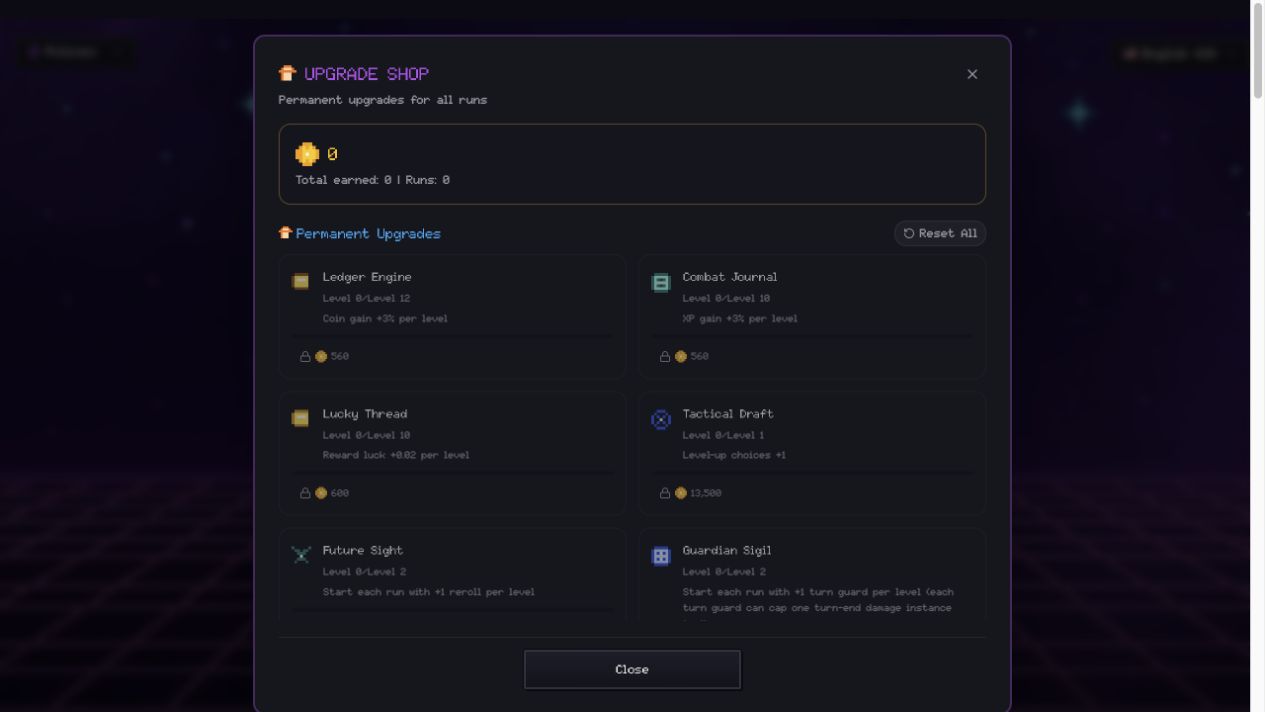
Our ten-shot Iron opening reached T11 with 15 coins displayed in the active run. That is an observation during a run, not a claim that 15 coins had already been banked. The run had not ended, and we did not purchase an upgrade for that record.
The real cost of a few early levels
Each next level costs floor(base cost × multiplier ^ current level). The second column of prices below is the price of buying level 2, not the cumulative cost. The total column shows what the first three levels cost together, or the full total when the upgrade has fewer than three levels.
| Upgrade | Effect per level | Level 1 | Level 2 | Early total | Level cap |
|---|---|---|---|---|---|
| Ledger Engine | Coin gain +3% per level | 560 | 890 | 2,865 (3 levels) | 12 |
| Combat Journal | XP gain +3% per level | 560 | 879 | 2,819 (3 levels) | 10 |
| Lucky Thread | Reward luck +0.02 per level | 600 | 942 | 3,020 (3 levels) | 10 |
| Tactical Draft | Level-up choices +1 | 13,500 | — | 13,500 (1 level) | 1 |
| Future Sight | Start each run with +1 reroll per level | 4,500 | 9,000 | 13,500 (2 levels) | 2 |
| Guardian Sigil | Start each run with +1 turn guard per level (each turn guard can cap one turn-end damage instance to 1) | 4,800 | 9,600 | 14,400 (2 levels) | 2 |
| Boss Cache | Boss reward choices +1 | 14,500 | — | 14,500 (1 level) | 1 |
| Steel Hammer | Damage +2.5% per level | 900 | 1,674 | 5,687 (3 levels) | 8 |
| Keen Sight | Crit chance +0.6% per level | 980 | 1,842 | 6,285 (3 levels) | 8 |
| Execution Scope | Crit damage +4% per level | 1,000 | 1,820 | 6,132 (3 levels) | 5 |
| Acceleration Coil | Ball speed +2% per level | 880 | 1,548 | 5,153 (3 levels) | 5 |
| Spare Sling | Start each run with +1 ball per level | 3,200 | — | 3,200 (1 level) | 1 |
| Guard Armor | Start each run with +1 HP per level | 3,000 | 6,750 | 9,750 (2 levels) | 2 |
| Counter Intel | Ghost/shield/regen counter stats +10% per level (max +40%) | 2,400 | 4,800 | 16,800 (3 levels) | 4 |
These values were calculated from the public runtime’s data/meta_upgrades.csv on September 5, 2026. Single-level upgrades have no second price. This is a cost comparison, not a measured ranking of win rates.
A worked 1,500-coin decision
Suppose your saved balance is 1,500 coins and you own no upgrades. This is a worked example, not a purchase made in the recorded run.
| Option | Spend | Balance left | What changes |
|---|---|---|---|
| Combat Journal levels 1–2 | 560 + 879 = 1,439 | 61 | +6% XP from this upgrade line. |
| Ledger Engine levels 1–2 | 560 + 890 = 1,450 | 50 | +6% coin gain from this upgrade line. |
| Combat Journal 1 + Steel Hammer 1 | 560 + 900 = 1,460 | 40 | +3% XP and +2.5% damage. |
| Save toward Guard Armor | 0 now; first level costs 3,000 | 1,500 | No immediate change; keep saving for +1 starting HP. |
Choose the option whose effect matches a recurring failure. If your shots already connect repeatedly but leave blocks alive, damage answers a different question from XP. If you are clearing blocks yet rewards arrive too slowly, XP is the more direct experiment. If descent damage repeatedly ends otherwise workable runs, extra starting HP is the relevant alternative.
Why the cheapest coin upgrade may take time to repay
One Ledger Engine level costs 560 and adds 3% coin gain. In a simplified comparison with unchanged play and all relevant coin earnings receiving that full bonus, recovering the purchase from the extra 3% takes about 18,667 base coins: 560 ÷ 0.03.
This is an arithmetic break-even example. Rounding, reward sources, other bonuses, and changes in how long you survive can change the actual result. It does explain why “buy the economy upgrade first” is not automatically the best answer for a player struggling to clear the opening board.
Match the purchase to the failure
- Too few level-ups: Combat Journal changes XP flow. Tactical Draft and Future Sight change reward selection once a reward is available; they do not generate XP themselves.
- Reliable hits, weak removal: compare Steel Hammer with your current crit setup. Spare Sling changes starting projectile count and costs more than one basic stat level.
- Repeated descent damage: Guard Armor adds starting HP. Guardian Sigil adds a charge that caps one turn-end damage event at one; it does not prevent every later hit.
- Boss rewards feel too restrictive: Boss Cache adds a boss reward choice. It is a late payoff for someone who can already defeat bosses; it will not solve an opening that ends before the first boss.
Compare upgrades without inventing a result
The current refund system returns the calculated cost of the last purchased level; resetting all upgrades returns the accumulated purchase cost. Check the confirmation and balance in the shop before using either action.
To compare a purchase, keep the character and other permanent upgrades fixed. Record several unmodified runs, make one purchase, then record several runs with it. Include turns reached, level, failure cause, and the same checkpoint. Random boards mean the runs are not identical, so report the spread as well as any average.
Evidence boundary: the shop screenshot, initial progression, and catalog prices were checked for this revision. The budget and break-even sections are calculations. We have not measured a before-and-after survival benefit for these purchases and do not present one here.