From 136 Automated News Posts to Original Games
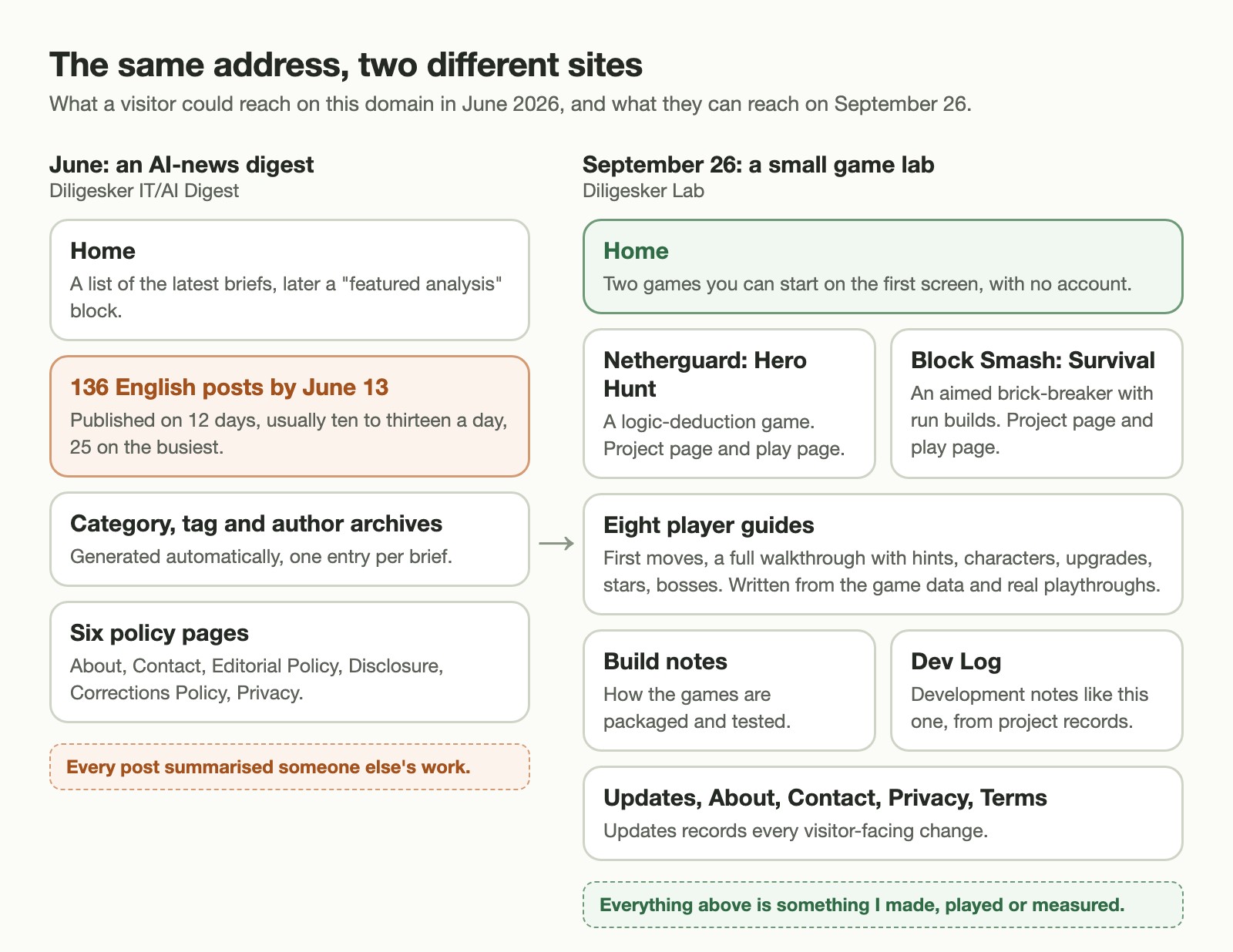
This site did not start as a game lab. From late May to mid-June 2026 it was an automated English news site called Diligesker IT/AI Digest. A pipeline I built picked tech stories, had an AI agent write an English brief about each one, attached SEO metadata and published the result through the WordPress REST API. In a little over two weeks it put out 136 English posts. None of them is public any more.
This note explains why that was the wrong product even though the machinery worked, what I tried before I admitted it, which pieces of common blogging advice did not help, and what replaced it: two games, player guides, build notes and, from today, this Dev Log. It is written for anyone tempted by the same kind of automation. I was, and the code was the easy part.
Sources: the pipeline’s code and commit history, the local archive of all 135 English news briefs, the scripts and saved reports from the June clean-up, and my site audits of July 29–30, September 5 and September 15, 2026.
What the pipeline did
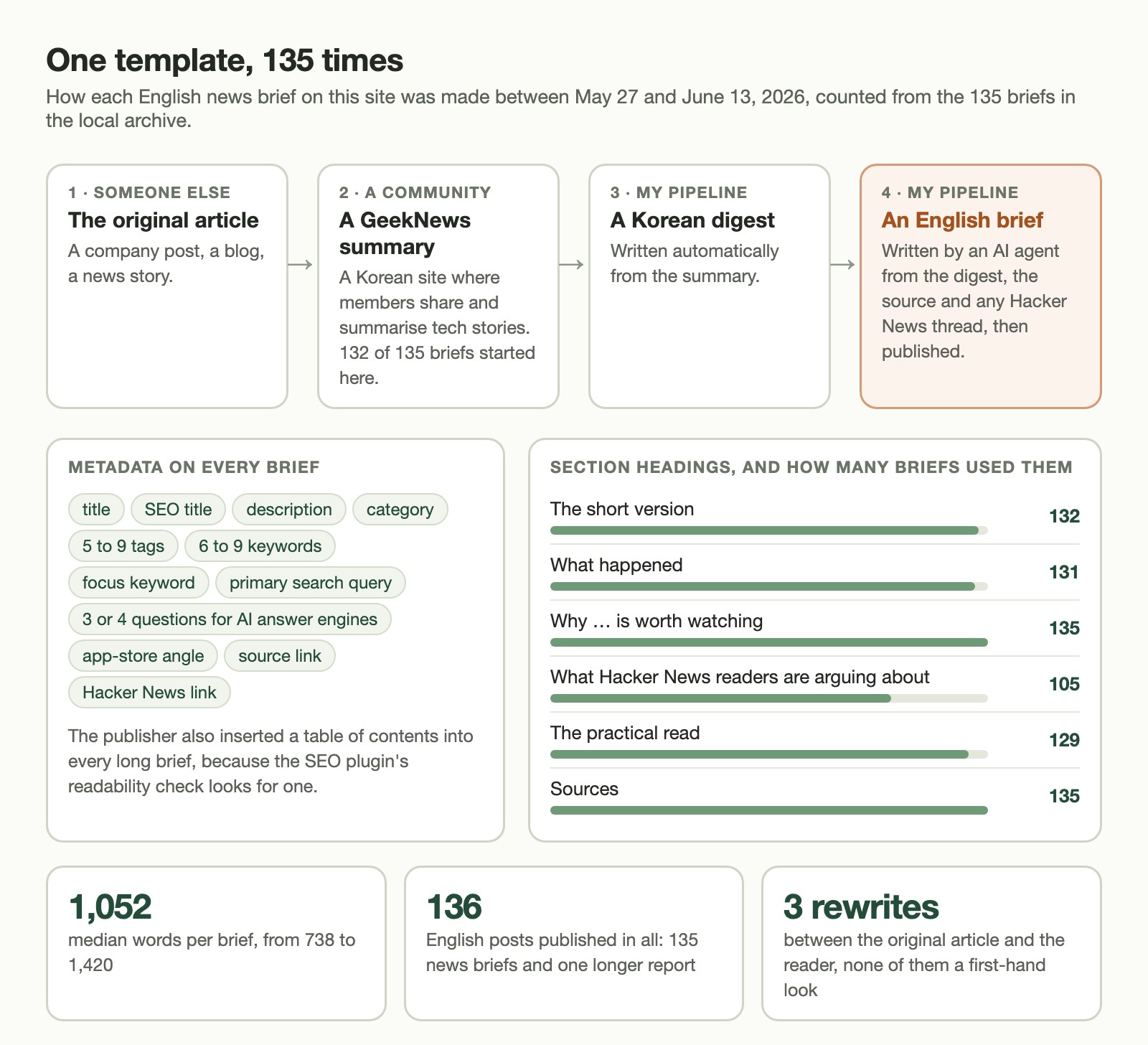
The input was GeekNews, a Korean community site where members share and summarise tech stories, similar in spirit to Hacker News. Another part of my automation already turned GeekNews items into Korean digests, and the English side started from those. A small watcher ran on a schedule, looked for Korean digests that had no English version yet, and started an AI agent for one of them at a time. The agent read the digest, the original source and, when there was one, the Hacker News discussion of the same story, then wrote an English brief. A validator checked the brief’s structure, and the publisher sent it to WordPress.
Every brief came with a block of metadata: a title and a separate SEO title, a description, a category, five to nine tags, six to nine keywords, one focus keyword, a “primary query” it was meant to rank for, three or four questions an AI answer engine might be asked about the topic, and links to the source and the discussion. The publisher copied the title, description and focus keyword into Rank Math, the site’s SEO plugin. It even inserted a table of contents into every long brief, because the plugin’s readability check looks for one.
The bodies followed one skeleton. Of the 135 news briefs in the archive, 132 open with “The short version” and 131 continue with “What happened”. All 135 have a “Why … is worth watching” section. 105 summarise “What Hacker News readers are arguing about”, 129 end with “The practical read”, and all 135 close with “Sources”. The median brief is 1,052 words long, the shortest 738 and the longest 1,420. The 136th English post was a write-up of someone else’s industry report, made by a separate pipeline.
Technically it worked. Posts went out on twelve days, usually ten to thirteen a day and 25 on the busiest. The metadata passed every check the SEO plugin runs. When something broke, such as a malformed table-of-contents block in the editor or a title whose punctuation changed in WordPress and failed verification, I fixed the code and the pipeline carried on. All of that was the wrong thing to measure.
Why it was the wrong product
Look at the chain in the figure above. An original article was summarised by a GeekNews member, my pipeline turned that summary into a Korean digest, and an agent turned the digest into an English brief. Three rewrites stood between the reader and the actual work, and none of them added anything first-hand. Every brief linked to its source, so a reader who found one could get the same facts faster, and more accurately, one click away.
The sections meant to add value could not do it. “Why it is worth watching” and “The practical read” are opinions, and an opinion is worth reading only when it comes from someone who has done the thing: used the tool, run the benchmark, shipped the change. The agent had done none of that. The practical read on a Kubernetes tool, written without running it, is a guess with good grammar.
The template made it worse in a way I did not see at first. Each brief looked complete: a summary up front, context, a discussion section, a takeaway, sources. Side by side they looked identical. A visitor who read two of them had seen the whole site. There was no reason to come back that the source sites did not already offer, and the automation made that emptiness efficient rather than fixing it.
I also had no answer to the simplest question about the site: what is here that exists nowhere else? For a news site the usual answers are speed, original reporting or a strong point of view. The briefs came after the community summaries they were built from, contained no reporting, and had no point of view of their own.
The advice I followed anyway
I did not drop the news site at the first doubt. In June I worked through the usual repair checklist, the advice that comes up whenever someone asks how to make a blog look like a quality site. Each step was done carefully, with backups and scripts. None of them changed the answer, and it is worth saying why for each one.
Prune to your best posts
The standard advice is to cut thin content and keep a small, strong core. On June 9 I wrote a script that scored every published post. It gave eight points for each link to another site, up to six, eight more at 900 words and four more at 1,100, and two to four points for each on-topic word near the top, such as AI, LLM, coding, developer, Kubernetes or agents. It took points away for off-topic words, and eighteen for a post with one outside link or none. Combined with a hand-picked list, the result kept 35 posts public and set 98 to private. Nothing was deleted. Four days later the public set was down to 32.
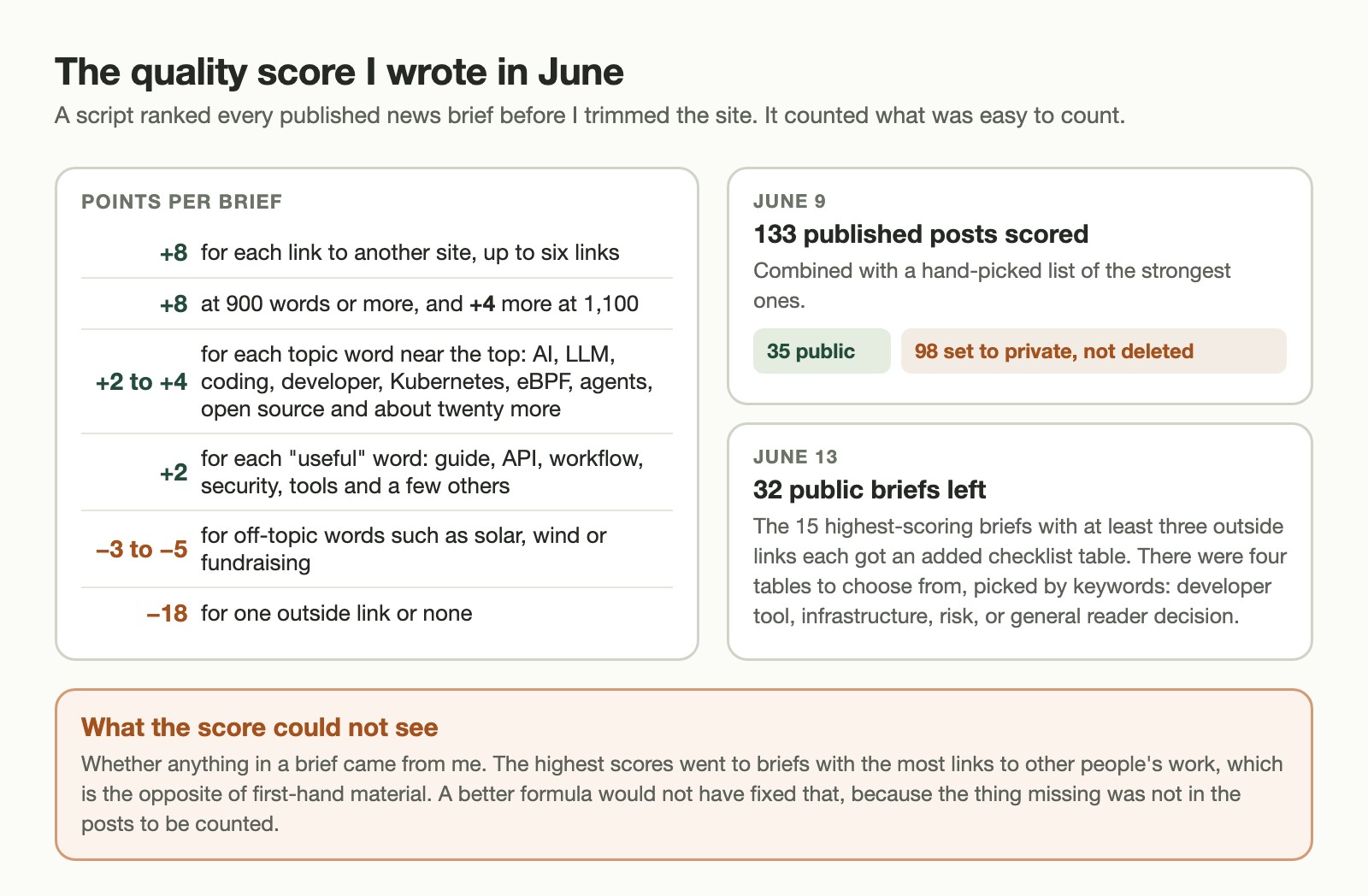
The score measured links, length and keywords. It could not see the one thing that mattered, which was whether anything in a post came from me. It actually rewarded the opposite: the more a brief leaned on other people’s work, the more links it had and the higher it ranked. A better formula would not have helped, because what was missing was not in the posts to be counted.
Add “unique value” to each post
The next piece of advice is to give every post something original, such as a checklist, a comparison or a table. On June 13 a second script added an evaluation table to the 15 highest-scoring public briefs. There were four tables to choose from, picked by keywords in the post: a developer-tool checklist, an infrastructure-adoption checklist, a risk review and a general reader-decision checklist. Each table had the same four rows wherever it appeared. The posts became longer and more structured. They did not become first-hand. A generic checklist pasted under a summary is still a summary, and the same table on several different posts is the opposite of unique.
Write trust pages
The same clean-up rewrote the About and Contact pages and added an Editorial Policy, a Disclosure page and a Corrections Policy. They described “an independent editorial desk”, which kinds of sources an article should rely on, how AI tools may and may not be used, and how to ask for a correction. Those are reasonable things to write down. But a policy describes a process, and no process description could supply what the posts lacked. The script’s own to-do list ended with the item that gave this away: provide a real editor biography with profile links, instead of a generic editorial desk.
The habit outlived the news site. By September the About page of the game lab repeated its statements about editing and tools twice, and on September 15 I cut the repetition. Saying that a page was tested does not make it more useful. Showing the test does.
Tidy the technical surface
The clean-up also listed the usual technical items: keep author and tag archives out of search results, replace the plain list of latest posts on the home page with a featured section, fix the spacing in the theme. These are sensible housekeeping. They change how a site is presented, not what it contains.
Hit the magic numbers
Blogging advice is full of thresholds: twenty posts, a thousand characters per post, a certain number of visitors a day. The news site cleared every length and count threshold I ever saw quoted. It had 136 posts, and the median one was over a thousand words. I could not trace any of these numbers to a primary source, and I stopped using them. When I measured the game guides in September they ran from about 650 to 1,015 words, and the play pages from about 615 to 655. I recorded that as a description, not as a target. More words about the same two games would not give anyone a new reason to visit.
Treat passing checks as quality
The last habit was the hardest to see, because it looked like discipline. After the September 5 refresh of the game site, my verification script reported a clean pass: nine edited pages, two menus and 34 public links and assets, all fine. Ten days later I found that the sitemap still carried July dates for all nine edited pages. I also found that the Block Smash play page told new players to choose a character, while a fresh save actually starts with Iron and the other five characters unlock through play. The project page promised an upgrade choice in the first minute, but my own recorded ten-shot opening ended at 40 of 150 XP with no reward offered at all. The checks were true. They just did not check those things.
What replaced it
The last two English briefs went out on June 13. On June 19 the site was rebuilt around two browser games I had made. Netherguard: Hero Hunt is a logic-deduction game: each case hides one or more heroes among the residents of a board, and every card you confirm reveals a clue that narrows down the rest. Block Smash: Survival is an aimed brick-breaker where you choose the shot, but the build you assemble during the run decides what happens after it hits. Both can be played on the site without an account or an installation.
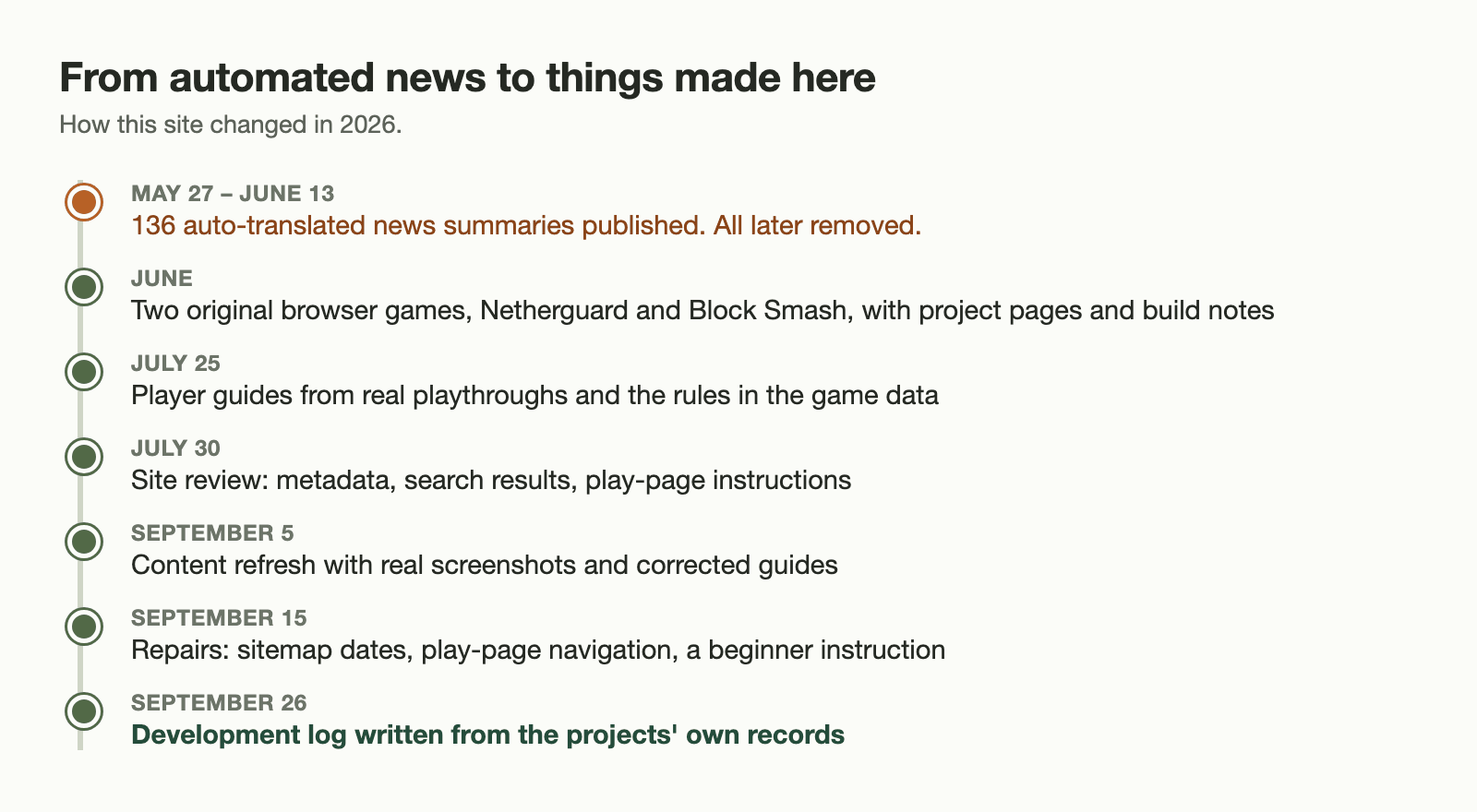
Over the next three months the rest was built around them, each part from something only this site has:
- Build notes (late June): how the games are packaged for the browser and how they are tested.
- Player guides (late July): four at first, eight by July 29. They cover first moves, reading clues, a full walkthrough of one case, characters, permanent upgrades, stars and boss preparation, and their rules were checked against the game data.
- A site audit (July 29–30): the first time I looked at the game site the way a visitor and a crawler see it, rather than the way the editor shows it.
- A content refresh (September 5): guides rebuilt around real playthroughs, with screenshots of the exact situations they describe.
- A repair pass (September 15): the stale sitemap dates, links from the play pages back to the guides, and the beginner instruction that contradicted the game.
- This Dev Log (September 26): development notes written from the projects’ own records.
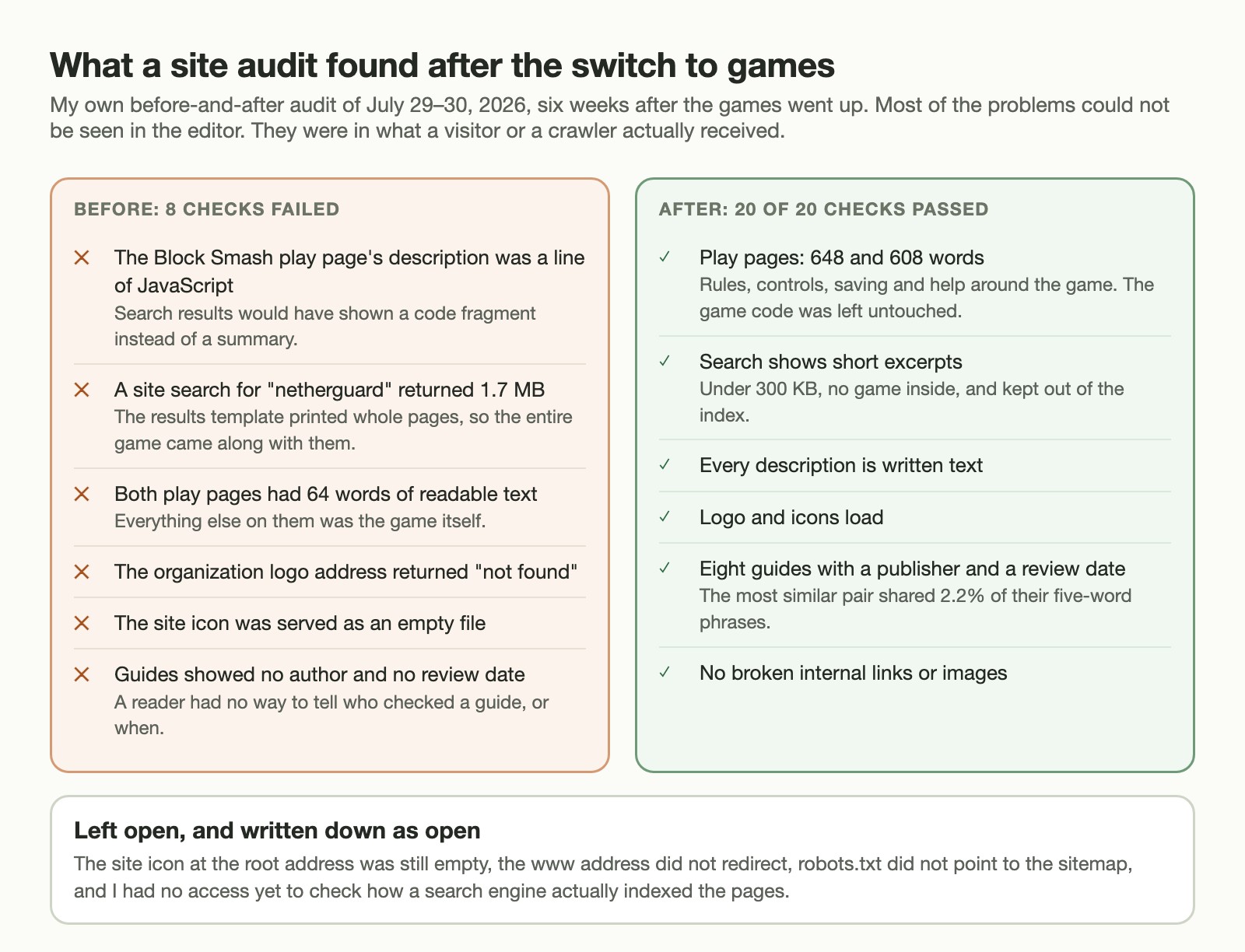
The July audit deserves a closer look, because most of what it found would never have shown up in a word count. The Block Smash play page’s search description was a line of JavaScript, the snippet that removed the page title, so a search result would have shown code instead of a summary. A site search for “netherguard” returned a 1.7 MB page, because the results template printed whole pages and the entire game came along with them. Each play page had 64 words of readable text, and everything else was the game. The organization logo returned “not found”, and the site icon was an empty file. The guides showed no author and no review date.
Afterwards each play page carried about 600 words on rules, controls, saving and getting help, and the game code itself was left untouched. The search page showed short excerpts and was kept out of the index. All twenty checks passed, and four items I could not fix yet were written down as open instead of being left out of the report.
The September 5 refresh is where the guides became what the news briefs never were. For the Reedshadow Passage walkthrough I solved the case and recorded every step. The clues have to be followed in the order they become available. Starting from the one card confirmed at the beginning, B2, the order is B3, B4, B1, A2, A4, A1 and A3. The earlier version of the guide had grouped two direct identity statements together, and that skipped a step: one of those statements is still hidden at the start. My run ended with all eight cards confirmed and all three chances left, at four minutes, for one star. The guide says plainly that this was a session with screenshots and note-taking, not a speed run.
For Block Smash I started a fresh save with Iron and played ten shots, writing down each decision and the totals the game showed. Upgrade costs and unlock conditions came from the data files inside the package the play page actually serves. Where a guide works something out, such as how many runs an upgrade takes to pay for itself, the result is labelled as a calculation and kept apart from what I observed.
What seems to matter
Three months is not long, and I am wary of turning one site’s history into rules. But the difference between the pages I removed and the pages I kept comes down to a few things, and I think they apply to any small site.
- Material only you have. The strongest pages here are ones nobody else could write: a walkthrough of an actual board with screenshots of that board, or the story of two ad bugs that cost players their rewards, told from the commits that fixed them. If a page could have been written by someone who never touched the thing it describes, it probably adds nothing.
- Check the text against the thing it describes. Guides are compared with the shipped build, and development notes with the repositories they describe. When two pages disagree, as the play page and the starter-builds guide did about Iron, the game decides which one is right.
- Say what was not proven. When I replayed Reedshadow on September 15 and finished in 1 minute 25 seconds for three stars, the stars guide added the screenshot and the comparison with the first clear, and it also says that two runs are not a controlled benchmark. The sitemap note names the plugin versions it was checked against and the case it did not test. A reader can do more with an honest limit than with a confident claim.
- Automation behind the work, not instead of it. Scripts still publish these pages, check the links and keep the sitemap accurate. What changed is which end of the pipeline I am on. The news pipeline started with someone else’s article and ended at my publish button. Now the work comes first, and the scripts only carry it.
- Check what a visitor receives, not what the editor shows. A description that is secretly code, a search page that contains a whole game, a sitemap that is ten days behind: none of these can be seen from the editing screen. I found them only by fetching the public pages the way a stranger would and reading what came back.
The pages on this site now are ones I would want to find myself. The news briefs were not, and no score, checklist or policy page could have changed that.