NETHERGUARD CAMPAIGN GUIDE
Written and tested by Diligesker Lab · Reviewed July 30, 2026 · Report a correction
Netherguard’s stars are not a vague “play better” grade. A completed case is scored from two measurable things: the time recorded for that case and the lives left when the final suspect is confirmed. This guide explains the current browser build’s rules, why a fast run can still lose a star, and how to improve a result without blocking campaign progress.
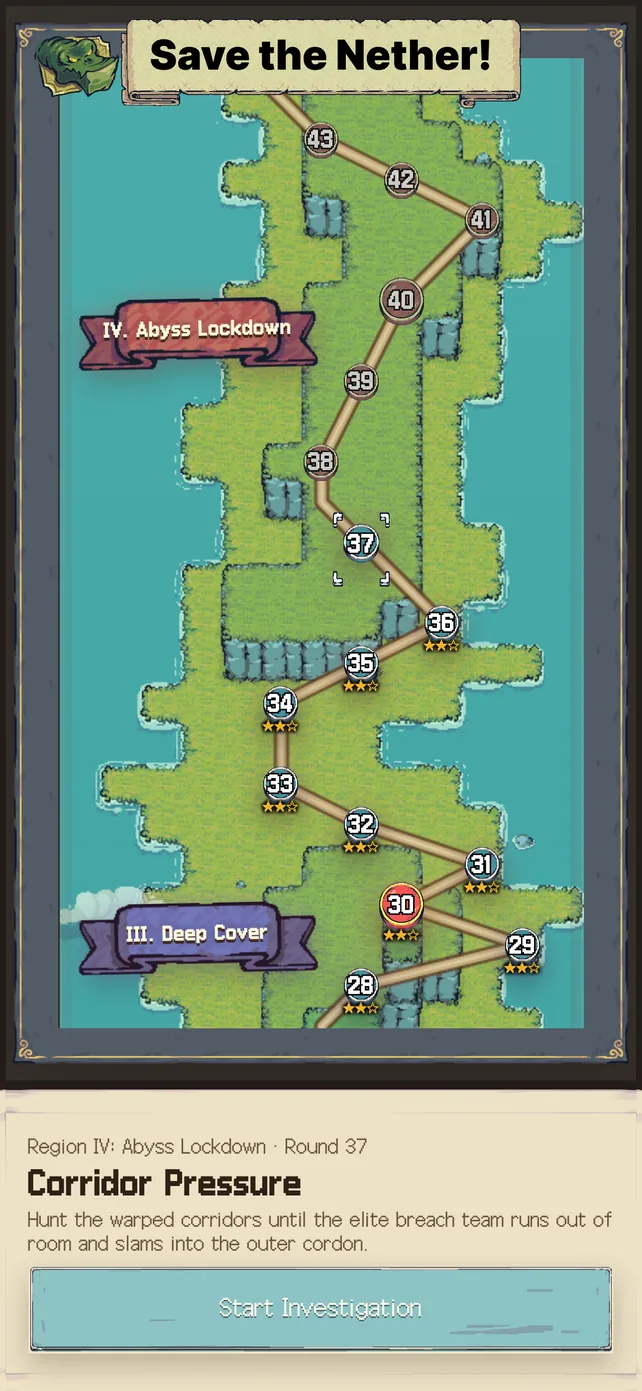
One star is enough to move forward
A fresh campaign begins with the first investigation available. The next ordered case unlocks after the current one has a saved result of at least one star. That means a slow but successful clear still advances the campaign. You do not need to replay a case for two or three stars before continuing, and a one-star clear is not a failed run.
This distinction is useful because the campaign contains 50 investigations across five regions. Treat the first pass as discovery. Learn each board’s clue mix, take the clear, and return for mastery only when you want a cleaner result.
The exact 1–3 star contract
| Result | Current requirement | What can prevent it |
|---|---|---|
| 3 stars | Finish at or under the case’s three-star time with all 3 lives remaining. | Any wrong confirmation, or exceeding the three-star time. |
| 2 stars | Finish at or under the case’s two-star time with at least 2 lives remaining. | Two wrong confirmations, or exceeding the two-star time. |
| 1 star | Complete the case without meeting both parts of a higher tier. | This still counts as a clear and unlocks the next case. |
The time target changes by case. Later and more complex boards receive different limits, so there is no single campaign-wide cutoff to memorize. For the first investigation, the current three-star target is 2:18.500 and the two-star target is 3:16.670. Reedshadow Passage uses 2:43.700 and 3:52.454 respectively. The faster number always belongs to three stars.
Lives create a hard ceiling
Every run starts with three lives. A confirmation that is unsupported by the active clues, or that chooses the wrong status, removes one life. A correct forced confirmation does not. Reaching zero ends the attempt.
This also makes the star ceiling easy to read. One wrong confirmation leaves two lives, so the best possible result for that run becomes two stars even if the remaining deductions are extremely fast. Two wrong confirmations leave one life, which limits the run to one star. Speed cannot cancel a lost life. If a card still has more than one possible status, keep reading instead of spending a life to test it.
Know which screens stop the clock
The rules dialog and the reset-confirmation dialog are explicitly configured to pause gameplay time. The normal suspect-card dialog is not. Opening a card to inspect its portrait, status choices, or clue therefore belongs to live play.
For a first clear, take the time you need and protect lives. For a three-star replay, do most of the reasoning on the visible board, open a suspect only when you are ready to confirm, and use the rules dialog if you genuinely need to check a definition. The important optimization is not frantic clicking; it is reducing backtracking and avoiding an unsupported confirmation.
A stronger retry cannot be erased by a weaker one
Netherguard saves the best star count for each case, along with the fastest completed time and the highest number of remaining lives. A later run can improve those records. If you earn three stars and then replay the case for two, the campaign map keeps the historical three-star badge rather than downgrading it.
Campaign progress is stored in the browser’s local storage. It is tied to that browser profile rather than a Diligesker account, so clearing site data, using a private window, or switching devices may produce a fresh campaign. If you care about a long-running save, avoid clearing this site’s stored data.
One case, two recorded results
Reedshadow Passage was first recorded here on September 5, 2026 at 04:00 with 3/3 lives and one star. A September 15 replay finished at 01:25 with 3/3 lives and three stars. Both cleared all 8 residents. The earlier run spent more time reading and recording the deductions; the replay followed the already understood clue sequence. These are two actual clears, not a controlled speed benchmark.
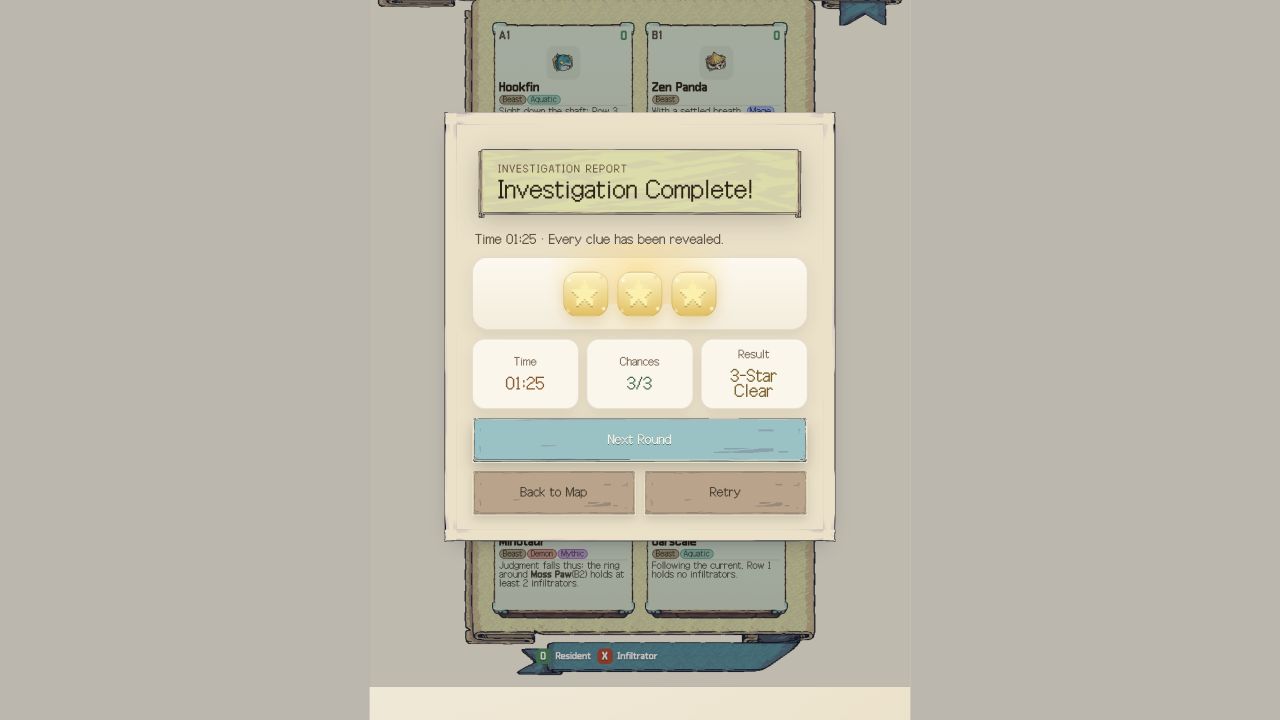
| Recorded clear | Lives | Result explained |
|---|---|---|
| September 5: 04:00 | 3/3 | 240 seconds exceeds the 232.454-second two-star limit: one star. |
| September 15: 01:25 | 3/3 | 85 seconds is below the 163.700-second three-star limit, with no lives lost: three stars. |
The practical difference was knowing which confirmation revealed the next needed clue. Use the recorded walkthrough and its first-clear screenshot to learn that sequence before trying to reduce the time.
A practical two-pass route
- First pass: aim for a proof-first clear. Protect at least one life, learn which clue families appear, and open the next case.
- Before a retry: remember the first two deductions that became forced. Those are usually where a cleaner route begins.
- Second pass: preserve all three lives first, then work on time. A fast mistake can never produce three stars.
- After finishing: compare the current result with the badge on the map. The map represents the saved best, not necessarily the most recent attempt.
What matters most
Progress and mastery are deliberately separate. One star continues the story; two stars reward a controlled run; three stars require both an error-free deduction chain and the case-specific time. If the clue language is the part slowing you down, use the beginner clue guide before chasing the clock. If you want a concrete worked example, the Reedshadow Passage walkthrough shows the board logic step by step.