Written and tested by Diligesker Lab · Published July 25, 2026 · Reviewed July 30, 2026. Mechanical claims are checked against the current browser build, project data, or test records. Report a correction.
NETHERGUARD BEGINNER GUIDE
Netherguard does not ask the player to test suspects until one works. A card can be inspected at any time, but confirmation is meant to follow from the revealed clue set. This guide organizes the implemented clue families into a practical reading order.
Begin with the smallest target
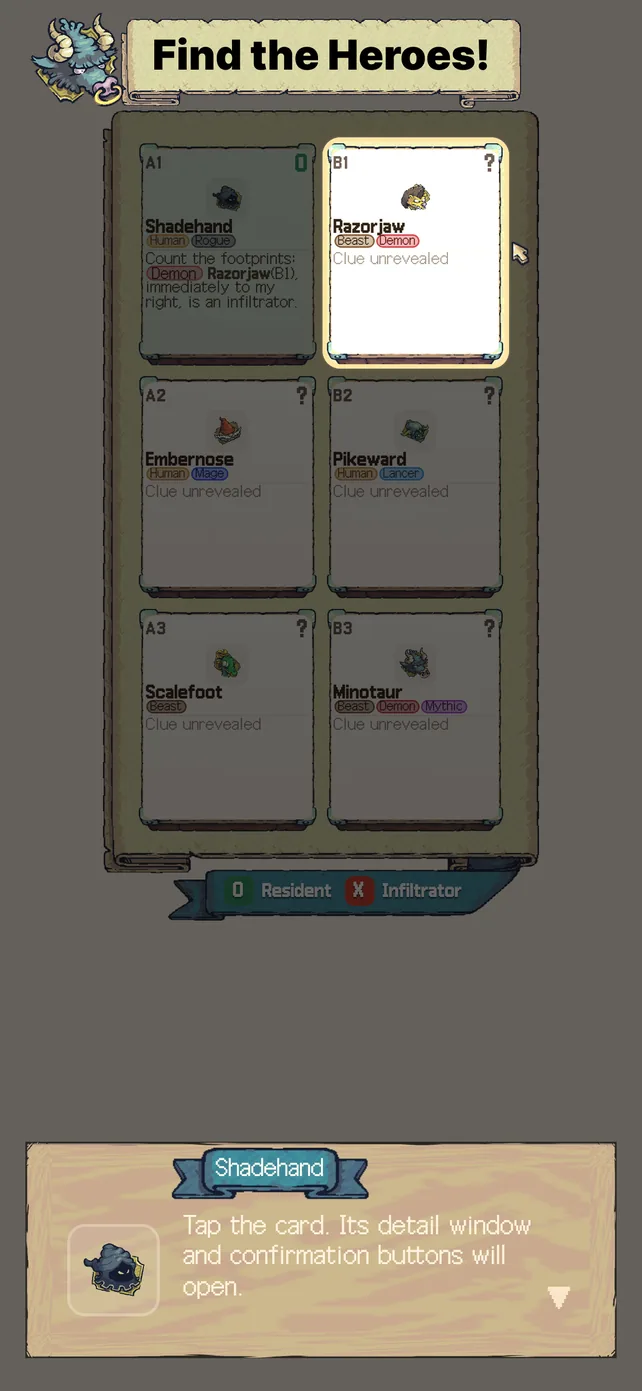
A clue naming one card is easier to apply than a clue describing a whole row or trait group. Direct target-status clues can settle one suspect immediately. Relative target clues use a named position relative to the speaker. Apply these first because later counts become simpler once one member is known.
Translate every group clue into a count
| Clue family | Question to ask | Safe deduction |
|---|---|---|
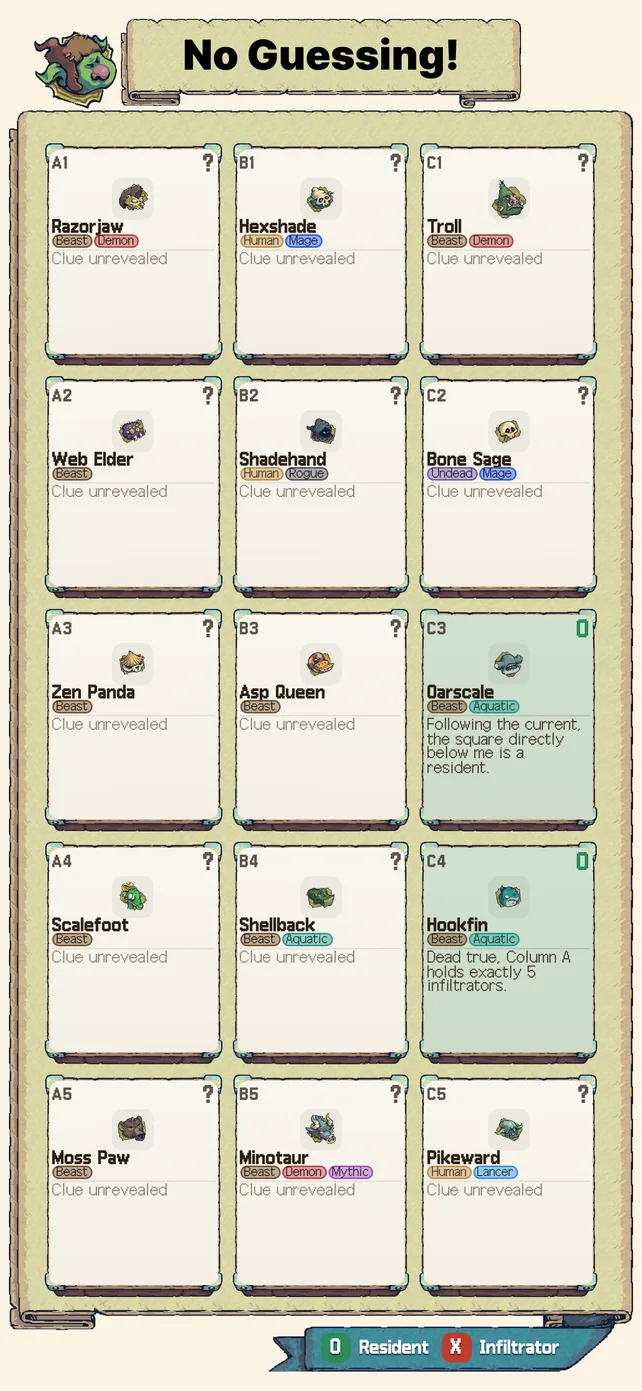
| Row or column count | How many infiltrators may appear in this line? | Exact zero clears the line; exact one settles the rest after one infiltrator is known. |
| Trait count | Which cards share the named trait? | Only count cards carrying that trait; do not include a visually similar card without the trait. |
| Neighbor count | Which slots are inside the target card’s neighboring ring? | Use board position, not reading order, to identify the group. |
| Slot-set count | Which explicitly named slots belong to the set? | Treat the set as its own group even when members are separated on the board. |
| Same status | Must the two named cards match? | Once one status is known, copy it to the other. |
| Different status | Must the two named cards differ? | Once one is known, the other must take the opposite status. |
Use exact zero before “at least one”
“No infiltrators” removes uncertainty from every member of a group. “At least one” only promises that the group contains an infiltrator somewhere. The second statement becomes useful after another clue narrows the candidates; applying it too early can create false certainty.
Separate information from confirmation
- Information: a clue reduces the possible states of a card or group.
- Cross-check: another clue reaches the same result through a different row, trait, or relationship.
- Confirmation: the available clues leave one supported status for the selected card.
A clue can be true without identifying a unique card. For example, a Beast group containing “at least one infiltrator” does not tell you which Beast is guilty. Wait until a direct statement, exact count, or relationship removes the alternatives.
A four-pass routine
- Mark initial reveals and direct named-card statements.
- Clear exact-zero rows, columns, traits, and slot sets.
- Revisit exact-one, same-status, and different-status clues with the new marks.
- Check neighbor and minimum-count clues against the proposed final board before confirming.
Three common mistakes
Guessing from character art
Names, species, and illustrations help identify cards, but appearance is not evidence unless the clue explicitly refers to a trait carried by that card.
Treating “at least one” as “exactly one”
A minimum leaves room for additional infiltrators. Do not settle the rest of the group unless another clue provides an upper bound.
Forgetting that one card can satisfy several clues
A single infiltrator may satisfy a row count, a trait minimum, and a neighbor minimum at the same time. Do not invent an extra infiltrator for each sentence.
When to stop and re-read
If two clues appear to conflict, first check the named slot, trait membership, comparison word, and whether the statement says exact, at least, or none. The board’s confirmation rule is designed to keep unsupported choices from becoming progress, but the reasoning is still easier when each group is written down explicitly.