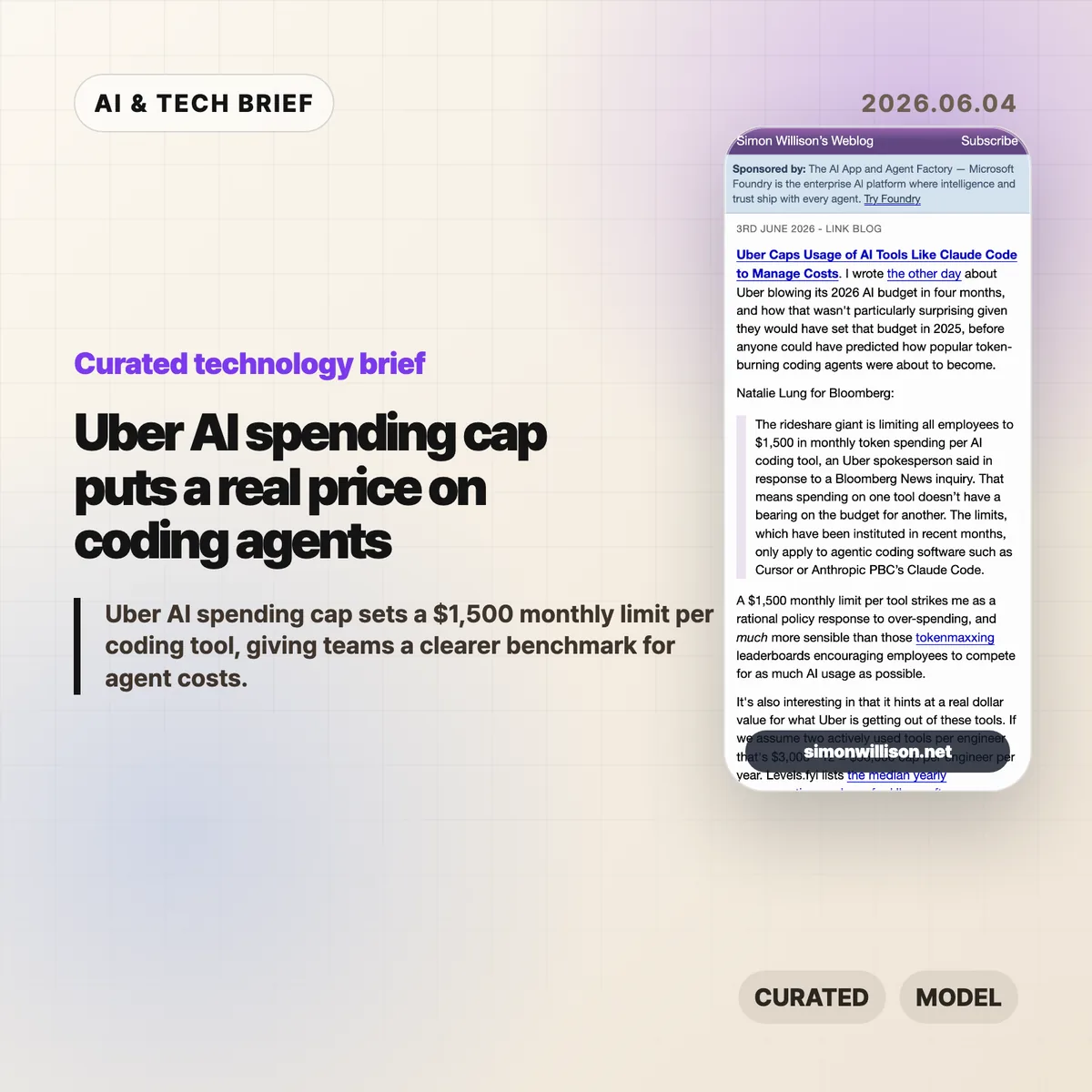
Uber AI spending cap is a useful pricing signal for anyone buying coding agents. According to Bloomberg, as quoted and analyzed by Simon Willison, Uber is limiting employees to $1,500 in monthly token spending per AI coding tool. That is not a normal SaaS seat price. It is closer to a live meter on how much work companies are willing to hand to Cursor, Claude Code, and similar tools.
Table of Contents
The short version
- Uber reportedly set a $1,500 monthly token-spending limit per employee, per AI coding tool, for agentic software such as Cursor and Anthropic’s Claude Code.
- Simon Willison calculates that two heavily used tools would imply a $36,000 annual cap per engineer, or about 11% of the median Uber software engineer compensation package listed on Levels.fyi.
- The useful signal is not that AI coding tools are too expensive by default. It is that enterprise buyers now need budget controls tied to actual token usage.
- The Hacker News thread around the Bloomberg story was thin, but the related links point back to a broader argument about token-heavy agent use and corporate AI rationing.
What happened
Uber has capped employee spending on AI coding tools at $1,500 per month for each tool, according to a Bloomberg report cited by Simon Willison. The policy applies to agentic coding software, including Cursor and Claude Code, rather than every AI assistant used inside the company. Bloomberg’s quoted detail matters: spending on one tool does not reduce the budget for another tool.
Willison connects the cap to an earlier report that Uber burned through its 2026 AI budget in four months. His reading is blunt and plausible. Uber likely set that budget in 2025, before coding agents became heavy users of tokens through planning, editing, testing, retrying, and reading large codebases.
This is why the Uber AI spending cap is more interesting than a normal procurement memo. It gives the market a number. For a large company, an AI coding assistant is no longer just a $20 or $100 monthly subscription. Once agents run long tasks, the bill starts to look like compute spend.
Why Uber AI spending cap is worth watching
Uber AI spending cap puts a ceiling on a kind of usage that many software teams still treat as fuzzy. Willison’s back-of-the-envelope math is the best part: if an engineer actively uses two tools, the cap becomes $3,000 per month, or $36,000 per year. Levels.fyi lists the median yearly compensation package for US Uber software engineers at $330,000, so the AI-tool cap would be about 11% of that figure.
That does not mean every company should copy Uber’s number. Uber pays US engineering salaries at the high end of the market, and its internal productivity math may not match a startup, agency, or mid-market SaaS company. But $36,000 per engineer per year is large enough to force a real ROI conversation and small enough that a company might approve it for the right teams.
The line to watch is not the nominal subscription price. The line is the work pattern. Short autocomplete and chat are one cost profile. Agentic coding, where the tool searches files, writes patches, runs tests, and retries after failures, is a different one.
What does Uber AI spending cap change for builders?
Uber AI spending cap changes the buying conversation for developer-tool companies. Builders selling coding agents now have to prove that high token usage maps to saved engineering time, fewer blocked tasks, faster migration work, or better test coverage. A slick editor plugin is not enough once finance sees a four-figure monthly meter for a single employee.
For product teams, the lesson is to expose cost controls early. Tool-level caps, project-level budgets, usage reports, and admin policies are no longer enterprise afterthoughts. They are part of the product. A developer may love an agent that burns through context to solve a problem. A CTO still needs to know which repo, task type, or team made that spend worthwhile.
There is also an ASO-style discovery angle for developer tools. In a crowded market of extensions, IDE plugins, and agent platforms, buyers will not only search for the smartest model. They will search for tools that make usage visible enough to justify adoption.
For more coverage of developer tools and AI infrastructure, see the IT & AI archive.
What Hacker News readers are arguing about
The Hacker News discussion attached to this Bloomberg story did not turn into a substantial debate. One thread had no comments, and another mostly linked back to related discussions about tokenmaxxing, Uber’s earlier AI budget burn, and broader corporate rationing of AI usage.
That thin reaction is still informative. The community did not produce a clear consensus on whether Uber’s $1,500 limit is generous, restrictive, or wasteful. The related links point to the more useful argument: AI coding cost is becoming a recurring infrastructure expense, not a novelty budget. The skeptical side is easy to infer from those adjacent threads, but it should not be overstated here. The public discussion around this specific cap is still sparse.
The practical caveat for readers is simple: do not treat HN comment volume as evidence of market acceptance. Treat the thread as a pointer to the larger concern that agent usage can run ahead of the budgets companies set when these tools looked cheaper and narrower.
The practical read
Teams buying coding agents should start with a per-person cap, but they should not stop there. A flat $1,500 limit is easy to explain, yet it hides the difference between a developer using an agent for low-risk refactors and a team using it to grind through migrations, test repairs, or large code reviews.
The better policy pairs a cap with measurement. Track which tools consume tokens, which tasks trigger long runs, and whether the output survives review. If a coding agent saves several hours of senior engineering time each week, a four-figure monthly allowance can make sense. If the usage mostly produces abandoned branches and noisy suggestions, the same spend is hard to defend.
Vendors should read Uber’s number as a warning and an opportunity. The warning is that subsidized individual plans do not describe enterprise economics. The opportunity is that large companies may pay serious money for agents when the value is visible, governable, and tied to work that would otherwise cost more in engineering time.