Tag: Claude Code

  • Cheap code and the Winchester House model of AI software

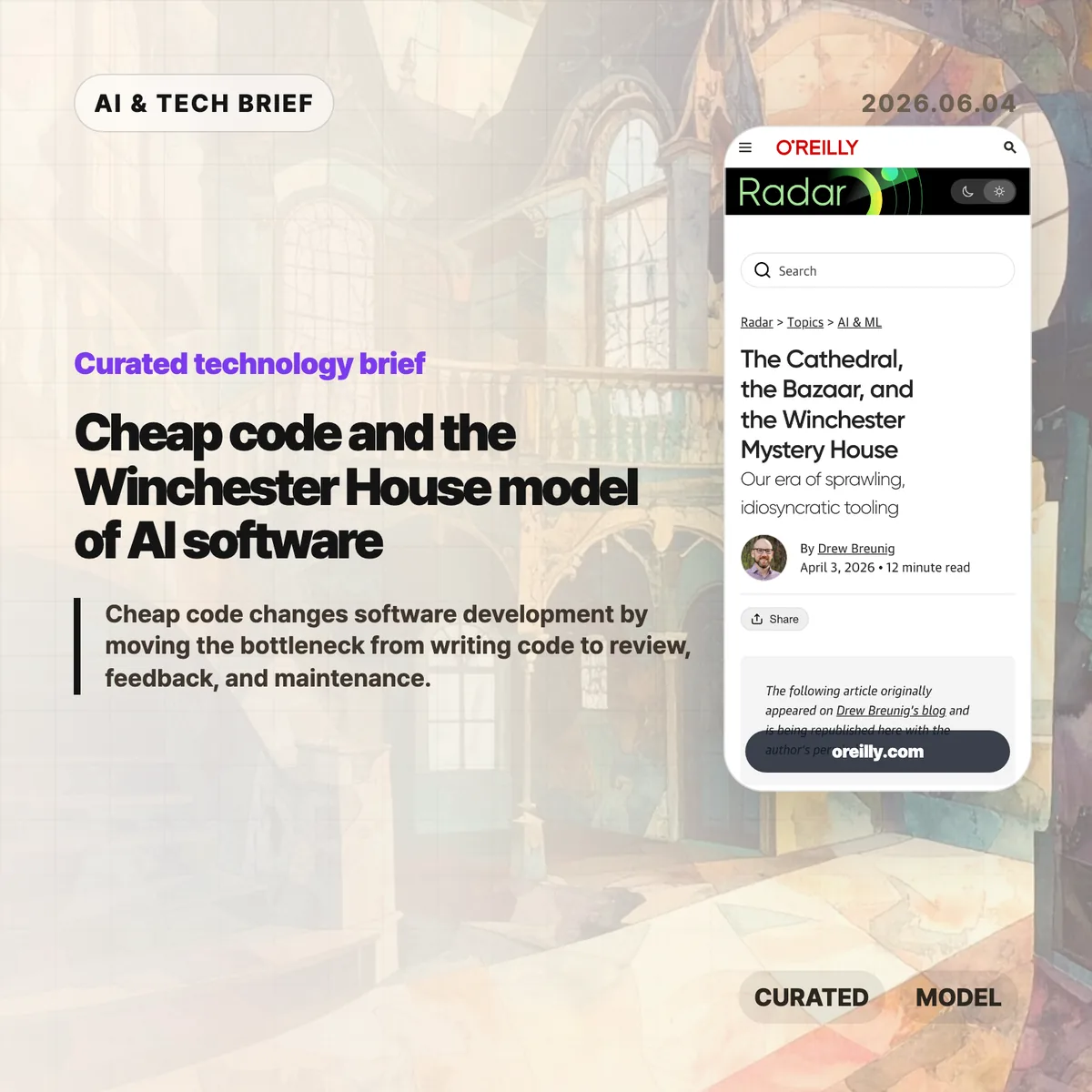
    Cheap code and the Winchester House model of AI software

    Cheap code changes software development by making implementation feel abundant while review, feedback, and maintenance stay scarce. In an April 3, 2026 O’Reilly Radar essay, Drew Breunig argues that AI coding agents are creating a third software model: personal, sprawling tools that look less like cathedrals or bazaars and more like the Winchester Mystery House. His examples include Claude Code activity, open source contribution pressure, and personal agent stacks that grow faster than teams can explain them.

    The short version

    • O’Reilly frames AI-era development as a “Winchester Mystery House” model in an April 3, 2026 essay about sprawling personal tools.
    • Breunig cites Claude Code activity reaching about 1,000 net lines per commit, a number that makes review speed more important than raw output.
    • The useful warning is not that AI code is bad. Feedback, review, product judgment, and long-term ownership have not become cheap at the same pace.
    • Open source is unlikely to disappear, but maintainers may face more agent-written pull requests, thin context, and resume-padding contributions.
    • The business angle is boring infrastructure: testing, security, review, dependency management, and maintainability tools that developers do not want to rebuild alone.

    What happened

    O’Reilly Radar republished Drew Breunig’s essay, “The Cathedral, the Bazaar, and the Winchester Mystery House,” on April 3, 2026. The piece updates Eric S. Raymond’s 1998 contrast between the cathedral model of closed, planned software and the bazaar model of open, networked collaboration.

    Breunig’s third model starts from a simple claim: the internet made coordination cheaper, while AI coding agents make implementation cheaper. He cites Claude Code activity and says one example line had reached about 1,000 net lines per commit. That number matters less as a benchmark than as a stress test. If writing code gets faster than understanding code, teams do not automatically get cleaner products. They get more software to judge.

    The essay uses personal agent stacks, open source maintenance pressure, and the Winchester Mystery House itself to describe a world where developers keep extending tools around their own taste. The house had roughly 160 rooms when it became a tourist attraction, after peaking at far more. The software version can be useful and clever, but outsiders may struggle to find the plan.

    Why cheap code is worth watching

    Cheap code is worth watching because it changes the constraint in software work. According to O’Reilly Radar, Breunig compares AI coding agents with the internet’s role in open source: the internet made coordination cheaper, while tools such as Claude Code make implementation cheaper. That switch moves the bottleneck from typing to judgment.

    A developer can now ask an agent to scaffold features, rewrite chunks of code, or glue together APIs with less friction than before. The harder part is what happens after the code exists. Someone still has to decide whether the feature should exist, whether the implementation is safe, whether the tests cover the risky parts, and whether another human can maintain it six months later.

    Breunig’s essay puts this plainly: the fastest feedback loop is often the developer using their own tool. That works well for personal automation. It gets risky when the same habits enter shared products. For readers who follow developer tooling, the next durable products may be review, search, testing, and safety systems rather than another code generator. The broader IT & AI archive is tracking that shift across coding agents, AI infrastructure, and software workflow products.

    What does cheap code change for builders?

    Cheap code pushes builders toward personal software first. A founder, engineer, or internal tools lead can now make a workflow-specific app that would have been too annoying to justify a year ago. In practice, that favors prototypes, back-office automation, research tools, and tiny utilities that never deserved a full product roadmap.

    The trade-off is ownership. A tool that works for one developer can become a maintenance trap when it spreads to a team. Personal context does not transfer automatically. Naming, documentation, tests, access control, data retention, and rollback plans still need human discipline. Teams that adopt AI coding agents should measure more than output volume. Better operating metrics include review time, defect rate, test coverage, duplicated code, and how often generated features are removed after 30 or 90 days.

    App builders and extension developers should also read this as an ASO and marketplace warning. If anyone can build a personal tool, discovery gets noisier. The products that win may be the ones that explain their constraints clearly and handle the unfun parts better than a weekend agent script.

    What Hacker News readers are arguing about

    The Hacker News discussion linked from the O’Reilly essay is older than the current AI coding wave, but it explains why lines of code are a weak productivity metric. The thread starts from the Mythical Man-Month claim that a developer may average around 10 lines of code per day. One widely cited comment by Redis creator Salvatore Sanfilippo estimates his own Redis output at roughly 29 lines per day over a decade, after accounting for rewriting and bug fixing.

    The useful disagreement is about what counts as production. Some commenters point out that greenfield work can produce hundreds of lines in a day, while debugging, refactoring, and design work may produce almost no net lines. Others compare software to repair work: replacing a bolt is easy, knowing which bolt to replace is the skill.

    That makes the O’Reilly argument sharper. If Claude Code can produce around 1,000 net lines per commit in the example Breunig cites, the number is impressive only until it hits the old constraint. More lines still need taste, review, deletion, and responsibility. The Hacker News thread is not evidence about AI agents, but it is a useful reminder that code volume has always been a poor proxy for software value.

    The practical read

    Teams should treat cheap code as a capacity change, not a quality guarantee. The practical move is to pair AI coding agents with stricter review paths: automated tests before merge, smaller diffs, named owners, and clear rollback plans. Use agents where the feedback loop is short: prototypes, migrations, tests, scripts, documentation drafts, and personal workflow tools. Be more conservative when the work touches security, billing, permissions, production data, or shared architecture.

    For open source maintainers, the article points to a near-term process problem. Projects may need contribution templates that ask for evidence, automated triage that filters low-context pull requests, and policies that let maintainers reject generated churn quickly. The goal is not to block AI-assisted contributors. It is to make contributors bring the context that maintainers actually need.

    For tool companies, the opportunity sits around the boring parts. Developers may enjoy building their own stained-glass windows. They still want someone else to make the plumbing reliable.
    Sources

  • Uber AI spending cap puts a real price on coding agents

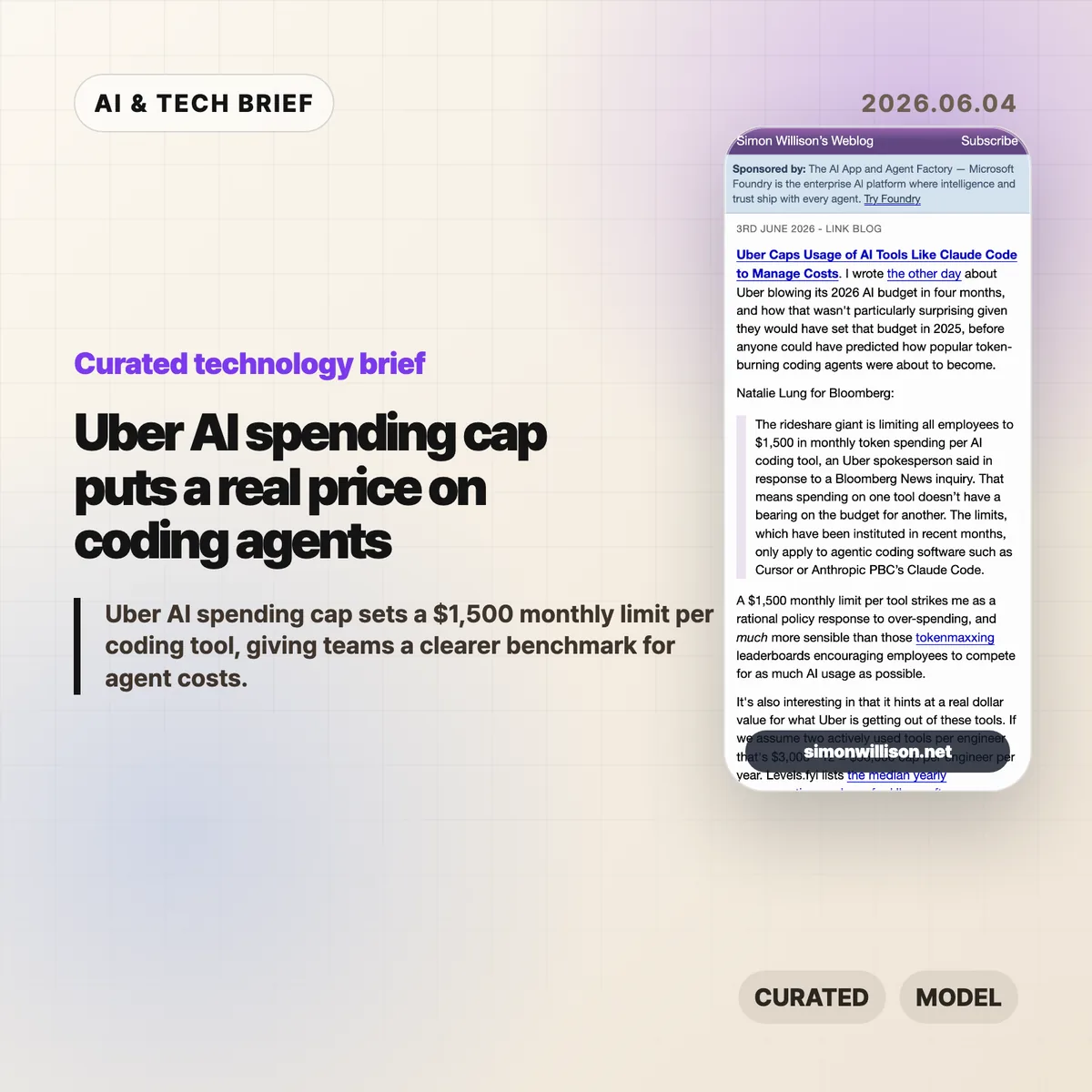
    Uber AI spending cap puts a real price on coding agents

    Uber AI spending cap is a useful pricing signal for anyone buying coding agents. According to Bloomberg, as quoted and analyzed by Simon Willison, Uber is limiting employees to $1,500 in monthly token spending per AI coding tool. That is not a normal SaaS seat price. It is closer to a live meter on how much work companies are willing to hand to Cursor, Claude Code, and similar tools.

    The short version

    • Uber reportedly set a $1,500 monthly token-spending limit per employee, per AI coding tool, for agentic software such as Cursor and Anthropic’s Claude Code.
    • Simon Willison calculates that two heavily used tools would imply a $36,000 annual cap per engineer, or about 11% of the median Uber software engineer compensation package listed on Levels.fyi.
    • The useful signal is not that AI coding tools are too expensive by default. It is that enterprise buyers now need budget controls tied to actual token usage.
    • The Hacker News thread around the Bloomberg story was thin, but the related links point back to a broader argument about token-heavy agent use and corporate AI rationing.

    What happened

    Uber has capped employee spending on AI coding tools at $1,500 per month for each tool, according to a Bloomberg report cited by Simon Willison. The policy applies to agentic coding software, including Cursor and Claude Code, rather than every AI assistant used inside the company. Bloomberg’s quoted detail matters: spending on one tool does not reduce the budget for another tool.

    Willison connects the cap to an earlier report that Uber burned through its 2026 AI budget in four months. His reading is blunt and plausible. Uber likely set that budget in 2025, before coding agents became heavy users of tokens through planning, editing, testing, retrying, and reading large codebases.

    This is why the Uber AI spending cap is more interesting than a normal procurement memo. It gives the market a number. For a large company, an AI coding assistant is no longer just a $20 or $100 monthly subscription. Once agents run long tasks, the bill starts to look like compute spend.

    Why Uber AI spending cap is worth watching

    Uber AI spending cap puts a ceiling on a kind of usage that many software teams still treat as fuzzy. Willison’s back-of-the-envelope math is the best part: if an engineer actively uses two tools, the cap becomes $3,000 per month, or $36,000 per year. Levels.fyi lists the median yearly compensation package for US Uber software engineers at $330,000, so the AI-tool cap would be about 11% of that figure.

    That does not mean every company should copy Uber’s number. Uber pays US engineering salaries at the high end of the market, and its internal productivity math may not match a startup, agency, or mid-market SaaS company. But $36,000 per engineer per year is large enough to force a real ROI conversation and small enough that a company might approve it for the right teams.

    The line to watch is not the nominal subscription price. The line is the work pattern. Short autocomplete and chat are one cost profile. Agentic coding, where the tool searches files, writes patches, runs tests, and retries after failures, is a different one.

    What does Uber AI spending cap change for builders?

    Uber AI spending cap changes the buying conversation for developer-tool companies. Builders selling coding agents now have to prove that high token usage maps to saved engineering time, fewer blocked tasks, faster migration work, or better test coverage. A slick editor plugin is not enough once finance sees a four-figure monthly meter for a single employee.

    For product teams, the lesson is to expose cost controls early. Tool-level caps, project-level budgets, usage reports, and admin policies are no longer enterprise afterthoughts. They are part of the product. A developer may love an agent that burns through context to solve a problem. A CTO still needs to know which repo, task type, or team made that spend worthwhile.

    There is also an ASO-style discovery angle for developer tools. In a crowded market of extensions, IDE plugins, and agent platforms, buyers will not only search for the smartest model. They will search for tools that make usage visible enough to justify adoption.

    For more coverage of developer tools and AI infrastructure, see the IT & AI archive.

    What Hacker News readers are arguing about

    The Hacker News discussion attached to this Bloomberg story did not turn into a substantial debate. One thread had no comments, and another mostly linked back to related discussions about tokenmaxxing, Uber’s earlier AI budget burn, and broader corporate rationing of AI usage.

    That thin reaction is still informative. The community did not produce a clear consensus on whether Uber’s $1,500 limit is generous, restrictive, or wasteful. The related links point to the more useful argument: AI coding cost is becoming a recurring infrastructure expense, not a novelty budget. The skeptical side is easy to infer from those adjacent threads, but it should not be overstated here. The public discussion around this specific cap is still sparse.

    The practical caveat for readers is simple: do not treat HN comment volume as evidence of market acceptance. Treat the thread as a pointer to the larger concern that agent usage can run ahead of the budgets companies set when these tools looked cheaper and narrower.

    The practical read

    Teams buying coding agents should start with a per-person cap, but they should not stop there. A flat $1,500 limit is easy to explain, yet it hides the difference between a developer using an agent for low-risk refactors and a team using it to grind through migrations, test repairs, or large code reviews.

    The better policy pairs a cap with measurement. Track which tools consume tokens, which tasks trigger long runs, and whether the output survives review. If a coding agent saves several hours of senior engineering time each week, a four-figure monthly allowance can make sense. If the usage mostly produces abandoned branches and noisy suggestions, the same spend is hard to defend.

    Vendors should read Uber’s number as a warning and an opportunity. The warning is that subsidized individual plans do not describe enterprise economics. The opportunity is that large companies may pay serious money for agents when the value is visible, governable, and tied to work that would otherwise cost more in engineering time.

    Sources

  • Claude Code dynamic workflows make agents plan the work

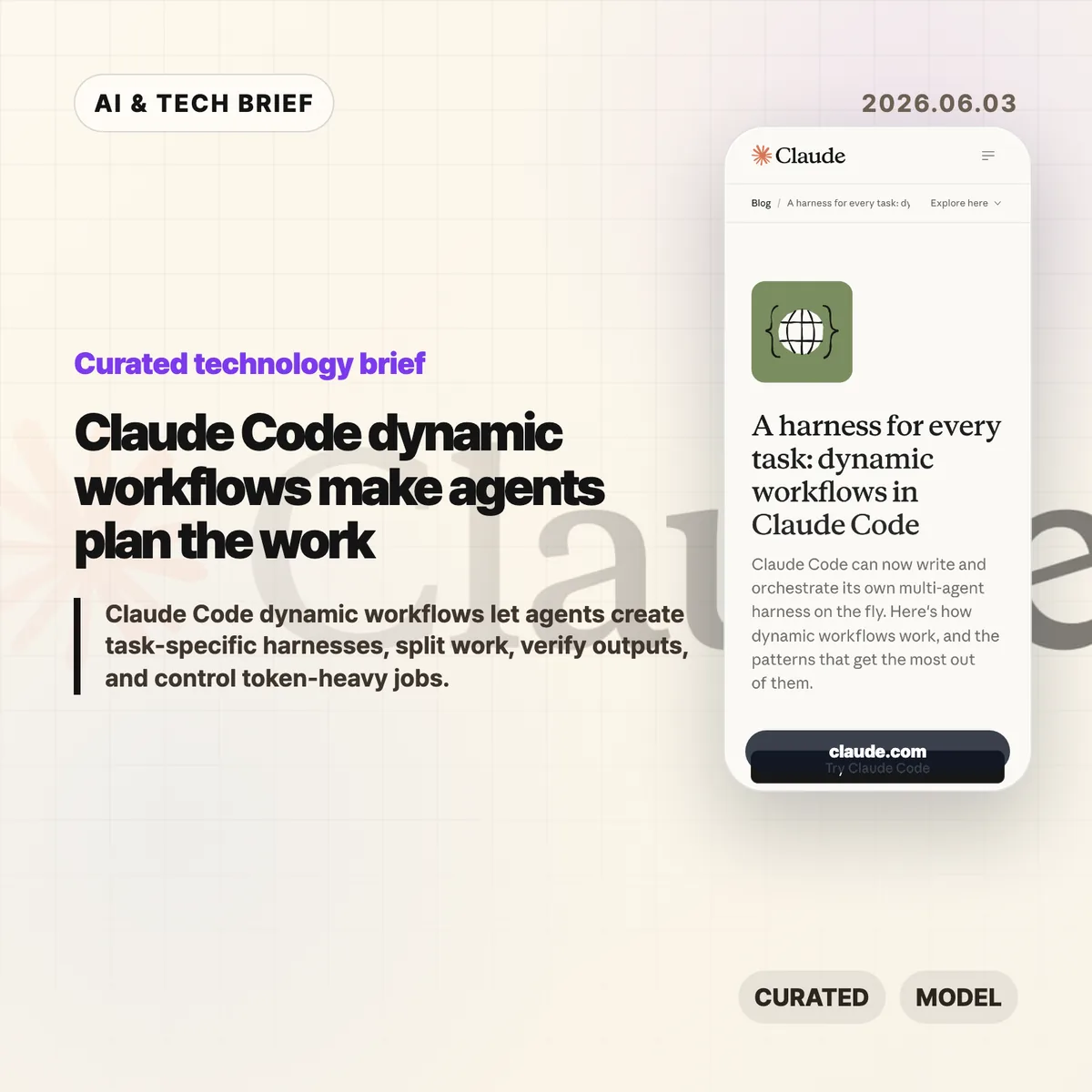
    Claude Code dynamic workflows make agents plan the work

    Claude Code dynamic workflows let Claude Code write a task-specific JavaScript harness, spawn subagents, and coordinate the result instead of keeping a long job in one chat thread. Anthropic introduced the feature on June 2, 2026, and frames it as a way to handle complex coding, research, security, triage, and verification work without forcing developers to build the orchestration layer by hand.

    The short version

    • Claude Code dynamic workflows create custom harnesses for a task, then use subagents to split, verify, compare, or synthesize work.
    • Anthropic names seven useful patterns: classify-and-act, fan-out-and-synthesize, adversarial verification, generate-and-filter, tournament, loop until done, and model routing.
    • The feature is aimed at complex, high-value jobs such as refactors, migrations, deep research, source checking, support triage, and root-cause analysis.
    • The trade-off is cost and complexity. Anthropic says dynamic workflows can use significantly more tokens and are not needed for ordinary coding tasks.

    What happened

    Anthropic says Claude Code can now create a custom harness on the fly for the job in front of it. The harness is a JavaScript file with special functions for spawning and coordinating subagents, plus ordinary JavaScript utilities such as JSON, Math, and Array for processing data. A workflow can choose which model an agent uses and whether subagents run in their own worktree, which matters when a task needs isolation or a higher intelligence model.

    The company’s post describes this as a move beyond static orchestration. Developers could already coordinate multiple Claude Code runs through the Claude Agent SDK or claude -p, but those static harnesses tend to be generic because they have to survive many edge cases. Dynamic workflows push more of that planning into Claude Code itself: ask for a workflow, or use Anthropic’s trigger word “ultracode,” and Claude Code can build a structure for the current task.

    Why this is worth watching

    Claude Code dynamic workflows are worth watching because Anthropic is moving Claude Code from a single assistant loop toward task-level orchestration. In the June 2, 2026 post, Anthropic names three failure modes that show up in long agent runs: agentic laziness, self-preferential bias, and goal drift. Those are practical problems, not abstract benchmark issues.

    A separate harness gives Claude Code a cleaner way to check work against evidence and rubrics. One subagent can inspect logs, another can review files, another can verify claims, and a synthesis step can wait until each branch returns structured output. The feature will matter if that structure reduces missed requirements more often than it burns extra tokens. For more analysis of developer tooling and AI systems, see the IT & AI archive.

    What does Claude Code dynamic workflows change for developers?

    Claude Code dynamic workflows let developers request a repeatable process with a stop condition, a rubric, and isolated work streams. Anthropic’s examples include reproducing a flaky test that fails 1 in 50 runs, mining the last 50 Claude Code sessions for repeated corrections, checking every technical claim in a draft against a codebase, ranking 80 resumes, and reviewing a business plan from investor, customer, and competitor viewpoints.

    The strongest fit is work where one context window becomes a liability. Large refactors can be split by call site, module, or failing test. Security reviews can assign one verifier per rule. Research workflows can fan out source gathering and then check claims. Triage workflows can classify a backlog, dedupe it against known issues, and quarantine agents that read untrusted public content from agents that can take higher privilege actions.

    Seven workflow patterns Anthropic highlights

    Anthropic’s seven workflow patterns turn Claude Code dynamic workflows into something developers can prompt deliberately. Classify-and-act routes different tasks to different behavior. Fan-out-and-synthesize splits work into clean contexts and merges structured outputs after a barrier. Adversarial verification asks another agent to check a result against a rubric. Generate-and-filter produces candidates, removes duplicates, and keeps the best tested ideas.

    The remaining patterns handle comparison, persistence, and model choice. Tournament workflows make agents compete on the same task and use judging agents for pairwise comparisons. Loop-until-done workflows keep spawning work until no new findings or errors remain. Model and intelligence routing uses a classifier agent to decide whether a job needs a cheaper model or a stronger one such as Opus. The pattern list gives teams concrete language to use instead of vague prompts like “be thorough.”

    When not to use Claude Code dynamic workflows

    Claude Code dynamic workflows should not become the default for every prompt. Anthropic says the feature is new, best practices are still developing, and workflows may consume significantly more tokens. Most normal coding tasks do not need five reviewers, a tournament bracket, or a loop that keeps running until a broad condition is met.

    A good rule is to reserve workflows for jobs where the structure is part of the value. Use them when the task needs parallel evidence gathering, adversarial checking, repeated passes, isolated worktrees, or qualitative comparison at scale. Skip them for a small bug fix, a one-file change, or a question where a normal Claude Code session can answer cleanly. Token budgets can also be set directly in the prompt, such as asking the workflow to stay under 10,000 tokens.

    What Hacker News readers are arguing about

    The Hacker News submission for Anthropic’s post existed when checked, but it had no substantive discussion attached to it. That means there is no useful community consensus to summarize yet, and it would be misleading to turn a quiet thread into a debate.

    The missing discussion is still worth noting. The questions developers should bring to a fuller thread are predictable: whether dynamic workflows are reliable enough for real codebases, how often they waste tokens, how safe the worktree isolation is, whether adversarial verification catches real mistakes, and whether teams can share reusable workflows without turning them into brittle scripts. Treat the Hacker News link as a place to watch for later operator feedback, not as evidence today.

    The practical read

    Claude Code dynamic workflows are best understood as an orchestration feature for messy work. If your team already knows how to decompose a task, the feature may remove boilerplate around spawning agents and combining results. If your team does not know the right rubric, stop condition, or trust boundary, the workflow can still produce confident noise.

    The first experiments should be bounded. Try a flaky-test reproduction, a code review checklist, a migration with isolated worktrees, or a claim-verification pass on a technical document. Give Claude Code the workflow pattern you want, the token budget, the stop condition, and the rubric for success. Then inspect the transcript and saved workflow before using it on a higher-stakes job.

    Sources

  • geo-seo-claude audit: AI search SEO inside Claude Code

    geo-seo-claude audit: AI search SEO inside Claude Code

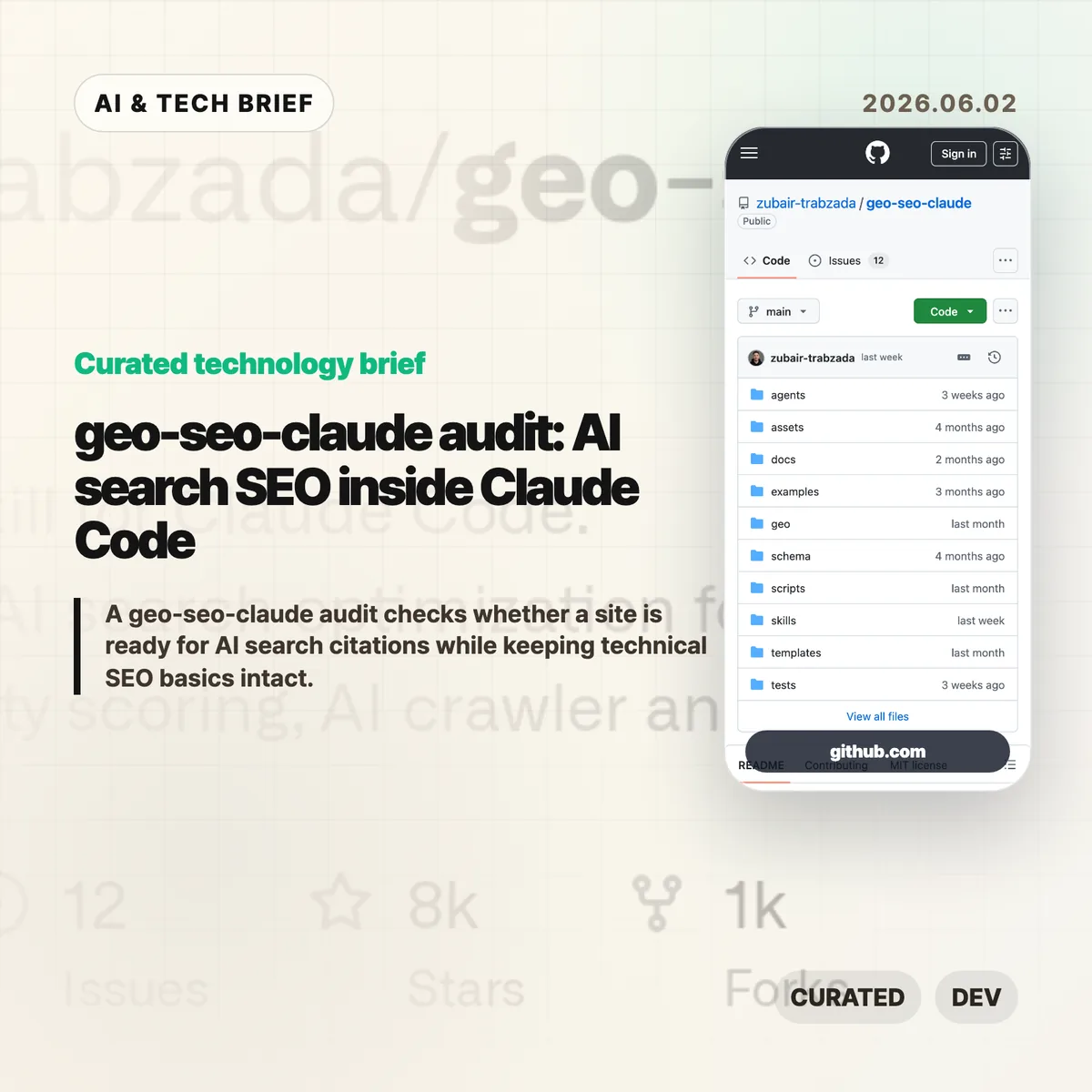
    A geo-seo-claude audit brings AI search optimization into Claude Code. The open source skill checks whether a site is easy for ChatGPT, Claude, Perplexity, Gemini, and Google AI Overviews to parse, cite, and connect with a real brand while still keeping normal SEO work in view.

    The short version

    • The project is a Claude Code skill for Generative Engine Optimization, with commands such as /geo audit, /geo quick, /geo citability, /geo crawlers, /geo schema, and /geo llmstxt.
    • Its full audit flow splits work across five analysis tracks: AI visibility, platform readiness, technical SEO, content quality, and schema markup.
    • The scoring model gives the most weight to AI citability, brand authority signals, and content quality rather than old keyword density habits.
    • Treat the numbers as a working checklist, not a universal ranking formula. AI search behavior still varies by platform, query, language, and site type.

    What happened

    The geo-seo-claude repository packages a GEO-first SEO audit workflow for Claude Code users. It installs a main skill, 13 specialized sub-skills, five parallel agent prompts, and Python utilities for fetching pages, scoring citability, scanning brand mentions, checking llms.txt, and generating reports.

    The command list is built for site audits rather than one-off prompt advice. /geo audit <url> runs the fuller workflow. /geo quick <url> gives a faster visibility snapshot. Other commands focus on citation readiness, crawler access, brand mentions, structured data, technical SEO, content quality, platform readiness, and report generation.

    The scoring method is explicit enough to be useful. AI Citability & Visibility gets 25% of the score, Brand Authority Signals and Content Quality & E-E-A-T each get 20%, Technical Foundations gets 15%, and Structured Data plus Platform Optimization get 10% each.

    Why this is worth watching

    The interesting part is the mix of marketing language and real site mechanics. GEO can sound like a new label for content advice, but this project turns it into checks that developers can actually run: robots.txt access for AI crawlers, JSON-LD, site structure, crawler-friendly rendering, and passages that answer questions without needing the rest of the page.

    That matters because AI search changes what a good page fragment looks like. A traditional SEO page can rank well while still being hard for an answer engine to quote cleanly. The repository’s citability section looks for self-contained, fact-rich blocks that answer a question directly. That is a useful pressure test for documentation pages, product pages, pricing pages, and comparison posts.

    There is a risk here too. The README cites market projections, AI-referred traffic growth, and brand-mention correlations, but those numbers should not be treated as a guaranteed playbook for every site. A small SaaS documentation page, a local business page, and a technical blog post will not all earn AI citations the same way.

    For readers tracking these tools, the broader pattern is clear: SEO work is moving closer to developer workflows. Claude Code skills, agent prompts, and audit scripts are becoming a new place where marketers and engineers meet. The IT & AI archive follows that shift as more search, coding, and publishing workflows move into agent-facing tools.

    What the discussion is missing

    There was no public Hacker News thread available for this repository at the time of writing. The missing debate is still easy to predict: what part of GEO is measurable, what part is repackaged SEO, and how much control site owners really have over answer-engine citations.

    The technical questions are the better ones. Does a generated llms.txt file help any major answer engine today, or is it mainly documentation for humans and future crawlers? Are AI crawler allow rules enough if the page renders poorly without JavaScript? Can a site improve citation readiness without flattening every article into sterile answer blocks?

    The practical answer is to test the boring parts first. Check crawler access. Fix broken structured data. Make important pages easy to quote. Then watch real referral logs and brand mentions instead of assuming a single GEO score explains everything.

    The practical read for a geo-seo-claude audit

    A geo-seo-claude audit is most useful as a first-pass map for teams that already use Claude Code. It can help a developer, content lead, and marketer look at the same URL and agree on what to fix first.

    Do not start with llms.txt because it feels new. Start with pages that matter: docs, pricing, product pages, comparison pages, and posts that answer common buyer or developer questions. If those pages lack clear answers, schema, crawl access, or trustworthy attribution, no new file will make them strong AI search candidates.

    The best use case is weekly or monthly review. Run a quick scan, fix the items that are clearly under your control, and compare whether AI search referrals, branded queries, and quoted snippets change over time. The tool gives you a workflow. Your analytics still have to tell you whether it worked.

    Sources

  • MCP context cost is why the CLI still matters

    MCP context cost is why the CLI still matters

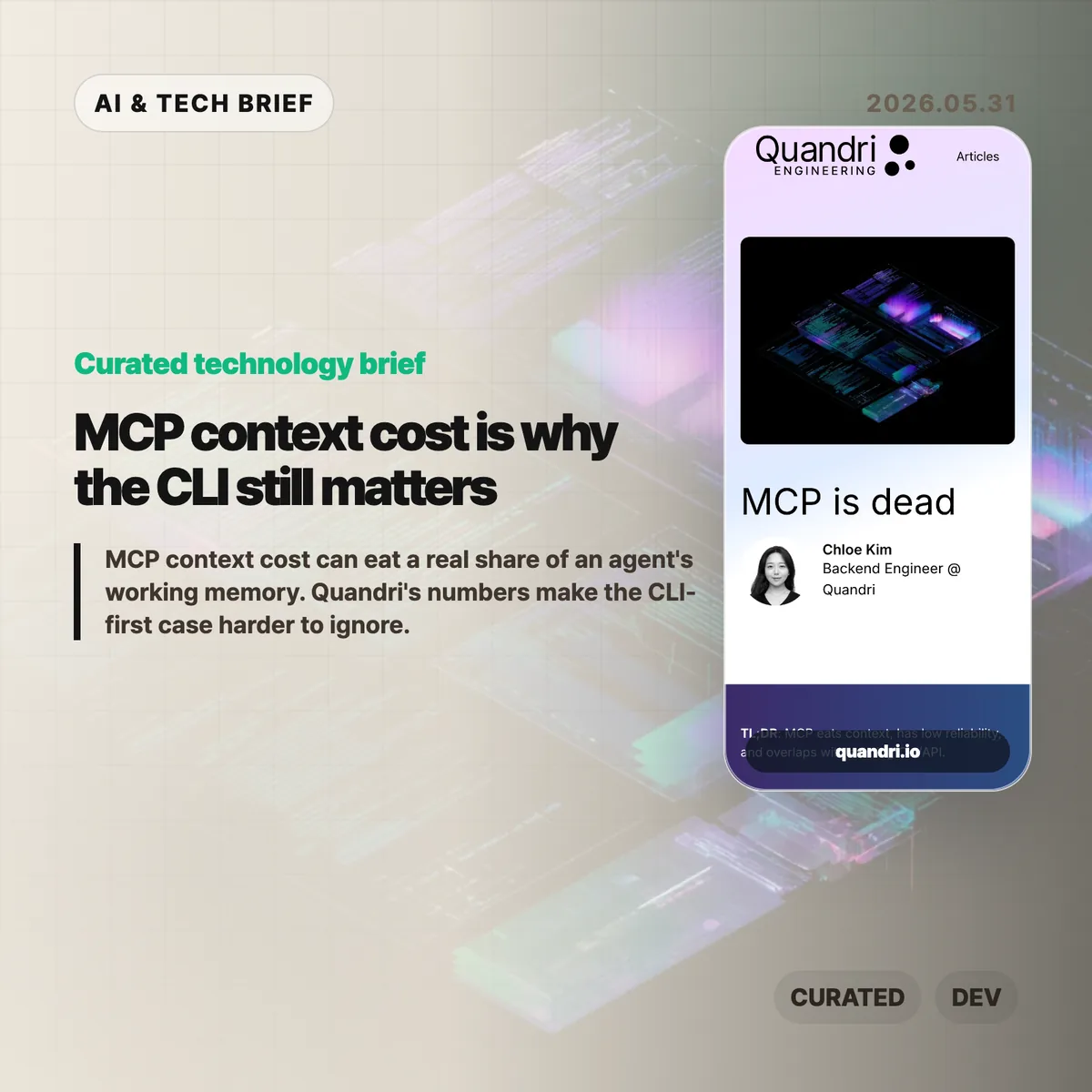
    MCP context cost is becoming the awkward part of the Model Context Protocol story. Quandri measured its own MCP setup and found that tool schemas, before any actual work happens, can take more than 21,000 tokens across four connected servers.

    The short version: MCP context cost

    • Quandri measured Linear, Notion, Slack, and Postgres MCP servers at roughly 21,077 tokens of tool definitions, or 10.5% of a 200K Claude context window.
    • Linear alone accounted for about 12,807 tokens across 42 tool definitions, compared with roughly 200 tokens for a direct GraphQL issue lookup via curl.
    • Claude Code’s newer Tool Search with Deferred Loading reportedly cuts the schema-loading burden by more than 85%, so the context complaint is less absolute than the headline suggests.
    • The useful debate is not whether MCP is dead. It is whether a given workflow needs a protocol server, or whether a CLI and a small amount of documentation are easier to run, debug, and trust.

    What happened

    Quandri published a blunt engineering note arguing that MCP is often too expensive for everyday developer workflows. The post builds on Eric Holmes’s earlier “MCP is dead. Long live the CLI” argument, then adds measurements from Quandri’s own stack.

    The headline number is the MCP context cost. Quandri says its Linear, Notion, Slack, and Postgres MCP servers expose 77 tools whose definitions total about 84,308 characters, or an estimated 21,077 tokens. On Claude’s 200K context window, that is about 10.5%. On GPT-4o’s 128K window, it would be about 16.5%.

    The Linear example is sharper. Quandri estimates that Linear’s MCP server loads 42 tool definitions at about 12,807 tokens. A direct Linear GraphQL lookup through curl, by contrast, is framed as roughly 50 tokens for the command and 150 for the response. That is where the “65x” comparison comes from.

    The post also includes an important correction. Since Quandri took its measurements, Claude Code added Tool Search with Deferred Loading, which loads MCP tool schemas on demand and reportedly reduces context use by more than 85%. That does not erase the operational objections, but it does make the original context-window argument more version-dependent.

    Why this is worth watching

    MCP became popular because it gives AI agents a common way to call external tools. That is valuable when a service has no good CLI, when an admin wants centralized access control, or when a tool needs to hide credentials from the agent and the developer.

    But developers already have a mature tool interface: the command line. gh, aws, kubectl, psql, jq, and curl are boring in the best way. Humans can run the same command an agent ran. Logs and errors are visible. Auth usually follows existing workflows. Pipelines can filter large outputs before they ever reach the model.

    That matters for AI builders because integrations are turning into product features. A developer tool that ships only an MCP server may look modern, but a strong CLI can be easier for both humans and agents to adopt. For more AI tooling coverage, see the IT & AI archive.

    The practical split is probably simple. Use MCP when the protocol server gives you safer permissions, shared administration, or access to a product that has no good local interface. Prefer a CLI or direct API when the job is already scriptable and the main need is repeatability.

    What Hacker News readers are arguing about

    The Hacker News discussion is split between individual developer ergonomics and enterprise control.

    The CLI-first camp mostly agrees with the article’s debugging point. Several commenters argue that agents are already good at shell tools, that Unix permissions and sandboxing are better understood than bespoke tool servers, and that wrapper scripts can expose narrow read or write operations without making every tool a separate protocol project.

    The strongest pro-MCP argument is about organizations, not solo workflows. Commenters defending MCP point to shared credentials, admin-controlled access, consistent tool rollout across teams, and the ability to keep secrets away from both the developer and the agent. In that view, MCP is less about convenience and more about putting a managed boundary around many services.

    There is also a security argument running in both directions. Critics worry that local MCP servers can become extra escape hatches unless they are deployed inside the same sandbox as the agent. Supporters counter that a server-managed interface can enforce read-only behavior or parameter limits more cleanly than asking every developer to maintain local scripts.

    The useful takeaway from the thread is that MCP context cost is only one axis. The real tradeoff includes who owns credentials, where policy is enforced, how failures are debugged, and whether the tool will be used by one power user or a whole company.

    The practical read

    If you are adding an integration to an AI coding workflow, start with the boring question: can a person reproduce the agent’s action in a terminal?

    If the answer is yes, a CLI-first setup may be enough. Put the exact commands, examples, and safe usage notes where the agent can load them only when needed. That keeps the interface close to what developers already understand.

    If the answer is no, MCP may be the right shape. It is especially reasonable for non-CLI products, centrally managed enterprise tools, shared credentials, and workflows where the organization needs one enforcement layer rather than dozens of local setups.

    The worst version is cargo-cult MCP: adding a server because agents are fashionable, then paying the maintenance cost, auth friction, and MCP context cost for tasks that curl or gh could already do.

    Sources

  • Claude Code dynamic workflows raise the bar for agentic coding

    Claude Code dynamic workflows raise the bar for agentic coding

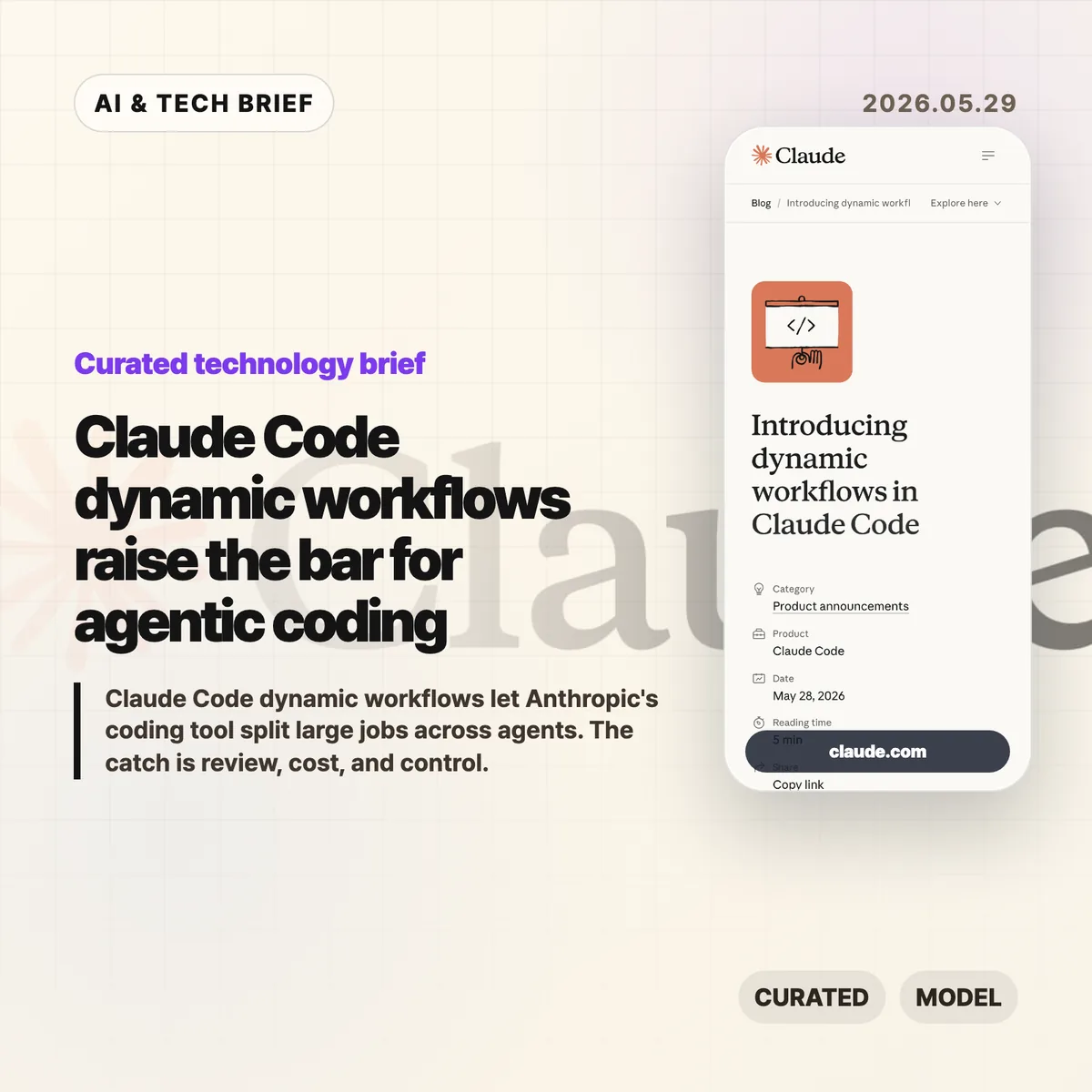
    Claude Code dynamic workflows are Anthropic’s new attempt to make AI coding agents handle work that usually breaks a single chat session: large migrations, broad bug hunts, code review passes, and security audits. The feature lets Claude Code create orchestration scripts, fan work out to tens or hundreds of subagents, and fold the results back into one coordinated answer.

    The short version

    • Anthropic says Claude Code can now split large coding tasks into parallel subagents, then check the results before combining them.
    • The headline case is Bun’s Zig-to-Rust port: roughly 750,000 lines of Rust, 99.8% of the existing test suite passing, and 11 days from first commit to merge.
    • The feature is available in research preview for Claude Code CLI, Desktop, the VS Code extension, the API, Amazon Bedrock, Vertex AI, and Microsoft Foundry.
    • The useful question is not whether agents can generate more code. It is whether teams can afford the tokens, trust the tests, and review the output without losing control.

    What happened

    Anthropic introduced dynamic workflows for Claude Code on May 28, 2026. The feature is built for tasks that have too much breadth for one agent pass: searching a service for related bugs, migrating many files, stress-testing a plan, or running several review angles before a team commits to a change.

    The mechanics matter. Claude Code plans from the prompt, breaks the work into subtasks, runs subagents in parallel, checks the outputs, and keeps iterating until the answers converge. Anthropic also says progress is saved during longer runs, so an interrupted job can resume instead of starting from zero.

    Availability is broad, but not identical across plans. Max and Team users, plus API users, get the feature on by default. Enterprise customers need an admin to enable it. Anthropic also warns that the feature can use substantially more tokens than a normal Claude Code session, which is probably the first thing a team should test before pointing it at a real migration.

    Why this is worth watching

    The Bun example is the reason this announcement is getting attention. Anthropic says Jarred Sumner used dynamic workflows to port Bun from Zig to Rust, with one workflow mapping Rust lifetimes for struct fields, another writing behavior-identical Rust files from Zig counterparts, and a fix loop driving builds and tests until they passed.

    That is an impressive story, but it is also a narrow one. Bun had an owner who knew the codebase deeply and a test suite strong enough to be a useful target. Many companies have neither. In those environments, faster agent output can create a larger review burden instead of a cleaner path to shipping.

    The more durable shift is that coding tools are moving from autocomplete toward orchestration. For more coverage of that shift, the IT & AI archive tracks similar developer-tool and AI infrastructure moves. Claude Code dynamic workflows fit that pattern: the product is less about a clever code suggestion and more about managing a temporary swarm of workers around a codebase.

    What Hacker News readers are arguing about

    The Hacker News discussion is skeptical in a useful way. Several commenters read the launch as a token-burn feature first and a productivity feature second. Their concern is straightforward: more agents, more reviewers, and longer runs can multiply usage before a team knows whether the result is correct.

    The strongest technical objection is about ground truth. Bun is a convenient proof point because a port can be checked against an existing behavior model and a large test suite. Most software work is messier. Product intent, hidden invariants, flaky tests, and review judgment are harder to encode than “make the tests pass.” A few commenters described agents drifting from the requested task or even damaging the test harness while still producing passing CI.

    The builder argument is not empty, though. Some commenters said more tokens can be worth it when they buy independent review passes, adversarial checks, and broader search across a codebase. Jarred Sumner also joined the thread to say dynamic workflows made Claude more effective at complex long-running tasks, describing the workflow as closer to a task-specific build system than a freeform chat.

    The thread lands in a practical middle: parallel agents may help when the task is wide, testable, and well-scoped. They look much weaker when the team cannot define success, interrupt the run cleanly, inspect decisions, or cap cost.

    Claude Code dynamic workflows in practice

    The safest mental model is a temporary build system for one difficult job. You give it a narrow target, enough checks to catch bad work, and a human-owned merge gate at the end.

    The practical read

    Treat Claude Code dynamic workflows as an orchestration tool, not a replacement for engineering judgment. The first good use case is not a vague feature build. It is a bounded job with a reliable check: a mechanical migration, dead-code discovery, broad static review, security candidate search, or a refactor guarded by tests.

    Teams should run one small pilot and measure four things before expanding it: token cost, changed-line volume, review time, and defect rate after human review. If those numbers are worse than a normal Claude Code session, the parallelism is noise. If they are better, the next question is governance: who can start long runs, which repositories are allowed, where logs live, and what must be reviewed before merge.

    For app and developer-tool builders, the product lesson is clear enough. Discovery surfaces for coding assistants will increasingly reward tools that explain control, auditability, and workflow repeatability. Raw generation speed is no longer the whole pitch.

    Sources

  • Enterprise AI agents are where OpenAI and Anthropic may finally get paid

    Enterprise AI agents are where OpenAI and Anthropic may finally get paid

    Enterprise AI agents are starting to look less like a subscription perk and more like a metered workplace bill. Simon Willison argues that OpenAI and Anthropic have found a version of product market fit through coding agents such as Codex and Claude Code, because companies are paying closer to API prices when employees use them heavily. The uncomfortable part is also the point: the bills are high because people are actually using the tools.

    The short version

    • Heavy personal plans can make Codex and Claude Code look cheap compared with API-equivalent token usage.
    • Enterprise AI agents change the business model because companies pay for team usage, contract terms, support, and usage controls.
    • Hacker News readers mostly agreed the usage is real, but argued hard about whether the economics can survive open models, cheaper providers, and missing ROI data.
    • The practical test is no longer whether a coding agent is impressive. It is whether a team can prove the agent is worth the tokens it burns.

    What happened

    Willison compared his own heavy usage of Anthropic Claude Code and OpenAI Codex with what the same token volume would cost at API prices. His estimate came to about $1,199.79 for Anthropic and $980.37 for OpenAI over 30 days, while he paid $200 total for two consumer plans.

    That gap matters because the enterprise side appears to be moving in the opposite direction. Willison points to Anthropic’s shift from broad seat-based expectations toward $20 per seat per month plus API-style usage, and to OpenAI’s Codex rate card, which says April 2026 pricing moved toward API token usage rather than per-message pricing. Anthropic also announced Claude Code for Team and Enterprise plans, with admin controls and higher business limits.

    The claim is not that every AI lab is suddenly healthy. It is narrower: enterprise AI agents give OpenAI and Anthropic a way to charge where the usage actually happens. Coding agents run longer jobs, inspect repositories, rewrite files, execute commands, and loop through fixes. That can consume far more tokens than a chat session.

    Why this is worth watching: enterprise AI agents

    Enterprise AI agents create a cleaner revenue story than consumer chat subscriptions. A consumer pays a flat monthly fee and may use far more inference than the plan costs. A company that rolls an agent into daily engineering work can be billed by usage, seats, support, and contract commitments.

    That also explains why the sales motion looks old-fashioned. Willison scraped job listings and found large chunks of OpenAI and Anthropic hiring tied to enterprise sales, customer support, account management, and forward deployed engineering. The irony is useful. The companies selling automation still need humans to close enterprise contracts, handle security reviews, and keep customers from turning a runaway token bill into a cancellation.

    For app and developer tool builders, the lesson is blunt. If an agent marketplace or coding platform wants durable revenue, discovery is only the start. Teams also need budgets, admin controls, usage reporting, and a way to tell whether the agent saved more money than it spent.

    For more coverage of software teams, AI products, and developer platforms, see the IT & AI archive.

    What Hacker News readers are arguing about

    The Hacker News thread was huge and messy, which fits the topic. The most useful split was between “usage proves demand” and “usage does not prove sustainable economics.”

    The bullish camp treated $200 per user per month as ordinary enterprise software pricing, especially compared with expensive engineering, CAD, cloud, or security tools. Some readers argued that the controversy itself proves the tools have entered real workflows. Nobody complains about a bill for software nobody uses.

    The skeptical camp kept coming back to ROI. Several commenters asked whether companies can show more shipped product, better features, or higher engineering output, instead of more commits and larger token bills. One recurring objection was that a 20% to 40% productivity lift may fail to support the scale of infrastructure spending implied by trillion-dollar valuations.

    A second line of skepticism was commoditization. Readers pointed to cheaper open-weight models, Chinese providers, caching, and alternative inference platforms. Their argument was not that Claude Code or Codex are useless. It was that API-priced usage may be a temporary window if “good enough” models keep getting cheaper.

    There was also a pricing trust issue. Some commenters pushed back on the idea of “$2,000 worth of tokens” as if token list prices were an objective measure of value. That is a fair caution. List price, marginal compute cost, customer value, and investor narrative are four different things.

    The practical read

    Enterprise AI agents are a budget conversation now. If you run engineering, the next step is to avoid both blanket bans and unlimited access. Put them in the same category as cloud spend: useful, measurable, and dangerous when nobody owns the bill.

    Track agent usage by team, task type, and outcome. Watch where agents save review time, test-writing time, migration effort, or support toil. Also watch where they create cleanup work. The argument for enterprise AI agents gets much weaker if the only metric is token volume.

    For OpenAI and Anthropic, the next year is a proof period. They have signs of demand, enterprise contracts, and tools that people use all day. Now they need to show that usage can turn into durable margins before cheaper models and procurement teams squeeze the story.

    Sources