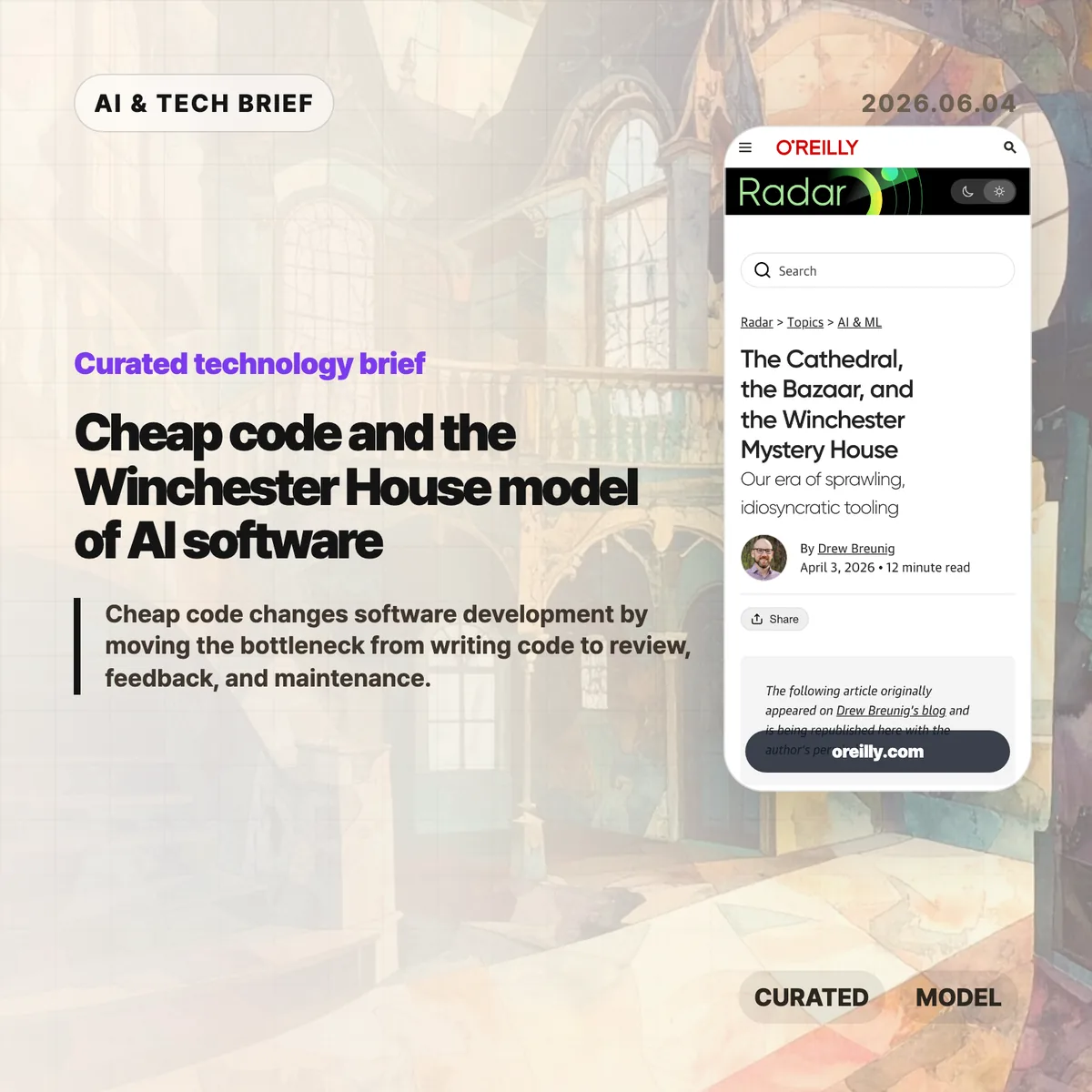
Cheap code changes software development by making implementation feel abundant while review, feedback, and maintenance stay scarce. In an April 3, 2026 O’Reilly Radar essay, Drew Breunig argues that AI coding agents are creating a third software model: personal, sprawling tools that look less like cathedrals or bazaars and more like the Winchester Mystery House. His examples include Claude Code activity, open source contribution pressure, and personal agent stacks that grow faster than teams can explain them.
Table of Contents
The short version
- O’Reilly frames AI-era development as a “Winchester Mystery House” model in an April 3, 2026 essay about sprawling personal tools.
- Breunig cites Claude Code activity reaching about 1,000 net lines per commit, a number that makes review speed more important than raw output.
- The useful warning is not that AI code is bad. Feedback, review, product judgment, and long-term ownership have not become cheap at the same pace.
- Open source is unlikely to disappear, but maintainers may face more agent-written pull requests, thin context, and resume-padding contributions.
- The business angle is boring infrastructure: testing, security, review, dependency management, and maintainability tools that developers do not want to rebuild alone.
What happened
O’Reilly Radar republished Drew Breunig’s essay, “The Cathedral, the Bazaar, and the Winchester Mystery House,” on April 3, 2026. The piece updates Eric S. Raymond’s 1998 contrast between the cathedral model of closed, planned software and the bazaar model of open, networked collaboration.
Breunig’s third model starts from a simple claim: the internet made coordination cheaper, while AI coding agents make implementation cheaper. He cites Claude Code activity and says one example line had reached about 1,000 net lines per commit. That number matters less as a benchmark than as a stress test. If writing code gets faster than understanding code, teams do not automatically get cleaner products. They get more software to judge.
The essay uses personal agent stacks, open source maintenance pressure, and the Winchester Mystery House itself to describe a world where developers keep extending tools around their own taste. The house had roughly 160 rooms when it became a tourist attraction, after peaking at far more. The software version can be useful and clever, but outsiders may struggle to find the plan.
Why cheap code is worth watching
Cheap code is worth watching because it changes the constraint in software work. According to O’Reilly Radar, Breunig compares AI coding agents with the internet’s role in open source: the internet made coordination cheaper, while tools such as Claude Code make implementation cheaper. That switch moves the bottleneck from typing to judgment.
A developer can now ask an agent to scaffold features, rewrite chunks of code, or glue together APIs with less friction than before. The harder part is what happens after the code exists. Someone still has to decide whether the feature should exist, whether the implementation is safe, whether the tests cover the risky parts, and whether another human can maintain it six months later.
Breunig’s essay puts this plainly: the fastest feedback loop is often the developer using their own tool. That works well for personal automation. It gets risky when the same habits enter shared products. For readers who follow developer tooling, the next durable products may be review, search, testing, and safety systems rather than another code generator. The broader IT & AI archive is tracking that shift across coding agents, AI infrastructure, and software workflow products.
What does cheap code change for builders?
Cheap code pushes builders toward personal software first. A founder, engineer, or internal tools lead can now make a workflow-specific app that would have been too annoying to justify a year ago. In practice, that favors prototypes, back-office automation, research tools, and tiny utilities that never deserved a full product roadmap.
The trade-off is ownership. A tool that works for one developer can become a maintenance trap when it spreads to a team. Personal context does not transfer automatically. Naming, documentation, tests, access control, data retention, and rollback plans still need human discipline. Teams that adopt AI coding agents should measure more than output volume. Better operating metrics include review time, defect rate, test coverage, duplicated code, and how often generated features are removed after 30 or 90 days.
App builders and extension developers should also read this as an ASO and marketplace warning. If anyone can build a personal tool, discovery gets noisier. The products that win may be the ones that explain their constraints clearly and handle the unfun parts better than a weekend agent script.
What Hacker News readers are arguing about
The Hacker News discussion linked from the O’Reilly essay is older than the current AI coding wave, but it explains why lines of code are a weak productivity metric. The thread starts from the Mythical Man-Month claim that a developer may average around 10 lines of code per day. One widely cited comment by Redis creator Salvatore Sanfilippo estimates his own Redis output at roughly 29 lines per day over a decade, after accounting for rewriting and bug fixing.
The useful disagreement is about what counts as production. Some commenters point out that greenfield work can produce hundreds of lines in a day, while debugging, refactoring, and design work may produce almost no net lines. Others compare software to repair work: replacing a bolt is easy, knowing which bolt to replace is the skill.
That makes the O’Reilly argument sharper. If Claude Code can produce around 1,000 net lines per commit in the example Breunig cites, the number is impressive only until it hits the old constraint. More lines still need taste, review, deletion, and responsibility. The Hacker News thread is not evidence about AI agents, but it is a useful reminder that code volume has always been a poor proxy for software value.
The practical read
Teams should treat cheap code as a capacity change, not a quality guarantee. The practical move is to pair AI coding agents with stricter review paths: automated tests before merge, smaller diffs, named owners, and clear rollback plans. Use agents where the feedback loop is short: prototypes, migrations, tests, scripts, documentation drafts, and personal workflow tools. Be more conservative when the work touches security, billing, permissions, production data, or shared architecture.
For open source maintainers, the article points to a near-term process problem. Projects may need contribution templates that ask for evidence, automated triage that filters low-context pull requests, and policies that let maintainers reject generated churn quickly. The goal is not to block AI-assisted contributors. It is to make contributors bring the context that maintainers actually need.
For tool companies, the opportunity sits around the boring parts. Developers may enjoy building their own stained-glass windows. They still want someone else to make the plumbing reliable.