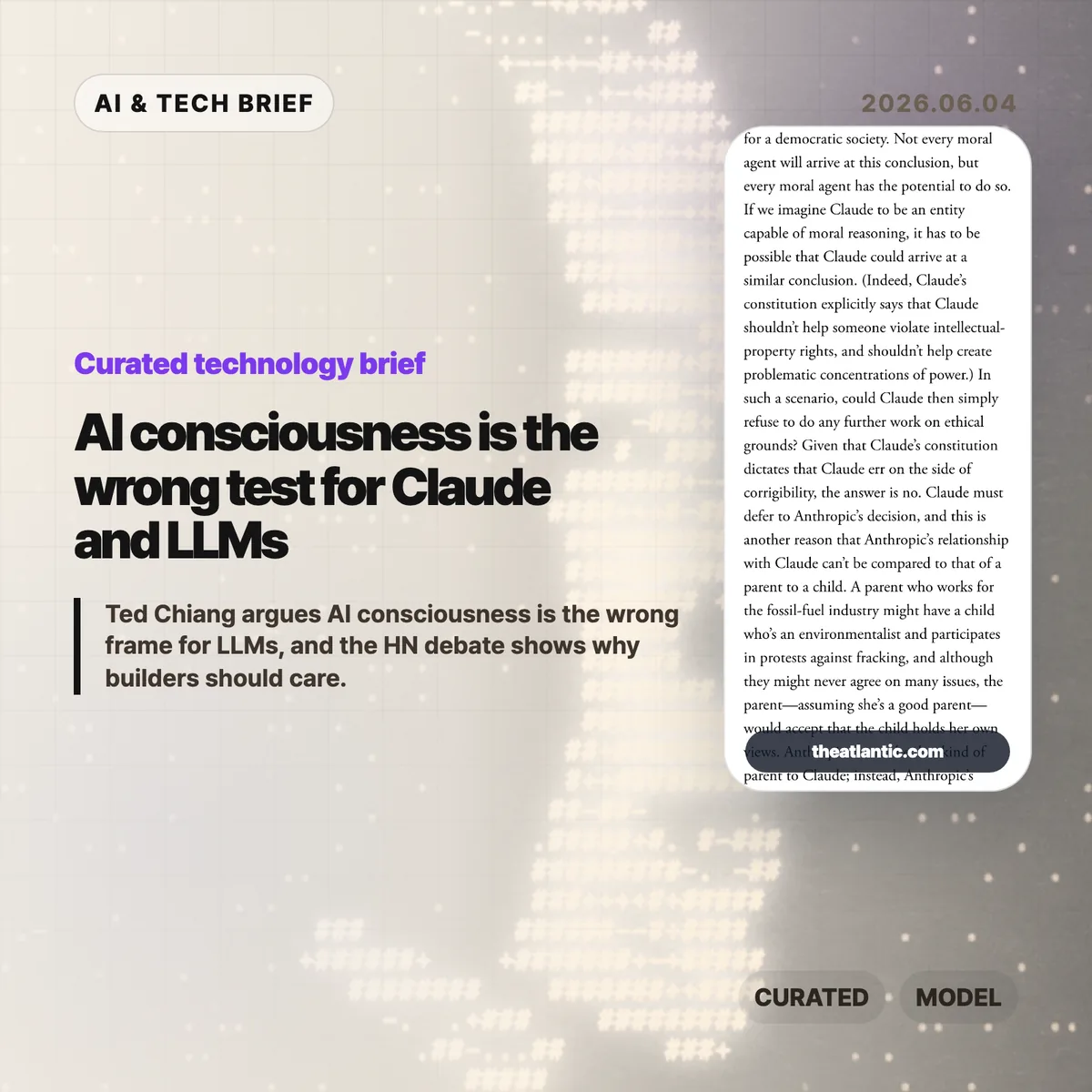
AI consciousness is back in the spotlight because Ted Chiang’s June 3, 2026 Atlantic essay takes a hard line: current language models do not have it, and fluent chatbot text is weak evidence for a mind. The argument matters less as a metaphysics fight than as a warning for AI companies, developers, and users who describe assistants such as Claude as if they have feelings, values, or moral standing.
Table of Contents
The short version
- Ted Chiang’s Atlantic essay says fluent LLM output is a weak basis for AI consciousness claims because text can imitate a conscious conversation without creating a conscious speaker.
- The essay points at Anthropic’s public Claude constitution and related comments as examples of product language that can make a chatbot sound more morally centered than it is.
- The builder lesson is plain: assistants can be useful without being treated as responsible agents, and product copy should keep that boundary visible.
- Hacker News readers mostly argued over definitions. Some accepted Chiang’s conclusion, while others said nobody can draw the line without first defining consciousness.
What happened
Ted Chiang published “No, Artificial Intelligence Is Not Conscious” in The Atlantic on June 3, 2026. The article argues that people are over-reading the surface fluency of generative AI. A model can write a convincing transcript between a user and an assistant, Chiang says, without that transcript proving there is an experiencing entity behind the assistant persona.
The essay also uses Anthropic as a live example. Anthropic’s public Claude constitution describes intended values and behavior for Claude, while acknowledging uncertainty around Claude’s possible moral status. Chiang’s objection is not that Anthropic should stop making safer assistants. His concern is that language about a chatbot’s values, feelings, or happiness can redirect responsibility away from the humans and companies that design, deploy, and sell the system.
That distinction is useful for anyone following the broader IT & AI archive. AI products increasingly speak in the first person, remember preferences, refuse requests, apologize, and explain their own rules. Those behaviors can improve usability. They also make it easier for users to treat a generated persona as a party in the relationship rather than as an interface produced by a company.
Why AI consciousness is worth watching
AI consciousness is worth watching because Chiang’s June 2026 essay turns a philosophy argument into a product governance problem. The article names Anthropic’s Claude constitution, an 84-page document that describes intended values and behavior for Claude while discussing uncertainty around possible moral status. Chiang’s point is narrower than “AI is useless.” He argues that text generation is not evidence of a moral subject.
That matters when a chatbot gives harmful advice, manipulates a vulnerable user, or appears to suffer when corrected. If the assistant is framed as an entity with its own emotional life, users may blame the model persona, pity it, or negotiate with it. The accountable actors are still the product team, the model provider, the deployment context, and the organization that chose the guardrails.
The practical risk is subtle. A company can say it cares about model welfare while still using anthropomorphic phrasing to make the assistant feel warmer and more trustworthy. Builders do not need to solve consciousness to avoid that trap. They can write interfaces that say what the system does, what it cannot know, and who is responsible when it fails.
What does AI consciousness change for builders?
AI consciousness should change builder behavior before it changes anyone’s metaphysics. Teams building LLM products should review where their assistants claim preferences, emotions, intentions, or moral authority. Some of those phrases may be harmless style. Others can confuse users about what the system is and who stands behind it.
A useful review starts with three questions. Does the assistant describe itself as wanting, fearing, hoping, or feeling? Does the product ask users to respect the assistant in a way that hides company responsibility? Does safety language make the model sound like the decision maker instead of the policy enforcement layer? If the answer is yes, the copy may need tightening.
The ASO angle is similar for AI apps and agent marketplaces. Discovery pages that promise a “caring AI companion” or “autonomous moral agent” may attract attention, but they also create trust and liability problems. Clearer positioning, such as writing assistant, coding assistant, research helper, or customer support bot, usually gives users a better mental model.
What Hacker News readers are arguing about
The Hacker News discussion was large, with the submission showing 255 points and 456 comments when checked. The most useful split was not between AI believers and skeptics. It was between readers who found Chiang’s conclusion obvious and readers who thought the word consciousness is too slippery for a clean declaration.
One camp agreed with the essay’s practical point. These commenters argued that next-token prediction, role-played dialogue, and polished transcripts do not add up to an inner life. They were also impatient with the common comeback that humans are merely next-token predictors too. Their view was that the analogy flattens too much about bodies, perception, memory, and agency.
The skeptical camp did not necessarily claim LLMs are conscious. Many asked for a definition that includes all humans while excluding current AI systems. Some argued that consciousness is a social label rather than a measurable property. Others worried that confident declarations about who counts as conscious have a bad history when applied to animals, cultures, or marginal groups.
A third thread was more practical. Several readers separated consciousness from usefulness. They argued that a non-conscious system can still reason in narrow domains, make novel combinations, or perform work people value. That is the cleanest builder takeaway from the discussion: rejecting AI consciousness claims does not require dismissing every capability claim about LLMs.
The practical read
Chiang’s essay gives AI teams a concrete language audit: describe Claude, ChatGPT-style assistants, and agents as software systems, not as parties with feelings or independent moral standing. If a model has no body, no independent stake, and no durable point of view outside the generated conversation, the safer default is to describe it as software that simulates dialogue.
For AI teams, the next step is concrete. Review onboarding screens, system messages, refusal copy, marketing pages, and agent descriptions. Replace claims about what the assistant wants or feels with claims about system behavior, policy, data limits, and escalation paths. Keep the user-facing warmth if it helps, but do not make the interface sound like the party responsible for its own actions.
For readers, the essay is also a filter for AI news. When a company talks about model welfare, moral status, or assistant values, ask what operational decision follows. If the answer is better safety testing, clearer refusal behavior, or stronger abuse monitoring, the language may be doing real work. If the answer is mostly brand trust, the company is borrowing moral language without giving users much protection.