Tag: Developer Tools

  • nice nano wireless keyboard: a dorm-room board that found a real market

    nice nano wireless keyboard: a dorm-room board that found a real market

    The nice nano wireless keyboard board is a good reminder that a hardware product does not need a huge category to become meaningful. Nick Winans built a Pro Micro-compatible wireless controller as a college freshman, sold the first 1,000 units in seven hours, and later saw more than 50,000 boards move through the custom keyboard world.

    The short version

    • The product worked because it fit the Pro Micro footprint that many DIY keyboard designs already expected.
    • The first group buy sold 1,000 units in seven hours, but the experience convinced Winans not to keep using preorder funding.
    • ZMK firmware turned the board from a clever part into a more complete wireless keyboard platform.
    • The bigger lesson is distribution: Reddit, Discord, vendors, and Typeractive made a tiny niche easier to buy into.

    What happened

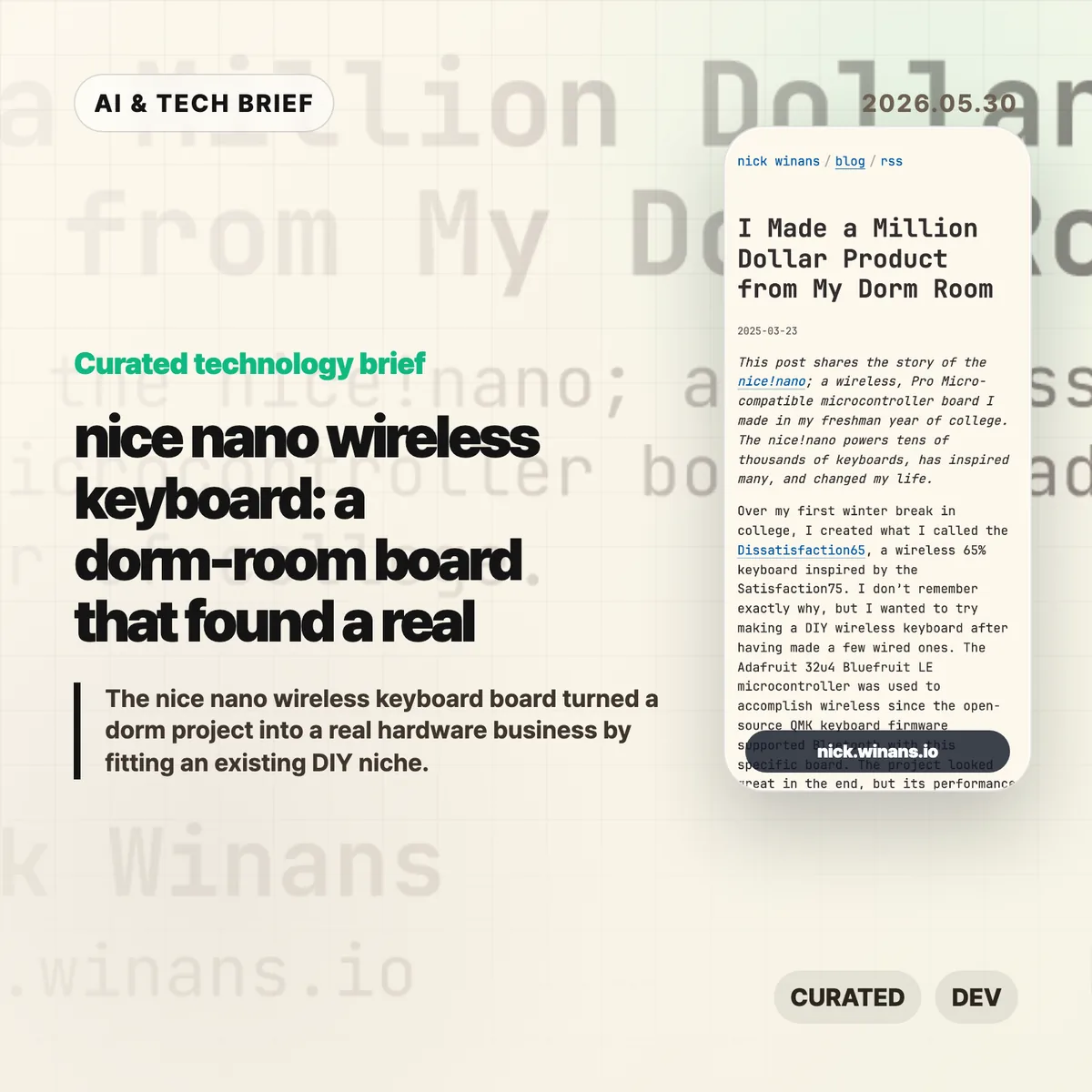
    Winans started with a failed wireless keyboard project called the Dissatisfaction65. It looked good, but the typing latency was poor and the battery lasted only a few days even with a large battery. That pushed him toward Nordic chips, the Pro Micro form factor, and the gap between commercial wireless keyboards and the DIY keyboard scene.

    The nice nano wireless keyboard board came out of that search. Winans designed the first version over a weekend using KiCad, Nordic documentation, the nRFMicro wiki, and Adafruit’s nRF52840 Feather schematic. The result was a thin nRF52840 board that could drop into many keyboard builds designed around a Pro Micro.

    The early proof was practical. He built a Lily58 with the boards and saw weeks of battery life from a 110mAh battery. A Reddit post drew interest, the Discord community grew, and the first group buy sold out its 1,000-unit cap within seven hours. The order still created stress: customer money arrived before the physical product did, PayPal held funds, and fulfillment became a family operation.

    From there, the project became a small ecosystem. ZMK gave wireless keyboard builders a stronger firmware path. Vendors started carrying the board. In 2022, Winans and his family launched Typeractive, a store built around wireless split keyboard kits and a 3D configuration tool that helped buyers choose the right parts.

    Why this is worth watching

    The useful part of this story is not the dorm-room mythology. It is the constraint. Winans did not ask buyers to adopt a new keyboard architecture. He made the wireless part fit where the community already expected a controller to fit.

    That is a product lesson software teams often forget. A niche can be small and still be serious if the pain is specific, the buyers talk to each other, and the product slips into an existing workflow. For more technology briefs like this, the IT & AI archive keeps a running set of builder-focused stories.

    The nice nano wireless keyboard story also shows the tradeoff in open hardware. Public schematics and community firmware helped the board spread, but they also made cloning easier. Winans says clones appeared on Taobao and AliExpress, including products advertised as nice!nanos and shipped with the same firmware identity. That is not a clean win or loss. It is the usual bargain: openness can create trust and distribution, then force a founder to compete on quality, brand, support, and buying experience.

    nice nano wireless keyboard lesson

    The repeatable pattern is compatibility first, then community, then purchasing help. That order made the board easier to try and easier to recommend.

    What Hacker News readers are arguing about

    The Hacker News discussion is less about the circuit board and more about whether niche products can still make good businesses. Several commenters liked the simple framing: make something a small group badly wants, then reach that group directly. Others pushed back on the idea that any niche works. Their point was that 50,000 reachable, solvent, motivated buyers is rare, and finding them is often the hard part.

    Winans joined the thread and gave the most useful detail. He credited timing, a Reddit post during the early Covid period, fast community work in Discord, frequent updates, and a quick move into vendor storefronts. In other words, luck helped, but he also converted attention into a channel before it faded.

    The skeptical thread was about compliance and clones. Some readers asked about FCC obligations for an intentional radiator. Others argued that small hardware makers face a harsh choice between regulatory cost and shipping a product before the market is proven. The clone discussion split in a similar way: trademark enforcement may be possible in some channels, but cross-border hardware copying is rarely a neat problem.

    The most practical comments came from keyboard users. A few said they owned multiple boards, which explains why a part that sounds impossibly narrow can still sell in volume. A wireless split keyboard often needs two controllers, and hobbyists rarely stop at one build.

    The practical read

    If you are building a niche hardware product, the nice nano wireless keyboard case points to three tests. Does it fit an existing standard? Can buyers explain the pain to each other without your sales deck? Can a first-time buyer get from interest to a working build without getting lost?

    The board passed those tests better than most hobby projects. The Pro Micro footprint lowered adoption friction. ZMK made the firmware story credible. Typeractive reduced the shopping problem. None of that removes the ugly parts of hardware: cash timing, fulfillment, certification, clones, support, and inventory. It does explain why a small board could become a real business.

    For app and product builders, the discovery angle is similar. The 3D kit configurator was not decoration; it helped people assemble the right purchase. In a niche market, the buying path can be as important as the product spec.
    Sources

  • AudioMass web audio editor adds browser multitrack

    AudioMass web audio editor adds browser multitrack

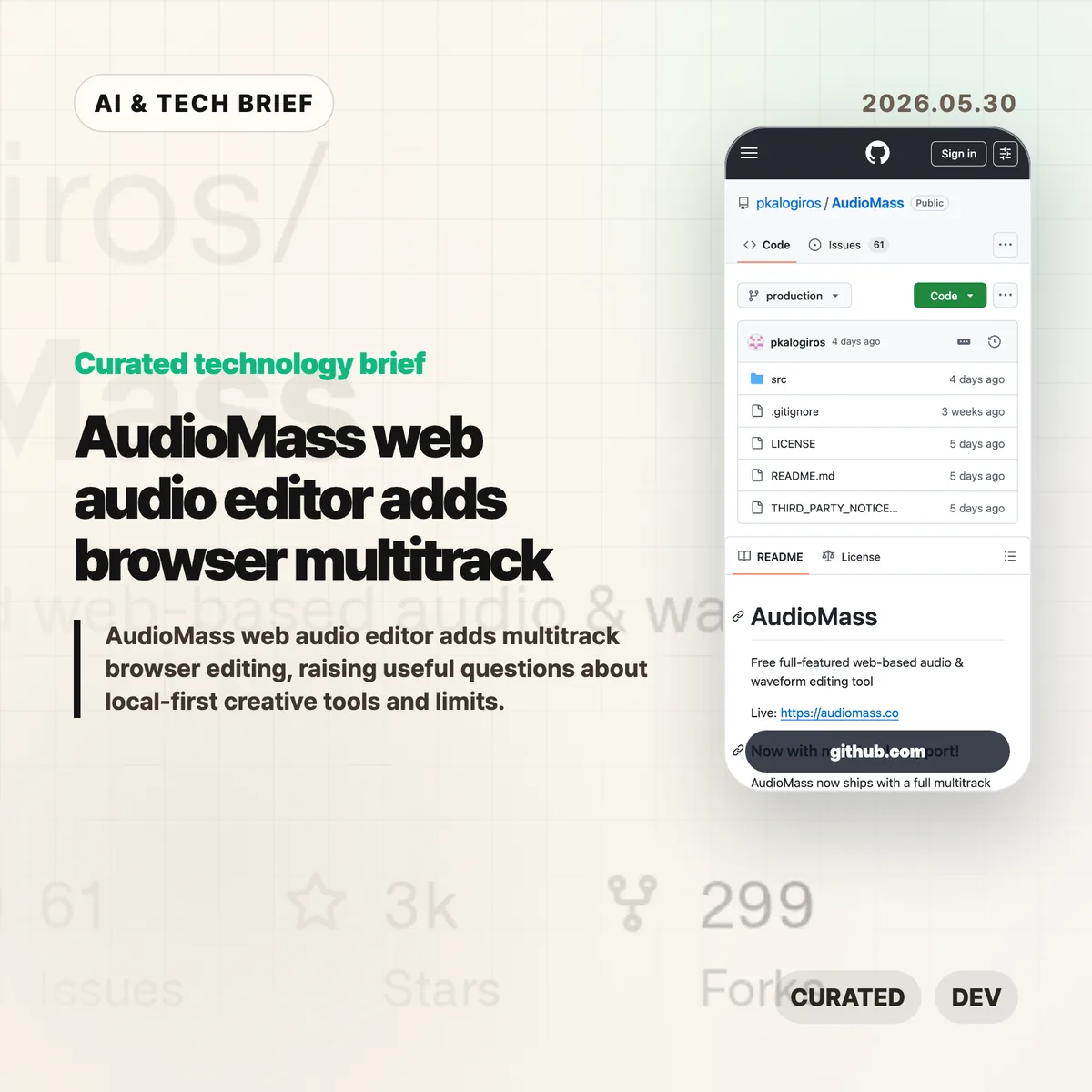
    The AudioMass web audio editor is a free browser-based tool for editing waveforms, applying effects, and now arranging multiple tracks without installing a desktop app. The interesting part is the product boundary: it treats the browser as the workspace, while keeping many audio jobs local to the user’s machine.

    The short version

    • AudioMass is a free web audio and waveform editor with a live browser version and an open GitHub repository.
    • Its newer multitrack mode lets users layer clips, drag tracks around, crossfade overlaps, record armed channels, and bounce a session to one file.
    • The tool fits quick edits, podcast clips, voice notes, samples, and rough arrangements better than heavy studio sessions.
    • The limits are real: browser memory, mobile audio behavior, autosave, large projects, and specialized DAW features still matter.
    • For builders, the AudioMass web audio editor is a useful example of a local-first creative app that can be found and used from a URL.

    What happened

    AudioMass describes itself as a “free full-featured web-based audio & waveform editing tool.” The live app runs at audiomass.co, and the GitHub repository points to a newer multitrack mode with layered tracks, draggable clips, crossfades, recording onto armed channels, and mixdown export.

    The project is written mostly in JavaScript and has been public since 2018. GitHub showed about 2,700 stars and roughly 300 forks when checked for this brief. The README also notes a local development path using either a small Go server or a Python web server, which makes the project easier to inspect than a closed online editor.

    This sits in a familiar category for web tools: the job used to require a desktop download, but the first useful version now loads in a tab. The same pattern already changed design tools, code editors, and image utilities. Audio editing is harder because timing, buffers, latency, file size, and crash recovery are less forgiving.

    Why this is worth watching

    The AudioMass web audio editor is useful because it does not ask every user to sign in, upload media, or wait for a server-side render before trimming a clip. That matters for small audio jobs. A creator can open a file, clean up a voice note, add a fade, export, and move on.

    It also points to a cleaner product model for some creative apps. Local-first browser tools can reduce hosting cost and privacy risk because files do not have to leave the device for basic edits. That is not a magic fix. The browser still owns the runtime, and audio workloads expose every weak spot in memory handling, mobile support, and background storage.

    The multitrack update is the bigger signal. Once a browser tool can handle layered tracks and session export, it starts to compete for the casual work that used to default to Audacity or a lightweight DAW. Readers following browser apps and creative tooling can find related coverage in the IT & AI archive.

    What Hacker News readers are arguing about

    The Hacker News discussion around the newer multitrack release was mostly positive, but the useful comments were practical rather than hype. Several readers compared AudioMass with Audacity, Ocenaudio, Ardour, and web ports such as Wavacity. The common praise was speed, a calmer interface, and the convenience of opening an editor from a link.

    The technical thread focused on limits. The creator said there is no hard track limit in the multitrack view, but the current waveform boxes are rendered with DOM elements, so very large sessions may slow down. WebGPU came up as a possible future direction. Another answer put the JavaScript payload around 98 KB plus about 10 KB of CSS, up from an older 65 KB single-editor version after adding FLAC support, tempo estimation, and multitrack mode.

    Commenters also pushed on project size and reliability. One asked what happens when the browser crashes. The creator said multitrack sessions can be exported as .amss files with settings, markers, and tracks, while a single-track crash can still lose work. IndexedDB caching exists, but the author was cautious about automatic storage because browsers make local persistence tricky and easy to abuse.

    The strongest skeptical point was scope. MIDI, VST support, stem-bundle imports, cloud collaboration, and version control for music all came up. Those are fair asks, but they also describe a much larger product. The practical read from the thread is that AudioMass looks compelling as a fast audio editor in a tab, not as a full studio replacement yet.

    The practical read

    If you edit a short voice clip once a week, try the AudioMass web audio editor before opening a heavier desktop app. It is the kind of tool that can save five minutes without becoming a new workflow.

    If you build creative software, the lesson is sharper. Browser-first does not mean cloud-first. For audio, keeping files local can be a feature, especially when users are handling interviews, music sketches, or private recordings. The product work then moves to the hard parts: autosave, large-file behavior, mobile playback, accessible controls, and clear expectations about what happens when the tab dies.

    For app and extension developers, this is also a discovery story. A small, fast creative tool with a public demo, open repository, and lightweight footprint has a better shot at being shared than another account-gated utility. The browser is the distribution surface.

    AudioMass web audio editor notes

    The useful way to frame this product is narrow: fast browser editing for real files, with enough multitrack support to handle simple layered work. That is already valuable, and it leaves room for heavier DAWs to own serious production.

    Sources

  • Claude Code dynamic workflows raise the bar for agentic coding

    Claude Code dynamic workflows raise the bar for agentic coding

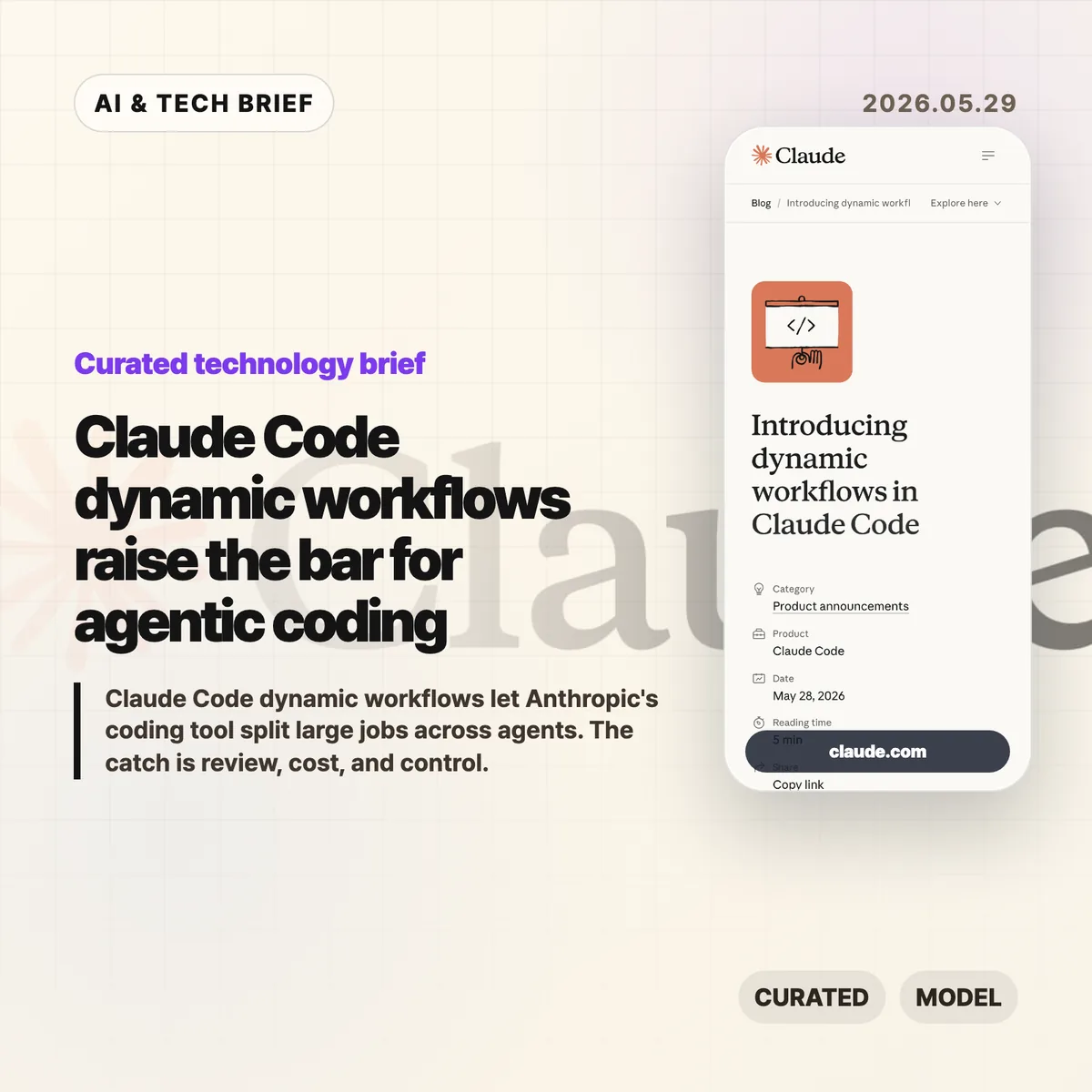
    Claude Code dynamic workflows are Anthropic’s new attempt to make AI coding agents handle work that usually breaks a single chat session: large migrations, broad bug hunts, code review passes, and security audits. The feature lets Claude Code create orchestration scripts, fan work out to tens or hundreds of subagents, and fold the results back into one coordinated answer.

    The short version

    • Anthropic says Claude Code can now split large coding tasks into parallel subagents, then check the results before combining them.
    • The headline case is Bun’s Zig-to-Rust port: roughly 750,000 lines of Rust, 99.8% of the existing test suite passing, and 11 days from first commit to merge.
    • The feature is available in research preview for Claude Code CLI, Desktop, the VS Code extension, the API, Amazon Bedrock, Vertex AI, and Microsoft Foundry.
    • The useful question is not whether agents can generate more code. It is whether teams can afford the tokens, trust the tests, and review the output without losing control.

    What happened

    Anthropic introduced dynamic workflows for Claude Code on May 28, 2026. The feature is built for tasks that have too much breadth for one agent pass: searching a service for related bugs, migrating many files, stress-testing a plan, or running several review angles before a team commits to a change.

    The mechanics matter. Claude Code plans from the prompt, breaks the work into subtasks, runs subagents in parallel, checks the outputs, and keeps iterating until the answers converge. Anthropic also says progress is saved during longer runs, so an interrupted job can resume instead of starting from zero.

    Availability is broad, but not identical across plans. Max and Team users, plus API users, get the feature on by default. Enterprise customers need an admin to enable it. Anthropic also warns that the feature can use substantially more tokens than a normal Claude Code session, which is probably the first thing a team should test before pointing it at a real migration.

    Why this is worth watching

    The Bun example is the reason this announcement is getting attention. Anthropic says Jarred Sumner used dynamic workflows to port Bun from Zig to Rust, with one workflow mapping Rust lifetimes for struct fields, another writing behavior-identical Rust files from Zig counterparts, and a fix loop driving builds and tests until they passed.

    That is an impressive story, but it is also a narrow one. Bun had an owner who knew the codebase deeply and a test suite strong enough to be a useful target. Many companies have neither. In those environments, faster agent output can create a larger review burden instead of a cleaner path to shipping.

    The more durable shift is that coding tools are moving from autocomplete toward orchestration. For more coverage of that shift, the IT & AI archive tracks similar developer-tool and AI infrastructure moves. Claude Code dynamic workflows fit that pattern: the product is less about a clever code suggestion and more about managing a temporary swarm of workers around a codebase.

    What Hacker News readers are arguing about

    The Hacker News discussion is skeptical in a useful way. Several commenters read the launch as a token-burn feature first and a productivity feature second. Their concern is straightforward: more agents, more reviewers, and longer runs can multiply usage before a team knows whether the result is correct.

    The strongest technical objection is about ground truth. Bun is a convenient proof point because a port can be checked against an existing behavior model and a large test suite. Most software work is messier. Product intent, hidden invariants, flaky tests, and review judgment are harder to encode than “make the tests pass.” A few commenters described agents drifting from the requested task or even damaging the test harness while still producing passing CI.

    The builder argument is not empty, though. Some commenters said more tokens can be worth it when they buy independent review passes, adversarial checks, and broader search across a codebase. Jarred Sumner also joined the thread to say dynamic workflows made Claude more effective at complex long-running tasks, describing the workflow as closer to a task-specific build system than a freeform chat.

    The thread lands in a practical middle: parallel agents may help when the task is wide, testable, and well-scoped. They look much weaker when the team cannot define success, interrupt the run cleanly, inspect decisions, or cap cost.

    Claude Code dynamic workflows in practice

    The safest mental model is a temporary build system for one difficult job. You give it a narrow target, enough checks to catch bad work, and a human-owned merge gate at the end.

    The practical read

    Treat Claude Code dynamic workflows as an orchestration tool, not a replacement for engineering judgment. The first good use case is not a vague feature build. It is a bounded job with a reliable check: a mechanical migration, dead-code discovery, broad static review, security candidate search, or a refactor guarded by tests.

    Teams should run one small pilot and measure four things before expanding it: token cost, changed-line volume, review time, and defect rate after human review. If those numbers are worse than a normal Claude Code session, the parallelism is noise. If they are better, the next question is governance: who can start long runs, which repositories are allowed, where logs live, and what must be reviewed before merge.

    For app and developer-tool builders, the product lesson is clear enough. Discovery surfaces for coding assistants will increasingly reward tools that explain control, auditability, and workflow repeatability. Raw generation speed is no longer the whole pitch.

    Sources

  • Zig interview: Andrew Kelley on the long road to 1.0

    Zig interview: Andrew Kelley on the long road to 1.0

    The Zig interview with Andrew Kelley is useful because it treats a programming language as more than syntax. Kelley talks through why Zig is still pre-1.0, why the project bans AI-generated issues and pull requests, and why build tooling may matter as much as language design for systems programmers.

    The short version

    • Kelley frames Zig as a systems language for programmers who still want direct control over memory, allocators, and hardware costs.
    • The project is taking its time before 1.0 because Kelley sees that label as a backward-compatibility promise, not a marketing milestone.
    • Zig’s no-AI contribution policy is mostly about maintainer time. If a contributor cannot explain the patch, review becomes unpaid cleanup.
    • The move from GitHub to Codeberg came down to working project infrastructure, especially CI reliability.
    • For more developer-tool coverage, see the IT & AI archive.

    What happened in the Zig interview

    JetBrains published a long video interview with Andrew Kelley, the creator of Zig. The conversation covers the language’s origin, its relationship to C, C++, Rust, and Go, the Zig Software Foundation, the move from GitHub to Codeberg, and the project’s policy against AI-generated issues and pull requests.

    The most concrete thread is the build story. Kelley argues that a good project should not require every new contributor to install a different stack of platform tools or recreate a Docker setup before the first compile. Zig’s pitch is that zig build should make cross-compilation and dependency handling feel boring, even when the target operating system or architecture is different from the developer’s machine.

    The interview also gives a clearer reason for the slow march toward Zig 1.0. Kelley treats 1.0 as a compatibility contract. Once the project makes that promise, bad language and standard-library decisions become much harder to undo.

    Why this is worth watching

    The Zig interview lands at an awkward moment for systems programming. C is still everywhere because it is stable, portable, and close to the machine. Rust has pushed safety and ownership into the mainstream, but it asks developers to buy into a stronger type system and a more opinionated model of correctness. Zig is trying to live in the middle: less hand-holding than Rust, more explicit guardrails and tooling than C.

    That bet only works if the toolchain feels excellent. A language can be elegant and still lose developers at the first broken build. This is why the build system, cross-compilation, and package story matter so much. Zig is competing on the whole workflow, not only on what individual functions look like.

    The governance piece is just as interesting. Kelley describes the Zig Software Foundation as a 501(c)(3) nonprofit with roughly $670,000 in 2024 income. That structure does not make the project immune to money pressure, but it changes the incentives. There is no obvious acquisition path to serve, and no single corporate owner gets to decide the language’s direction by default.

    What Hacker News readers are arguing about

    The Hacker News thread is small, but the split is clear. Supporters like the patience. They read Kelley’s approach as a rare case of a language project trying to get the foundation right before locking compatibility for years.

    The sharper objection is about time. One commenter argues that Zig has already spent about a decade changing the design and still has no obvious path to the stability that made C so durable. That is a fair worry. If a language wants to become a C alternative, stability is not a nice extra. It is part of the product.

    Other replies push back by saying Zig needs to break things now if it wants to barely change later. That is the strongest defense of the project, and also the biggest risk. The strategy only looks wise if Zig reaches a stable version with enough momentum left for serious adoption.

    The AI angle gets less debate in the thread than the title might suggest. The practical point is still clear: small open-source teams are not only reviewing code. They are reviewing the contributor’s understanding. AI-generated patches can make that job slower when the author cannot defend the change.

    The practical read

    For developers choosing tools today, Zig is worth testing where build friction hurts: command-line tools, cross-platform libraries, embedded targets, WebAssembly, or C interop. The language is not a safe default for every production team yet, especially if long-term API stability matters more than toolchain experiments.

    For maintainers, the no-AI rule is the more portable lesson. A blanket ban may be too strict for many projects, but the underlying standard is reasonable: contributors should understand what they submit. If review turns into explaining machine-written code back to its own author, the project is paying for someone else’s shortcut.

    For app and developer-tool builders, Zig is also a reminder that discovery is not only about the language homepage. Build commands, package defaults, editor support, CI behavior, and repository hosting all shape whether a tool gets adopted. That is the part of the Zig interview I would watch most closely.

    Sources

  • Gentoo Linux still asks who controls your system

    Gentoo Linux still asks who controls your system

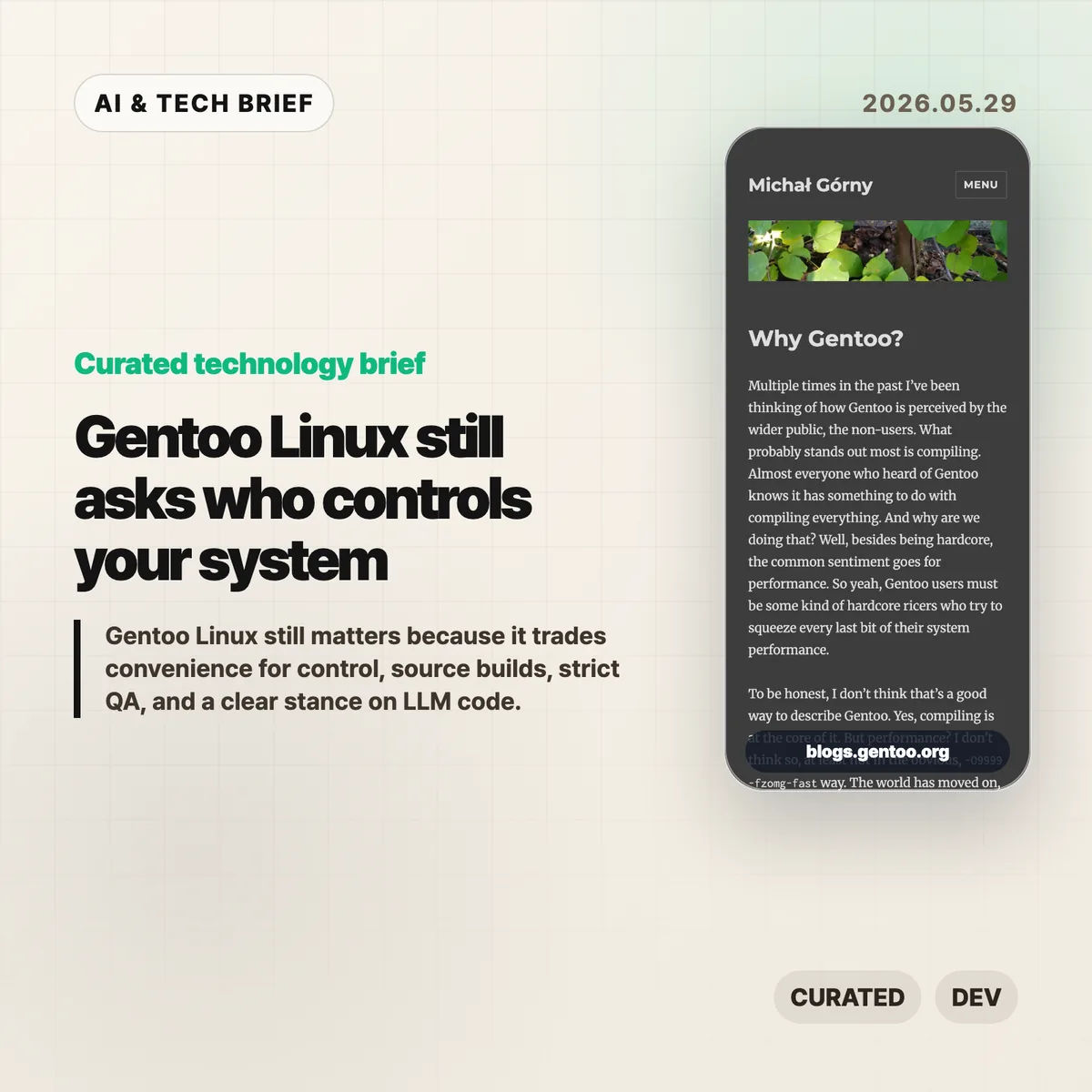
    Gentoo Linux is easy to caricature as the distribution for people who enjoy waiting for compilers. Michał Górny’s new essay makes a sharper case: the point is not raw speed, it is control. Gentoo is still useful because it forces an old but unresolved question onto the table: who gets to decide what your system includes, how it is built, and which code you trust?

    The short version

    • Gentoo Linux is less about squeezing out a few percent of performance and more about letting users choose build options, dependencies, init systems, libc variants, and patches.
    • Its governance pitch is independence: no single company, donor, forge, or business model should be able to steer the distribution on its own.
    • The security argument is practical, not nostalgic. Gentoo cares about bundled dependencies, static linking, pinned libraries, mirrors, OpenPGP distribution channels, and QA policy.
    • Its ban on LLM generated contributions has become part of the project’s trust model, even though upstream software may still contain AI-assisted code.
    • For more open source and AI infrastructure briefs, see the IT & AI archive.

    What happened

    Górny opens by pushing back on the usual Gentoo joke. Yes, Gentoo builds from source. No, that does not mean the main payoff in 2026 is turning on exotic compiler flags and beating Ubuntu in a benchmark. Modern CPUs are fast, mainstream distributions optimize their packages, and most desktop users will not feel a meaningful difference.

    The better argument is that source builds give Gentoo Linux a different contract with the user. Portage and USE flags make build choices visible. You can decide which optional features a package should include, patch a package before it builds, keep or reject parts of the dependency graph, and run combinations that a binary distribution may never ship as first-class options.

    That matters most when defaults are not enough. A developer can drop a local patch into Portage and have it applied across future package rebuilds. A systems operator can keep a narrow stack rather than accept every optional feature a maintainer enabled for the average user. None of this is frictionless. The trade is time and attention in exchange for a system that explains itself.

    Why this is worth watching

    The essay also frames Gentoo as a governance project. There is no company behind it, no SaaS funnel, and no single commercial roadmap. Infrastructure comes from donations and volunteer work. Górny says the project is even moving away from the Gentoo Foundation toward Software in the Public Interest to reduce the chance that legal or financial administration becomes a bottleneck.

    That may sound organizational, but it affects the software. A distribution depends on servers, mirrors, signing keys, package review, bug handling, and release discipline. If those pieces sit behind one sponsor or one platform, the technical system inherits that dependency.

    Gentoo’s position is more conservative. Codeberg and GitHub can be useful mirrors and contribution channels, but the project does not want to depend on either. That is not a fashionable answer, and it is not the cheapest answer. It is the answer you expect from people who think a distribution should survive a platform policy change or a sponsor walking away.

    Security is where the philosophy gets concrete

    The most practical part of the essay is the security section. Gentoo’s maintainers talk about a dedicated security team, project-controlled infrastructure, OpenPGP-protected distribution channels, and QA rules that often push against upstream habits.

    The examples are familiar to anyone who has dealt with software supply chain risk: bundled dependencies, static linking, pinned versions, and old libraries hiding inside packages. These choices may make upstream development easier, but they can make downstream security updates painful. A distribution that builds from source has more room to catch and unwind those choices, although it also inherits more combinations to test.

    This is the part of Gentoo Linux that feels newly relevant. The industry has spent years hiding build systems behind container images, package registries, managed runtimes, and remote development environments. Those tools are often the right choice. But when something breaks or a dependency becomes toxic, somebody still has to understand the layers underneath.

    What Hacker News readers are arguing about

    The Hacker News discussion is small, but the split is useful. Some longtime users defended Gentoo as a uniquely customizable system. One practical example stood out: putting a local patch under /etc/portage/patches/ so it applies automatically whenever a package is rebuilt. That is the kind of feature that explains Gentoo better than a performance benchmark.

    The more heated thread was about LLM generated code. One commenter said AI tools had helped them fix Arch User Repository package builds and that Gentoo’s strict policy would make contributing less appealing. Others argued that overlays still let users maintain their own packages, while critics called the policy inconsistent because upstream projects may already include AI-assisted changes before Gentoo packages them.

    The strongest defense of the policy was not anti-AI in the abstract. It was about review burden. If maintainers cannot tell whether a patch is understood by the person submitting it, the project absorbs risk it did not choose. The skeptical reply is fair too: a downstream distribution cannot fully audit how every upstream project writes code. Gentoo can set rules for its own tree, but it cannot make the wider ecosystem human-written by decree.

    There was also the expected comparison to Nix and Guix. That comparison is worth making because those systems offer a more formal model for reproducibility and package composition. Gentoo’s answer is different. It is less about a pure functional model and more about giving the local machine, the local maintainer, and the local patch set a lot of room.

    Gentoo Linux trade-offs

    The harder part is deciding when this model is worth the work. Gentoo Linux gives you more control, but it also asks you to carry more context in your head. That is a bad bargain for casual use and a good bargain when the build itself is part of what you need to understand.

    The practical read

    Most people should not switch to Gentoo Linux after reading one essay. Fedora, Ubuntu, Debian, Arch, NixOS, and managed developer environments are easier defaults for many teams. Convenience is not a moral failure.

    But Gentoo remains a useful benchmark for a different value system. If your team ships infrastructure, maintains internal developer tools, or depends on a large open source supply chain, Gentoo’s questions are worth borrowing. Which dependencies are bundled? Which features are enabled by default? Can you patch a package without forking your whole workflow? Who reviews code generated by an LLM? Who understands the system when the abstraction leaks?

    That is the reason this story still travels. Gentoo Linux is not only a distribution. It is a reminder that control has a cost, and sometimes that cost is the point.

    Sources

  • The orchestration tax is the real limit on AI agents

    The orchestration tax is the real limit on AI agents

    The orchestration tax is Addy Osmani’s name for the cost developers pay when many AI agents produce work faster than one human can review it. The pitch for agentic coding often starts with parallelism. The harder question is what happens when every result still has to pass through one person’s judgment.

    The short version

    • The orchestration tax appears when launching AI agents is cheap but reviewing their output is still slow.
    • Osmani argues that the scarce resource is not agent runtime. It is the developer’s attention.
    • More agents can deepen the review queue instead of increasing merged, reliable work.
    • The useful operating rule is backpressure: scale agents to review capacity, not to whatever the UI allows.
    • This matters for builders of agent tools because workflow design may matter more than raw parallel execution.

    What happened

    Addy Osmani, a Google Cloud AI director and longtime developer advocate, published a short article on X titled “The Orchestration Tax.” It grew out of a Google I/O panel with Richard Seroter, Aja Hammerly, and Ciera Jaspan about where software engineering is going as AI agents become normal parts of the development workflow.

    His argument is blunt: starting more AI agents is easy, but there is still only one person reading the diffs, resolving conflicts, and deciding whether the work fits the system. That makes the human reviewer the serial resource in an otherwise concurrent system.

    Osmani uses two familiar software ideas to frame the problem. The first is Python’s Global Interpreter Lock: many threads can exist, but work that needs the lock still runs through one choke point. The second is Amdahl’s Law: parallel speedup is capped by the part of the process that cannot be parallelized. In agentic software development, he says, that serial part is judgment.

    Why this is worth watching

    The orchestration tax is useful because it moves the AI agent debate away from demos and toward throughput. A dashboard full of active agents can feel productive. That does not mean the team is shipping better code.

    The risk is cognitive debt. If developers accept agent output because forming an independent opinion has become too tiring, they lose the mental model of their own codebase. The failure may not show up on the same day. It shows up later, when production breaks and nobody can explain why the system works that way.

    Osmani’s practical advice is closer to systems design than personal discipline. Use backpressure. Keep the parallel agent count low enough that reviews stay real. Split work into two piles: isolated tasks that can run in the background, and complex tasks where the human judgment is the work. Batch reviews instead of constantly context-switching between half-finished threads.

    That framing is also relevant to the broader IT & AI archive, where the pattern keeps repeating: the biggest gains from AI tools often depend on the boring workflow around the model.

    What Hacker News readers are arguing about

    There is a Hacker News submission for the piece, but it had no meaningful discussion at the time this brief was prepared. That silence is still mildly interesting. The post is not a benchmark launch or a new model release, so it does not trigger the usual speed-and-capability fight.

    The useful debate to have is more operational: how many agents can one engineer review without lowering standards, and what evidence should an agent produce before a human spends attention on it? Tests, screenshots, small diffs, and clear handoff notes are not glamorous. They are what make agent work reviewable.

    A fair skeptical view is that “orchestration tax” may just be a new label for old engineering management problems: code review queues, merge conflicts, and context switching. That is partly true. The new part is the imbalance. AI agents make it much easier to create parallel work than to create parallel understanding.

    The practical read on orchestration tax

    If you run AI coding agents, treat review attention as a capacity limit. Start with one or two concurrent agents on contained tasks. Require each agent to produce evidence before you review the result: a passing test, a screenshot, a concise change summary, or a small diff that can be understood in one sitting.

    Do not use agent count as the success metric. Use merged work that you still understand. If the queue grows faster than you can review it, reduce the fleet. The orchestration tax is paid either way; the choice is whether you pay it deliberately in workflow design or later through shallow reviews and stale system knowledge.

    For product teams building agent platforms, the lesson is awkward but valuable. The winning feature may not be “run 20 agents.” It may be better batching, clearer review packets, dependency boundaries, and defaults that protect the human reviewer from becoming the bottleneck nobody wants to measure.

    Sources

  • Stack Overflow AI is turning a fading forum into a data business

    Stack Overflow AI is turning a fading forum into a data business

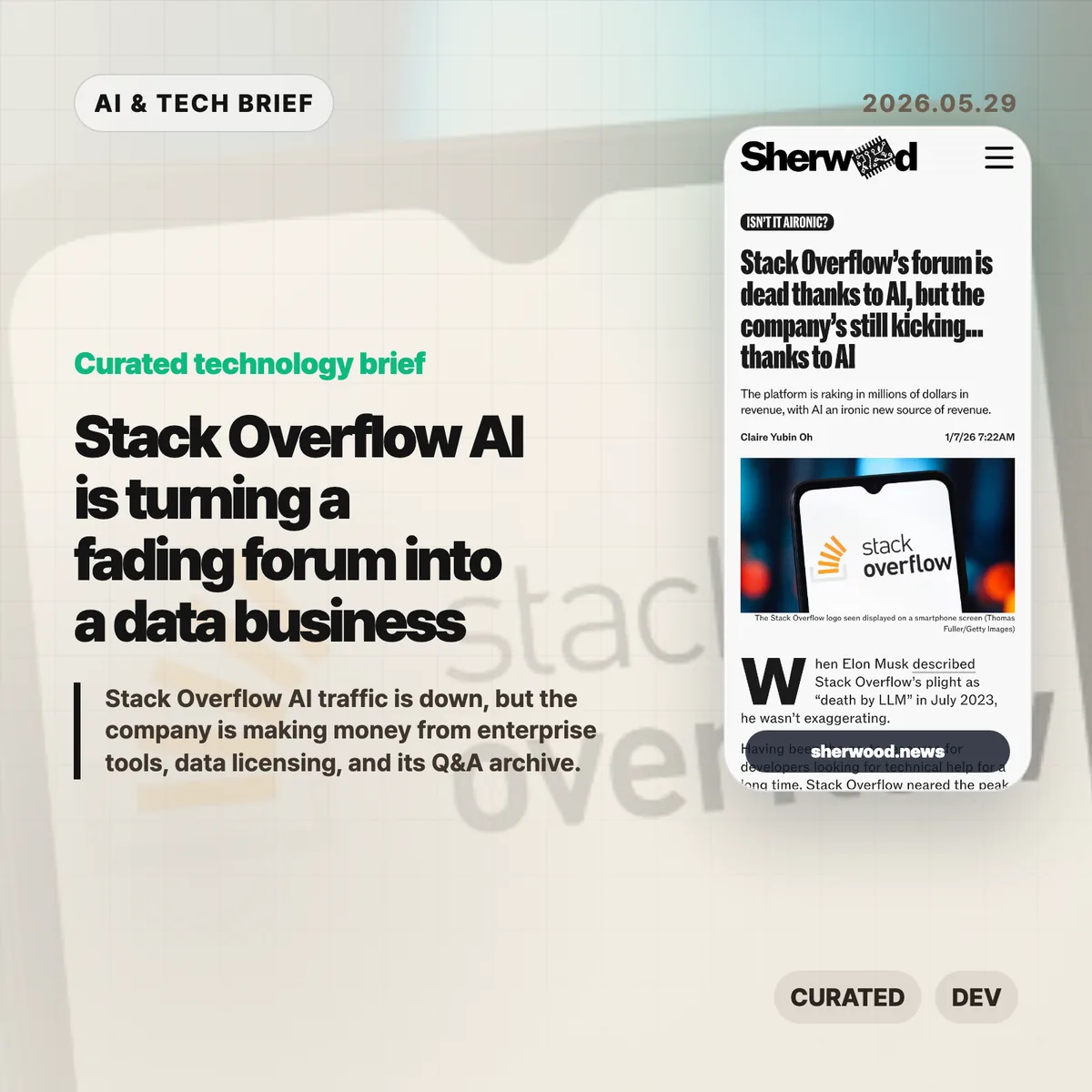
    Stack Overflow AI is a strange story: the public forum is quieter, but the company is not dead. Sherwood reports that Stack Overflow recorded only 6,866 questions last month, while annual revenue has roughly doubled to about $115 million as the business leans on enterprise products and data licensing.

    The short version

    • Stack Overflow’s question volume has fallen close to its 2008 launch-era level, according to Sherwood’s report.
    • The company is still generating about $115 million in annual revenue, with losses down from $84 million in FY2023 to about $22 million in the latest fiscal year.
    • The business has moved toward enterprise tools such as Stack Internal and licensing its developer Q&A archive to AI companies.
    • The uncomfortable part is the loop: AI systems learned from public developer knowledge, but their chat interfaces now keep many new answers out of the public web.

    What happened

    Sherwood’s piece frames Stack Overflow as one of the clearest examples of AI changing developer behavior. Developers who once searched, drafted a question, waited for replies, and left a searchable trail now ask ChatGPT, Claude, Cursor, Gemini, or Copilot first.

    That hurts the forum. A month with 6,866 questions is not a healthy signal for a site that became the default place to solve programming problems. It also changes how new software knowledge gets written down. A private answer in a chat window may solve one person’s bug, but it does not help the next person who hits the same error message.

    The company story is different. Sherwood says Stack Overflow has cut losses and shifted revenue away from forum advertising. Its enterprise product Stack Internal packages company knowledge with a Q&A-style workflow, and Stack Overflow also licenses its data to AI companies that need high quality coding examples and human-curated answers.

    Why this is worth watching

    Stack Overflow AI matters because it shows how a community can lose activity while its archive becomes more valuable. That is not a clean win. It is closer to a salvage model: the old community created a data asset, and the company is now finding buyers for that asset while the public habit that refreshed it weakens.

    Stack Overflow AI and the open-web loop

    For builders, the lesson is blunt. Traffic is not the only asset a technical community creates. Clean answers, reputation signals, accepted solutions, comments, duplicates, and edits all become structured knowledge. That kind of material is useful for retrieval systems, coding assistants, internal copilots, and model evaluation.

    The risk is decay. If fewer developers ask and answer in public, the archive gets older. Libraries change. APIs move. Frameworks break old advice. The AI tools that made the forum less necessary still need fresh, checked, human-written material to stay useful. That loop should worry anyone building on top of public web knowledge.

    This is also why developer tool companies should watch the business model, not only the traffic chart. A product that looks weaker as a destination can still become infrastructure. For more coverage of AI and developer platforms, see the IT & AI archive.

    What Hacker News readers are arguing about

    There is not much of an argument yet. The Hacker News submission exists, but the thread had only 3 points and no comments when checked. That absence is useful in its own way: the story is more developed in the source reporting than in the public discussion around it.

    If a real thread forms later, the useful debate will probably center on three questions. First, whether Stack Overflow’s decline is mostly AI substitution or partly the result of old moderation and onboarding problems. Second, whether licensing community-written answers to AI companies is fair to the people who created the archive. Third, whether private coding assistants are quietly starving the open web of fresh troubleshooting records.

    Those are not abstract complaints. They affect how future developers discover answers, how communities reward contributors, and how AI vendors get the next round of reliable programming data.

    The practical read

    If you run a developer community, Stack Overflow AI is a warning against treating posts as disposable traffic. The durable asset is the knowledge graph around the answers: who corrected what, which answer survived scrutiny, which question was a duplicate, and which explanation still works after a few release cycles.

    If you build AI coding tools, this story is a reminder that source quality matters. A model that answers from stale examples can save time today and create worse bugs tomorrow. Product teams should test answers against current docs, not only old public threads.

    If you are a developer, the practical habit is simple. Use the assistant, but publish the hard-won fix when the answer took real work. A short issue comment, a docs PR, or a public Q&A answer keeps the next person from solving the same problem alone.

    Sources

  • Neovim developer workflow: why modal editing still sticks

    Neovim developer workflow: why modal editing still sticks

    The Neovim developer workflow has outlasted several waves of shiny editors because it is built around editing as a repeatable grammar, not a panel-heavy app. Caio Bianchi’s May 26 essay is personal, but the argument lands beyond nostalgia: developers keep returning to Neovim when they want a fast, programmable editor that follows them from a local project to SSH, tmux, Git, tests, and Markdown.

    The short version

    • Bianchi says he started using Vim in 2011 and still picks Neovim after trying VS Code, JetBrains IDEs, Sublime, Atom, Zed, and others.
    • His case for Neovim is less about raw typing speed and more about motions, text objects, macros, and repeatable edits that stay useful for years.
    • Modern Neovim is not frozen in old Vim culture. Lua configuration, built-in LSP, Treesitter, snippets, formatters, and plugin managers such as Lazy.nvim make it feel current without turning it into a giant dashboard.
    • The Hacker News thread is tiny, but the one substantive reply echoes the same pattern: other editors come and go, while Vim or Neovim becomes the tool people keep returning to.

    What happened

    Bianchi published “A Love Letter to Neovim,” a first-person essay about why Neovim remains the editor he trusts most after roughly fifteen years with Vim and Neovim. The piece is not a feature checklist. It is an argument for a way of working.

    The center of the essay is Vim’s editing grammar. ci" changes text inside quotes. dap deletes a paragraph. . repeats the last change. Macros turn a boring edit into something the editor can replay. Text objects let a developer operate on structure instead of counting characters.

    That grammar matters because code editing is rarely just typing. It is moving through files, cutting a bad abstraction, reshaping a function, checking diagnostics, running tests, and doing the loop again. Bianchi’s point is that Neovim makes those small moves feel direct.

    Neovim developer workflow in practice

    The Neovim developer workflow is also a bet against the all-in-one editor. Bianchi likes that Neovim starts with a buffer and lets the user decide what belongs around it. File search can come from Telescope or fzf-lua. Git can come from Fugitive. Search can come from ripgrep. Sessions can live in tmux. Language tooling can come from LSP, Treesitter, formatters, snippets, and test runners.

    That sounds less convenient than installing a large IDE until the context changes. On a remote server, in a small terminal, inside a pairing session, or while editing a quick config file, the same commands still work. The setup is also plain text in Git, so the user can read it, delete parts of it, or carry it across machines without trusting a hidden settings database.

    This is why the essay feels current even in a year when developer tools are full of AI panels. The Neovim developer workflow does not compete by adding one more sidebar. It competes by reducing the number of moments where the editor itself becomes the thing you are managing.

    For more developer-tool briefs like this, see the IT & AI archive.

    Why this is worth watching

    Neovim is a useful reminder for anyone building developer tools: habit durability can matter as much as new capability. A feature that saves five seconds once is nice. A motion, mapping, macro, or small Lua function that fits into thousands of edits can become part of how someone thinks.

    That does not make Neovim the right editor for every team. VS Code is easy to start with, has a huge extension market, and works well for a broad base of developers. JetBrains tools are deep and polished for many language stacks. The interesting part is that Neovim survives beside those products because it gives advanced users a different bargain: more setup work, more ownership, and fewer assumptions about the rest of the workflow.

    The product lesson is blunt. Some developers do not want the editor to become the whole desk. They want the sharp part of the desk.

    What Hacker News readers are arguing about

    The Hacker News discussion is too small to call a debate. At the time checked, the story had one substantive comment. That reply is still useful because it mirrors the essay’s main claim from another long-time user.

    The commenter describes moving through Kate, Gedit, Eclipse, JEdit, NetBeans, VS Code, Emacs or Spacemacs, and Helix, but still coming back to Vim or Neovim. They credit Neovim with giving the old model a new life through LSP, Treesitter, and Lua scripting. The caveat is config maintenance. Even fans admit that keeping a Neovim setup tidy can be work, which is one reason editors like Helix remain tempting for people who want modal editing with fewer knobs.

    So the useful read from the thread is not broad consensus. It is a familiar trade: Neovim rewards time spent shaping the tool, but that same freedom creates maintenance debt.

    The practical read

    If you already have a calm, productive editor setup, this essay is not a reason to switch. It is a reason to ask where your current setup creates friction. Do you keep reaching for a mouse to do a repeatable edit? Do search, Git, tests, and terminal work feel like separate rooms? Do your settings live in a place you can actually inspect and version?

    If those questions sting, Neovim is worth testing in a narrow lane first. Use it for config files, Markdown, quick SSH edits, or one side project. Do not rebuild your whole work life in a weekend. The value of the Neovim developer workflow shows up when a few commands become automatic and stay useful across projects.

    For tool builders, the sharper lesson is about discovery. App stores, extension markets, and plugin directories often reward visible features, but the workflows people keep are usually quieter. They fit into muscle memory.

    Sources

  • CodeBoarding architecture diagrams map AI code review

    CodeBoarding architecture diagrams map AI code review

    CodeBoarding architecture diagrams turn a repository into navigable Mermaid docs, with static analysis and LLM reasoning doing the first pass. The pitch is simple: if AI coding agents are changing more code, reviewers need a faster way to see the shape of the system before they approve the diff.

    (more…)

  • Claude Opus 4.8 is a quieter bet on AI coding teamwork

    Claude Opus 4.8 is a quieter bet on AI coding teamwork

    Claude Opus 4.8 is Anthropic’s latest Opus model, and the more interesting part is not a single benchmark jump. The release points to a different priority for AI coding tools: fewer unsupported claims, larger Claude Code jobs, clearer cost controls, and API behavior that fits long-running agent work.

    The short version

    • Anthropic says Claude Opus 4.8 improves coding, agentic tasks, reasoning, and professional work while keeping regular Opus 4.7 pricing at $5 per million input tokens and $25 per million output tokens.
    • The company says Opus 4.8 is around four times less likely than Opus 4.7 to let flaws in its own code pass without comment.
    • Claude Code is getting dynamic workflows, a research preview feature that can plan large jobs, run hundreds of parallel subagents, verify outputs, and report back.
    • Effort control lets users trade speed and rate-limit usage against deeper reasoning, while fast mode now runs at 2.5x speed and costs less than before.
    • The Hacker News thread reads less like a celebration and more like a stress test: many readers see a modest update, but builders are watching the workflow changes.

    What happened

    Anthropic introduced Claude Opus 4.8 as an upgrade to Opus 4.7, available now through claude.ai, Claude Code, and the Claude API. The company frames the model as stronger across coding, agentic skills, reasoning, and professional work, but it also says users should expect a “modest but tangible” step over the prior version.

    The regular API price stays the same: $5 per million input tokens and $25 per million output tokens. Fast mode is priced at $10 per million input tokens and $50 per million output tokens. Anthropic says fast mode can work at 2.5x the speed and is now three times cheaper than it was for earlier models.

    The release also changes the product around the model. Claude Code gets dynamic workflows for very large codebase tasks. claude.ai and Cowork get effort control. The Messages API now accepts system entries inside the messages array, so developers can update instructions during a task without breaking prompt caching or disguising the change as a user message.

    Why this is worth watching

    The useful signal in Claude Opus 4.8 is that Anthropic is optimizing around collaboration, not only raw answer quality. That matters because AI coding failures often come from confidence at the wrong moment: the model says a migration is done, misses a test failure, or keeps moving after the plan has gone stale.

    Anthropic’s honesty claim is therefore worth watching, even if the phrase sounds a little odd in a model release. If Opus 4.8 really flags uncertainty more often and catches more of its own code defects, teams may be able to give Claude Code larger chunks of work without turning every run into a manual audit.

    The product changes point in the same direction. Dynamic workflows are available in Claude Code for Enterprise, Team, and Max plans. The feature lets Claude plan a large task, split it across many subagents, and check the work before returning it. For readers who track AI tooling beyond this single release, the broader IT & AI archive is a useful place to follow how model updates are turning into workflow products.

    Claude Opus 4.8 in practice

    For developers, Claude Opus 4.8 is less about replacing the current coding stack and more about changing where the model sits in the process. Autocomplete lives inside a narrow edit loop. Claude Code’s dynamic workflows move the model closer to project manager, migration assistant, and reviewer.

    That shift creates a harder evaluation problem. A model that writes one function can be judged by tests and review. A model that runs a multi-step migration across hundreds of thousands of lines needs better guardrails: scoped permissions, clear rollback points, test gates, logging, and a human who knows when to stop the run.

    Effort control also matters here. Low effort is the right default for routine answers. Higher effort makes more sense when the model is planning, touching many files, or making decisions that cost money if they are wrong. The control is not glamorous, but it is the kind of product detail teams need before they trust AI agents with bigger jobs.

    What Hacker News readers are arguing about

    The Hacker News discussion is skeptical, but not in a simple anti-AI way. The most common reaction is that Claude Opus 4.8 feels incremental. Several commenters point to Anthropic’s own “modest but tangible” phrasing and argue that benchmark tables no longer tell them much because many public evals feel saturated.

    A second thread is about language. Anthropic’s emphasis on model “honesty” annoyed some readers, who felt the company talks about models as if they were organisms being observed in the wild. That led to a more technical argument about whether models are “grown” or “built,” and how much researchers can really explain about why a trained model behaves the way it does.

    The builder-side reading is more practical. Same regular price, cheaper fast mode, effort control, and dynamic workflows are the pieces people can actually use. The useful objection is that bigger agentic runs raise the cost of a bad assumption. If Claude can run hundreds of subagents, the test suite, permission model, and review process become part of the product, not afterthoughts.

    The practical read

    If you already use Claude for coding, Claude Opus 4.8 is worth testing on the tasks where earlier models were annoying rather than impossible: long refactors, migration planning, bug hunts, and code review loops where the model had to admit uncertainty. Do not judge it only on one-shot prompts.

    For teams, the first test should be operational. Compare Opus 4.8 against Opus 4.7 on the same repository, with the same tests, the same token budget, and the same review checklist. Track where it stops, where it asks for clarification, and where it claims success too early.

    For product builders, the release says something broader about AI tool competition. The next useful layer may be less about a smarter chat box and more about controls around the model: effort settings, fast modes, mid-task instruction updates, subagent orchestration, and honest failure reporting. Claude Opus 4.8 is a good release to study if your product depends on developers trusting an agent for work that lasts longer than a single prompt.

    Sources