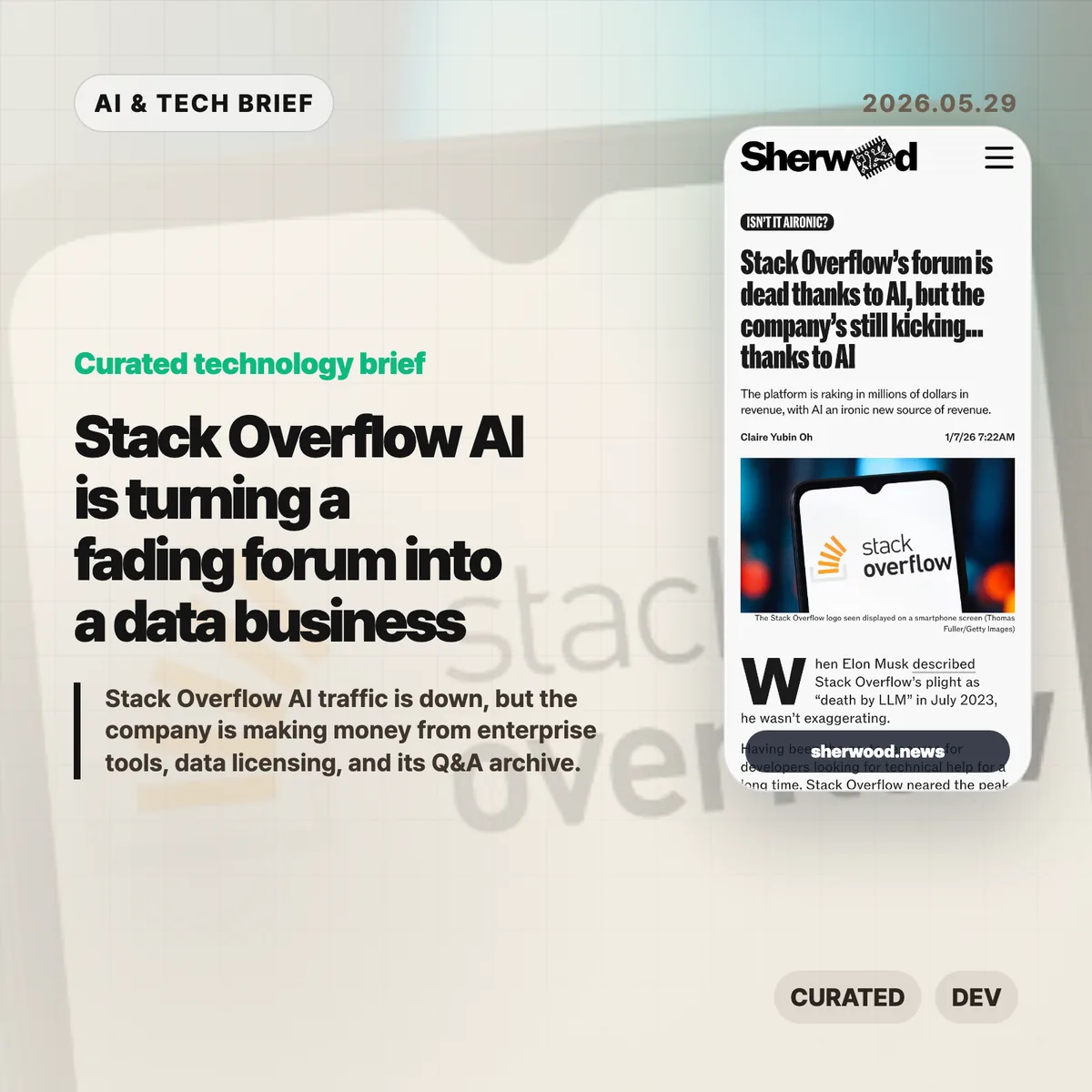
Stack Overflow AI is a strange story: the public forum is quieter, but the company is not dead. Sherwood reports that Stack Overflow recorded only 6,866 questions last month, while annual revenue has roughly doubled to about $115 million as the business leans on enterprise products and data licensing.
Table of Contents
The short version
- Stack Overflow’s question volume has fallen close to its 2008 launch-era level, according to Sherwood’s report.
- The company is still generating about $115 million in annual revenue, with losses down from $84 million in FY2023 to about $22 million in the latest fiscal year.
- The business has moved toward enterprise tools such as Stack Internal and licensing its developer Q&A archive to AI companies.
- The uncomfortable part is the loop: AI systems learned from public developer knowledge, but their chat interfaces now keep many new answers out of the public web.
What happened
Sherwood’s piece frames Stack Overflow as one of the clearest examples of AI changing developer behavior. Developers who once searched, drafted a question, waited for replies, and left a searchable trail now ask ChatGPT, Claude, Cursor, Gemini, or Copilot first.
That hurts the forum. A month with 6,866 questions is not a healthy signal for a site that became the default place to solve programming problems. It also changes how new software knowledge gets written down. A private answer in a chat window may solve one person’s bug, but it does not help the next person who hits the same error message.
The company story is different. Sherwood says Stack Overflow has cut losses and shifted revenue away from forum advertising. Its enterprise product Stack Internal packages company knowledge with a Q&A-style workflow, and Stack Overflow also licenses its data to AI companies that need high quality coding examples and human-curated answers.
Why this is worth watching
Stack Overflow AI matters because it shows how a community can lose activity while its archive becomes more valuable. That is not a clean win. It is closer to a salvage model: the old community created a data asset, and the company is now finding buyers for that asset while the public habit that refreshed it weakens.
Stack Overflow AI and the open-web loop
For builders, the lesson is blunt. Traffic is not the only asset a technical community creates. Clean answers, reputation signals, accepted solutions, comments, duplicates, and edits all become structured knowledge. That kind of material is useful for retrieval systems, coding assistants, internal copilots, and model evaluation.
The risk is decay. If fewer developers ask and answer in public, the archive gets older. Libraries change. APIs move. Frameworks break old advice. The AI tools that made the forum less necessary still need fresh, checked, human-written material to stay useful. That loop should worry anyone building on top of public web knowledge.
This is also why developer tool companies should watch the business model, not only the traffic chart. A product that looks weaker as a destination can still become infrastructure. For more coverage of AI and developer platforms, see the IT & AI archive.
What Hacker News readers are arguing about
There is not much of an argument yet. The Hacker News submission exists, but the thread had only 3 points and no comments when checked. That absence is useful in its own way: the story is more developed in the source reporting than in the public discussion around it.
If a real thread forms later, the useful debate will probably center on three questions. First, whether Stack Overflow’s decline is mostly AI substitution or partly the result of old moderation and onboarding problems. Second, whether licensing community-written answers to AI companies is fair to the people who created the archive. Third, whether private coding assistants are quietly starving the open web of fresh troubleshooting records.
Those are not abstract complaints. They affect how future developers discover answers, how communities reward contributors, and how AI vendors get the next round of reliable programming data.
The practical read
If you run a developer community, Stack Overflow AI is a warning against treating posts as disposable traffic. The durable asset is the knowledge graph around the answers: who corrected what, which answer survived scrutiny, which question was a duplicate, and which explanation still works after a few release cycles.
If you build AI coding tools, this story is a reminder that source quality matters. A model that answers from stale examples can save time today and create worse bugs tomorrow. Product teams should test answers against current docs, not only old public threads.
If you are a developer, the practical habit is simple. Use the assistant, but publish the hard-won fix when the answer took real work. A short issue comment, a docs PR, or a public Q&A answer keeps the next person from solving the same problem alone.