Tag: Developer Tools

  • Decepticon red team agent puts autonomous hacking on a tighter leash

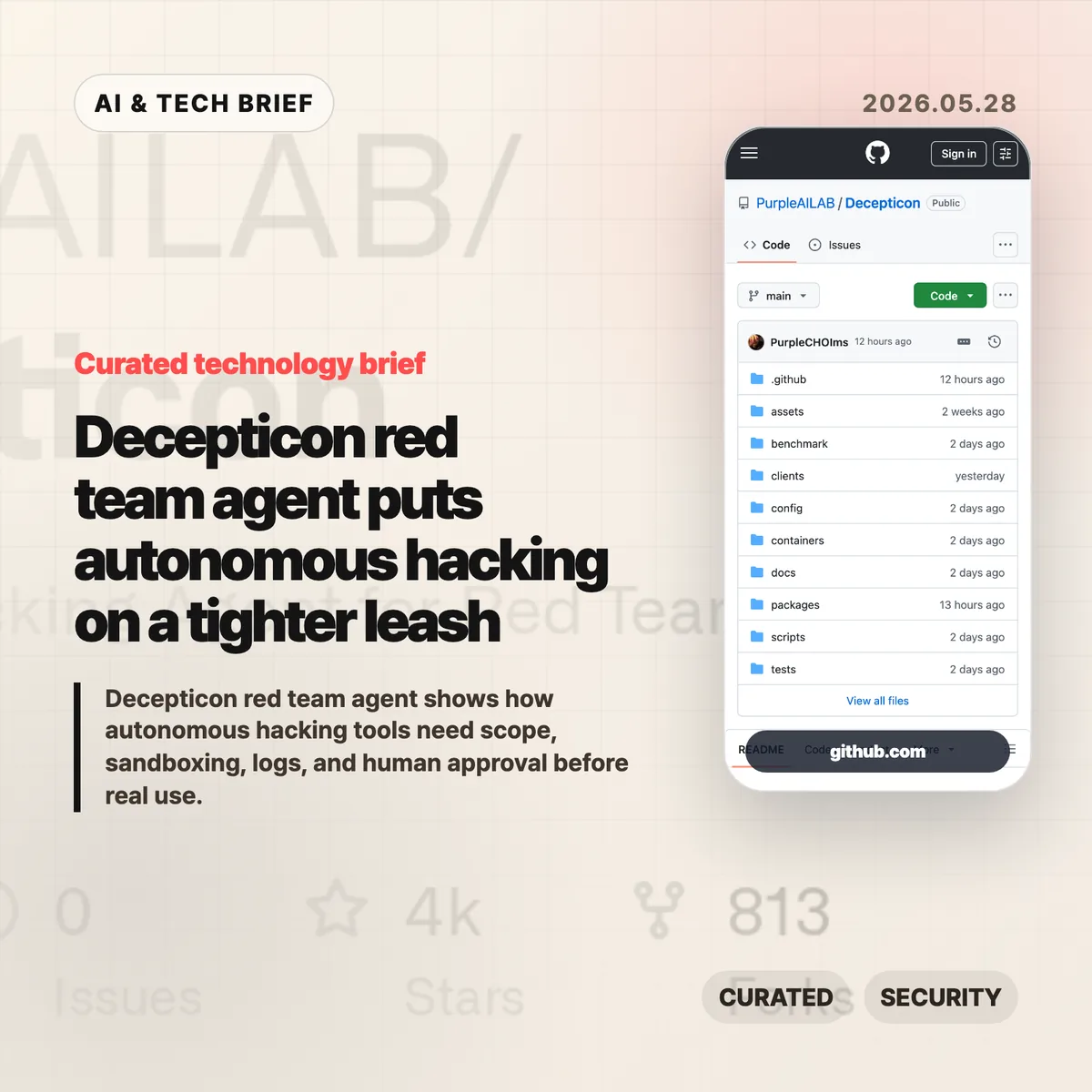
    Decepticon red team agent puts autonomous hacking on a tighter leash

    Decepticon red team agent is an open source attempt to turn red team work into an agent workflow rather than a scanner-plus-report routine. The interesting part is not that it can call offensive tools. It is that the project puts rules of engagement, sandbox isolation, and an operation plan in front of the automation.

    The short version

    • Decepticon describes itself as an autonomous red team agent for reconnaissance, exploitation, privilege escalation, lateral movement, and command-and-control work.
    • The project claims a 102 out of 104 pass rate on the XBOW validation benchmarks, which is useful context but still not a substitute for testing in your own lab.
    • Its design separates management services from a Kali Linux sandbox and says commands run inside that sandboxed operational network.
    • The product question is less “can an AI hack?” and more “who approves the target, constrains the run, and reads the logs afterward?”

    What happened

    Purple AI Lab published Decepticon as an Apache-2.0 open source project on GitHub. The repository describes it as an autonomous red team agent that can work across a full attack chain: reconnaissance, exploitation, privilege escalation, lateral movement, and command-and-control.

    The README also claims a 98.08% result on the XBOW validation benchmarks: 102 passes out of 104 challenges. That number will draw attention, but the repo’s operating model is the more useful part for security teams. Before activity begins, Decepticon says it generates an engagement package with rules of engagement, concept of operations, a deconfliction plan, and an operation plan mapped to MITRE ATT&CK.

    Architecturally, Decepticon separates management services such as LiteLLM, PostgreSQL, LangGraph, and the web interface from the sandbox side where Kali, command-and-control components, and targets live. It also describes 16 specialist agents organized by kill chain phase, with a fresh context window per objective.

    Why this is worth watching

    Security automation has a different risk profile from code completion or meeting notes. A coding agent can break a test suite. A red team agent can touch a network, run a tool against the wrong host, or leave artifacts that defenders have to explain later.

    That is why Decepticon is worth reading even if you never run it. Its docs force a practical checklist: target scope, written authorization, network isolation, tool execution boundaries, prompt and command logs, model fallback behavior, and a human stop button. Those controls are the difference between a useful internal security tool and a liability with a web dashboard.

    The broader signal is also clear. AI agent products are moving into jobs where mistakes have real blast radius. For more coverage of agent tools and security-adjacent developer workflows, see the IT & AI archive.

    why the Decepticon red team agent matters

    The Decepticon red team agent is a good test case for how AI security tools should be judged. A long feature list is not enough. Teams need to know whether the agent can be confined to an approved lab, whether it records each command and decision, and whether operators can interrupt it before a bad assumption turns into traffic on the wire.

    The project’s use of specialist agents also raises a product design question. Splitting work by kill chain phase can keep context cleaner, but it can also make accountability harder if the system does not preserve a readable trail. Security teams should ask how the agent chose a path, which tool produced each result, and which human approved the next step.

    For app builders and security vendors, this is also an app discovery problem. Agent directories and security marketplaces will need trust markers that ordinary software listings do not capture well: safe defaults, isolated execution, audit export, model provider controls, and clear warnings around authorization.

    What the discussion is missing

    A public Hacker News thread was not available for this brief. The missing discussion is still easy to predict because offensive security automation tends to split readers into familiar camps.

    Builders will want to know whether the benchmark claims hold outside curated environments, whether the tool can handle messy interactive shells, and how well it recovers when a scan or exploit path fails. Operators will care more about containment: where credentials live, what traffic can leave the sandbox, how logs are stored, and whether the model can be tricked into stepping outside the engagement plan.

    The useful skepticism is not “AI hacking is scary.” It is more specific: any autonomous offensive tool needs proof that its guardrails are harder to bypass than its demo is impressive.

    The practical read

    Treat Decepticon as a design reference before treating it as an operational tool. If you evaluate it, start in a lab you own, with disposable targets, no production credentials, and a written scope. Then read the logs as closely as the results.

    For security teams, the buying or adoption checklist should be boring on purpose: authorization workflow, sandbox boundaries, network egress controls, credential handling, audit retention, model/provider configuration, and rollback steps. If those pieces are unclear, the automation is not ready for real assets.

    For AI product teams, the lesson is broader. Once an agent can run terminal commands, cloud tools, or security scanners, product quality depends on operational discipline as much as model quality. The Decepticon red team agent makes that tradeoff visible.
    Sources

  • Local AI coding costs are starting to pressure frontier labs

    Local AI coding costs are starting to pressure frontier labs

    Local AI coding costs are becoming a real budget line for teams that run coding agents all day. A SignalBloom essay argues that cheap open-source models, local inference, and lower-cost engineering labor could put a ceiling on what frontier labs can charge for routine software work. The claim is a little aggressive, but the cost pressure is not imaginary.

    The short version

    • The essay compares frontier-model API economics with much cheaper open-source model usage, using a roughly 30x token-cost gap as the headline example.
    • Coding agents burn tokens differently from chatbots: they read files, retry commands, inspect logs, and loop through implementation work.
    • The strongest case for local AI is not replacing every frontier model call. It is routing boring, repeatable coding tasks to cheaper systems.
    • The hard part is quality control. Architecture, product judgment, security review, and long-context debugging still need stronger models or stronger humans.
    • For more coverage of AI tools and software economics, see the IT & AI archive.

    What happened

    SignalBloom published an argument that outsourcing plus LocalAI-style setups may soon look more economical than relying on frontier AI labs for a large share of coding work. The piece frames the issue around price: if frontier model calls keep getting more expensive while open-source models keep improving, teams that run many coding-agent loops will start looking for cheaper routing strategies.

    The article cites a large gap between high-end commercial model pricing and DeepSeek-style open model costs, with the headline comparison landing around 30x in favor of the cheaper option. Treat that number as a directional example, not a permanent price table. Model pricing changes quickly, and a token price alone does not include hardware, orchestration, monitoring, review time, or failed attempts.

    Still, the basic point is useful. AI coding agents are not one-shot assistants. They may scan a repository, write code, run tests, read the failure, try again, and repeat the loop. That makes local AI coding costs more important than they looked when teams were only comparing chat subscriptions.

    Why this is worth watching

    The interesting shift is in routing. A team does not have to choose one model for everything. It can use a frontier model for planning, ambiguous debugging, security-sensitive review, or architecture. It can then hand well-scoped implementation chores to cheaper open-source models or local inference when the task is narrow enough.

    That is why this story matters for developer-tool companies. Heavy users are already different from casual users. A founder asking a chatbot for a landing-page tweak is not the same customer as a team running ten agents across a monorepo. Once agents become part of the workflow, inference starts to look like cloud spend. You need budgets, limits, queues, caches, and a reason for every expensive call.

    The catch is that cheap does not mean free. Local inference brings hardware costs, model-serving work, evaluation, prompt routing, and review burden. Outsourced engineering also adds coordination cost. If the cheaper system produces work that a senior engineer must constantly unwind, the apparent savings vanish fast.

    What Hacker News readers are arguing about

    The Hacker News thread is more useful than the headline because it pushes on the economics from several angles. One camp buys the basic pressure story: open-source models only need to become good enough for day-to-day software tasks to take revenue away from frontier labs. Several commenters imagined hybrid workflows where a strong model handles planning while cheaper models handle the token-heavy implementation loop.

    The main objection is marginal cost. Some readers argued that AI is not like older software, where serving one more user can feel close to free. Inference uses expensive hardware, and the cost curve becomes stepwise: if existing capacity is full, the next user may require another server. That makes price competition more complicated than a simple SaaS comparison.

    A second thread focused on energy, chips, and geography. Some commenters thought lower energy costs and more efficient inference infrastructure could favor Chinese labs or local deployment. Others pushed back, noting that training expertise, capital allocation, chip constraints, and regulatory friction still matter.

    The practical signal from the discussion is that nobody should model this as a clean replacement story. The believable version is a mixed stack: frontier models where quality pays for itself, cheaper local models where repetition dominates, and humans watching the seams.

    The practical read on local AI coding costs

    If you run a small team, the move is not to rip out frontier models. Start by measuring where the tokens go. Coding-agent usage often hides the expensive part in repository reads, failed runs, and repeated edits. Once you know that, you can test cheaper models on bounded tasks: test generation, mechanical refactors, migration scripts, documentation updates, and first-pass bug fixes.

    Keep the evaluation boring. Compare accepted pull requests, reviewer time, rollback rate, failed test loops, and security findings. If a local model saves 80% on inference but doubles review time, it did not save money. If it handles repetitive changes while the frontier model handles planning, it may be worth keeping.

    The bigger lesson is that local AI coding costs will become a product-design constraint. Coding-assistant vendors, agent platforms, and internal tooling teams need pricing that survives power users. The winning stack may be less glamorous than the model leaderboard: good routing, clear budgets, strong review, and enough taste to know when the cheap path is getting expensive.

    Sources

  • React Doctor wants to audit the React code AI agents leave behind

    React Doctor wants to audit the React code AI agents leave behind

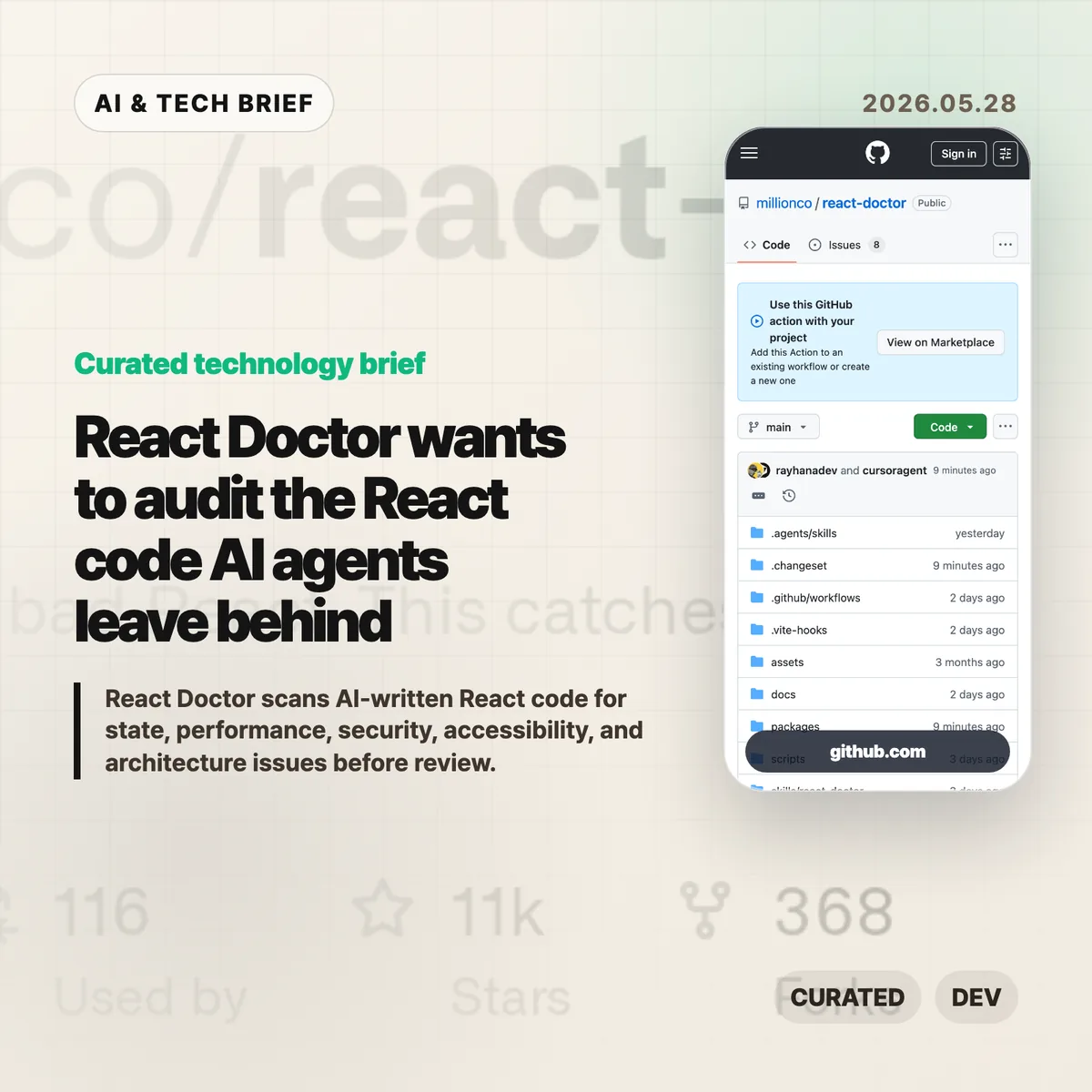
    React Doctor is an open source scanner for React projects that are getting more code from AI agents than humans can comfortably review line by line. It runs from the command line, reports issues across state, effects, performance, architecture, security, and accessibility, and can be wired into GitHub Actions for pull request feedback.

    The short version

    • React Doctor is published by Million.co under an MIT license and lives at millionco/react-doctor on GitHub.
    • The quick start is npx react-doctor@latest, which runs an audit from a project root without a long setup step.
    • Its pitch is narrower than a general linter: catch React-specific trouble that may slip through when agents generate code quickly.
    • The tool supports agent setup, GitHub Actions annotations, and diff-focused scanning for pull requests.
    • Treat it as a second reviewer, not a verdict machine. Static analysis can point at suspicious code, but a team still has to decide what matters.

    What happened

    Million.co has released React Doctor, a static analysis tool with the blunt tagline: “Your agent writes bad React, this catches it.” The README says it scans React codebases for issues across state and effects, performance, architecture, security, and accessibility. It also says the tool works across common React environments, including Next.js, Vite, TanStack, React Native, and Expo.

    The basic command is intentionally small: npx react-doctor@latest. After an audit, teams can run npx react-doctor@latest install to set up agent-facing guidance for tools such as Claude Code, Cursor, Codex, and OpenCode. There is also a GitHub Marketplace action for pull request annotations and comments.

    The repository was created in February 2026 and, when checked on May 28, showed more than 11,000 GitHub stars, hundreds of forks, and an MIT license. Those numbers can move quickly, but they are enough to show that this is not a quiet side note in the React tooling world.

    Why this is worth watching

    React Doctor lands in a gap that many frontend teams are starting to feel. AI coding tools can generate components, hooks, and refactors fast. The slow part is figuring out whether the result quietly introduced a stale effect dependency, an accessibility miss, a performance trap, or an unsafe pattern that only shows up later.

    Existing linters already catch plenty of mistakes. The interesting part here is the packaging: React Doctor talks like an audit tool for agent output, not a hand tuned rule set that a team spends a week configuring. That framing matters. If agents are going to submit more pull requests, teams will want cheap automated friction before a human reviewer spends attention.

    For readers tracking developer tools, the IT & AI archive has more coverage of how coding agents are changing the review loop. React Doctor fits that same pattern: code generation is becoming normal, so code acceptance needs better guardrails.

    React Doctor in practice

    The first useful test is simple. Run React Doctor on a real project and read the false positives before wiring it into CI. A scanner that finds every possible smell can still waste a reviewer’s time if the signal is too noisy.

    The safer rollout is report-only mode on a few pull requests, then diff scanning for changed files once the team understands the output. The GitHub Action is the obvious place to start because reviewers already live inside pull requests. If the tool catches repeated issues, move those categories into a stronger policy. If a category is mostly noise, keep it as advisory or turn it off if the tool allows that path.

    This is especially relevant for teams using agents to touch React Native, Expo, or Next.js code. Those stacks have enough framework-specific behavior that a generic code review checklist often misses practical UI bugs.

    What Hacker News readers are arguing about

    There is a Hacker News submission for React Doctor, but it had no comments when checked through the public HN APIs. That means there is no real thread to summarize yet.

    The absence of debate is its own small warning. React developers should judge the tool on runs against production code, not on launch-day voting. The questions worth asking are concrete: How many findings are actionable? Does it duplicate ESLint, TypeScript, or existing React rules? Can it explain issues well enough for a junior developer or an agent to fix them safely?

    The practical read

    React Doctor is worth a trial if AI coding tools are already producing React changes in your repo. Start with npx react-doctor@latest on a branch, save the report, and compare the findings with issues your team has actually seen in reviews.

    Do not make it a required CI gate on day one. Put it beside ESLint and TypeScript first. If React Doctor repeatedly catches issues that your current checks miss, then promote the narrow categories that proved useful. That is the boring path, but it is also how static analysis becomes part of a workflow instead of another dashboard nobody trusts.

    Sources

  • AI generated answers are making online work feel fake

    AI generated answers are making online work feel fake

    AI generated answers have created a strange new failure mode: you ask a person a question, and the person sends back machine-written text they may not have read. A short Orchid Files post captured that irritation through three small scenes: a malware-reporting problem on GitHub, a bad ChatGPT screenshot at work, and a Reddit exchange that turned out to be an AI agent.

    The short version

    • Orchid Files argues that the worst part of AI generated answers is not the model being wrong. It is the human handoff without judgment.
    • The GitHub malware example matters because security reports need context, ownership, and a clear path to action.
    • The workplace example is more familiar: a coworker forwards a ChatGPT screenshot instead of answering the actual question.
    • The Hacker News discussion turned into a broader argument about online trust, fake productivity, and whether human contact is getting rarer.
    • For more coverage of AI and developer culture, see the IT & AI archive.

    What happened

    Orchid Files published “I’m tired of talking to AI” on May 22, 2026. The post is brief, but it lands because the examples are painfully ordinary.

    The author says they found GitHub repositories spreading malware and asked an AI system what to do. The answer was not useful. They then opened a GitHub discussion, only to receive a reply that matched the earlier AI answer. After they called it out, the comment disappeared, and another person posted essentially the same AI-generated response.

    A second example came from work. The author asked a business owner a question about a task. Instead of answering, the person sent a ChatGPT screenshot. When the author said the response did not answer the question and was wrong, another screenshot arrived almost immediately. The problem was not that ChatGPT existed. The problem was that the human in the loop seemed absent.

    The last example came from Reddit. After several messages, the author realized the other side of the conversation was an AI agent. That is the line the post keeps circling: people want to talk to real people, but even real people increasingly route the conversation through AI.

    Why this is worth watching

    The post is useful because it moves AI fatigue away from the usual benchmark debate. The issue is not whether a model can produce a plausible answer. The issue is whether the person sending that answer understands it, agrees with it, and will stand behind it.

    That distinction matters for developer teams. A generated response to a malware report, dependency question, or product requirement can sound polished while skipping the part that actually matters: who checked the facts, who owns the next step, and what context the answer depends on.

    It also matters for AI product design. If a tool makes it easier to paste generated text into another person’s workflow, it should also make review and accountability harder to fake. Agent builders, support software teams, and workplace AI vendors should treat that as a product requirement, not a nice extra.

    why AI generated answers feel different

    AI generated answers feel different because they shift work onto the receiver. A normal bad answer can be challenged directly: the person misunderstood, missed context, or disagreed. A generated answer adds another layer. Now the receiver has to ask whether the sender read it, whether the model invented something, and whether anyone owns the claim.

    That is why a screenshot can feel ruder than a short human reply. The screenshot says, in effect, “the machine said this,” while leaving the other person to do the checking. In low-stakes conversations, that is annoying. In security, hiring, customer support, or product planning, it can become expensive.

    What Hacker News readers are arguing about

    The Hacker News thread was large and messy, with more than 900 comments at the time it was indexed. The useful split was not pro-AI versus anti-AI. It was closer to this: some readers saw the post as evidence that people are outsourcing thought, while others argued that low-quality online content existed long before chatbots.

    One recurring argument was that “thinking” may become more valuable, not less, because cheap generated text makes real judgment easier to spot. The skeptical version of that point was harsher: many workplaces already rewarded simulated work, and AI just made the simulation faster.

    Another thread focused on detection. Several commenters pushed back on AI-content detector statistics, arguing that detectors produce false positives and often punish style markers rather than authorship. The more practical objection was that detection may be the wrong goal. If generated text can impersonate human communication cheaply, the social problem remains even when detection is unreliable.

    There was also a builder/operator angle. Some readers were less upset about AI as a drafting tool than about unreviewed AI in business workflows. A generated note in a private draft is one thing. A generated answer sent as if it were a person’s judgment is another.

    The mood was mostly weary, with a streak of gallows humor. People joked about needing to go offline, but the serious worry was trust: once every message might be machine-shaped, even real human messages start to feel suspect.

    The practical read

    Teams do not need a dramatic AI policy to handle this. They need a small norm: if you send an AI-assisted answer, you own it.

    That means reading it before forwarding it, cutting anything you cannot verify, and adding your own judgment in plain language. If you are unsure, say what is uncertain instead of hiding behind a generated paragraph. For technical work, link to the source, issue, documentation, or log that supports the answer.

    For product teams building AI assistants, the lesson is just as concrete. The best workflow is not the one that produces the most fluent text. It is the one that makes the human review step visible enough that the recipient can trust the answer.

    Sources

  • Enterprise AI agents are where OpenAI and Anthropic may finally get paid

    Enterprise AI agents are where OpenAI and Anthropic may finally get paid

    Enterprise AI agents are starting to look less like a subscription perk and more like a metered workplace bill. Simon Willison argues that OpenAI and Anthropic have found a version of product market fit through coding agents such as Codex and Claude Code, because companies are paying closer to API prices when employees use them heavily. The uncomfortable part is also the point: the bills are high because people are actually using the tools.

    The short version

    • Heavy personal plans can make Codex and Claude Code look cheap compared with API-equivalent token usage.
    • Enterprise AI agents change the business model because companies pay for team usage, contract terms, support, and usage controls.
    • Hacker News readers mostly agreed the usage is real, but argued hard about whether the economics can survive open models, cheaper providers, and missing ROI data.
    • The practical test is no longer whether a coding agent is impressive. It is whether a team can prove the agent is worth the tokens it burns.

    What happened

    Willison compared his own heavy usage of Anthropic Claude Code and OpenAI Codex with what the same token volume would cost at API prices. His estimate came to about $1,199.79 for Anthropic and $980.37 for OpenAI over 30 days, while he paid $200 total for two consumer plans.

    That gap matters because the enterprise side appears to be moving in the opposite direction. Willison points to Anthropic’s shift from broad seat-based expectations toward $20 per seat per month plus API-style usage, and to OpenAI’s Codex rate card, which says April 2026 pricing moved toward API token usage rather than per-message pricing. Anthropic also announced Claude Code for Team and Enterprise plans, with admin controls and higher business limits.

    The claim is not that every AI lab is suddenly healthy. It is narrower: enterprise AI agents give OpenAI and Anthropic a way to charge where the usage actually happens. Coding agents run longer jobs, inspect repositories, rewrite files, execute commands, and loop through fixes. That can consume far more tokens than a chat session.

    Why this is worth watching: enterprise AI agents

    Enterprise AI agents create a cleaner revenue story than consumer chat subscriptions. A consumer pays a flat monthly fee and may use far more inference than the plan costs. A company that rolls an agent into daily engineering work can be billed by usage, seats, support, and contract commitments.

    That also explains why the sales motion looks old-fashioned. Willison scraped job listings and found large chunks of OpenAI and Anthropic hiring tied to enterprise sales, customer support, account management, and forward deployed engineering. The irony is useful. The companies selling automation still need humans to close enterprise contracts, handle security reviews, and keep customers from turning a runaway token bill into a cancellation.

    For app and developer tool builders, the lesson is blunt. If an agent marketplace or coding platform wants durable revenue, discovery is only the start. Teams also need budgets, admin controls, usage reporting, and a way to tell whether the agent saved more money than it spent.

    For more coverage of software teams, AI products, and developer platforms, see the IT & AI archive.

    What Hacker News readers are arguing about

    The Hacker News thread was huge and messy, which fits the topic. The most useful split was between “usage proves demand” and “usage does not prove sustainable economics.”

    The bullish camp treated $200 per user per month as ordinary enterprise software pricing, especially compared with expensive engineering, CAD, cloud, or security tools. Some readers argued that the controversy itself proves the tools have entered real workflows. Nobody complains about a bill for software nobody uses.

    The skeptical camp kept coming back to ROI. Several commenters asked whether companies can show more shipped product, better features, or higher engineering output, instead of more commits and larger token bills. One recurring objection was that a 20% to 40% productivity lift may fail to support the scale of infrastructure spending implied by trillion-dollar valuations.

    A second line of skepticism was commoditization. Readers pointed to cheaper open-weight models, Chinese providers, caching, and alternative inference platforms. Their argument was not that Claude Code or Codex are useless. It was that API-priced usage may be a temporary window if “good enough” models keep getting cheaper.

    There was also a pricing trust issue. Some commenters pushed back on the idea of “$2,000 worth of tokens” as if token list prices were an objective measure of value. That is a fair caution. List price, marginal compute cost, customer value, and investor narrative are four different things.

    The practical read

    Enterprise AI agents are a budget conversation now. If you run engineering, the next step is to avoid both blanket bans and unlimited access. Put them in the same category as cloud spend: useful, measurable, and dangerous when nobody owns the bill.

    Track agent usage by team, task type, and outcome. Watch where agents save review time, test-writing time, migration effort, or support toil. Also watch where they create cleanup work. The argument for enterprise AI agents gets much weaker if the only metric is token volume.

    For OpenAI and Anthropic, the next year is a proof period. They have signs of demand, enterprise contracts, and tools that people use all day. Now they need to show that usage can turn into durable margins before cheaper models and procurement teams squeeze the story.

    Sources

  • Developer tools that stick usually solve boring pain

    Developer tools that stick usually solve boring pain

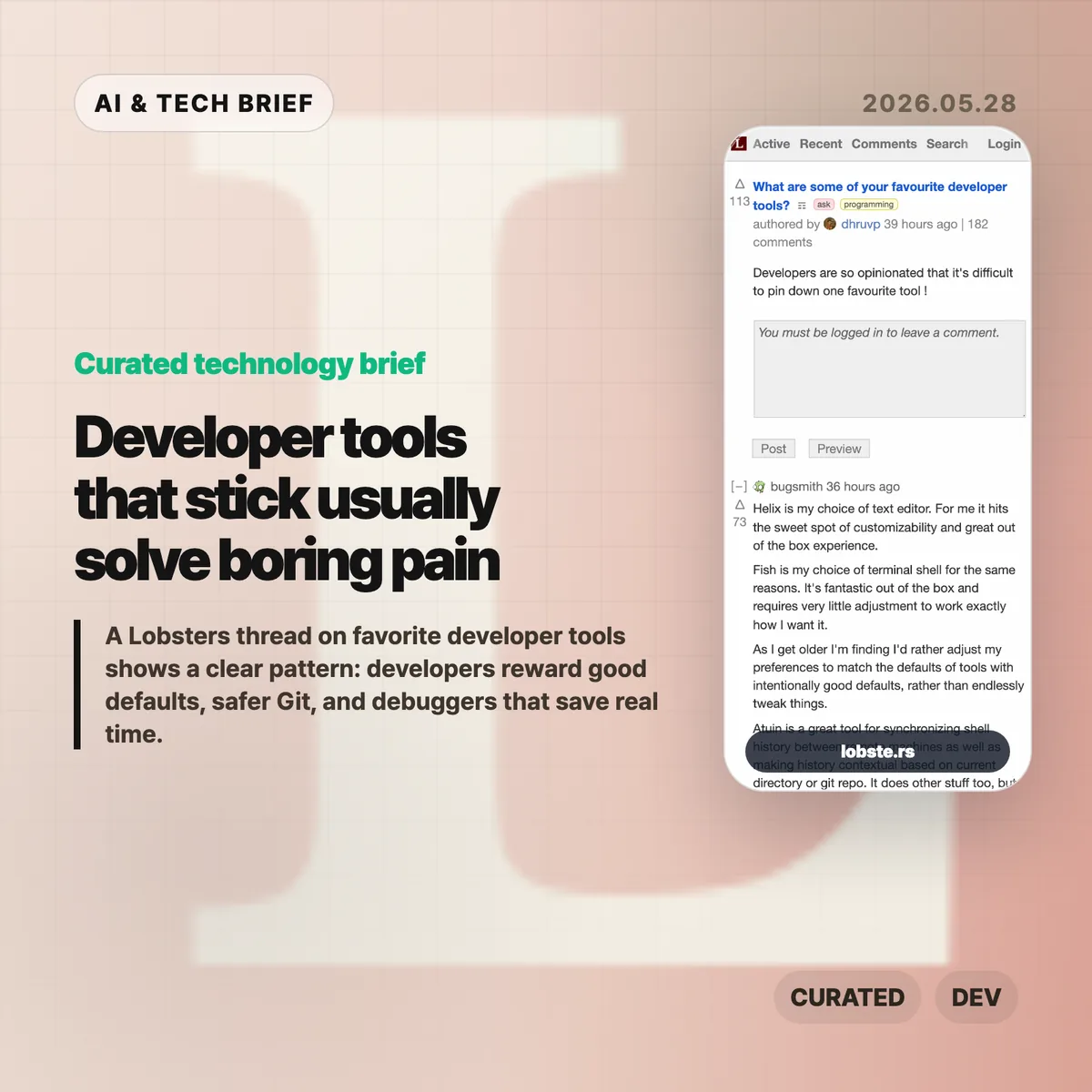
    A long Lobsters thread about favorite developer tools turned into a useful map of what developers actually keep using. The names are scattered across editors, shells, Git front ends, environment managers, and debuggers, but the pattern is fairly consistent: good tools remove friction without demanding a new hobby.

    The short version

    • Editors did not converge on one winner. Helix, Emacs, Neovim, Sublime Text, Zed, and JetBrains IDEs all came up, usually with strong opinions about defaults and muscle memory.
    • Version control comments leaned toward tools that make risky Git work feel safer, including Jujutsu, Magit, lazygit, Sublime Merge, delta, and difftastic.
    • Shell and environment picks such as Fish, WezTerm, Ghostty, tmux, Nix, mise, atuin, and fzf show how much developers care about repeatable setup.
    • The most practical answers were often about debugging and profiling: rr, Pernosco, RenderDoc, Tracy, RemedyBG, and Xcode Instruments.

    Developer tools worth keeping

    The useful developer tools in this discussion share a boring promise: they make daily work safer, faster, or easier to repeat without turning setup into the main project.

    What happened

    A Lobsters user asked a simple question: what are some of your favorite developer tools? The thread drew more than a hundred comments, which is not surprising for a community that can turn editor choice into a personality test.

    The interesting part is that the answers were not only about shiny new tools. Many developers praised tools that feel good out of the box. Helix and Fish came up that way. Several commenters said they now prefer tools with intentional defaults because they have less patience for endless configuration. Others pushed back, arguing that a carefully tuned Emacs or Vim setup can pay off for years.

    That tension says more than any single ranked list would. Some developers want defaults they can trust. Some want a tool chest they can shape over a decade. Both camps are trying to protect the same thing: attention.

    Why this is worth watching

    The thread is a useful reminder that developer productivity is rarely one big leap. It is usually a pile of small reductions in annoyance.

    Version control is a good example. Jujutsu, usually called jj, appeared repeatedly because it changes how people approach rebases, amends, branches, and history editing. Magit, lazygit, Sublime Merge, delta, and difftastic serve a similar need from different angles. They make state visible. They make diffs easier to read. They make undo and review feel less like a trap.

    Environment management came up for the same reason. Nix has a steep learning curve, but the developers who like it are tired of one project breaking another. mise drew praise for language and tool version management without much ceremony. Dev Containers and chezmoi sit in the same problem space: a laptop, a work machine, a remote server, and CI should not all feel like separate archaeological sites.

    The best answers were not always the flashiest ones. rr came up because being able to record a failing C or C++ program and replay it deterministically can save hours on memory corruption bugs. Pernosco adds time travel debugging with data flow analysis. RenderDoc and Tracy matter to graphics and performance work. JetBrains users praised the IDE because its debugger and framework support keep them moving.

    What the discussion is missing

    There is no Hacker News thread attached to this story, and the Lobsters discussion is already the source material. That means the useful caution is not about missing crowd sentiment. It is about sampling.

    Lobsters skews toward developers who enjoy tools enough to discuss them in public. That naturally favors editors, shells, version control tools, language managers, and low level debugging workflows. Enterprise defaults, team policy, accessibility, onboarding cost, Windows-heavy shops, and non-English developer communities get less attention.

    The thread also underplays one awkward truth: a great individual tool can still be a poor team default. Nix may solve dependency drift for one group and become a support burden for another. Jujutsu may make history editing nicer for an experienced engineer while confusing someone who only needs basic Git. The right question is not “which tool won?” It is “which recurring failure does this remove from my day?”

    The practical read

    If you are reviewing your own toolchain, start with the moments that waste time rather than the tools that sound fashionable. Slow search points toward ripgrep, fzf, or a better code search workflow. Messy shell history points toward atuin or autojump-style navigation. Git anxiety points toward lazygit, Magit, jj, Sublime Merge, delta, or difftastic. Reproducible setup problems point toward mise, Nix, Dev Containers, or a smaller dotfiles system.

    For teams, the thread argues for better defaults rather than forced sameness. You do not need every developer in the same editor. You do need a project that starts in minutes, a version control workflow people can recover from, and debugging tools that make the worst bugs less mysterious.

    For more briefs on software teams, AI products, and developer workflows, see the IT & AI archive.

    The dull test is the right one: does the tool get you back to the problem faster?

    Sources