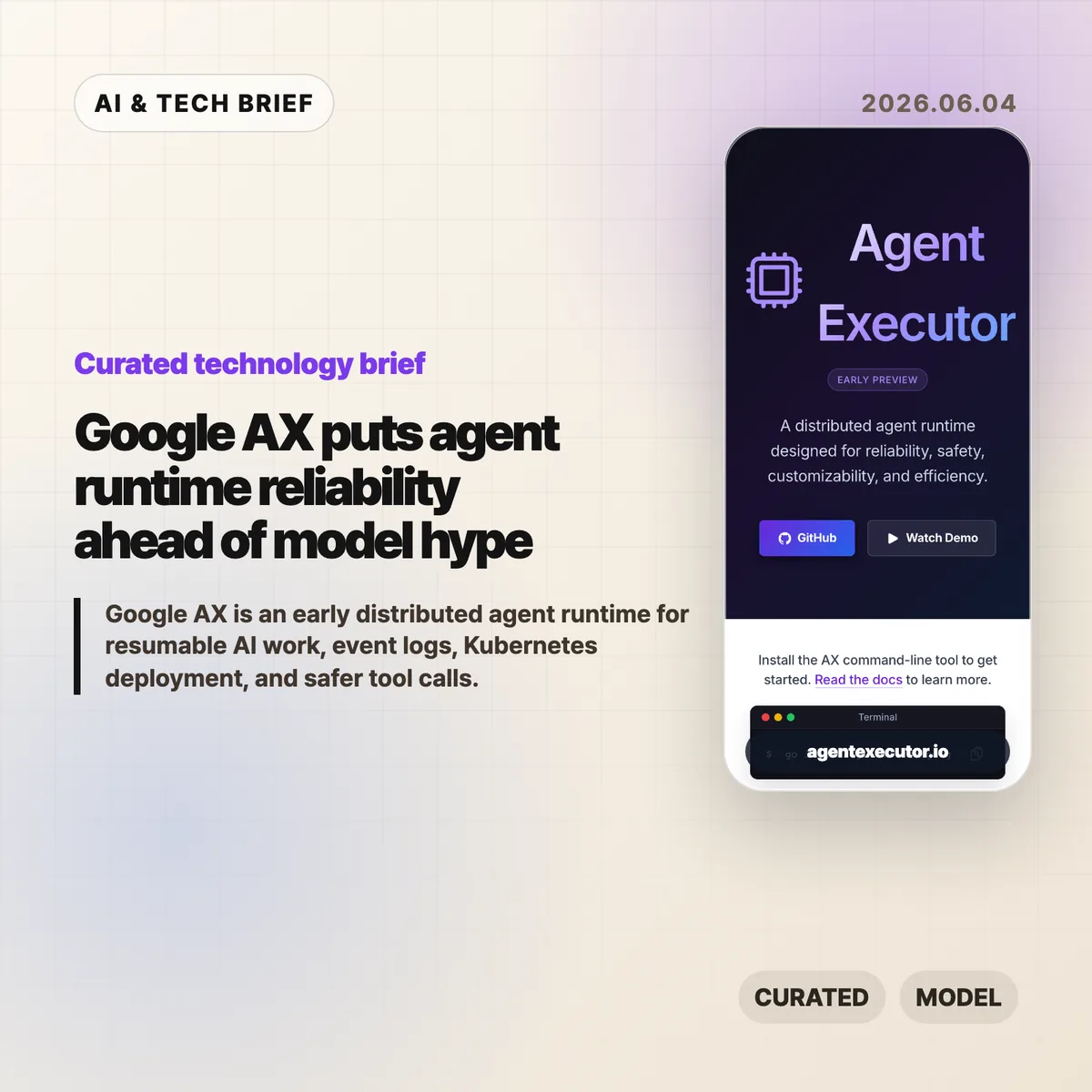
Google AX, short for Agent Executor, is Google’s Apache 2.0 early preview runtime for distributed AI agents in 2026. According to the google/ax README on GitHub, AX uses a controller to coordinate agentic loops, write an event log, and communicate with local and remote actors. The project focuses on resumable execution, isolated skills and tools, and Kubernetes-friendly deployment. Its clearest message is that agent apps need infrastructure for recovery and audit trails before they can be trusted with long-running work.
Table of Contents
AX also arrives with a blunt stability warning. According to Google, the core runtime, resumption protocols, and specifications are still being refined before a stable release, and external pull requests are paused for now. That makes the project useful as a map of Google’s agent infrastructure thinking, not a mature dependency to install casually.
The short version
- Google AX is an early preview distributed runtime for agentic applications, released under Apache 2.0 through the google/ax GitHub repository.
- The runtime coordinates controllers, skills, tools, and agents as isolated actors instead of treating an agent as one large process.
- Its strongest idea is resumability: AX keeps an event log so disconnected clients can catch up from the last event sequence they saw.
- Google says AX is compute agnostic, but the project currently aims to work especially well on Kubernetes and Agent Substrate.
- The practical signal is clear: serious agent products will compete on execution reliability, auditability, and recovery, not only on model choice.
What happened
Google published Agent Executor, or AX, as a distributed runtime for long-running AI work in 2026, and the repository is public under the Apache 2.0 license. According to the official site, AX is designed for reliability, safety, customizability, and efficiency. The GitHub README says AX coordinates agentic loops, manages executions with event logging, and communicates with both local and remote actors.
The project is still marked as an early preview. Google warns that the core, resumption protocols, and runtime specifications are still changing, and that major breaking changes may arrive before a stable release. External pull requests are temporarily paused while the team stabilizes the architecture, though issues and feedback are still invited through GitHub and ax-dev@google.com.
This is not a polished product announcement. It reads more like Google opening a systems layer early so developers can test assumptions before the stable runtime is cut. For more coverage like this, the IT & AI archive tracks developer infrastructure and AI platform shifts.
Why Google AX is worth watching
Google AX is worth watching because it names the boring problem that decides whether agents become products: execution has to survive interruptions. A useful agent may run for minutes, call tools, talk to remote services, and wait for external state. If a browser tab closes or a network connection drops, the runtime needs to know what happened and where to resume.
AX addresses that with a single-controller model and a durable event log. The README calls this a Single-Writer Architecture: one controller owns state updates, which reduces ambiguity when skills, tools, and remote agents are running separately. The event log gives clients a way to replay missed events from the last sequence number they saw. That is catch-up, not a rewind of the whole conversation.
The more agent apps look like background workers, the more this matters. Logging, replay, tool-call policy, and recovery become product features because users will blame the app when a long task silently dies.
What does Google AX change for builders?
Google AX changes the checklist for agent builders by pushing runtime questions closer to the start of product design. The README’s quick start uses ax exec, conversation IDs, and last-seen event sequences, which points to a product model where clients can disconnect and later catch up. Teams should ask how execution state is stored, which actor writes state, whether tool calls are auditable, and how a client reconnects after a failure.
That is especially relevant for apps that hand work to agents in the background: code changes, data cleanup, research runs, customer support workflows, infrastructure checks, or multi-step automation. These jobs need more than a chat transcript. They need an execution record that can be inspected after the fact.
The ASO angle is also practical. Agent apps and developer tools that can advertise reliable background runs, policy controls, and recoverable tool execution will be easier to trust in plugin stores, agent directories, and enterprise app catalogs.
Kubernetes is part of the runtime bet
Google AX is compute agnostic on paper, but Kubernetes is clearly part of the intended path. The README says AX aims to provide its best experience on Kubernetes, and the official site points to a demo running on Agent Substrate. The installation path also includes an AX CLI built from the GitHub repository.
That matters because many agent demos still assume a single process, a friendly local environment, and short sessions. Kubernetes pushes the conversation toward schedulable workers, isolated actors, deployment manifests, recovery boundaries, and resource density. Google is effectively treating agent execution as an orchestration problem.
For small experiments, that may feel heavy. For teams already running AI services on cloud infrastructure, it is a familiar trade-off: more operational surface area in exchange for clearer control over state, isolation, and scale.
What Hacker News readers are arguing about
The Hacker News thread is too small to support a real sentiment read. The submission had 2 points and one visible comment when checked through the public Algolia item API. That comment noted that AX is built on top of Kubernetes and Agent Substrate, which lines up with the project’s own deployment story.
The useful takeaway is the absence of debate as much as the comment itself. There is no broad public argument yet about whether AX is too complex, whether Kubernetes is the right default, or how it compares with LangGraph, Temporal-style workflows, or other agent orchestration stacks. Builders should treat the thread as a pointer, not evidence of adoption.
The questions worth asking are straightforward: how stable will the resumption protocol become, how much of the runtime depends on Google’s preferred substrate, and whether AX can stay useful for teams that do not want to put every agent workload on Kubernetes.
The practical read
Google AX is an early preview, so most teams should treat it as a design reference rather than production infrastructure. The README warns about breaking changes before a stable release, and Google has paused external pull requests while the core architecture settles. That is useful information: the runtime is public enough to study, but too young to bet a product deadline on.
If you are building an agent product, use AX as a checklist. Can a user reconnect without losing state? Is every tool call visible later? Does one component own state writes? Can a failing worker be resumed instead of restarted from scratch? Can local tools, remote agents, and policy checks be separated cleanly?
If those questions sound premature, the app is probably still a demo. If they sound painfully familiar, Google AX is worth tracking even before it is stable.