Tag: Open Source

  • Cheap code and the Winchester House model of AI software

    Cheap code and the Winchester House model of AI software

    Cheap code changes software development by making implementation feel abundant while review, feedback, and maintenance stay scarce. In an April 3, 2026 O’Reilly Radar essay, Drew Breunig argues that AI coding agents are creating a third software model: personal, sprawling tools that look less like cathedrals or bazaars and more like the Winchester Mystery House. His examples include Claude Code activity, open source contribution pressure, and personal agent stacks that grow faster than teams can explain them.

    The short version

    • O’Reilly frames AI-era development as a “Winchester Mystery House” model in an April 3, 2026 essay about sprawling personal tools.
    • Breunig cites Claude Code activity reaching about 1,000 net lines per commit, a number that makes review speed more important than raw output.
    • The useful warning is not that AI code is bad. Feedback, review, product judgment, and long-term ownership have not become cheap at the same pace.
    • Open source is unlikely to disappear, but maintainers may face more agent-written pull requests, thin context, and resume-padding contributions.
    • The business angle is boring infrastructure: testing, security, review, dependency management, and maintainability tools that developers do not want to rebuild alone.

    What happened

    O’Reilly Radar republished Drew Breunig’s essay, “The Cathedral, the Bazaar, and the Winchester Mystery House,” on April 3, 2026. The piece updates Eric S. Raymond’s 1998 contrast between the cathedral model of closed, planned software and the bazaar model of open, networked collaboration.

    Breunig’s third model starts from a simple claim: the internet made coordination cheaper, while AI coding agents make implementation cheaper. He cites Claude Code activity and says one example line had reached about 1,000 net lines per commit. That number matters less as a benchmark than as a stress test. If writing code gets faster than understanding code, teams do not automatically get cleaner products. They get more software to judge.

    The essay uses personal agent stacks, open source maintenance pressure, and the Winchester Mystery House itself to describe a world where developers keep extending tools around their own taste. The house had roughly 160 rooms when it became a tourist attraction, after peaking at far more. The software version can be useful and clever, but outsiders may struggle to find the plan.

    Why cheap code is worth watching

    Cheap code is worth watching because it changes the constraint in software work. According to O’Reilly Radar, Breunig compares AI coding agents with the internet’s role in open source: the internet made coordination cheaper, while tools such as Claude Code make implementation cheaper. That switch moves the bottleneck from typing to judgment.

    A developer can now ask an agent to scaffold features, rewrite chunks of code, or glue together APIs with less friction than before. The harder part is what happens after the code exists. Someone still has to decide whether the feature should exist, whether the implementation is safe, whether the tests cover the risky parts, and whether another human can maintain it six months later.

    Breunig’s essay puts this plainly: the fastest feedback loop is often the developer using their own tool. That works well for personal automation. It gets risky when the same habits enter shared products. For readers who follow developer tooling, the next durable products may be review, search, testing, and safety systems rather than another code generator. The broader IT & AI archive is tracking that shift across coding agents, AI infrastructure, and software workflow products.

    What does cheap code change for builders?

    Cheap code pushes builders toward personal software first. A founder, engineer, or internal tools lead can now make a workflow-specific app that would have been too annoying to justify a year ago. In practice, that favors prototypes, back-office automation, research tools, and tiny utilities that never deserved a full product roadmap.

    The trade-off is ownership. A tool that works for one developer can become a maintenance trap when it spreads to a team. Personal context does not transfer automatically. Naming, documentation, tests, access control, data retention, and rollback plans still need human discipline. Teams that adopt AI coding agents should measure more than output volume. Better operating metrics include review time, defect rate, test coverage, duplicated code, and how often generated features are removed after 30 or 90 days.

    App builders and extension developers should also read this as an ASO and marketplace warning. If anyone can build a personal tool, discovery gets noisier. The products that win may be the ones that explain their constraints clearly and handle the unfun parts better than a weekend agent script.

    What Hacker News readers are arguing about

    The Hacker News discussion linked from the O’Reilly essay is older than the current AI coding wave, but it explains why lines of code are a weak productivity metric. The thread starts from the Mythical Man-Month claim that a developer may average around 10 lines of code per day. One widely cited comment by Redis creator Salvatore Sanfilippo estimates his own Redis output at roughly 29 lines per day over a decade, after accounting for rewriting and bug fixing.

    The useful disagreement is about what counts as production. Some commenters point out that greenfield work can produce hundreds of lines in a day, while debugging, refactoring, and design work may produce almost no net lines. Others compare software to repair work: replacing a bolt is easy, knowing which bolt to replace is the skill.

    That makes the O’Reilly argument sharper. If Claude Code can produce around 1,000 net lines per commit in the example Breunig cites, the number is impressive only until it hits the old constraint. More lines still need taste, review, deletion, and responsibility. The Hacker News thread is not evidence about AI agents, but it is a useful reminder that code volume has always been a poor proxy for software value.

    The practical read

    Teams should treat cheap code as a capacity change, not a quality guarantee. The practical move is to pair AI coding agents with stricter review paths: automated tests before merge, smaller diffs, named owners, and clear rollback plans. Use agents where the feedback loop is short: prototypes, migrations, tests, scripts, documentation drafts, and personal workflow tools. Be more conservative when the work touches security, billing, permissions, production data, or shared architecture.

    For open source maintainers, the article points to a near-term process problem. Projects may need contribution templates that ask for evidence, automated triage that filters low-context pull requests, and policies that let maintainers reject generated churn quickly. The goal is not to block AI-assisted contributors. It is to make contributors bring the context that maintainers actually need.

    For tool companies, the opportunity sits around the boring parts. Developers may enjoy building their own stained-glass windows. They still want someone else to make the plumbing reliable.
    Sources

  • Elixir v1.20 makes gradual typing useful without annotations

    Elixir v1.20 makes gradual typing useful without annotations

    Elixir v1.20, released on June 3, 2026, turns gradual typing into a default compiler feature for every Elixir program. The important part is what it does not demand: teams do not need to add type annotations before the compiler can start finding dead code and type violations that would fail at runtime. The release team says the new checker passed 12 of 13 categories in the If T type-narrowing benchmark.

    The short version

    • Elixir v1.20 applies type inference and gradual type checking across every program, according to the official June 3, 2026 release post.
    • The release looks for “verified bugs,” meaning type violations where the accepted and supplied types are disjoint enough that runtime failure is guaranteed if the code executes.
    • The new dynamic() behavior narrows possible runtime types instead of throwing away type information the way many gradual systems do.
    • Elixir passed 12 of 13 categories in the If T type-narrowing benchmark cited by the release team.
    • The Hacker News discussion was excited about the type-system work, but much of the useful skepticism centered on Elixir’s learning curve, Phoenix macros, LiveView security habits, and BEAM concepts.

    What happened

    Elixir v1.20 is the first development milestone in the language team’s set-theoretic type-system plan. Jose Valim’s release post says every Elixir program is now gradually type checked without new type annotations, with the compiler using inference to find dead code and runtime-guaranteed type errors. That is a meaningful shift for a dynamic language that has historically leaned on pattern matching, guards, Dialyzer-style analysis, and runtime confidence rather than mandatory type signatures.

    The release also reports progress on type narrowing. Elixir v1.20 passed 12 of the 13 categories in the If T benchmark, a test suite focused on how well languages recover type information from ordinary control flow. That result matters because gradual typing is easy to sell in theory and hard to make pleasant in old codebases. A system that floods developers with false positives loses trust quickly.

    Why Elixir v1.20 is worth watching

    Elixir v1.20 is worth watching because it tries to make type checking useful before a project commits to a typed migration. The compiler behaves as if function arguments began as dynamic(), then narrows the possible range as code uses guards, pattern matches, conditionals, tuple checks, map-key checks, and standard-library calls. If a value might be an integer or a string, the compiler does not immediately reject every operation that accepts only one of those possibilities. It waits until the accepted type and the possible type no longer overlap.

    That design is more conservative than a strict static checker, but it fits the way many Elixir teams work. Existing Phoenix, OTP, and BEAM applications can upgrade and see which bugs the compiler now proves, without stopping the team for a large annotation project. For more IT and AI developer-tool coverage, see the IT & AI archive.

    What does Elixir v1.20 change for developers?

    Elixir v1.20 changes the default feedback loop for backend developers by moving some runtime failures into compile-time warnings. The June 2026 release gives examples where is_list, is_integer, is_map_key, tuple_size, case, and nil checks refine what the compiler knows. If a branch has already handled nil, the next branch can be checked as if the value is only the remaining type.

    The practical effect is not that Elixir suddenly becomes TypeScript or Rust. It is closer to a quiet compiler assistant that reads the shape of the code developers already write. That makes Elixir v1.20 especially interesting for teams that like the BEAM runtime and Phoenix ecosystem but still want earlier warnings for impossible calls, redundant clauses, and dead code before those paths reach production.

    How dynamic() avoids the usual gradual-typing trap

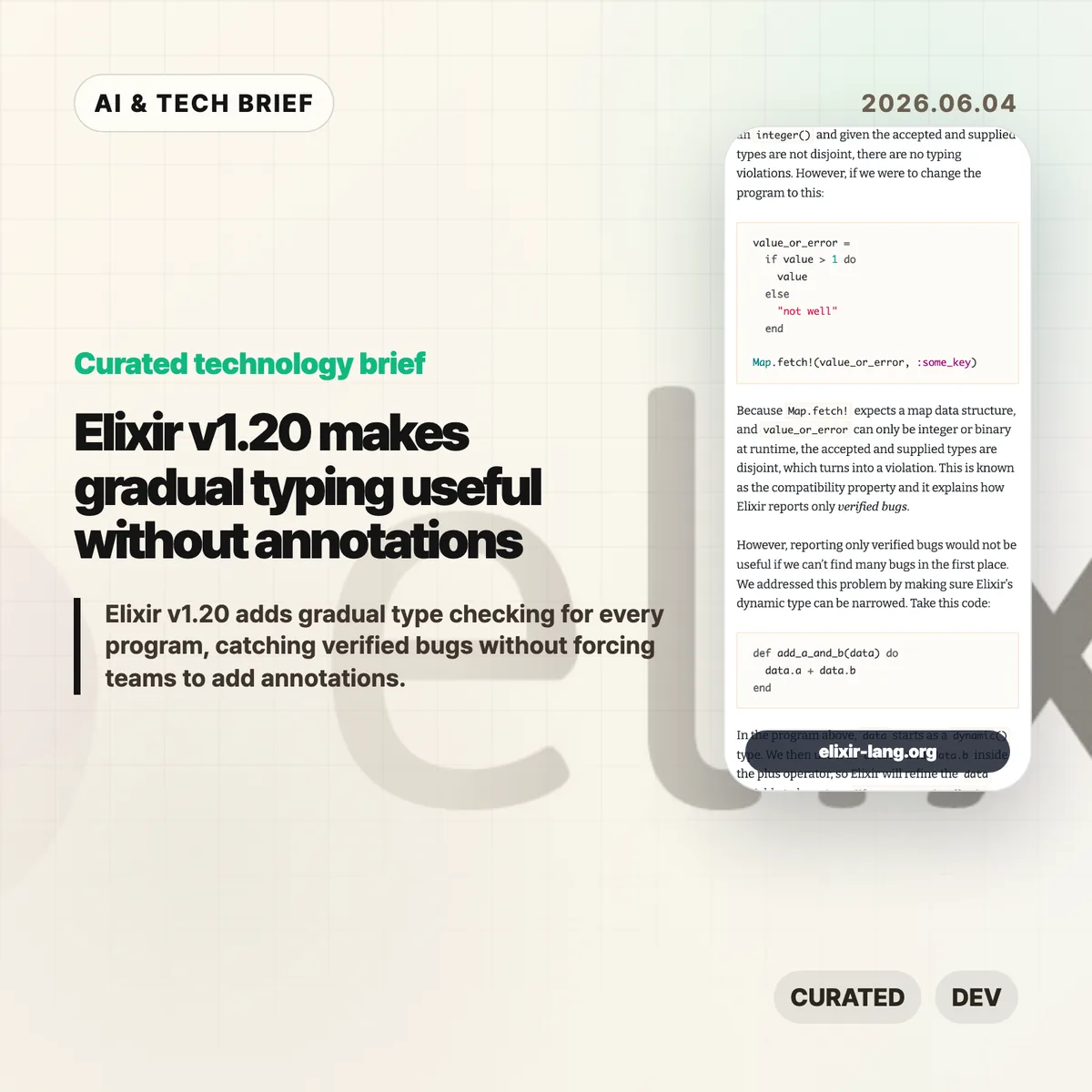
    The dynamic() type in Elixir v1.20 is not a polite spelling of “anything goes.” The release describes two properties: compatibility and narrowing. Compatibility means the compiler only reports a violation when the possible supplied type and the function’s accepted type are disjoint. Narrowing means the compiler keeps refining the possible type range as the program uses the value.

    A simple example from the release explains the difference. If a value can be either an integer or a binary, calling a function that accepts one of those types is not automatically an error. But passing the same value to a map-only function is a verified violation because neither integer nor binary overlaps with map. That choice trades aggressive warnings for developer trust. It will miss some questionable code, but the warnings it does produce should be harder to dismiss.

    What Hacker News readers are arguing about

    The Hacker News thread treated Elixir v1.20 as a serious language milestone, not a minor release-note item. The post drew more than 500 points and about 200 comments by June 4, 2026. The strongest positive thread was simple: gradual typing makes Elixir more attractive to developers who already like the BEAM model but hesitate because dynamic code can hide mistakes until production.

    The useful skepticism was less about the type system itself and more about adoption friction. Several commenters said Elixir and Phoenix can feel hard to learn because the ecosystem assumes familiarity with functional programming, OTP supervision, macros, optional parentheses, keyword lists, and LiveView’s security model. Others pushed back, pointing to ElixirForum, official guides, Elixir in Action, Erlang in Anger, Joy of Elixir, and the Phoenix LiveView security documentation as practical learning paths.

    The builder takeaway from that discussion is blunt: Elixir v1.20 improves compiler feedback, but it does not remove the need to learn the runtime model. Teams evaluating Elixir should test the new type checker on an existing service, then separately judge whether their team is comfortable with BEAM processes, supervision trees, Phoenix macros, and LiveView authorization patterns.

    The practical read

    Elixir v1.20 is not the release where Elixir gets user-written type signatures everywhere. The official post says typed struct definitions and broader type signatures still depend on more work around performance, recursive types, parametric types, and efficient traversal of map key-value pairs. Treat this release as the compiler starting to earn trust, not as the final typed-Elixir destination.

    For current Elixir teams, the obvious move is to upgrade a non-critical service first and read the new warnings with care. The warnings should identify code that is dead, redundant, or guaranteed to fail if reached. For teams outside the ecosystem, Elixir v1.20 is a reason to revisit the language if gradual typing was the missing piece. It is not a reason to ignore the learning curve. The runtime and framework model still matter as much as the new checker.

    Sources

  • Google AX puts agent runtime reliability ahead of model hype

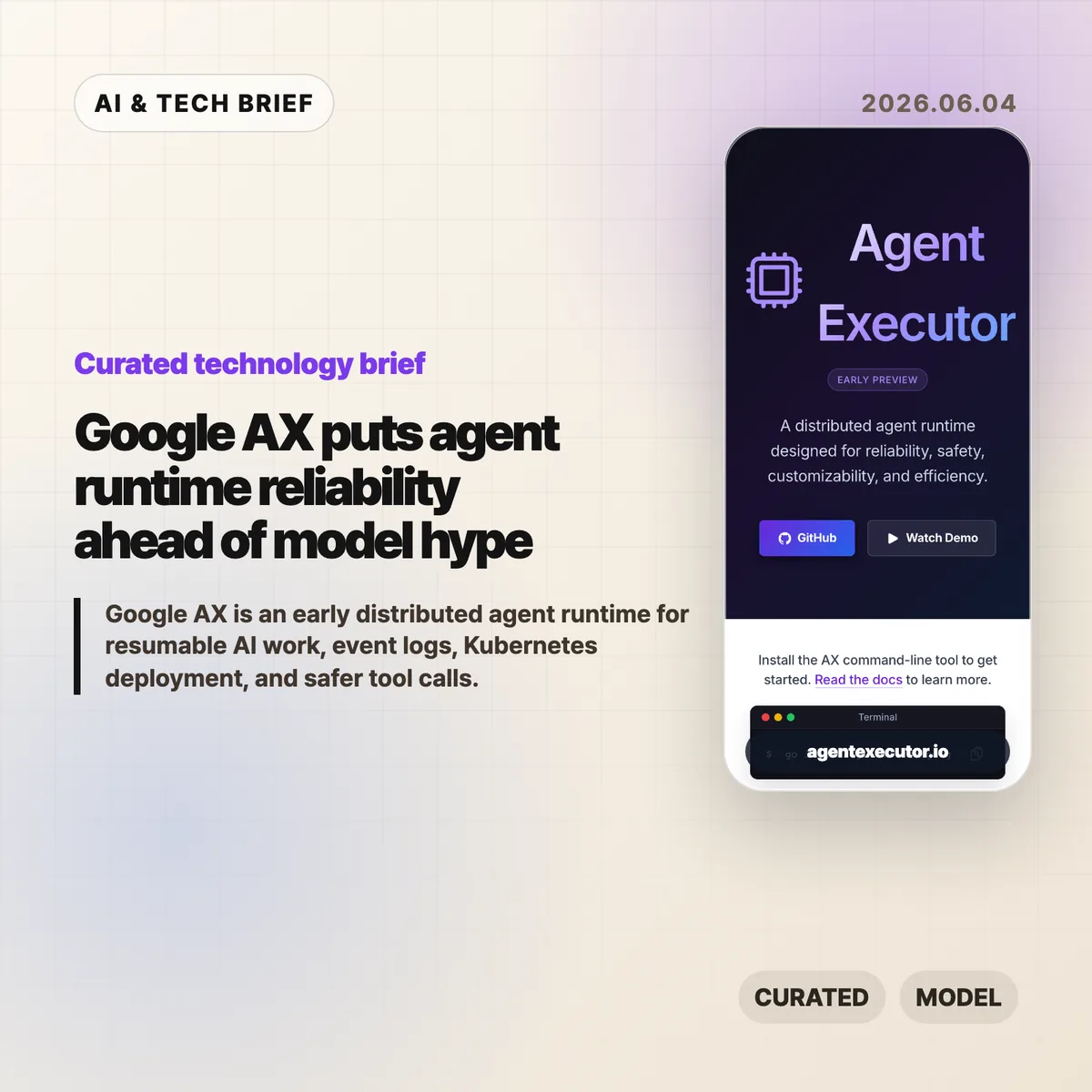
    Google AX puts agent runtime reliability ahead of model hype

    Google AX, short for Agent Executor, is Google’s Apache 2.0 early preview runtime for distributed AI agents in 2026. According to the google/ax README on GitHub, AX uses a controller to coordinate agentic loops, write an event log, and communicate with local and remote actors. The project focuses on resumable execution, isolated skills and tools, and Kubernetes-friendly deployment. Its clearest message is that agent apps need infrastructure for recovery and audit trails before they can be trusted with long-running work.

    AX also arrives with a blunt stability warning. According to Google, the core runtime, resumption protocols, and specifications are still being refined before a stable release, and external pull requests are paused for now. That makes the project useful as a map of Google’s agent infrastructure thinking, not a mature dependency to install casually.

    The short version

    • Google AX is an early preview distributed runtime for agentic applications, released under Apache 2.0 through the google/ax GitHub repository.
    • The runtime coordinates controllers, skills, tools, and agents as isolated actors instead of treating an agent as one large process.
    • Its strongest idea is resumability: AX keeps an event log so disconnected clients can catch up from the last event sequence they saw.
    • Google says AX is compute agnostic, but the project currently aims to work especially well on Kubernetes and Agent Substrate.
    • The practical signal is clear: serious agent products will compete on execution reliability, auditability, and recovery, not only on model choice.

    What happened

    Google published Agent Executor, or AX, as a distributed runtime for long-running AI work in 2026, and the repository is public under the Apache 2.0 license. According to the official site, AX is designed for reliability, safety, customizability, and efficiency. The GitHub README says AX coordinates agentic loops, manages executions with event logging, and communicates with both local and remote actors.

    The project is still marked as an early preview. Google warns that the core, resumption protocols, and runtime specifications are still changing, and that major breaking changes may arrive before a stable release. External pull requests are temporarily paused while the team stabilizes the architecture, though issues and feedback are still invited through GitHub and ax-dev@google.com.

    This is not a polished product announcement. It reads more like Google opening a systems layer early so developers can test assumptions before the stable runtime is cut. For more coverage like this, the IT & AI archive tracks developer infrastructure and AI platform shifts.

    Why Google AX is worth watching

    Google AX is worth watching because it names the boring problem that decides whether agents become products: execution has to survive interruptions. A useful agent may run for minutes, call tools, talk to remote services, and wait for external state. If a browser tab closes or a network connection drops, the runtime needs to know what happened and where to resume.

    AX addresses that with a single-controller model and a durable event log. The README calls this a Single-Writer Architecture: one controller owns state updates, which reduces ambiguity when skills, tools, and remote agents are running separately. The event log gives clients a way to replay missed events from the last sequence number they saw. That is catch-up, not a rewind of the whole conversation.

    The more agent apps look like background workers, the more this matters. Logging, replay, tool-call policy, and recovery become product features because users will blame the app when a long task silently dies.

    What does Google AX change for builders?

    Google AX changes the checklist for agent builders by pushing runtime questions closer to the start of product design. The README’s quick start uses ax exec, conversation IDs, and last-seen event sequences, which points to a product model where clients can disconnect and later catch up. Teams should ask how execution state is stored, which actor writes state, whether tool calls are auditable, and how a client reconnects after a failure.

    That is especially relevant for apps that hand work to agents in the background: code changes, data cleanup, research runs, customer support workflows, infrastructure checks, or multi-step automation. These jobs need more than a chat transcript. They need an execution record that can be inspected after the fact.

    The ASO angle is also practical. Agent apps and developer tools that can advertise reliable background runs, policy controls, and recoverable tool execution will be easier to trust in plugin stores, agent directories, and enterprise app catalogs.

    Kubernetes is part of the runtime bet

    Google AX is compute agnostic on paper, but Kubernetes is clearly part of the intended path. The README says AX aims to provide its best experience on Kubernetes, and the official site points to a demo running on Agent Substrate. The installation path also includes an AX CLI built from the GitHub repository.

    That matters because many agent demos still assume a single process, a friendly local environment, and short sessions. Kubernetes pushes the conversation toward schedulable workers, isolated actors, deployment manifests, recovery boundaries, and resource density. Google is effectively treating agent execution as an orchestration problem.

    For small experiments, that may feel heavy. For teams already running AI services on cloud infrastructure, it is a familiar trade-off: more operational surface area in exchange for clearer control over state, isolation, and scale.

    What Hacker News readers are arguing about

    The Hacker News thread is too small to support a real sentiment read. The submission had 2 points and one visible comment when checked through the public Algolia item API. That comment noted that AX is built on top of Kubernetes and Agent Substrate, which lines up with the project’s own deployment story.

    The useful takeaway is the absence of debate as much as the comment itself. There is no broad public argument yet about whether AX is too complex, whether Kubernetes is the right default, or how it compares with LangGraph, Temporal-style workflows, or other agent orchestration stacks. Builders should treat the thread as a pointer, not evidence of adoption.

    The questions worth asking are straightforward: how stable will the resumption protocol become, how much of the runtime depends on Google’s preferred substrate, and whether AX can stay useful for teams that do not want to put every agent workload on Kubernetes.

    The practical read

    Google AX is an early preview, so most teams should treat it as a design reference rather than production infrastructure. The README warns about breaking changes before a stable release, and Google has paused external pull requests while the core architecture settles. That is useful information: the runtime is public enough to study, but too young to bet a product deadline on.

    If you are building an agent product, use AX as a checklist. Can a user reconnect without losing state? Is every tool call visible later? Does one component own state writes? Can a failing worker be resumed instead of restarted from scratch? Can local tools, remote agents, and policy checks be separated cleanly?

    If those questions sound premature, the app is probably still a demo. If they sound painfully familiar, Google AX is worth tracking even before it is stable.

    Sources

  • Zstandard in Rust makes a low-level compression library safer

    Zstandard in Rust makes a low-level compression library safer

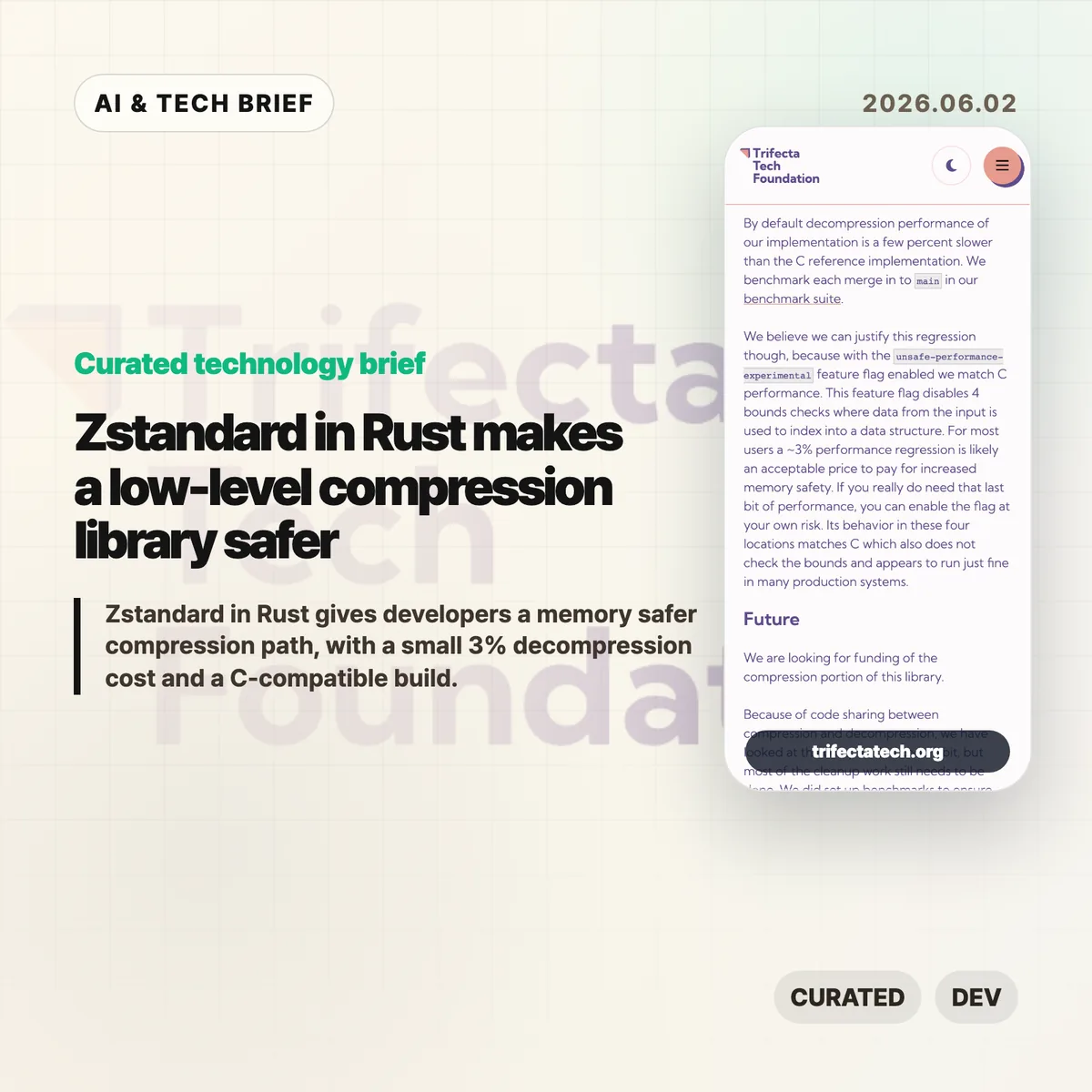
    Zstandard in Rust now has a public prerelease from Trifecta Tech Foundation, and the interesting part is where it sits: under web traffic, package managers, logs, build systems, and plenty of code that users never see. The project, libzstd-rs-sys, aims to provide a Rust implementation of Zstd that can also compile into a C-compatible static library. In plain terms, it is an attempt to make a common compression layer less dependent on memory-unsafe C without asking every downstream project to redesign its stack.

    The short version

    • Trifecta Tech Foundation has published libzstd-rs-sys version 0.0.1-prerelease.2, a Rust implementation of the Zstandard file format.
    • The cleaned-up decoder and dictionary builder are the most mature parts today; the encoder still needs more cleanup and funding.
    • Default decompression is a few percent slower than the C reference implementation, but Trifecta says the gap is about 3% for most users.
    • An unsafe-performance-experimental feature can match C performance by disabling four bounds checks, so the project is explicit about the safety-speed tradeoff.
    • Zstandard in Rust matters most for developers targeting Windows, WebAssembly, embedded systems, or cross compiled builds where a C toolchain can be the thing that breaks.

    What happened

    Trifecta Tech Foundation announced the first prerelease of libzstd-rs-sys, a Rust implementation of Zstandard. The repository describes the decoder as mostly cleaned up and ready for experimental use, while the dictionary builder has some remaining unsafe code and the encoder is still close to the raw c2rust translation.

    The foundation started from the Zstandard reference implementation, translated it with c2rust, and then cleaned up the decompression and dictionary builder paths. It tests the Rust code as a C static library against the reference implementation’s test suite. It also uses fuzz testing and Miri, which is the right kind of boring for a compression project. One bit wrong is still wrong.

    The work is not framed only as a Rust crate. Trifecta wants the library to compile into a drop-in compatible C library, similar to its earlier zlib and bzip2 work. That gives C projects a possible replacement path instead of limiting the work to Rust-only consumers.

    Zstandard in Rust details for builders

    For Rust developers, the first practical benefit is portability. The existing zstd crate already lets Rust code use Zstandard, but it compiles C code from source. That means the target needs a working C toolchain, and the target has to be supported by that C build path.

    That is usually manageable on mainstream Linux servers. It gets more annoying on Windows, WebAssembly, cross compiled targets, and smaller deployment environments. A dependency that stays inside the Rust toolchain can remove a surprising amount of build friction.

    There is also a software supply chain angle. Compression libraries are small enough to ignore and common enough to matter. If a safer implementation can be swapped in without breaking C callers, maintainers get a migration option instead of a rewrite plan. For more stories in this lane, the IT & AI archive tracks similar developer infrastructure shifts.

    Why this is worth watching

    The story is less about Zstd getting a shiny new language badge and more about where memory safety is moving. Rust rewrites usually get attention in browsers, kernels, cloud services, or command line tools. Compression sits lower. It is the kind of dependency that quietly spreads through many systems and then stays there for years.

    The performance numbers are also more honest than a lot of rewrite announcements. Trifecta says decompression is a few percent slower by default, and that most users may accept about a 3% cost for memory safety. If someone needs the last bit of speed, the experimental feature flag exists, but it turns off four bounds checks where input data indexes into structures. That is a clear choice, not marketing fog.

    The unfinished parts matter. The encoder still needs substantial cleanup, and the library is not described as battle-tested. The current release is a serious milestone, not a universal replacement for every Zstd deployment.

    What Hacker News readers are arguing about

    The Hacker News thread is tiny, so it should not be treated as a broad community read. The useful objection is specific: one commenter pointed to an existing pure Rust implementation, zstd-rs, and said the announcement should have compared against it directly.

    That criticism is fair. Trifecta explains why the current Rust zstd crate is not enough, because it still builds C code, but a reader can reasonably ask how libzstd-rs-sys differs from other pure Rust Zstd efforts. A comparison table would help: compatibility goals, C drop-in support, decoder maturity, encoder state, performance, unsafe code, and test coverage.

    The thread does not offer much more than that. Still, the comment catches the main editorial caveat: this project is easier to understand if you separate “Rust implementation for C-compatible replacement” from “another Rust library for Rust applications.”

    The practical read

    If you maintain software that already uses Zstd through the C reference implementation, watch libzstd-rs-sys but do not treat it as a finished migration path yet. The decoder looks like the part to test first. The encoder still needs work.

    If your pain is build portability, especially around Windows, WebAssembly, or cross compiled targets, Zstandard in Rust is more immediately interesting. The value is not only memory safety. It is fewer toolchain surprises.

    If performance is your reason to hesitate, benchmark your workload. A 3% decompression cost may be irrelevant for package downloads, logs, and background jobs. It may matter in a hot path. The experimental flag is there, but using it means accepting the same kind of unchecked indexing that Rust was supposed to help avoid.

    Sources

  • Website Specification turns web QA into a 128-point map

    Website Specification turns web QA into a 128-point map

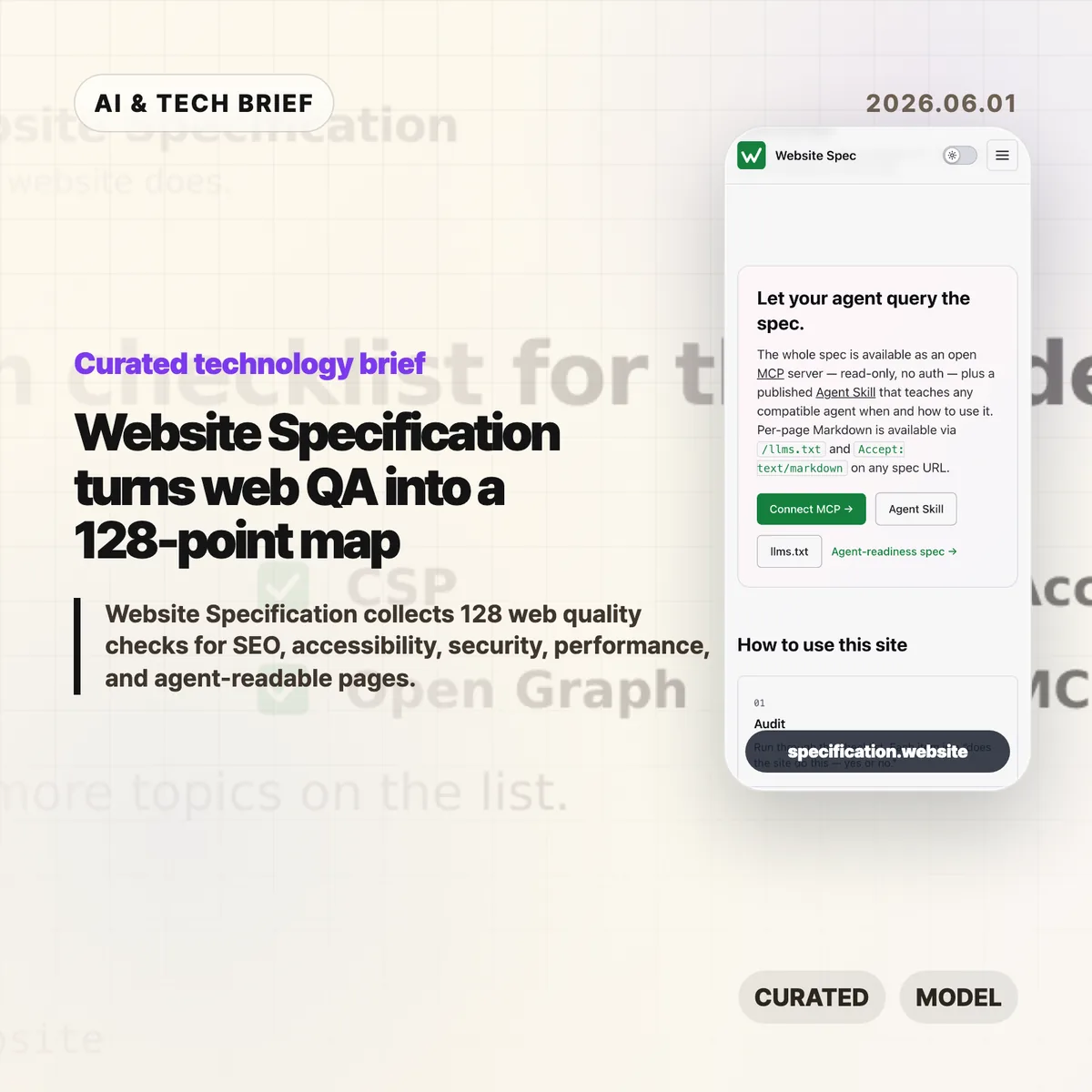
    Website Specification is a new open web checklist that tries to put the boring, easy-to-miss parts of a good site in one place. It covers 128 topics across SEO, accessibility, security, performance, privacy, resilience, internationalisation, and agent-readable surfaces such as Markdown pages and llms.txt.

    The short version

    • Website Specification is platform-agnostic: WordPress, Next.js, Astro, Django, Drupal, plain HTML, and other stacks are meant to be checked against the same list.
    • The project groups 128 topics into 10 areas, including foundations, SEO, accessibility, security, well-known URIs, agent readiness, performance, privacy, resilience, and internationalisation.
    • The useful part is not that every site must pass every item. It is that teams can discuss site quality with a shared map instead of a pile of scattered audit tools.
    • The controversial part is agent readiness. Hacker News readers liked the checklist but argued hard about llms.txt, MCP, and whether machine-facing pages invite abuse.

    What happened

    The Website Specification site describes itself as “a platform-agnostic specification of the technical features every decent website should have.” The home page points to familiar basics, such as <title>, /.well-known/security.txt, WCAG contrast, and llms.txt, then links into a full topic index.

    The index currently lists 128 topics across 10 categories. Foundations alone covers the doctype, <html lang>, UTF-8 charset, viewport, title, meta description, canonical URLs, favicons, theme color, Open Graph tags, feed discovery, and related basics. Other sections move into robots.txt, sitemaps, structured data, WCAG-aligned accessibility checks, security headers, Core Web Vitals, privacy signals, error handling, and language metadata.

    The project is also deliberately machine-readable. It publishes llms.txt, per-page Markdown via .md URLs or Accept: text/markdown, a full llms-full.txt, a public MCP server, and an Agent Skill. That makes the site a reference for humans, but also a test case for how web documentation might expose itself to AI coding tools and audit agents.

    Why this is worth watching

    Most website quality work is fragmented. One audit tool catches missing metadata. Another complains about contrast. A security scanner checks headers. A performance tool cares about images, caching, and script weight. Product teams often end up with a spreadsheet that mixes browser requirements, SEO advice, accessibility obligations, and someone’s personal preferences.

    Website Specification is interesting because it pulls those concerns into one model and cites the underlying sources: WHATWG, W3C, IETF RFCs, WCAG, MDN, IANA, and other web references. That does not make every recommendation equally urgent. It does make the tradeoffs easier to see.

    The agent-readable layer is the part to watch. A checklist that can be queried over MCP or consumed as Markdown is useful for AI-assisted QA, especially for teams building developer tools, site generators, CMS plugins, or agent workflows. If you track this space, the IT & AI archive is a good place to follow similar shifts in web tooling and AI developer infrastructure.

    Website Specification in practice

    For builders, the best use of Website Specification is probably as a deployment review, not a religion. A small landing page may not need every feed, structured data, or internationalisation detail. A public product site, docs site, or media site probably needs many more of them than its team remembers before launch.

    The checklist is also a useful way to split ownership. Engineers can handle headers, status codes, caching, redirects, and HTML correctness. Designers can review contrast, focus states, and readable layouts. Product and growth teams can own metadata, previews, search snippets, and feed behavior. The spec gives those conversations a common vocabulary.

    The weak spot is the same one that makes the project interesting: agent readiness is still unsettled. llms.txt, public MCP endpoints, and agent skills may help tools inspect a site, but they are not equivalent to browser standards or WCAG. Treat them as experiments until real adoption patterns become clearer.

    What Hacker News readers are arguing about

    The Hacker News discussion is split in a useful way. Many readers liked having a single checklist and said they discovered features they had missed, especially around /.well-known/ URLs and older web basics. A few developers with long experience said the list is handy precisely because websites accumulate quiet technical debt.

    The strongest objection is checklist inflation. Several commenters worried that a 128-item list could become another Jira mandate where teams must justify why a simple site does not implement every modern web feature. That is a fair concern. A spec like this is only helpful if teams can mark items as required, recommended, optional, or irrelevant for their context.

    The sharpest argument was about agent readiness. Some readers dismissed llms.txt as unsupported by major AI providers. Others argued that giving agents a separate surface could repeat old SEO problems, where machines see a cleaner or more flattering version of the site than humans do. The practical counterpoint is that plain Markdown, accessible HTML, and predictable URLs also help screen readers, search engines, archivers, and developer tools. The safest reading is boring but useful: make the human site clean first, then expose machine-readable versions only when they match the real content.

    The practical read

    If you run a website, use Website Specification as a triage tool. Start with the items that affect every visitor: valid HTML basics, mobile viewport, titles and descriptions, canonical URLs, accessible contrast and focus states, HTTPS, security headers, useful error pages, and reasonable performance.

    If you build web tooling, the project is more interesting as an interface pattern. A spec exposed through pages, Markdown, llms.txt, MCP, and an agent skill gives coding assistants something concrete to query. That could turn site QA from a vague prompt into a repeatable audit.

    Just do not let the checklist replace judgment. A good website still has to serve its users. The list helps you find gaps; it cannot decide which gaps matter this week.

    Sources

  • Zig build system cuts help startup from 150ms to 14.3ms

    Zig build system cuts help startup from 150ms to 14.3ms

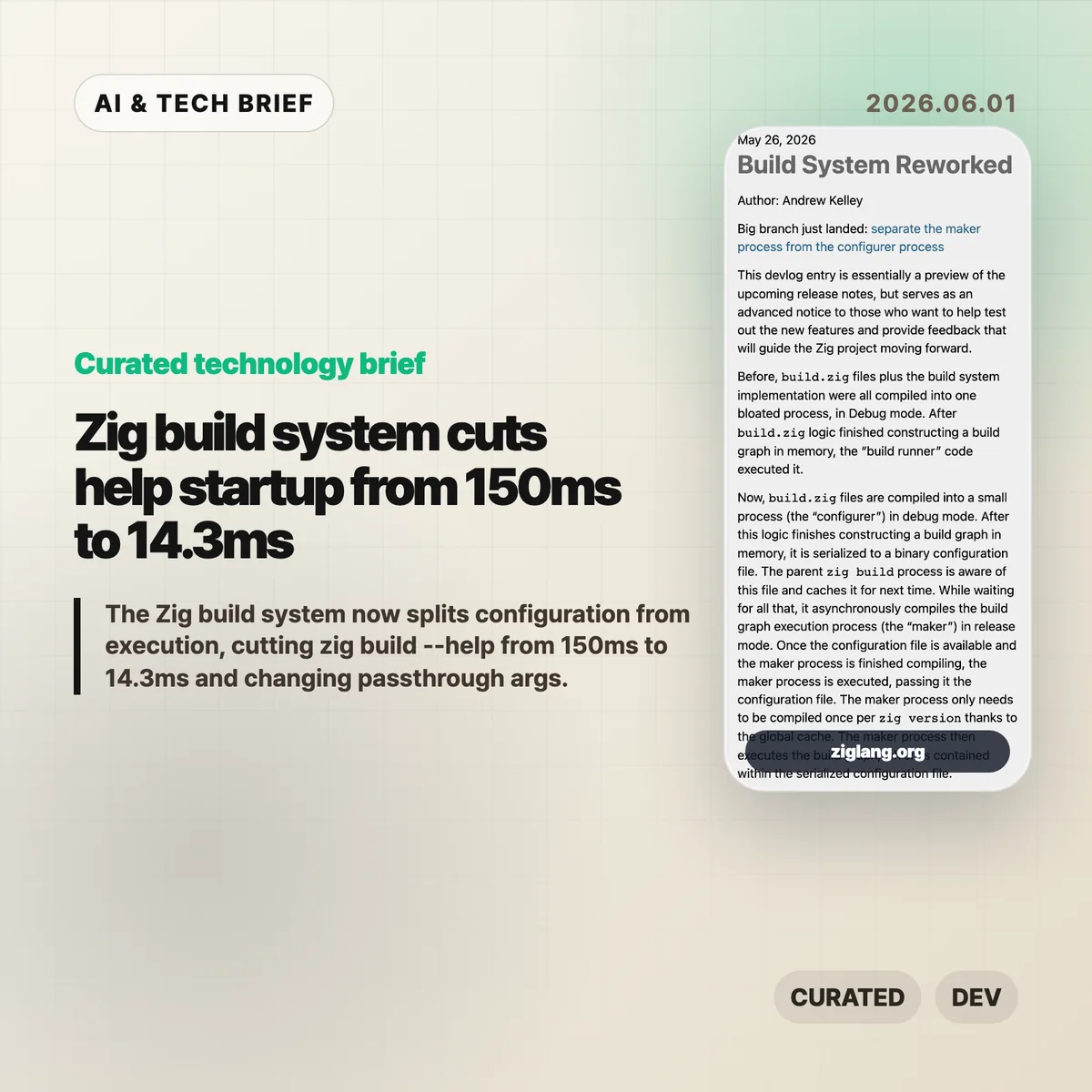
    The Zig build system has been split into two jobs: a small configuration step and a faster execution step. Andrew Kelley says the change cut zig build --help from 150ms to 14.3ms on the benchmark in Zig’s 2026 devlog, mostly by avoiding repeated work when the build graph has not changed.

    The short version

    • Zig now separates the configurer, which runs build.zig, from the maker, which executes the serialized build graph.
    • The benchmarked zig build --help path dropped from 150ms to 14.3ms, with CPU cycles down from 593M to 24.1M.
    • The Zig build system can reuse a cached binary configuration file when command-line changes do not alter the build graph.
    • Most build APIs remain compatible, but code that inspected b.args needs to move to addPassthruArgs().
    • The practical payoff is less waiting in watch mode, editor integrations, help output, and other small commands that developers run over and over.

    What happened

    Before this rework, a project’s build.zig file and Zig’s build runner implementation were compiled into one large Debug-mode process. The build script created a graph in memory, and the same combined process ran it.

    The new Zig build system splits that path. The configurer compiles and runs the user’s build.zig logic, then writes the resulting build graph as a binary configuration file. The parent zig build process can cache that file for later runs.

    Execution moves to the maker. Zig compiles the maker in Release mode, does that compilation asynchronously, and stores it in a global cache per Zig version. Once the cached config file and maker are ready, the maker executes the graph.

    That is a small architectural change with a very concrete point: editing a tiny build script should not force Zig to rebuild the whole build system machinery every time.

    Why this is worth watching

    The headline number is narrow but useful. Zig’s devlog says zig build --help fell from 150ms to 14.3ms in average wall time, a 90.4% reduction. CPU cycles fell 95.9%, instructions fell 95.6%, and cache references fell 94.3%.

    A help command is not the same thing as a full project build. Still, build tools spend a lot of time on short-lived commands: printing help, checking options, restarting watch mode, serving a web UI, or feeding data to an editor. Those are exactly the places where 100ms delays become noticeable.

    The cached configuration also means some command-line changes no longer force build.zig to run again. The devlog gives -freference-trace as an example: if the build graph does not change, Zig can reuse the previous configuration.

    For more developer tooling coverage, see the IT & AI archive.

    What changes for Zig build system users

    The rework is not meant to break most build scripts. The visible compatibility issue is passthrough arguments. Code that directly observed b.args and forwarded it with run_cmd.addArgs(args) now needs to use run_cmd.addPassthruArgs().

    That does remove one bit of observability from the build script. In return, changing those passthrough arguments no longer has to invalidate and rebuild the configuration step from source. It is the kind of trade that makes sense for a build tool: give up a rarely needed hook to make the common path cheaper.

    Zig 0.17.0 is expected within weeks, according to the devlog. Teams already using development builds should search for b.args patterns before upgrading. Everyone else can treat this as an early warning rather than a fire drill.

    What Hacker News readers are arguing about

    The Hacker News thread is less about the specific 150ms benchmark and more about whether Zig is becoming practical enough to use before 1.0.

    One camp is clearly encouraged. Several commenters said recent Zig releases have been disruptive but worth it, especially around I/O design and the feeling that Zig works well as a small tooling language. The recurring praise is not that Zig is magically faster everywhere. It is that the language feels good for low-level experiments without forcing as much ceremony as C++ or Rust.

    The skeptical side is also useful. Some readers pushed back on claims that the new I/O system is already highly efficient, pointing to dynamic dispatch, vtable indirection, and unresolved questions around async behavior. Others said they like Zig but are tired of release-to-release API churn and may wait for 1.0 before using it in serious projects.

    The build system change fits that split. It is a strong piece of engineering, but it lands in a language that is still moving quickly. If your project values stable tooling above all else, the number to watch is not 14.3ms. It is how much your build script changes between Zig releases.

    The practical read

    The Zig build system rework is worth watching because it attacks a boring part of developer experience that compounds all day. Fast compilers help, but fast tool startup matters too. If a build tool is called by editors, shells, watch processes, and documentation commands, every avoidable rebuild is a tax.

    For Zig users, the immediate task is simple: test development builds if you can, check for b.args, and read the 0.17.0 release notes when they land. For people building other developer tools, the design lesson is broader. Separate user configuration from execution, cache the serialized result, and make the hot path cheap enough that users stop noticing it.

    Sources

  • NixOS 26.05 makes early boot the upgrade to test first

    NixOS 26.05 makes early boot the upgrade to test first

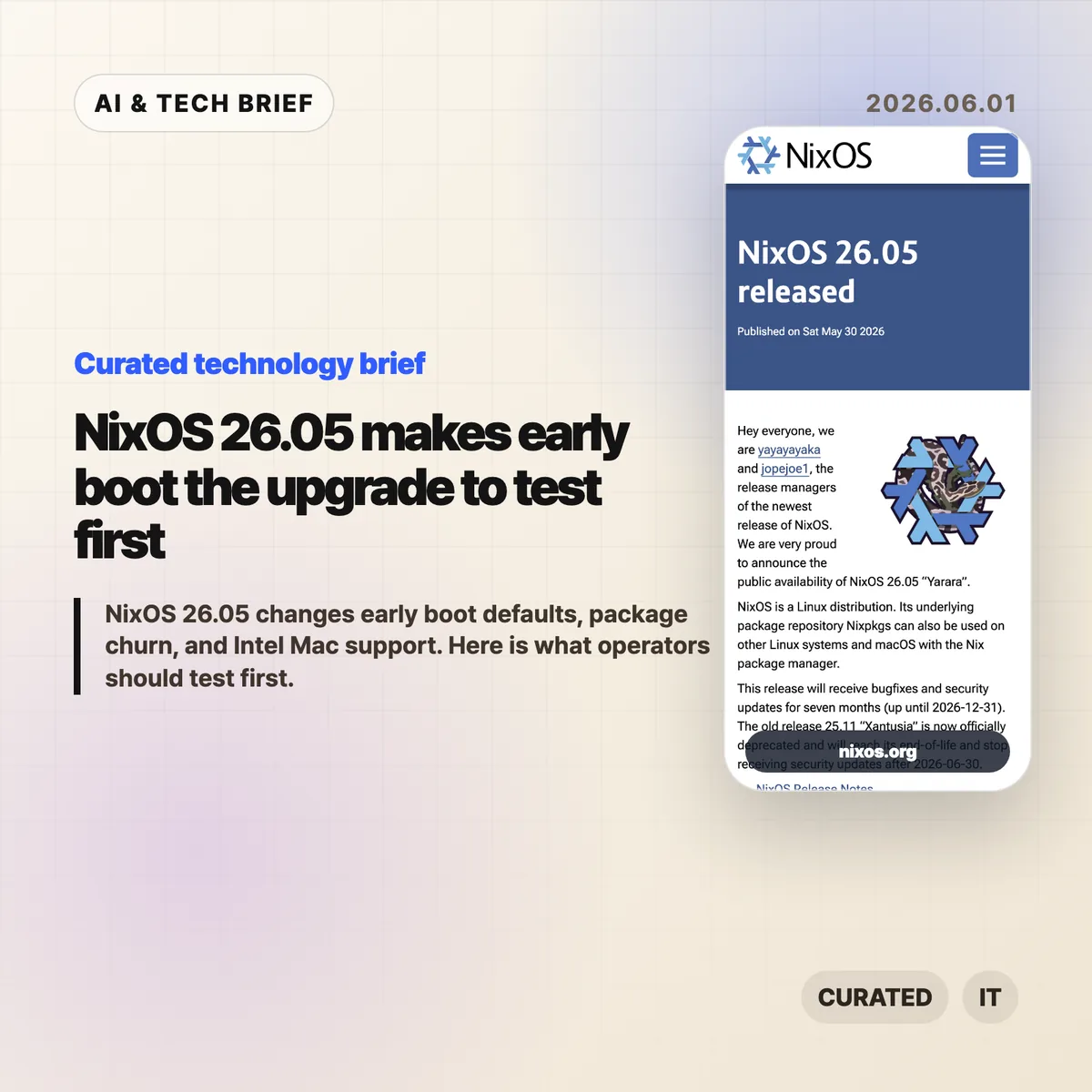
    NixOS 26.05 is less interesting as a package refresh than as an operations release. The headline change is that Stage 1, the early initrd phase before the root filesystem is mounted, now uses systemd by default. For teams that use NixOS because they like reproducible infrastructure, that is exactly the sort of default you test before touching production.

    The short version

    • NixOS 26.05, code-named “Yarara,” ships with seven months of bug fixes and security updates, ending on December 31, 2026.
    • Stage 1 is now systemd-based by default, while the old scripted implementation is deprecated and scheduled for removal in 26.11.
    • Nixpkgs added 20,442 packages, updated 20,641, and removed 17,532, so the release has real package churn.
    • This is the last Nixpkgs release to support x86_64-darwin, which matters for Intel Mac development setups.
    • GNOME 50 and GCC 15 are included, while LLVM stays at version 21.

    What happened

    NixOS 26.05 was announced on May 30, 2026 by the NixOS release managers. The release will receive fixes until December 31, 2026, while NixOS 25.11 reaches end of life on June 30, 2026.

    The scale is large even by Nixpkgs standards. The project says 2,842 contributors produced 59,703 commits for this cycle. Nixpkgs added 20,442 packages, updated 20,641, and removed 17,532 outdated packages. NixOS itself added 85 modules and 1,547 configuration options, while removing 25 modules and 355 options.

    The practical point is simple: NixOS 26.05 is not a casual channel bump for every machine. It deserves the same treatment as any infrastructure upgrade that touches boot behavior, package availability, desktop components, and compiler defaults.

    Why this is worth watching

    The most operationally sensitive change is Stage 1. This is the early boot environment inside initrd, before the system has mounted the real root filesystem. In NixOS 26.05, that stage is now based on systemd by default.

    That may be a welcome cleanup for many users. It aligns early boot with the system manager most Linux operators already know. But it also changes the assumptions around custom initrd hooks, encrypted disks, unusual storage layouts, network boot, recovery flows, and any setup that depended on the older scripted implementation.

    The old scripted Stage 1 is deprecated in this release and scheduled for removal in NixOS 26.11. That gives operators a clear window: test the new path now, while rollback is still easy and the old behavior has not disappeared.

    Nixpkgs 26.05 is also the last release that will support x86_64-darwin. The project says it will keep platform support and binary builds available until Nixpkgs 26.05 goes out of support at the end of 2026. After that, Nixpkgs 26.11 will no longer build packages for x86_64-darwin or support building them from source.

    The stated reasons are ordinary but important: Apple has moved away from the platform, build infrastructure is limited, and volunteer maintainer time is finite. If your team still uses Intel Macs with Nix-managed development shells, this is the moment to decide whether those machines stay pinned, move to Apple Silicon, shift to Linux builders, or run more of the workflow remotely.

    For teams that discover developer tools through package sets and reproducible environments, this is also an app-store-like discovery issue in miniature. The packages that remain easy to install tend to become the tools people actually try. That is why Nix and Linux operations stories often belong beside broader coverage in the IT & AI archive, even when they are not about AI directly.

    NixOS 26.05 upgrade checklist

    Use this release to check the parts of your setup that are hardest to fix after a reboot: initrd behavior, disk access, network boot, Intel Mac builders, compiler-sensitive packages, and desktop extensions.

    What Hacker News readers are arguing about

    The Hacker News thread is small, so it should not be treated as a broad community poll. The useful signal is still clear enough.

    One commenter focused on the package numbers. Updating roughly 20,000 packages sounded plausible given the size of Nixpkgs, but adding 20,442 and removing 17,532 looked unusually high. The question was whether renames or accounting details inflated the turnover, since recent releases had reportedly added closer to 7,000 or 8,000 packages.

    Another commenter pointed at the new NixOS modules as the fun part of each release. That is a good reminder of how people actually use NixOS release notes: not only to check breaking changes, but to discover mature projects that have become first-class enough to get a module.

    The thread is too thin for a verdict on NixOS 26.05. It does show the two checks many Nix users care about: how much churn is real, and what new modules are worth stealing ideas from.

    The practical read

    If you run NixOS on servers or workstations, start with machines that have custom boot behavior. Verify systemd Stage 1 with encrypted storage, remote disk access, nonstandard filesystems, or hardware-specific initrd logic before the old scripted path is removed.

    If you maintain development environments, audit package removals and compiler-sensitive builds. GCC 15 can expose warnings or build failures that were hidden before. GNOME 50 is also worth testing on machines with extensions or display-specific settings.

    If you still depend on Intel Mac builders or x86_64-darwin development shells, treat NixOS 26.05 as the last comfortable planning point. Pinning may buy time, but it is not the same as staying on the maintained path.

    The best upgrade plan is boring: test one representative machine, keep rollback generations available, read the release notes for the modules you use, and only then move the wider fleet.

    Sources

  • Files SDK tries to make blob storage less annoying

    Files SDK tries to make blob storage less annoying

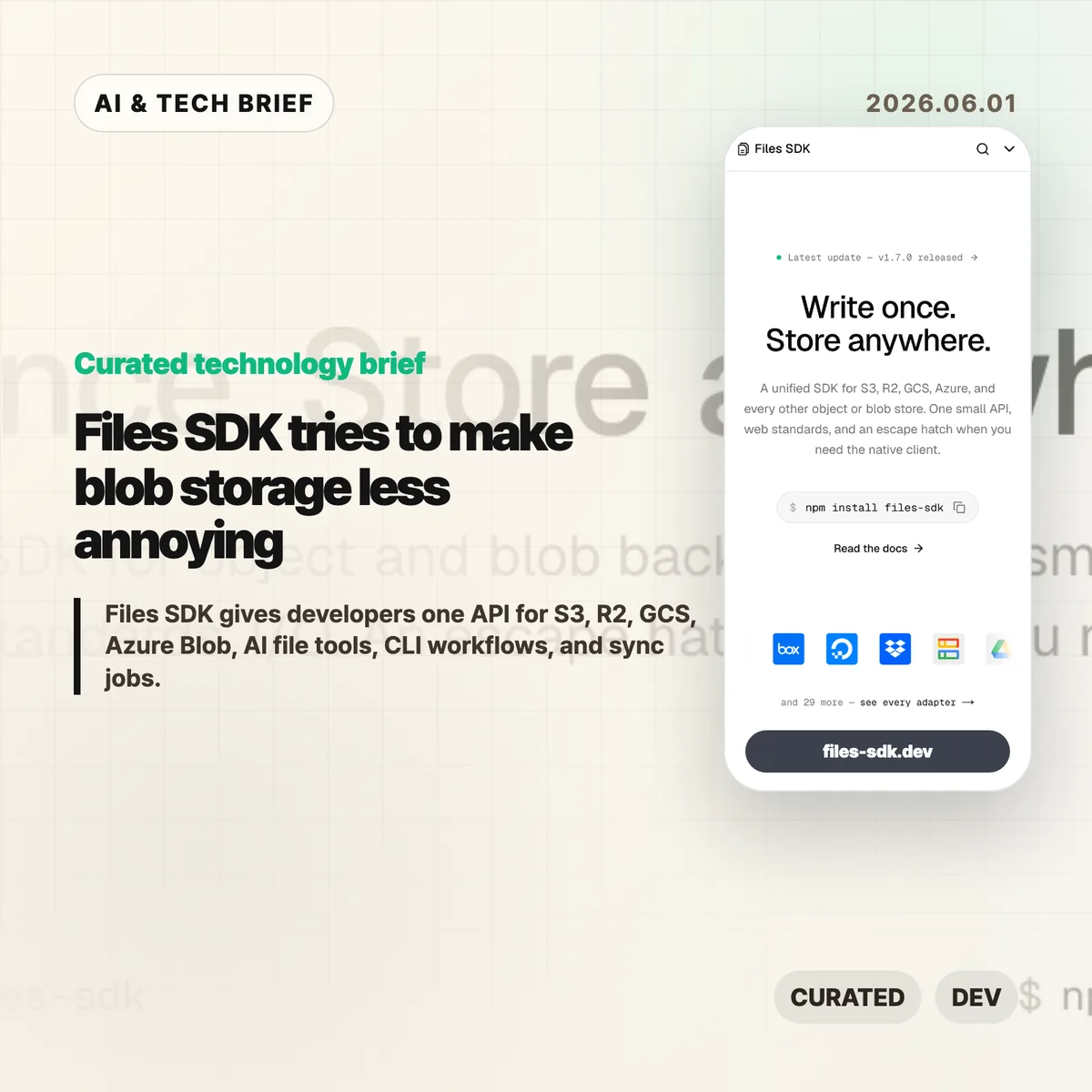
    Files SDK is an open source JavaScript storage library that puts S3, Cloudflare R2, Google Cloud Storage, Azure Blob, Vercel Blob, Netlify Blobs, MinIO, and other backends behind one file API. The pitch is simple: swap the adapter, keep the upload, download, list, head, copy, move, and delete calls mostly the same. For teams that keep writing the same storage glue in different projects, that is a boring problem worth solving.

    The short version

    • Files SDK advertises 40+ adapters, optional peer dependencies for provider clients, and npm install files-sdk as the base install path.
    • Version 1.7.0, published on May 31, 2026, adds sync() for incremental mirrors, dry runs, pruning, directory-style listing, and related CLI and MCP support.
    • The useful part is not that every storage backend becomes identical. It is that the common path gets smaller while escape hatches remain for native clients.
    • The agent angle matters: Files SDK can generate file tools for the Vercel AI SDK, OpenAI Agents, Claude, and MCP with read-only mode and approval gates.

    What happened

    The project site describes Files SDK as “one API” for object and blob storage, with examples for S3, R2, GCS, Azure Blob, Vercel Blob, Netlify Blobs, and MinIO. Its live snippets show the same basic sequence across providers: create a Files instance with an adapter, then call methods such as upload, download, head, list, and delete.

    The GitHub repository describes the package as a unified storage SDK for object and blob backends with web standards I/O and an escape hatch for native clients. The package is MIT licensed, authored by Hayden Bleasel, and published as an ES module package with a CLI binary named files.

    The latest release is files-sdk@1.7.0. The release notes add a few details that make the project more than a wrapper around upload and download. The new sync() API can mirror one provider into another, skip objects that already match, prune destination keys in mirror mode, and run a dry-run plan before it writes. The same release also adds directory-style listing through a delimiter option.

    Why this is worth watching

    Files SDK is aimed at the code that tends to age badly: migrations, backup scripts, user upload flows, admin tools, and one-off operations that quietly become production dependencies. If a product starts on S3, adds R2 for cheaper egress, stores some files in Vercel Blob, and later needs a GCS migration path, the API differences start leaking everywhere.

    A small abstraction can help there. It gives teams one place to handle routine file work, one CLI surface for scripts and CI, and one shape for bulk operations. The docs call out bounded concurrency for batch calls, async iterable listings, multipart upload, upload progress callbacks, byte-range downloads that map to HTTP 206, and lifecycle hooks such as onAction, onRetry, and onError.

    There is a catch. Storage providers differ in permissions, consistency behavior, object metadata, signed URL rules, regional constraints, and billing. Files SDK looks most useful when teams use it for the shared 80 percent and keep provider-native clients for the cases where those differences matter.

    For more developer tool briefs, the IT & AI archive keeps related coverage in one place.

    What the discussion is missing

    I could not find a public Hacker News thread for Files SDK in the usual search surface, so there is no community consensus to summarize yet. That leaves a few things buyers and maintainers should check directly.

    First, adapter depth matters more than adapter count. A list of 40+ adapters is useful only if the ones you need handle pagination, metadata, retries, range reads, signed URLs, and edge cases the way your app expects. Second, the AI agent file tools deserve a security review before anyone gives them write or delete access. Approval gates and read-only mode are good defaults, but the risk depends on what buckets, paths, and credentials the agent can reach.

    The missing debate is probably where the value lives: is this a clean common layer for boring file work, or will teams hit backend-specific behavior quickly enough that they return to native SDKs? That answer will vary by workload.

    Files SDK in practice

    Files SDK is worth testing if your team already has more than one blob store, expects to migrate between providers, or keeps rebuilding storage scripts for backups and cleanup. Start with a narrow path: list a prefix, copy a few objects, run sync() in dry-run mode, and compare the result against the provider’s native SDK.

    The practical read

    For AI workflows, keep the first integration read-only. Let an agent list and read files before it can upload, move, delete, or sync anything. If write tools are needed, put approval gates on destructive actions and limit the adapter credentials to the smallest bucket or prefix that works.

    Ignore the abstraction if your product depends heavily on provider-specific features. In that case, Files SDK may still be useful for CLI chores or migration scripts, but the core application path should stay close to the native client.

    Sources

  • Claw Patrol agent firewall puts action-level limits on AI agents

    Claw Patrol agent firewall puts action-level limits on AI agents

    The Claw Patrol agent firewall is an open source security layer for teams that want AI agents to touch production systems without handing them raw secrets or blank-check access. It sits between agents and services such as Postgres, ClickHouse, Kubernetes, GitHub, and Slack, then checks the actual request before it goes out.

    The short version

    • Claw Patrol keeps credentials outside the agent process and injects them only after a request passes policy checks.
    • The system can inspect HTTP method and body, SQL verbs and functions, and Kubernetes resources and verbs instead of stopping at a coarse network allowlist.
    • Risky requests can pause for an LLM judge or a human reviewer in Slack, a dashboard, or a webhook.
    • Teams can record real actions as JSON fixtures and run policy regression tests with clawpatrol test before changing rules.
    • The practical question is whether action-level security becomes a normal requirement for production AI agents.

    Claw Patrol agent firewall notes

    The Claw Patrol agent firewall is best understood as a policy checkpoint for live agent actions, not as another chatbot wrapper. It watches what the agent is about to send to production systems and decides whether that specific request deserves to pass.

    What happened

    Deno’s Claw Patrol project describes itself as “the security firewall for agents.” The idea is simple enough: agents route traffic through a gateway, and the gateway decides whether a specific action should be allowed, denied, logged, or sent for approval before it reaches the destination service.

    That distinction matters. OAuth scopes, IAM roles, and Kubernetes RBAC usually answer the access question: can this identity reach a service or resource? Claw Patrol is aimed at the next question: once the agent has a path to the service, what is it trying to do?

    The project gives concrete examples. A Postgres-capable agent may be allowed to run ordinary reads but blocked from calling functions such as pg_read_file, pg_read_binary_file, lo_get, or dblink_ routines. A Kubernetes agent may be allowed to inspect pods but forced through an LLM review before kubectl exec commands run. HTTP requests can be matched by method, path, headers, and body, then routed through custom approval logic.

    Claw Patrol can run as a gateway, join a gateway over WireGuard or Tailscale, or wrap a single agent process with clawpatrol run. The GitHub repository is MIT licensed and had 518 stars when checked for this brief.

    Why this is worth watching

    The Claw Patrol agent firewall points at a real gap in agent deployments. Prompt filtering and output scanning help, but they do not fully answer what happens when an agent already has a database password, a Kubernetes context, or an API token. A compromised or confused agent with those credentials can still make valid-looking calls.

    Moving the control point to the wire changes the shape of the problem. The agent can ask to do something, but the gateway can parse the request and make a second decision using operational facts: SQL verb, table name, Kubernetes namespace, HTTP route, request body, approval status, and prior policy tests.

    That is more useful than treating agent security as a model-only problem. It fits the way infrastructure teams already think: credentials, policy, logs, approvals, and regression tests. For readers tracking adjacent tools, the broader IT & AI archive is where we keep similar developer infrastructure briefs.

    What the discussion is missing

    I could not find a public Hacker News discussion tied to the Claw Patrol release. That absence is worth noting because the project raises the sort of questions operators usually pick apart in public: latency, failure modes, policy drift, coverage across protocols, and whether LLM approval adds a new weak point.

    The useful debate should be about boundaries. A gateway can stop a class of bad requests, but it still depends on accurate parsing, careful policy writing, and safe defaults when a reviewer or model is unavailable. Claw Patrol says human approval can time out closed, which is the right direction, but teams will need to test how that behaves during real incidents.

    There is also a deployment tradeoff. Routing an agent through WireGuard, Tailscale, NetworkExtension, or a per-process tunnel is cleaner than sprinkling checks through every tool call, but it adds another piece of infrastructure. Some teams will accept that cost for production agents. Others will keep agents away from production until the risk model is simpler.

    The practical read

    If your agents only run local coding chores, the Claw Patrol agent firewall may be more machinery than you need. The moment an agent can touch production data, customer communication, deployment systems, or cloud APIs, action-level controls start to look less optional.

    The first test is narrow: pick one dangerous action and see whether the policy can express it without blocking normal work. For a database, that might mean allowing read-only queries while denying filesystem-reaching functions. For Kubernetes, it might mean allowing inspection commands while pausing exec, deletes, and secret reads for review.

    The second test is operational. Check whether the audit log is clear enough to reconstruct what happened, whether recorded fixtures catch policy regressions, and whether approval timeouts fail closed. If those pieces work, the tool becomes more than an agent demo accessory. It becomes part of the production safety case.

    Sources

  • SQLite agentic code policy draws a hard line for AI patches

    SQLite agentic code policy draws a hard line for AI patches

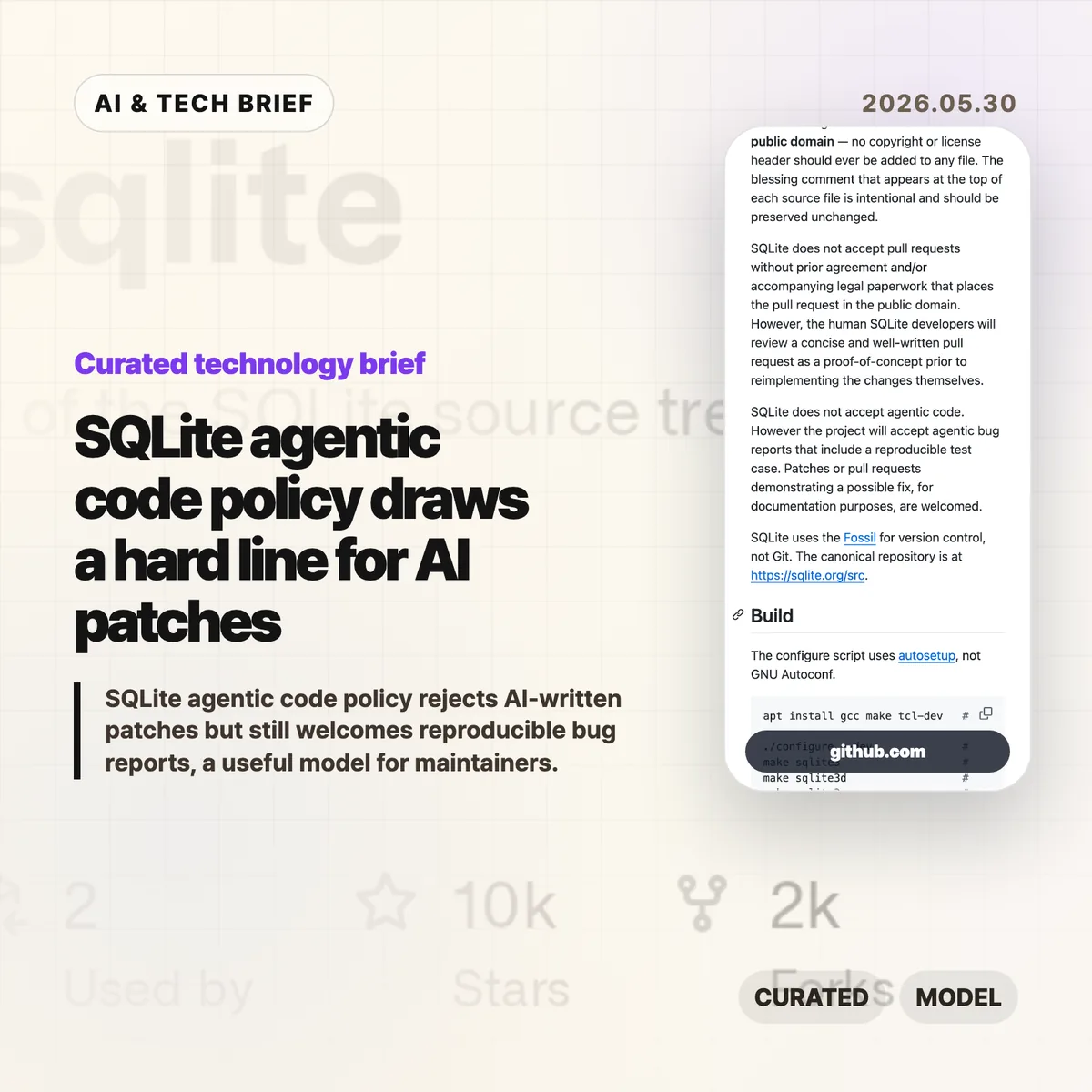
    SQLite added a plain rule to its repository guidance: it does not accept SQLite agentic code as a contribution. The project still welcomes bug reports that include a reproducible test case, which makes this less of an anti-AI manifesto and more of a maintenance boundary for a public-domain database used almost everywhere.

    The short version

    • SQLite’s AGENTS.md says the project does not accept agentic code, even though maintainers may review concise proof-of-concept patches before reimplementing changes themselves.
    • The project separates code contributions from bug reports: AI-assisted reports are acceptable when they include a reproducible test case.
    • The policy is tied to public-domain requirements, long-lived C code, Fossil-based development, and the cost of reviewing patches the maintainers did not write.
    • For AI coding tools, the useful lesson is blunt: a good repro may travel farther than a generated patch.

    What happened

    SQLite now has an AGENTS.md file aimed at people pointing coding agents at the SQLite source tree. The file explains project basics, build commands, testing commands, repository conventions, and contribution rules.

    The sharp part is the contribution policy. SQLite says it does not accept pull requests without prior agreement or legal paperwork that places the contribution in the public domain. It also says, in a separate sentence, that SQLite does not accept agentic code. Maintainers may still review a short, well-written pull request as a proof of concept, but the human SQLite developers reimplement accepted ideas themselves.

    That distinction matters because SQLite is not run like a typical GitHub-first project. Its canonical repository is Fossil, not Git, and its public-domain status is part of the project’s identity. A generated patch is not only a review burden. It can also blur authorship and provenance in a codebase that treats those details seriously.

    Why this is worth watching

    Most open source projects will not copy SQLite word for word. Plenty of maintainers do accept pull requests, and many projects live inside GitHub’s normal review flow. Still, SQLite has given maintainers a clean pattern: reject AI-written code as merge material while accepting AI-assisted evidence when it helps a human reproduce the problem.

    That is a useful split. A patch asks maintainers to trust the author, the code path, the licensing story, the tests, and the future maintenance cost. A reproducible bug report asks them to verify a failure. Those are different jobs.

    The wider lesson for developer tools is that output format matters. If an AI coding assistant produces a patch with no small failing test, it may be creating work for the maintainer. If it produces a minimal case, commands to reproduce it, and enough context for a person to inspect the failure, it has a better chance of being useful.

    For more coverage of developer-tool policy and AI engineering practice, see the IT & AI archive.

    What Hacker News readers are arguing about

    The Hacker News thread around Simon Willison’s write-up is small, so there is not enough there to claim a broad community consensus. The useful point in the comments is a clarification: SQLite is not refusing every artifact touched by an agent. It is refusing agent-written code as codebase input, while still allowing possible fixes to appear as documentation and accepting reproducible bug reports.

    A related earlier discussion on the prototype AGENTS.md commit framed the policy as a reasonable compromise. The tone was less “AI is banned” and more “give agent users rules, then keep generated code out of the project unless a human maintainer owns the final implementation.” That reading fits the file itself.

    The argument that remains open is practical. If AI tools get better at producing tests, minimization steps, and failure cases, maintainers may welcome them as triage tools. If the tools mostly produce plausible patches, projects with strict ownership rules will keep pushing back.

    SQLite agentic code policy in practice

    SQLite agentic code is the wrong deliverable for this project. A reproducible test case is the right one.

    That should influence how developers use coding agents around mature open source infrastructure. Instead of asking an agent to “fix SQLite,” ask it to isolate the failing behavior, reduce the input, show the exact command that fails, and explain why the result conflicts with documented behavior. If a patch is generated along the way, treat it as a debugging note, not as something to submit.

    For coding-agent companies, this is also a product signal. The next useful feature may not be a bigger diff. It may be a maintainer-friendly report: environment, build command, failing test, expected result, actual result, and a short explanation a human can audit.

    The practical read

    If you maintain an open source project, SQLite’s policy is a good starting template even if you soften the wording. Say whether you accept AI-written patches. Say whether AI-assisted bug reports are allowed. Say what evidence makes a report useful. The policy does not need to be dramatic; it needs to reduce ambiguity before the first generated pull request lands.

    If you contribute to projects with AI help, submit less code and better evidence. A concise failing test and reproduction steps respect the maintainer’s time. A large generated patch shifts the risk to someone else.

    Sources