Tag: Kubernetes

  • Google AX puts agent runtime reliability ahead of model hype

    Google AX puts agent runtime reliability ahead of model hype

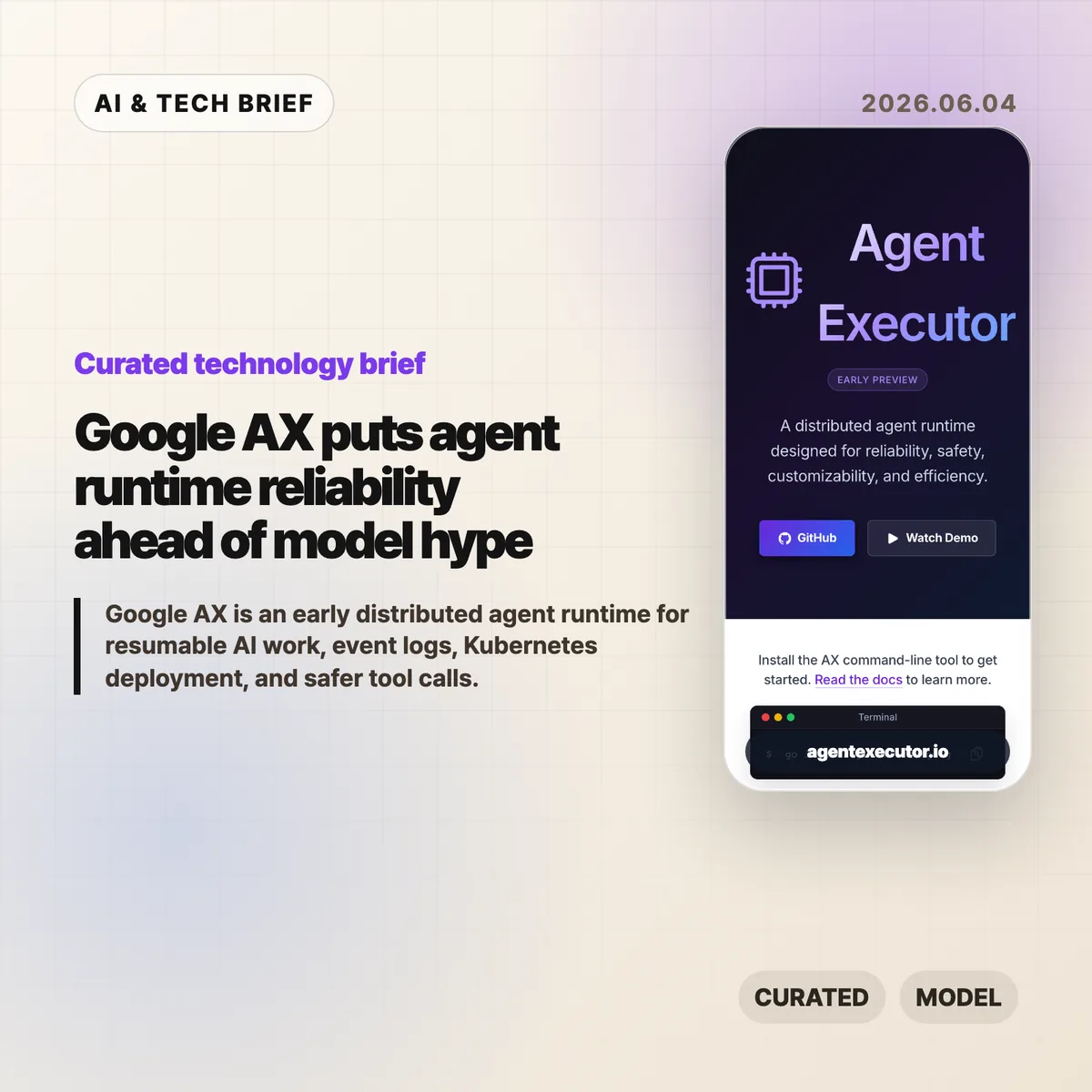
    Google AX, short for Agent Executor, is Google’s Apache 2.0 early preview runtime for distributed AI agents in 2026. According to the google/ax README on GitHub, AX uses a controller to coordinate agentic loops, write an event log, and communicate with local and remote actors. The project focuses on resumable execution, isolated skills and tools, and Kubernetes-friendly deployment. Its clearest message is that agent apps need infrastructure for recovery and audit trails before they can be trusted with long-running work.

    AX also arrives with a blunt stability warning. According to Google, the core runtime, resumption protocols, and specifications are still being refined before a stable release, and external pull requests are paused for now. That makes the project useful as a map of Google’s agent infrastructure thinking, not a mature dependency to install casually.

    The short version

    • Google AX is an early preview distributed runtime for agentic applications, released under Apache 2.0 through the google/ax GitHub repository.
    • The runtime coordinates controllers, skills, tools, and agents as isolated actors instead of treating an agent as one large process.
    • Its strongest idea is resumability: AX keeps an event log so disconnected clients can catch up from the last event sequence they saw.
    • Google says AX is compute agnostic, but the project currently aims to work especially well on Kubernetes and Agent Substrate.
    • The practical signal is clear: serious agent products will compete on execution reliability, auditability, and recovery, not only on model choice.

    What happened

    Google published Agent Executor, or AX, as a distributed runtime for long-running AI work in 2026, and the repository is public under the Apache 2.0 license. According to the official site, AX is designed for reliability, safety, customizability, and efficiency. The GitHub README says AX coordinates agentic loops, manages executions with event logging, and communicates with both local and remote actors.

    The project is still marked as an early preview. Google warns that the core, resumption protocols, and runtime specifications are still changing, and that major breaking changes may arrive before a stable release. External pull requests are temporarily paused while the team stabilizes the architecture, though issues and feedback are still invited through GitHub and ax-dev@google.com.

    This is not a polished product announcement. It reads more like Google opening a systems layer early so developers can test assumptions before the stable runtime is cut. For more coverage like this, the IT & AI archive tracks developer infrastructure and AI platform shifts.

    Why Google AX is worth watching

    Google AX is worth watching because it names the boring problem that decides whether agents become products: execution has to survive interruptions. A useful agent may run for minutes, call tools, talk to remote services, and wait for external state. If a browser tab closes or a network connection drops, the runtime needs to know what happened and where to resume.

    AX addresses that with a single-controller model and a durable event log. The README calls this a Single-Writer Architecture: one controller owns state updates, which reduces ambiguity when skills, tools, and remote agents are running separately. The event log gives clients a way to replay missed events from the last sequence number they saw. That is catch-up, not a rewind of the whole conversation.

    The more agent apps look like background workers, the more this matters. Logging, replay, tool-call policy, and recovery become product features because users will blame the app when a long task silently dies.

    What does Google AX change for builders?

    Google AX changes the checklist for agent builders by pushing runtime questions closer to the start of product design. The README’s quick start uses ax exec, conversation IDs, and last-seen event sequences, which points to a product model where clients can disconnect and later catch up. Teams should ask how execution state is stored, which actor writes state, whether tool calls are auditable, and how a client reconnects after a failure.

    That is especially relevant for apps that hand work to agents in the background: code changes, data cleanup, research runs, customer support workflows, infrastructure checks, or multi-step automation. These jobs need more than a chat transcript. They need an execution record that can be inspected after the fact.

    The ASO angle is also practical. Agent apps and developer tools that can advertise reliable background runs, policy controls, and recoverable tool execution will be easier to trust in plugin stores, agent directories, and enterprise app catalogs.

    Kubernetes is part of the runtime bet

    Google AX is compute agnostic on paper, but Kubernetes is clearly part of the intended path. The README says AX aims to provide its best experience on Kubernetes, and the official site points to a demo running on Agent Substrate. The installation path also includes an AX CLI built from the GitHub repository.

    That matters because many agent demos still assume a single process, a friendly local environment, and short sessions. Kubernetes pushes the conversation toward schedulable workers, isolated actors, deployment manifests, recovery boundaries, and resource density. Google is effectively treating agent execution as an orchestration problem.

    For small experiments, that may feel heavy. For teams already running AI services on cloud infrastructure, it is a familiar trade-off: more operational surface area in exchange for clearer control over state, isolation, and scale.

    What Hacker News readers are arguing about

    The Hacker News thread is too small to support a real sentiment read. The submission had 2 points and one visible comment when checked through the public Algolia item API. That comment noted that AX is built on top of Kubernetes and Agent Substrate, which lines up with the project’s own deployment story.

    The useful takeaway is the absence of debate as much as the comment itself. There is no broad public argument yet about whether AX is too complex, whether Kubernetes is the right default, or how it compares with LangGraph, Temporal-style workflows, or other agent orchestration stacks. Builders should treat the thread as a pointer, not evidence of adoption.

    The questions worth asking are straightforward: how stable will the resumption protocol become, how much of the runtime depends on Google’s preferred substrate, and whether AX can stay useful for teams that do not want to put every agent workload on Kubernetes.

    The practical read

    Google AX is an early preview, so most teams should treat it as a design reference rather than production infrastructure. The README warns about breaking changes before a stable release, and Google has paused external pull requests while the core architecture settles. That is useful information: the runtime is public enough to study, but too young to bet a product deadline on.

    If you are building an agent product, use AX as a checklist. Can a user reconnect without losing state? Is every tool call visible later? Does one component own state writes? Can a failing worker be resumed instead of restarted from scratch? Can local tools, remote agents, and policy checks be separated cleanly?

    If those questions sound premature, the app is probably still a demo. If they sound painfully familiar, Google AX is worth tracking even before it is stable.
    Sources

  • Claw Patrol agent firewall puts action-level limits on AI agents

    Claw Patrol agent firewall puts action-level limits on AI agents

    The Claw Patrol agent firewall is an open source security layer for teams that want AI agents to touch production systems without handing them raw secrets or blank-check access. It sits between agents and services such as Postgres, ClickHouse, Kubernetes, GitHub, and Slack, then checks the actual request before it goes out.

    The short version

    • Claw Patrol keeps credentials outside the agent process and injects them only after a request passes policy checks.
    • The system can inspect HTTP method and body, SQL verbs and functions, and Kubernetes resources and verbs instead of stopping at a coarse network allowlist.
    • Risky requests can pause for an LLM judge or a human reviewer in Slack, a dashboard, or a webhook.
    • Teams can record real actions as JSON fixtures and run policy regression tests with clawpatrol test before changing rules.
    • The practical question is whether action-level security becomes a normal requirement for production AI agents.

    Claw Patrol agent firewall notes

    The Claw Patrol agent firewall is best understood as a policy checkpoint for live agent actions, not as another chatbot wrapper. It watches what the agent is about to send to production systems and decides whether that specific request deserves to pass.

    What happened

    Deno’s Claw Patrol project describes itself as “the security firewall for agents.” The idea is simple enough: agents route traffic through a gateway, and the gateway decides whether a specific action should be allowed, denied, logged, or sent for approval before it reaches the destination service.

    That distinction matters. OAuth scopes, IAM roles, and Kubernetes RBAC usually answer the access question: can this identity reach a service or resource? Claw Patrol is aimed at the next question: once the agent has a path to the service, what is it trying to do?

    The project gives concrete examples. A Postgres-capable agent may be allowed to run ordinary reads but blocked from calling functions such as pg_read_file, pg_read_binary_file, lo_get, or dblink_ routines. A Kubernetes agent may be allowed to inspect pods but forced through an LLM review before kubectl exec commands run. HTTP requests can be matched by method, path, headers, and body, then routed through custom approval logic.

    Claw Patrol can run as a gateway, join a gateway over WireGuard or Tailscale, or wrap a single agent process with clawpatrol run. The GitHub repository is MIT licensed and had 518 stars when checked for this brief.

    Why this is worth watching

    The Claw Patrol agent firewall points at a real gap in agent deployments. Prompt filtering and output scanning help, but they do not fully answer what happens when an agent already has a database password, a Kubernetes context, or an API token. A compromised or confused agent with those credentials can still make valid-looking calls.

    Moving the control point to the wire changes the shape of the problem. The agent can ask to do something, but the gateway can parse the request and make a second decision using operational facts: SQL verb, table name, Kubernetes namespace, HTTP route, request body, approval status, and prior policy tests.

    That is more useful than treating agent security as a model-only problem. It fits the way infrastructure teams already think: credentials, policy, logs, approvals, and regression tests. For readers tracking adjacent tools, the broader IT & AI archive is where we keep similar developer infrastructure briefs.

    What the discussion is missing

    I could not find a public Hacker News discussion tied to the Claw Patrol release. That absence is worth noting because the project raises the sort of questions operators usually pick apart in public: latency, failure modes, policy drift, coverage across protocols, and whether LLM approval adds a new weak point.

    The useful debate should be about boundaries. A gateway can stop a class of bad requests, but it still depends on accurate parsing, careful policy writing, and safe defaults when a reviewer or model is unavailable. Claw Patrol says human approval can time out closed, which is the right direction, but teams will need to test how that behaves during real incidents.

    There is also a deployment tradeoff. Routing an agent through WireGuard, Tailscale, NetworkExtension, or a per-process tunnel is cleaner than sprinkling checks through every tool call, but it adds another piece of infrastructure. Some teams will accept that cost for production agents. Others will keep agents away from production until the risk model is simpler.

    The practical read

    If your agents only run local coding chores, the Claw Patrol agent firewall may be more machinery than you need. The moment an agent can touch production data, customer communication, deployment systems, or cloud APIs, action-level controls start to look less optional.

    The first test is narrow: pick one dangerous action and see whether the policy can express it without blocking normal work. For a database, that might mean allowing read-only queries while denying filesystem-reaching functions. For Kubernetes, it might mean allowing inspection commands while pausing exec, deletes, and secret reads for review.

    The second test is operational. Check whether the audit log is clear enough to reconstruct what happened, whether recorded fixtures catch policy regressions, and whether approval timeouts fail closed. If those pieces work, the tool becomes more than an agent demo accessory. It becomes part of the production safety case.

    Sources

  • Container registry API: 5 things Docker hides

    Container registry API: 5 things Docker hides

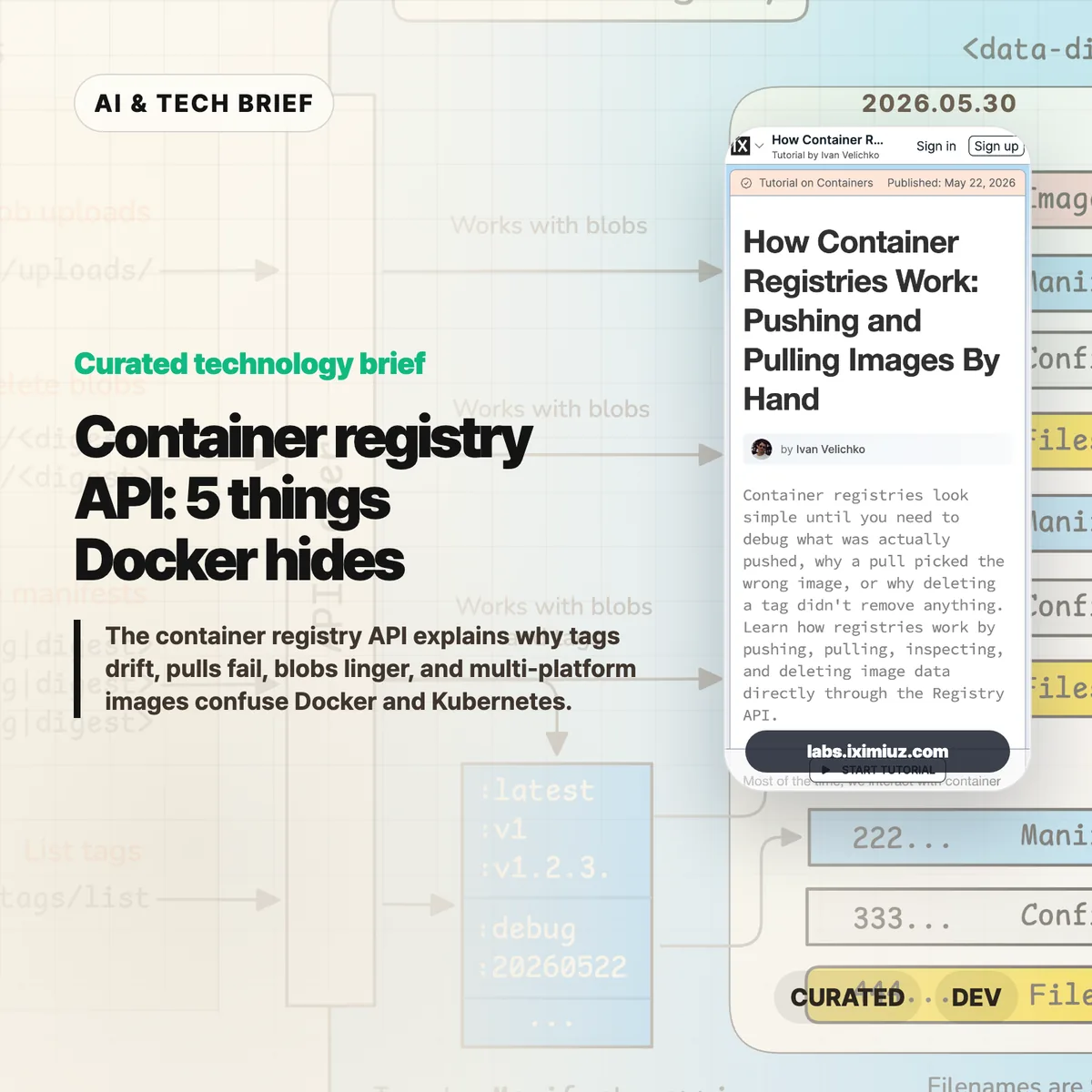
    The container registry API is the part of Docker and Kubernetes that most teams only meet when something breaks. Ivan Velichko’s iximiuz Labs tutorial is useful because it strips the registry down to HTTP calls: upload blobs, attach a manifest, pull by digest, list tags, and see what deletion really means.

    The short version

    • A registry is closer to a content-addressed blob store than a simple tag database.
    • docker push uploads layer and config blobs first, then publishes a JSON manifest that points at them.
    • docker pull starts with the manifest, so many pull failures are easier to debug if you inspect that document before blaming the runtime.
    • Deleting a tag is not the same as deleting every blob behind the image.
    • Multi-platform images add an image index above per-platform manifests, which is where amd64 versus arm64 confusion often starts.

    What happened

    iximiuz Labs published a hands-on tutorial called “How Container Registries Work: Pushing and Pulling Images By Hand.” It walks through the OCI-style registry flow with curl, not Docker. The tutorial starts with raw blob upload and download, then builds toward pushing an image manifest, listing tags, pulling image contents, deleting image data, and storing multi-platform images.

    The point is not that everyone should replace Docker with shell scripts. The point is that the registry has a small, inspectable HTTP surface. A blob upload starts with POST /v2/<repo>/blobs/uploads/, finishes with a digest-aware PUT, and a tag appears when a manifest is pushed to PUT /v2/<repo>/manifests/<tag>. Once you see that flow, tags stop feeling like magic labels and start looking like pointers to JSON documents.

    Why this is worth watching

    The registry gives platform teams a better failure model. If a cluster pulls the wrong image, the useful question is not “why is Docker weird?” It is which manifest the tag currently resolves to, which config and layer digests that manifest references, and whether the client selected the right platform entry.

    That matters in boring, expensive ways. A CI pipeline can push successfully while production still resolves an older digest. A cleanup job can remove a tag while shared layer blobs remain. An Apple Silicon laptop can produce an image that works locally but misses the manifest entry a mixed Kubernetes fleet expects. These are not exotic edge cases. They are the kind of problems that show up after a release, when people are looking at dashboards instead of registry headers.

    The tutorial also hints at a broader registry shift without over-selling it. OCI registries now hold more than runnable images: Helm charts, SBOMs, provenance attestations, and other artifacts can use the same distribution model. For more infrastructure briefs, the IT & AI archive tracks similar developer-tool shifts as they move from novelty into operational plumbing.

    What the container registry API shows

    The container registry API shows that image delivery is mostly a chain of small claims: this tag points to this manifest, this manifest points to these digests, and these digests are the bytes the runtime needs. Once that chain is visible, debugging gets less mystical.

    What the discussion is missing

    There does not appear to be a public Hacker News thread for this specific tutorial. That is a shame, because the useful debate would probably be practical rather than philosophical.

    The missing discussion is about where teams should draw the line. Most engineers do not need to hand-push manifests every week. But build, SRE, security, and platform teams benefit from knowing enough of the container registry API to answer three questions during an incident: what does this tag point to, which blobs does this manifest need, and did the client choose the platform variant we expected?

    The other open question is tooling. crane, regctl, oras, and registry vendor CLIs already wrap much of this work. The best use of the tutorial is not memorizing every endpoint. It is learning the mental model behind those tools so their output makes sense under pressure.

    The practical read

    If you ship containers, run through the tutorial once with a throwaway registry. Then add a few registry-level checks to your normal debugging playbook.

    Start by resolving tags to digests before and after a deploy. Inspect the manifest media type when a pull fails on one architecture but not another. Treat deletion as a manifest-and-garbage-collection problem, not a tag-removal problem. For security work, check whether the artifacts you care about, such as SBOMs or attestations, are attached in a way your scanners and deployment systems can actually find.

    That is the practical value of the container registry API. It turns image distribution from a black box into a set of documents and blobs you can inspect.

    Sources