Doodle Go: How a Clumsy Drawing Learns to Walk
Doodle Go is a game I am making about bad drawings that try very hard. The title screen sums it up: “Draw any old thing. It’ll figure out how to walk.” You draw a creature in a dotted box, press Go, and watch it stumble toward a flag. You cannot steer. If it falls into the spikes, you change the drawing, not your reflexes.
It is not out yet, so this is a first look at where it stands in early October 2026, mostly about how it works and what went wrong on the way. The game is plain JavaScript built with Vite, drawn on a Canvas, with Planck.js, a JavaScript port of the Box2D physics engine (MIT license), moving everything.
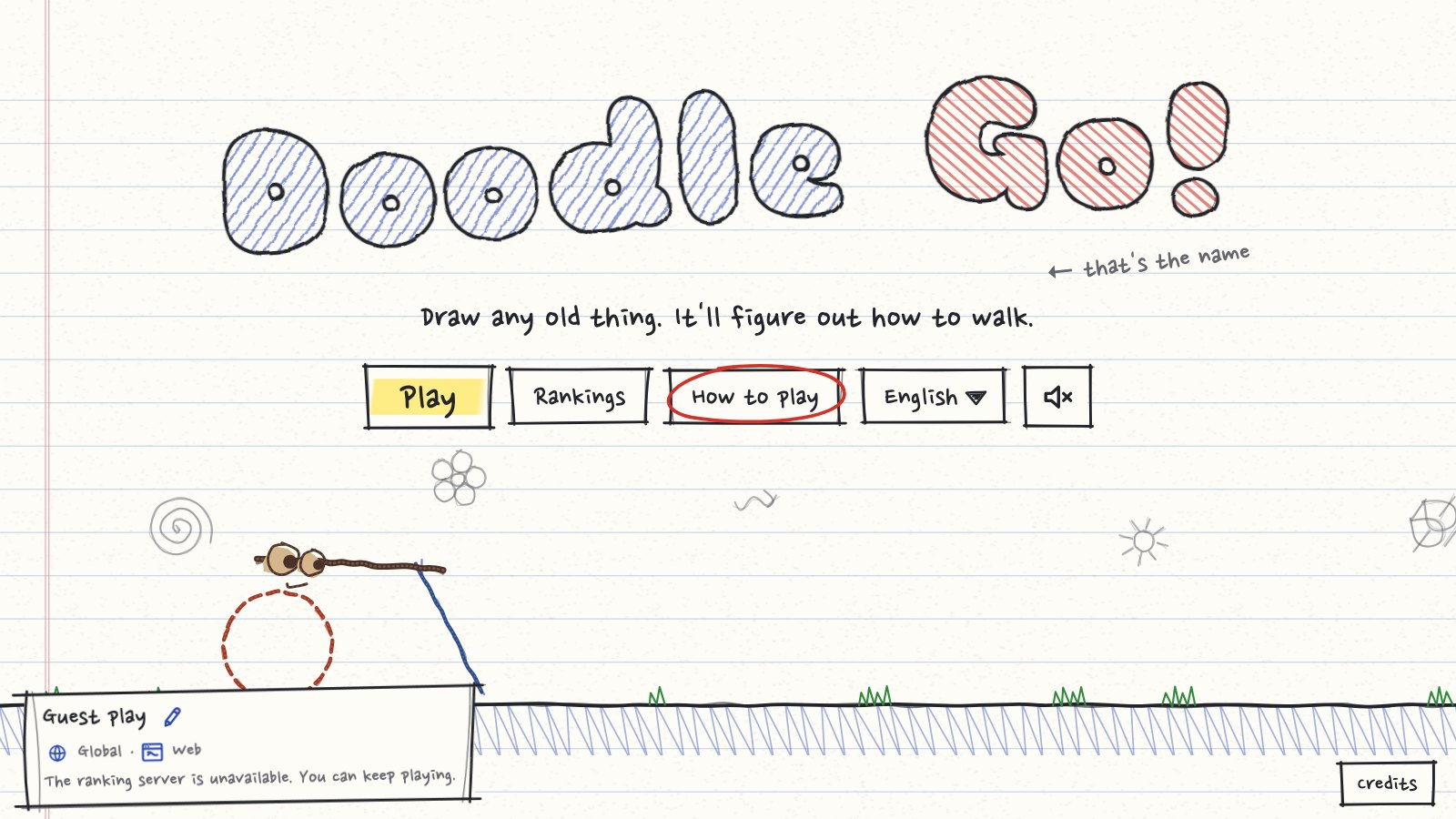
The only input is the drawing
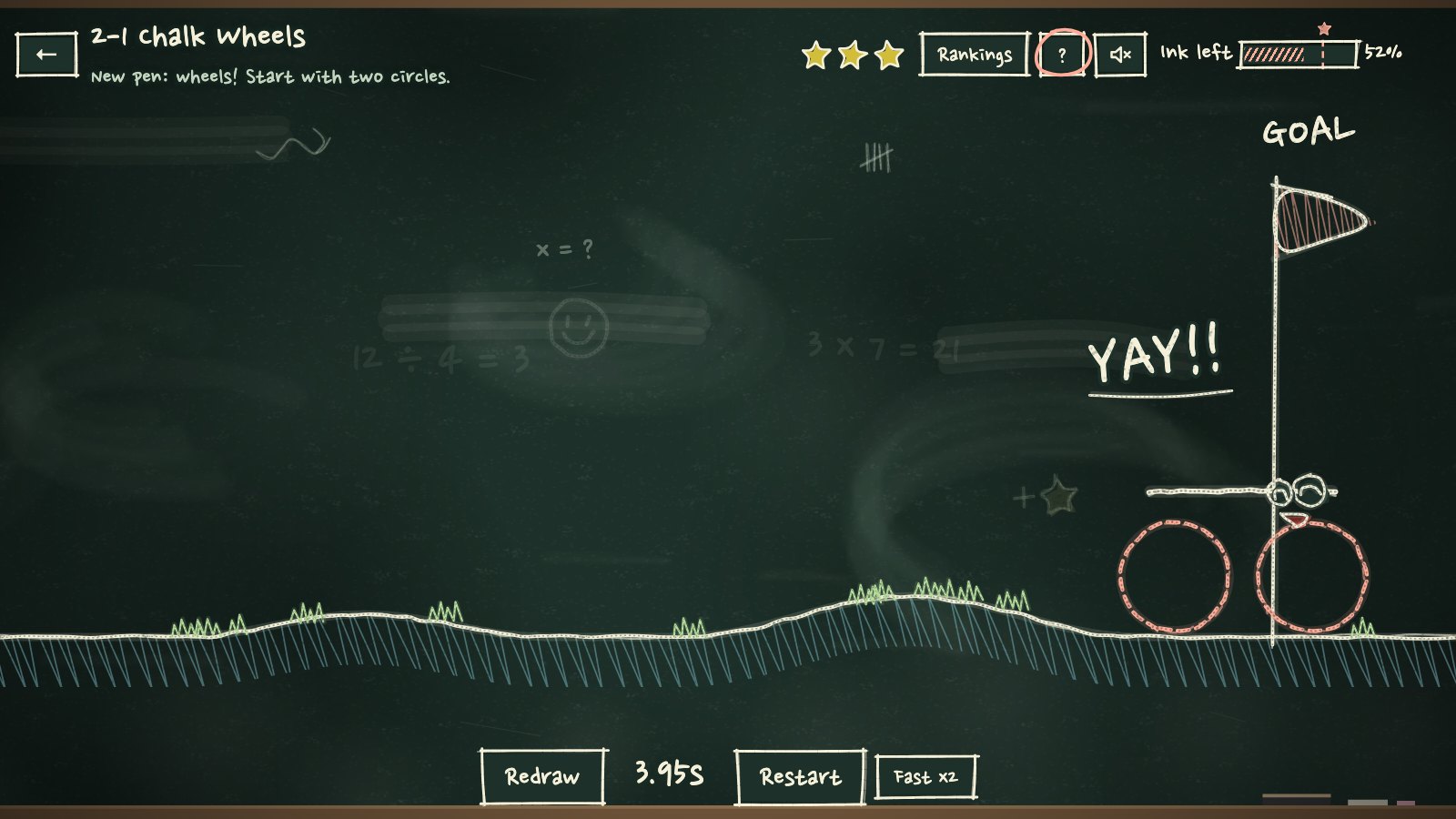
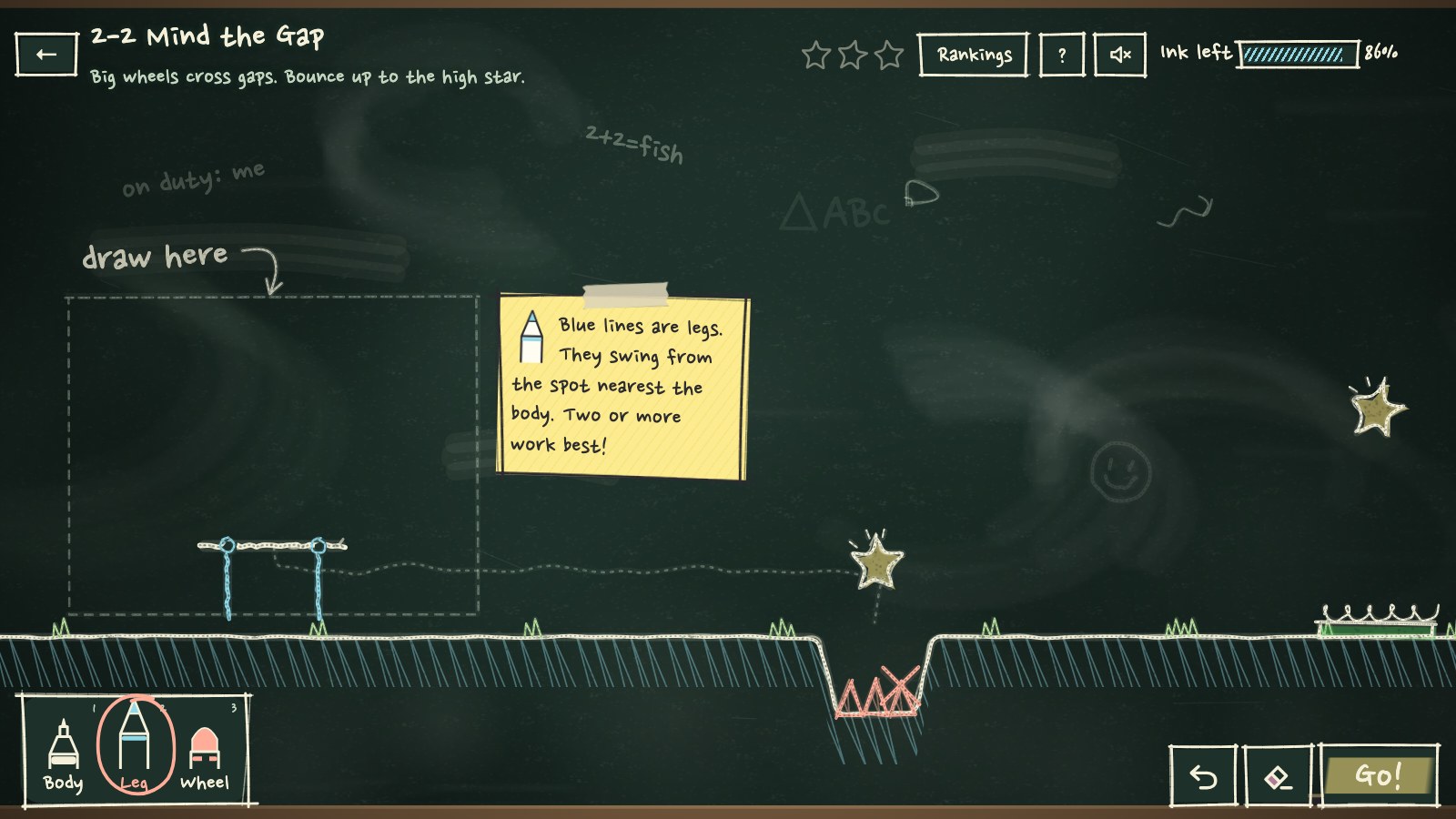
Every page gives you a dotted box, a limited amount of ink and a few pens. A thick black line is the body. Blue lines are legs. Later chapters add wheels, balloons, springs, thread and a spray can. Once you press Go, the creature runs on its own; you can only watch, restart or speed it up.
That rule shapes every design decision. Since nothing is controlled during a run, an obstacle only means something under one condition, which I wrote at the top of the stage notes: a drawing that worked elsewhere fails here, and changing the drawing fixes it. If every drawing gets past, the obstacle is scenery. If exactly one does, it is a lock and key, and the game turns into guessing. A good obstacle sits in between and makes you choose along one axis: height, length, weight, way of moving, speed or reach.
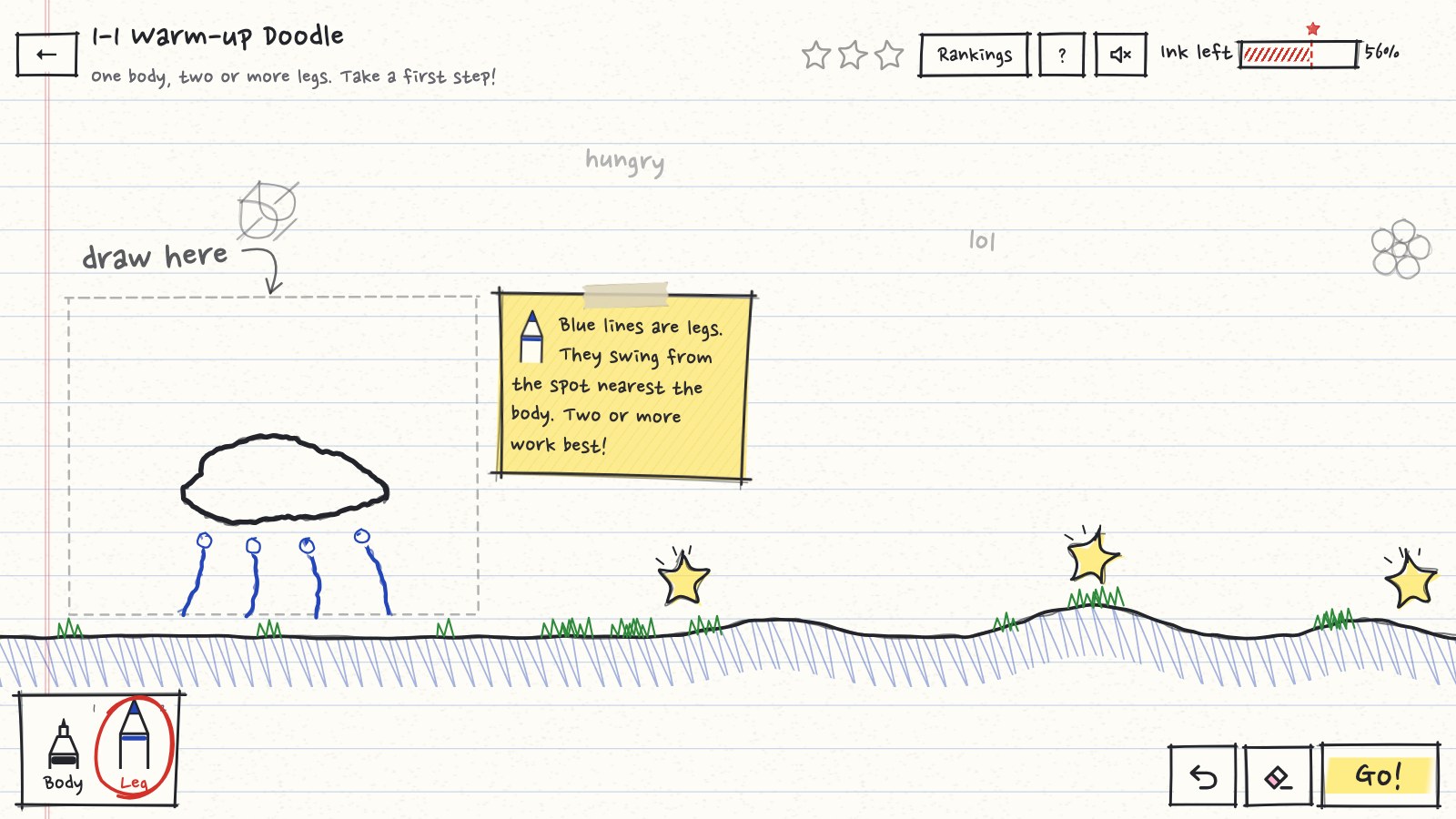
From a line to a creature
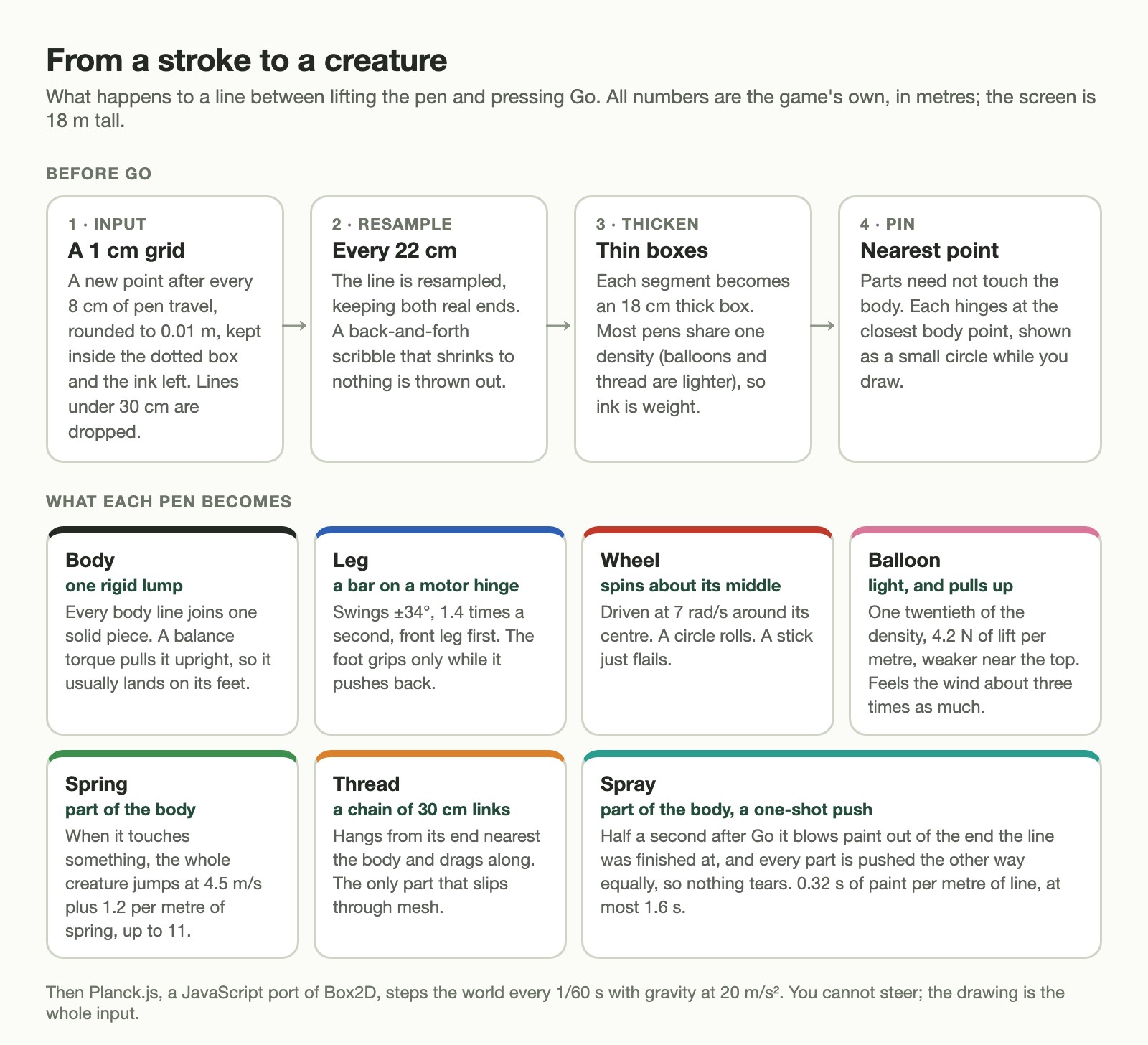
A drawing is stored as a list of lines, each with a pen and some points, and the creature is rebuilt from that list on every run. While you draw, a point is added only after the pen has moved 8 cm in game units (the screen is 18 m tall). Each point is snapped to a 1 cm grid, kept inside the box, and cut short when the ink runs out. The snapping always rounds toward the previous point, so it can shorten a line but never lengthen it. That means the ink on screen is measured on exactly the coordinates that are saved, replayed and checked later. Lines under 30 cm are dropped.
When you press Go, each line is resampled to one point every 22 cm, keeping both real ends, and every segment becomes a thin box, 18 cm thick, on a physics body. One early bug came from here: a fast back-and-forth scribble could shrink to segments too short to get a box at all, which made a creature with nothing to collide with. Such lines are now thrown out first, and a test keeps it that way.
All body lines become one rigid lump. Most pens share one density (only balloons and thread are lighter), so ink is weight. The other parts do not have to touch the body: each one hinges at the body point closest to it, shown as a small circle while you draw, so a shaky hand never makes a leg fall off.
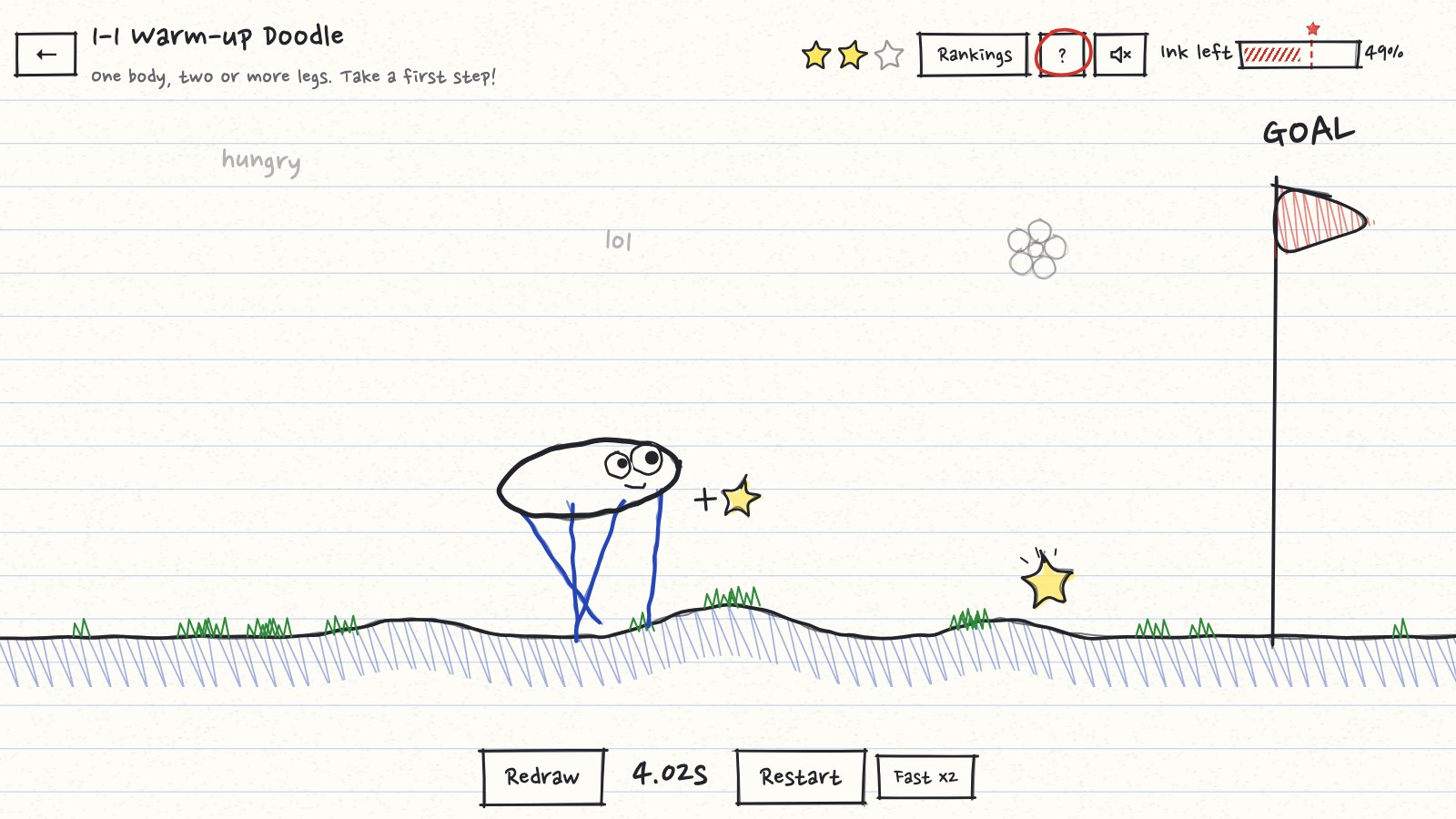
Touching spikes destroys every joint and throws the parts apart, with a fixed random seed so the same drawing always breaks the same way. You reach the flag when the front-most point of anything you drew crosses the line, not the body’s centre, so drawing a long nose is a real strategy. If the creature has not moved half a metre in six seconds, a note says “Hmm, it’s stuck,” but the run goes on in case it wriggles free.
Legs that walk without a brain
Each leg is its own stick on a motorised hinge. The motor follows a sine wave, swinging about 34 degrees each way, 1.4 times a second, front leg first and the rest following in a wave. Its strength scales with the weight of the whole creature and the length of the leg, so a big body on thin legs still has a chance.
A swinging stick on its own would just rock in place. What makes it walk is the foot. Before the engine resolves each contact, the game checks which way the foot is sliding along the ground. Sliding backwards, it gets a lot of grip; sliding forwards, almost none. The stick pushes on the backstroke and glides on the return, like a ratchet, and it works for anything stick-like you draw, at any angle.
The body also gets a little sense of balance: a torque that pulls it back toward upright, like a spring with a damper, scaled by how hard the whole creature is to turn. Creatures still topple and flail, but usually land on their feet. In fact none of the test drawings ever turned over, so a planned “never flip” challenge was dropped.
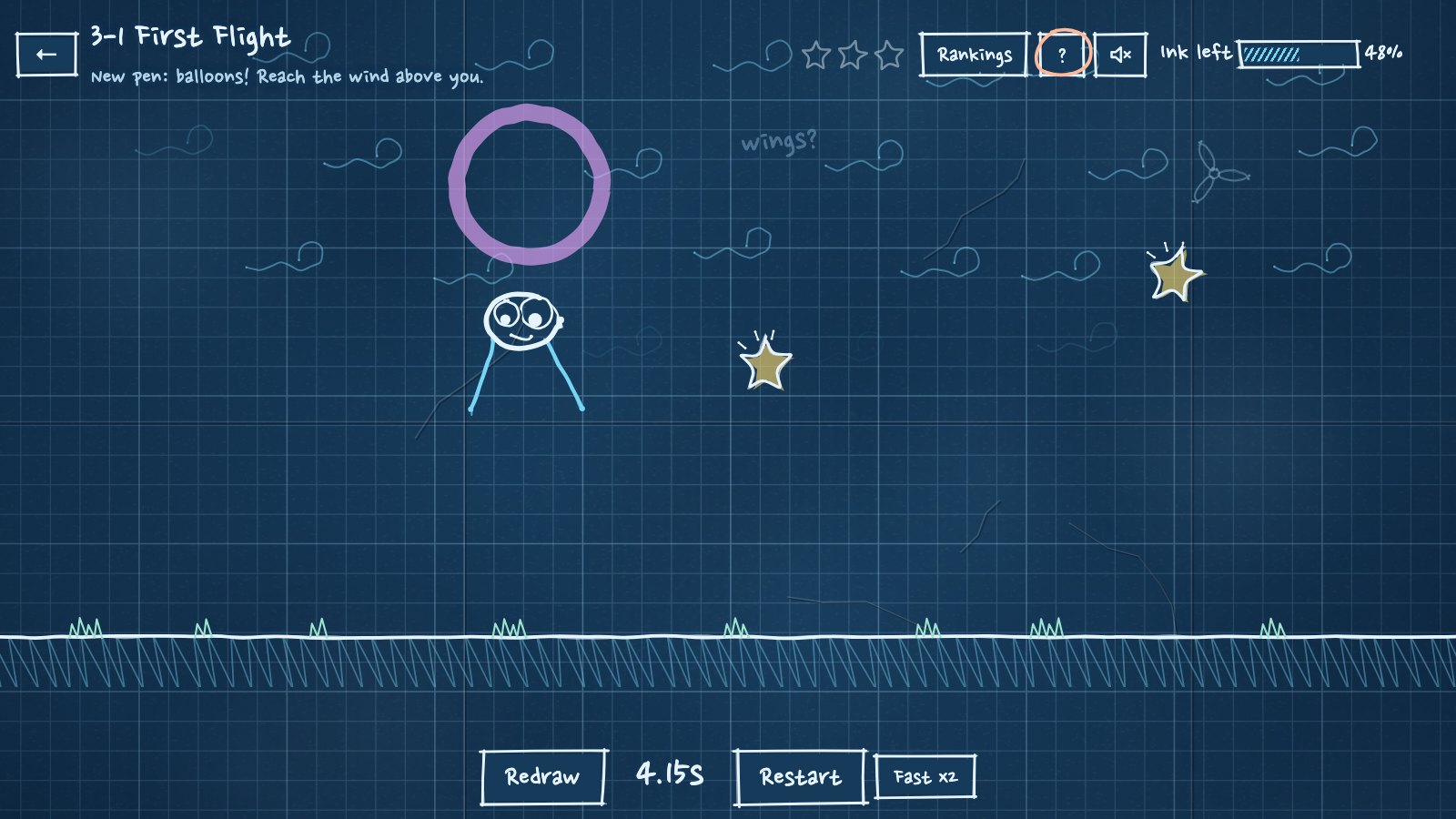
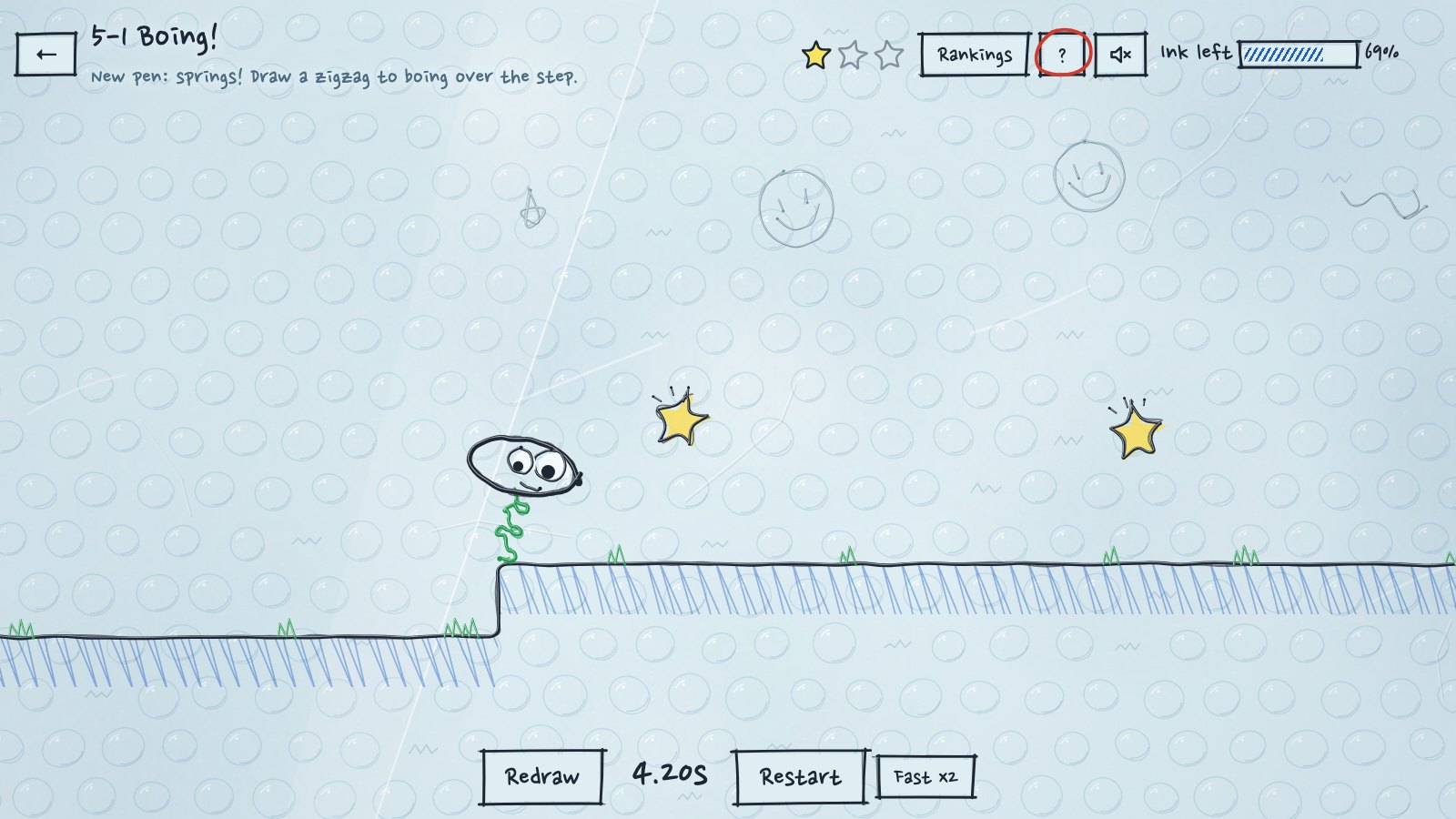
The other pens are a few lines of physics each, tuned until the right drawing works and the wrong one fails visibly. Wheels spin about their own centre, so a circle rolls and a straight line flails. Balloons are a twentieth as dense as other lines and lift in proportion to their length, with the lift fading near the top of the page so they never fly off forever. Springs give every part of the creature the same upward speed at once, so it jumps without spinning. Thread is a chain of 30 cm links. A spray can pushes the creature away from the end where you finished the line, with the same acceleration for every part so a flying doodle does not tear itself apart.
Same drawing, same run, everywhere
A lot depends on a drawing producing exactly the same run every time: the online rankings, the clear video you can share, and the demos in the guide. Planck steps the world every 1/60 second, time is recorded as a whole number of steps, and ink as a whole number of millimetres.
That was not enough. On September 28 I found that the same drawing could finish differently in different browsers. The cause was the built-in sine and cosine: JavaScript engines may differ in the very last bit, and a physics engine full of contacts turns one bit into a different landing a few seconds later. The fix was to pin the maths. The game uses fixed implementations of sine, cosine, arctangent and hypotenuse from the open-source stdlib project (Apache-2.0), the classic fdlibm algorithms. A build step injects them into an untouched copy of Planck and refuses to run if that copy’s checksum changes, so a library update cannot quietly change the physics. Deliberate physics changes bump a rules version, keeping old records apart.
A regression check replays 212 drawings and fingerprints every body’s position, angle and velocity on every step. All 212 matched in Node, the Cloudflare Workers runtime, Chromium, Firefox, WebKit, Electron and the iOS simulator’s web view, and a smaller set matched at 5 to 144 frames a second. The ranking server relies on this: it replays the submitted drawing itself and accepts a score only if stars, finishing step and ink match exactly.
Ten papers, one new question each
The campaign is a trip across ten things you might doodle on, six pages each. Every chapter changes the paper and adds one new pen or obstacle, and the paper is chosen to explain the rule before any tip does: bubble wrap pops, a box lid folds, spilled coffee is sticky.
- Notebook: body and legs. Chalkboard: wheels, spike gaps, bounce pads, a low ceiling.
- Flight Plans: balloons and wind. Kraft Adventure: ice, and a mix of everything so far.
- Bubble Wrap: springs, and bubbles that pop a quarter second after you touch them.
- Cardboard Box: lids that tip into bridges, corrugated ridges. Coffee Napkin: puddles that hold you up but drag you nearly to a stop.
- Jeans Pocket: thread, mesh, and snaps under the mesh that open zippers. Back Alley: spray cans, loose bricks, shutters on a timer.
- Sketchbook: all seven pens and two or three old obstacles per page, ending on a 76 m final page.
Each chapter runs the same six steps: introduce the new thing somewhere safe, practise it, vary it, combine it with something older, make it hard, then a finale. Pens are not simply inherited either. Wheels are left out of Bubble Wrap because in simulation they rolled across the bubble bridge before the bubbles could pop, leaving no reason to learn the spring. Balloons are left out of Back Alley because they flew over the bricks and shutters alike.
The paper changes how lines look too: chalk with powdery gaps, drafting lines with dotted ends, waxy crayon, glossy marker on plastic, spray paint that drips where a line stops. All textures are drawn in code; I studied free texture packs from Resource Boy for colour and grain, but no image file ships in the game. Lines also “boil” slightly, as in hand-drawn animation. The first version redrew the whole screen into new shapes six times a second, which hurt to look at. Now each line keeps its shape and trembles by about 0.6 pixels on its own beat, so the page never jumps at once, and it holds still for players who ask for reduced motion.
Testing pages with drawings that are not players
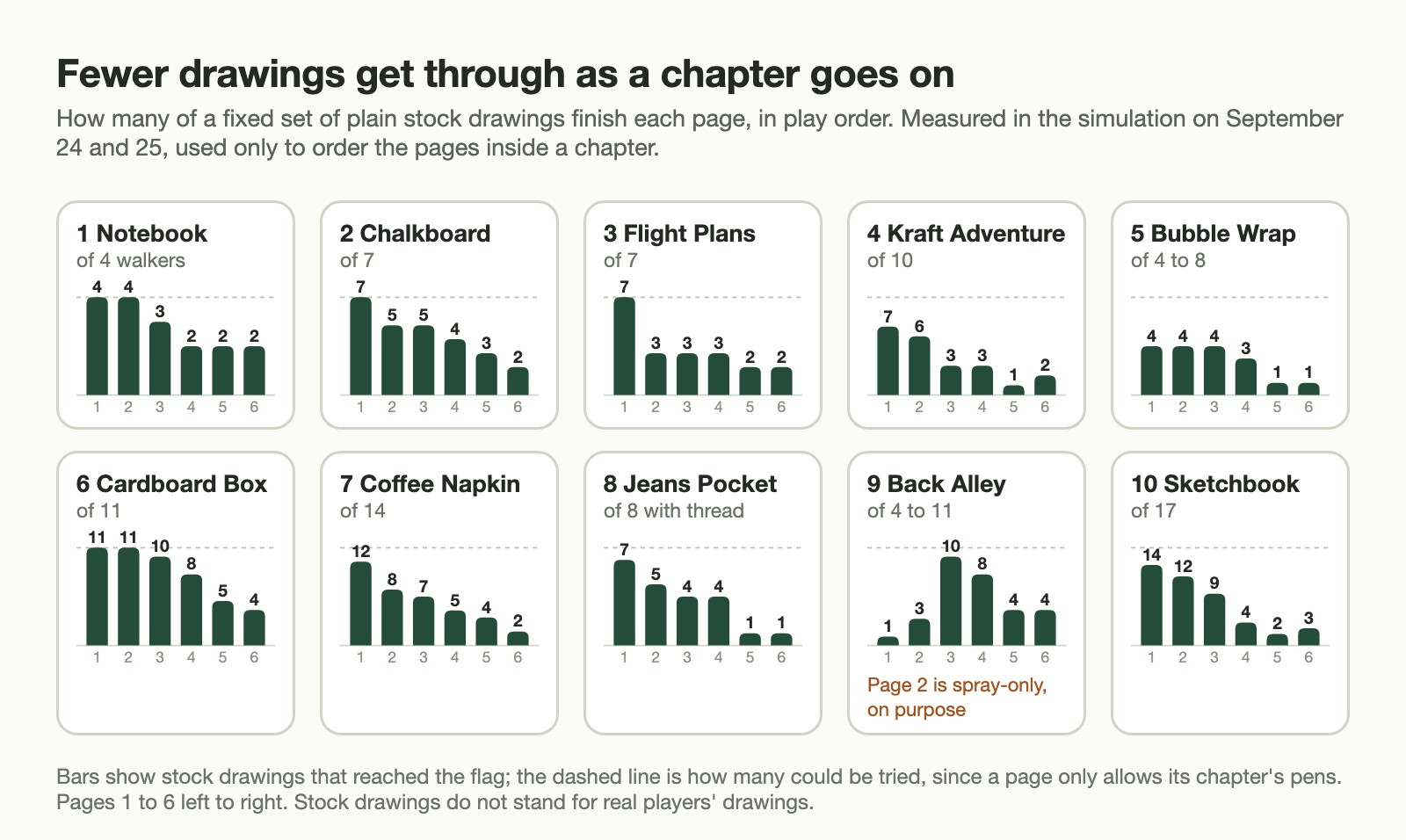
An earlier prototype showed me the main risk. In it, a body on four long legs cleared eight of twelve pages, and one balloon design cleared all three balloon pages. You found the shape that worked and stopped drawing. So the current pages are checked against a fixed set of plain stock drawings: walkers, wheels and balloons of several sizes, springs, and walkers carrying thread or a spray can. The number that reach the flag on each page is a rough difficulty signal, and within a chapter I ordered the pages so it falls.
A second set of hand-made reference drawings proves that everything can be done. The test suite drives every page with a legal drawing (allowed pens, inside the box, within the ink, on the same 1 cm grid as real input) and requires the flag and all three stars. Every page also has two challenges, such as keeping most of the ink, using no legs, or staying airborne for twenty seconds. That is 120 challenges, each with its own proof drawing that must earn the stamp in one run. Pages that introduce a pen show a faint dotted example, and those are tested to clear the page too.
The simulations were also honest about my designs, and I wrote the results down. Spikes, ceilings against ledges, and the size of balloons and springs really split drawings into “bigger” and “smaller” answers; Bubble Wrap is the best-built chapter. Lids, bricks and ice barely split anything. Coffee asks the same “fly or bounce” question as two earlier chapters. Mesh and snaps are a lock and key: you attach thread or you do not. A few pages pass only their reference drawing, a sign the solution is too narrow. None of this has met real players yet: a flipping lid might be fun anyway, and a shutter that crushes a fast wheel might just look unfair.
Two ideas changed on contact with the simulation. Coffee was meant to float light creatures, but every line has the same density, so nothing was lighter than anything else; it became a sticky puddle that carries 75 percent of your weight while you slowly sink. Thread was meant to dangle into gaps, but walkers ran at six to nine metres a second and pulled it straight, and hanging it from a balloon bounced too much. Hence the rule that only thread passes through mesh, with the snap right under the fabric.
Making failure readable
A game about fixing drawings needs failures you can read. When a page opens, the camera pans to the flag and back. When a run fails, the redraw screen keeps the attempt as a dotted pencil path, with a red cross where it popped or fell and a cross with a question mark where it got stuck. The failure message links to the guide entry for whatever got you. Ink is shown as what is left, rounded down, so a stamp never looks earned when it is not.
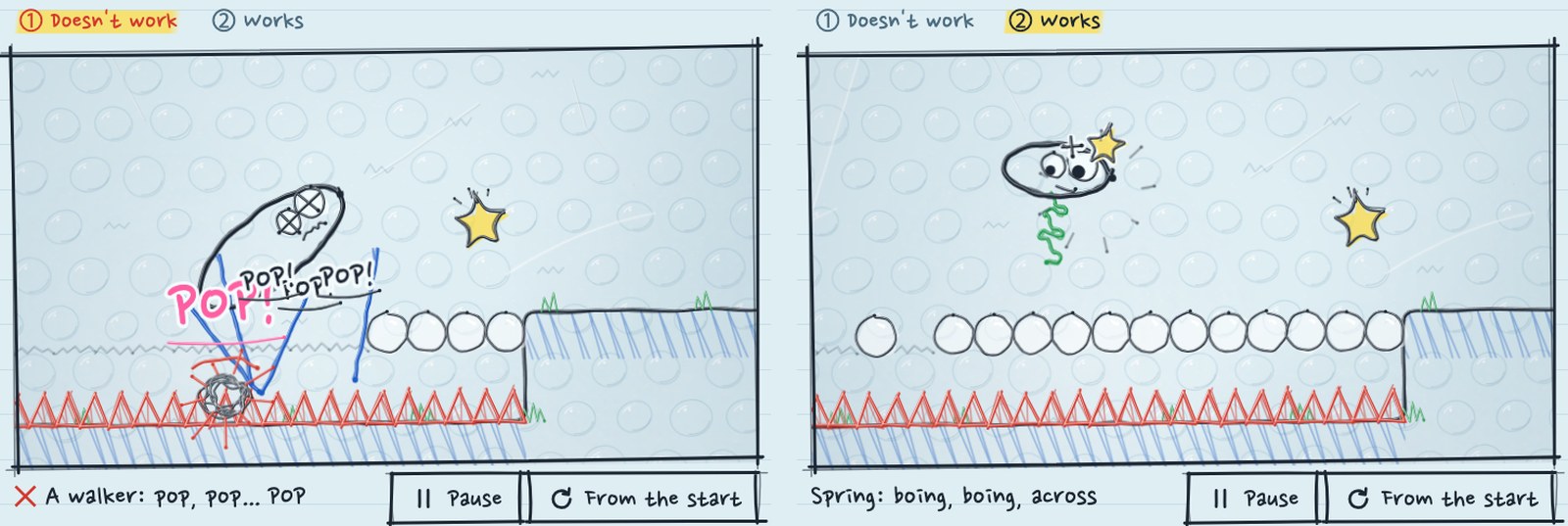
The guide is not a set of pictures. Its entries for the seven pens and thirteen obstacles run the real physics on a real page, usually a drawing that fails followed by one that works, in that chapter’s paper and pens. A test checks that every demo still ends the way its caption says, so a physics tweak cannot quietly turn “this works” into a crash.
How the sound was made
Drawing has its own sound on each paper, made from ten CC0 recordings on Freesound by Gnarlycuga, digitale.de, PanosA, wstarling, ve6ji, florianreichelt, franckwalden, STERREDEVRESSE, digital.arts.MA and one since-deleted account. Each was cut to its scratching and looped seamlessly; pen speed sets the volume, and music dips by 6 dB while you draw.
The 22 kinds of effects were generated with ElevenLabs. The first Go sound came out like a grown man making a mouth noise, so it became four short chirps for a small, wordless character, never the same one twice in a row. The music had a bumpier road. The first set was generated too, but the music terms for self-serve plans exclude studio games, meaning games that earn money on more than one platform. On September 28 I replaced all ten tracks with CC0 music from OpenGameArt, using only tracks uploaded by their own composers: Happy Clappy Loop by OwlishMedia, Recorder Jam by Of Far Different Nature, Happy Lullaby by cynicmusic, A Small Fire Will Do by Trex0n, Bouncy Tune by AdoTheLimey, Children’s March Theme by Cleyton Kauffman, Cozy Puzzle In-Game 1 by MintoDog, Funked Up by Joth, Jazzy blues by LushoGames, and a music box polka by Aureolus_Omicron.
Safari decoded the last 12 milliseconds of one loop as silence, a hiccup on every repeat. Every music file now carries 50 ms of real audio past each end, and Web Audio loops between exact points inside that margin; a browser check renders each seam at 44.1 and 48 kHz. The mixer plays at most four sounds at once, with wins, pops and stars ahead of footsteps. Its hardest job is deciding what counts as an event: a landing needs the body to come down faster than 2.5 m/s after 120 ms in the air, and rolling friction plays through brief gaps in contact, which cut its restarts on the low-ceiling page from 55 to 1. The physics only reports what happened; sound never changes a force.
26 languages, all handwritten
The text ships in 26 languages, Arabic included. A style guide gives every line one of three voices: the guide talking like a friendly classmate, the doodle itself (sound effects, self-talk, jokes), and short labels. A glossary fixes the words: a level is always a “page” and a tool always a “pen”, because the game is a notebook. Margin scribbles and sound-effect words are rewritten for each language, since a literal joke is a broken joke.
Every language uses a thin-pen handwriting font that has its letters, all under the SIL Open Font License: Nanum Pen Script for English and Korean, Caveat for eighteen Latin and Cyrillic languages, Hachi Maru Pop, Long Cang, ChenYuluoyan, Sriracha, Mynerve and Playpen Sans Arabic for the rest, and Sniglet for the logo. Before any translation existed, English stretched by 40 percent with accents showed which buttons would overflow, and mirrored English showed what right-to-left would break. In Arabic the menus mirror, but the doodle still runs right, toward the flag. A test checks every language file for matching keys, placeholders and the exact plural forms that language needs.
Phones, and a clip worth sharing
On October 1 the game got Android and iOS test apps, built with Capacitor around the same web code. On iOS the whole app was silent at first: files bundled inside the app answer with a status code of 0, the sound loader took that as an error, and nothing loaded. Finger-drawn lines also looked scratchy, because a finger delivers far more points than a mouse and each point got its own wobble. On touch screens lines are now drawn through points about 20 cm apart, keeping corners and ends, while physics and ink still use every point.
A cleared page can be saved as a short video. The game reruns the same drawing at normal speed and records the canvas and the mixer; if the rerun does not finish on the same step with the same stars, the clip is thrown away. The browser’s recorder writes MP4 files with an empty index, so apps that read only the index see a nearly empty video: a 14-second clip sent from a Galaxy S21 through a messaging app arrived as 0.58 seconds. The game now rewrites each recording into an ordinary MP4 with a full index at the front, without re-encoding, in a few milliseconds.
Where it is now
- The campaign, ten chapters and sixty pages, plays from start to finish, with 120 stamps to collect.
- About 255 automated tests run before each commit, plus browser checks for replays, sound and video sharing.
- Online rankings for speed and ink saving work in testing, scored by the server’s own replay.
- Android and iOS test builds run, on a real Android phone and in the iOS simulator.
- No one outside development has played it yet. That is next, and the page order will be re-tuned from where people actually give up. Races and co-op modes are still designs.
Update, November 2026. On October 19 legs got a stride rate set by their average length: long legs swinging as fast as short ones flung the creature around, so drawing longer legs could make it worse at the very ledges they are for. The same change added an eraser for single lines. The website doodlego.app went live on October 23 with the first page playable on its front page, and the iPhone version went into App Store review at the end of October. The new chapter map and app icon are in the October progress note.
Screenshots are from a development build and will change.