Sestet: Inside a Fog-Covered Tile Game Where Nobody Fights
Sestet is a tile-placement game I am making. Its one-line pitch: draw a world hidden in fog, one tile at a time, while your neighbors reach for the same land. It is in development and not playable here yet. This note goes inside it: the rules and the reasons behind them, how a map comes out of a single number, how the fog keeps its secrets, how the computer opponents decide, what simulated games showed, and the ideas I dropped. Everything below comes from the project’s design records, rulebook, engine and browser client.
Four pillars for every feature
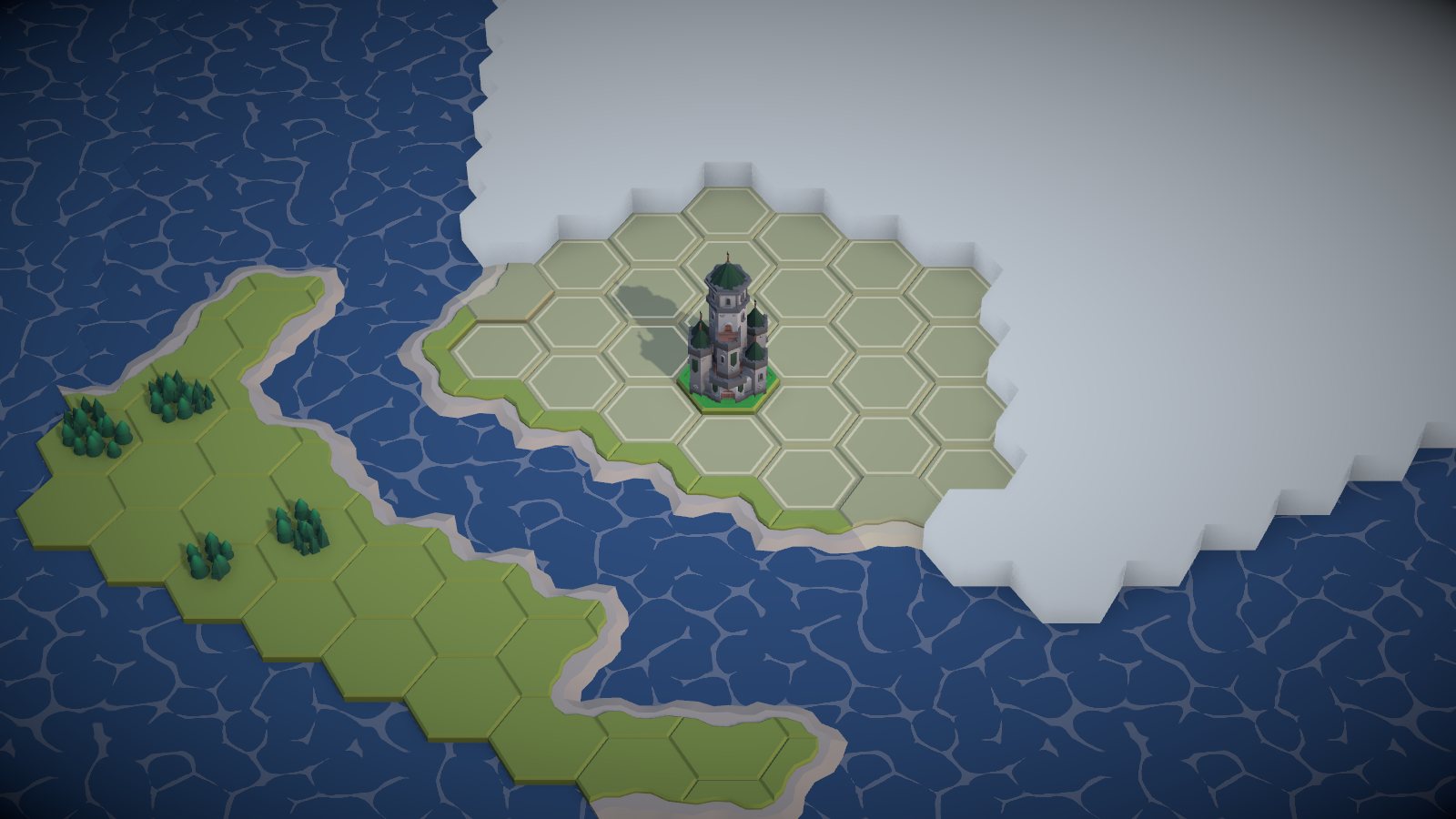
Before any rule, I wrote down four pillars. A feature that strengthens none of them does not go in.
- One tile, one real choice. Every round asks: build up what you have, or reach into the fog?
- A country you made. The end leaves you a landscape, not only a number.
- Compete without fighting. Competition comes from shared places and connections. Nothing anyone builds can be destroyed.
- Fifteen minutes, one more game.
The action never changes: pick a tile, rotate it, place it. There are no units and no city menus. Up to four civilizations start from one capital each on a shared hex map, and a match lasts twenty rounds.
Everyone moves at once
The first draft had players take turns. In a four-player game that means watching three people think before you can act, and the last player in each round always gets to react to the others. The second draft made every round simultaneous. All seats see the same three tiles, each picks one, and everyone decides at the same time. Two players may take the same tile.
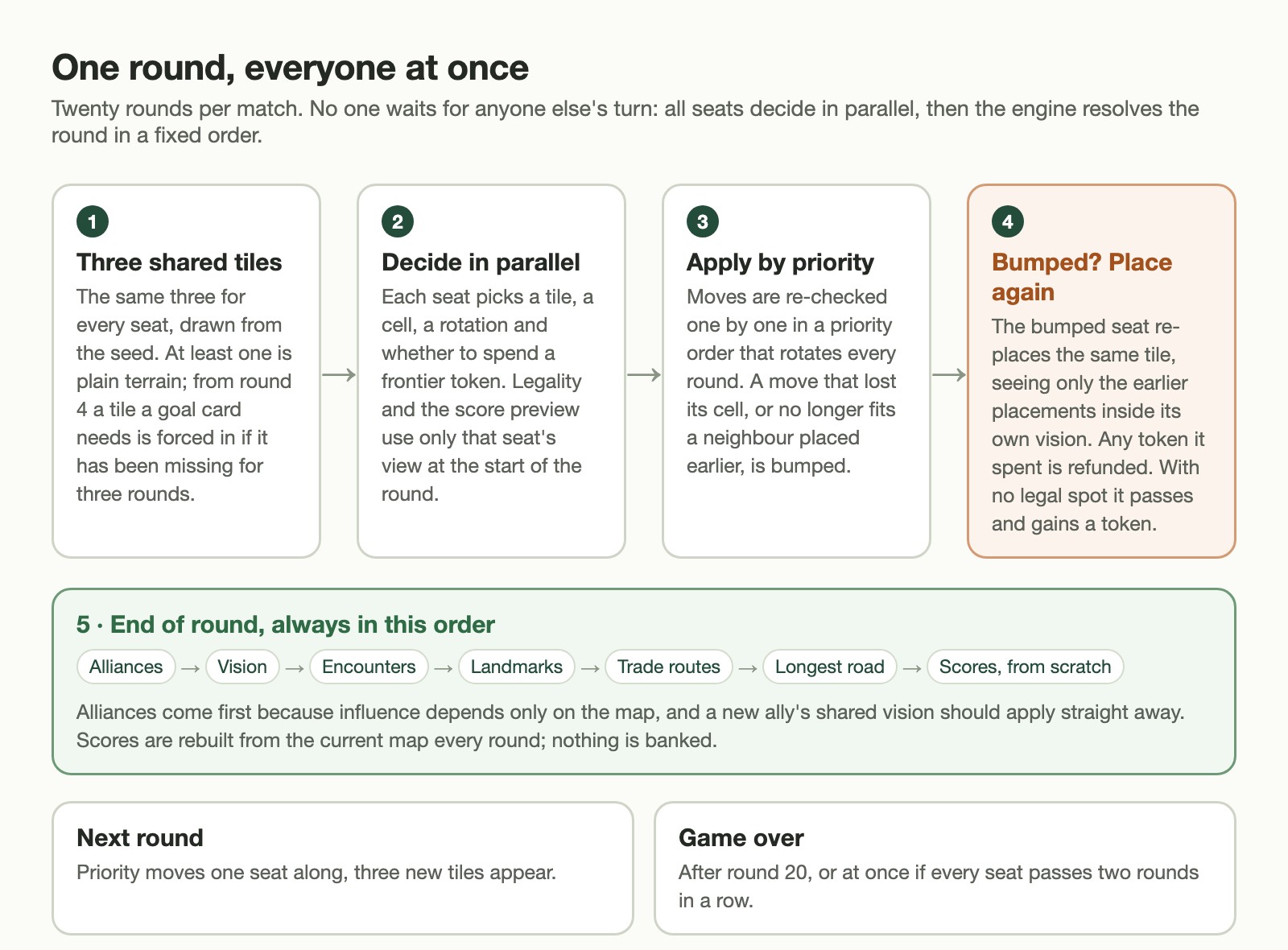
Simultaneous moves bring one new problem: two players can want the same cell, or place tiles side by side whose roads do not meet. The engine applies moves in a priority order that rotates by one seat every round. A move that no longer fits is bumped, and that player places the same tile again, now seeing the earlier placements inside their own vision. If nothing is legal, they pass. In simulated games this is rare: 0.06 conflicts per round with two players, 0.12 with three and 0.18 with four, under the limit of 0.3 I had set.
The shared offer also takes most of the luck out of the draw. Nobody gets a better hand, so the question is who used the same tile better. Two guarantees keep the offer useful: at least one of the three tiles is plain terrain, and from round 4, a facility that a public goal card needs is forced in if it has been missing for three rounds.
What a tile is
There are 25 tiles: fields, forest, farmland, villages, roads, rivers, a bridge, and four facilities (windmill, sawmill, mine and harbor). Each of the six edges has a terrain, and roads and rivers leave through particular edges. The rules split edges into two kinds on purpose. Roads, rivers and a harbor’s dock are required: a road must meet a road, a river a river, and the dock must face water. Plain terrain only scores. A forest edge may touch a field, but a tile whose six neighbors are all filled with every edge matching is a perfect placement worth a point. With random offers, mandatory terrain matching would leave you with nowhere to put a tile far too often. For the same reason I dropped an early rule that land edges facing water had to be coast: players never place water, so the rule only produced dead ends.
A new tile only has to touch one of your own tiles; roads matter for scoring, not for where you may build. If you get boxed in, you have frontier tokens. You start with two, and each lets you place a tile on a free cell away from your land, as long as you can see it and it is at least two cells from other civilizations, city-states and landmarks. Passing because you truly had no legal move earns a token, and each token left at the end is worth a point.
Points without fighting
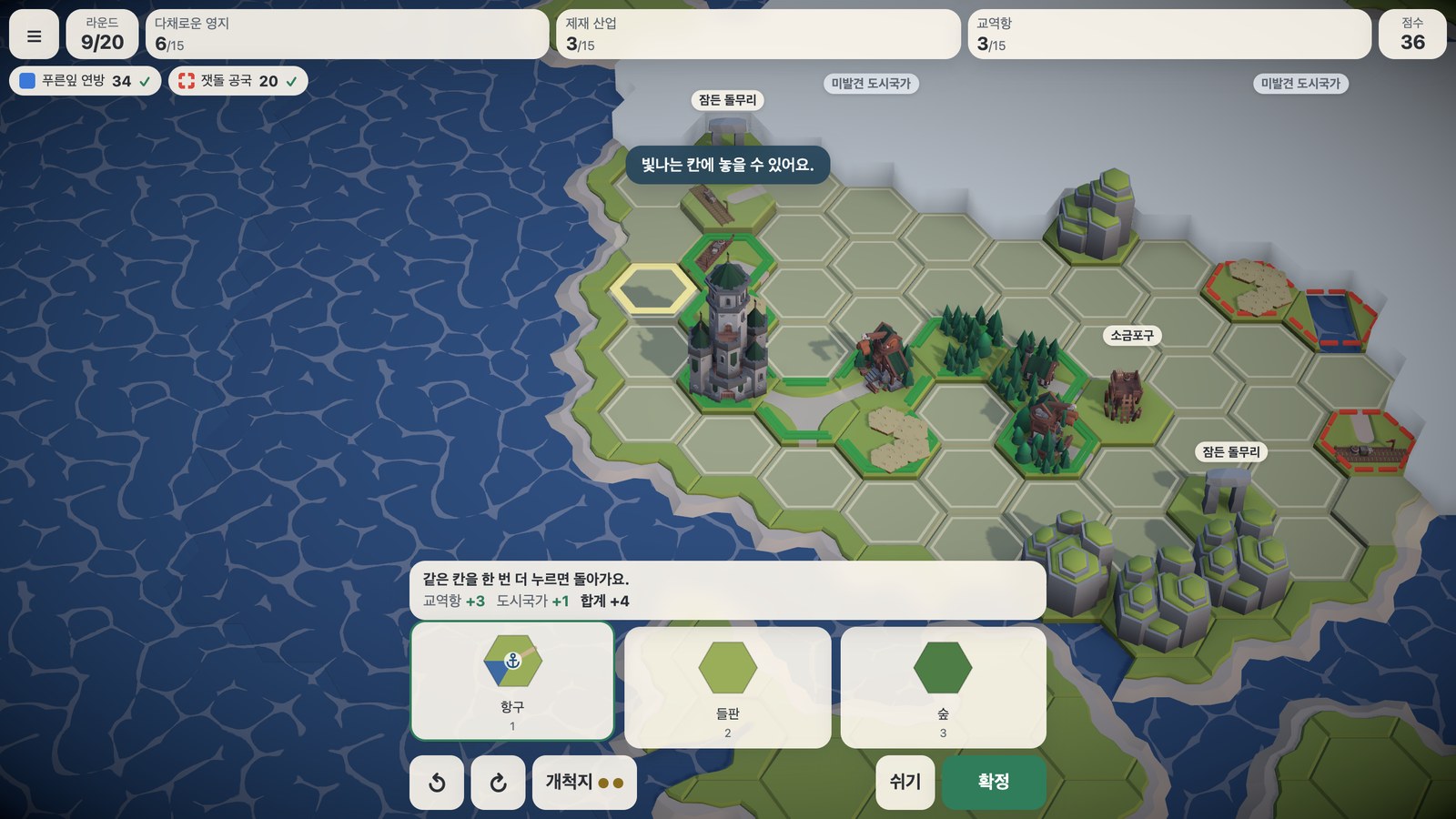
Each match shows three public goal cards from a pool of sixteen, such as the largest connected farmland, windmills next to fields, or mines linked to the capital by road. Each card is capped at 15 points. Around them sit shared sources of points, each built so that two players can want the same thing without destroying anything:
- City-states cannot be conquered. Your influence is your tiles within two cells, plus 2 if your road runs into it. The highest influence of at least 3 wins the alliance: 6 points plus a bonus that depends on the city-state’s character. A tie keeps the current ally.
- Landmarks are ranked, not owned. Nearby tiles count, suitable ones such as mines near a great peak count twice, and first and second place get 8 and 4 points, so arriving late still pays.
- Trade routes pay both sides 4 points when two civilizations’ roads meet.
- The longest road of at least five tiles is worth 5, and civilization traits up to 6.
One decision shaped all of this: scores are not banked. After every round the engine recomputes every score from the current map, plus the only history it needs for ties: who held each alliance and the longest road. Because a score is always the value of the board as it stands, the preview can show exactly what a tile would change, and contests for neutral places stay open until the last round.
A map from one number
A match is only fair if every seat starts with the same surroundings, so maps are symmetric: a 180° turn for two players, a 120° turn for three, and a 180° turn plus a mirror for four. Capitals and city-states have fixed positions; everything else comes from the seed.
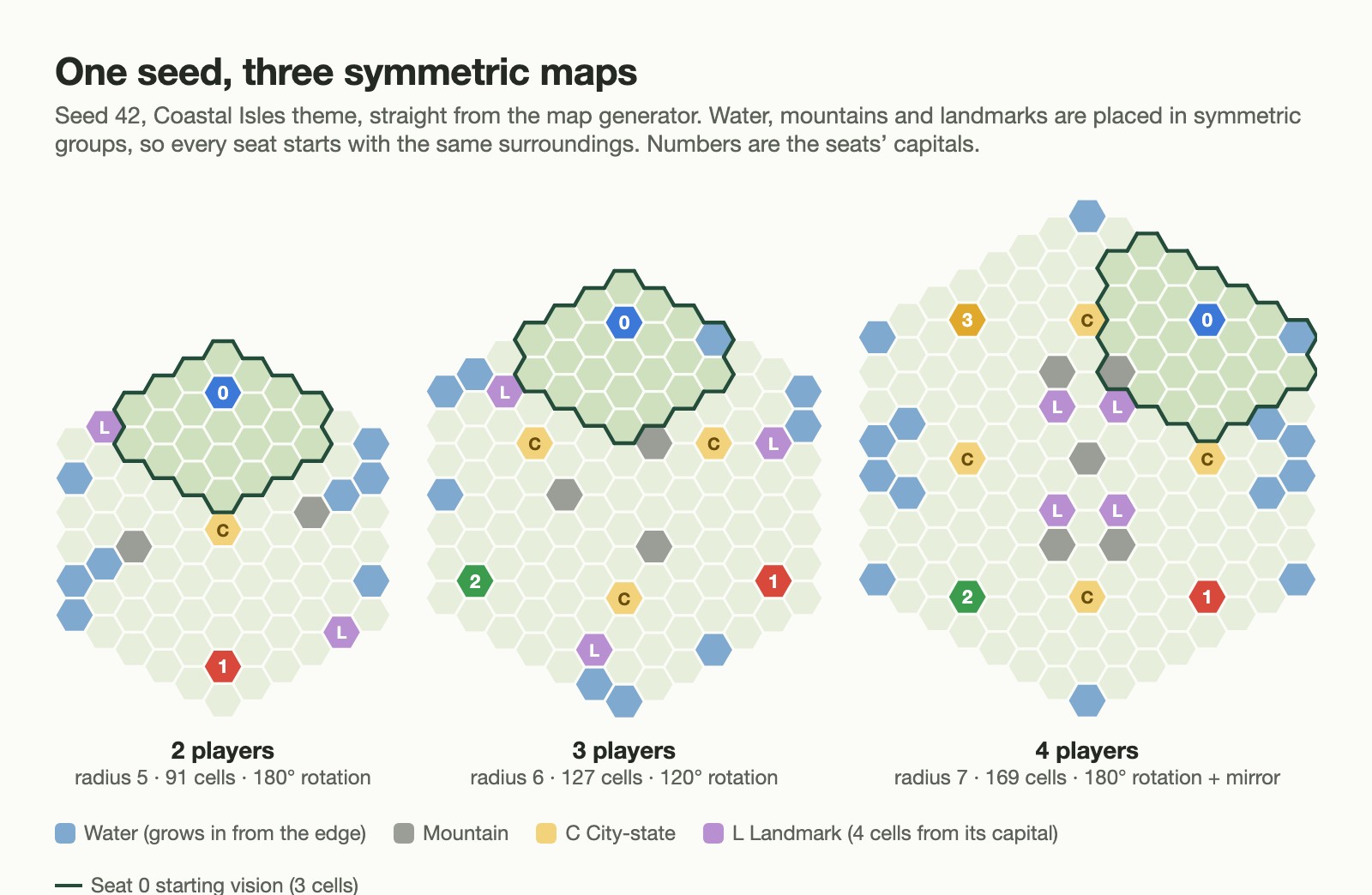
The generator works on orbits: a cell together with its symmetric twins. Water and mountains are placed one orbit at a time, so a bay on one side always has its twin on the others. The steps run in a fixed order:
- Water. Only cells on the map’s edge, or next to water already placed, can become water, so seas grow inward as coastlines. The theme sets the share: 4% of cells on the temperate plains, 9% on the coastal isles, 3% in the river valley.
- Mountains. A free cell next to an existing mountain gets three times the weight, so mountains gather into ranges. Nothing goes within two cells of a capital.
- Landmarks. One cell four steps from seat 0’s capital, at least five from the other capitals and two from any city-state; its twins become the same landmark for the other seats. The conditions are tight enough to leave only eight, seven and five candidate cells for two, three and four players.
- City-state characters. Symmetric city-states share a character, so no seat gets a better neighbor.
- A check that every capital can reach every city-state and landmark through empty cells.
A failed step means a retry with a fresh map stream, up to 64 times, then a fallback map without water or mountains, which always succeeds. The fallback has no water, so the harbor civilization cannot be picked on it; that is why civilizations are chosen after the map exists.
Saved games, replays and the planned daily leaderboard all rebuild a match from its seed and its moves, so every draw must come out identical on every device. The map, goal cards, seating and tile offers each have their own random stream: the seed and a label are hashed with SHA-256, and the first 16 bytes start a xoshiro128** generator, a small, well-studied pseudorandom generator. Separate streams mean a map retry never shifts the tile offers. The rulebook fixes the order of every draw, and 36 golden cases (three seeds, one to four players, three themes) pin the expected output. The daily map takes the UTC date as its seed, so everyone plays the same map, offers, goals and civilization that day.
Fog that keeps its secrets
You see two cells around your tiles, three around your capital and three around an allied city-state. Landmarks sit four cells from each capital, just past the starting vision; an earlier version had them at three, so you began the game already looking at your own landmark. An unexplored landmark within five cells of your land shows as a silhouette without its type, so exploring is a choice rather than a lottery.
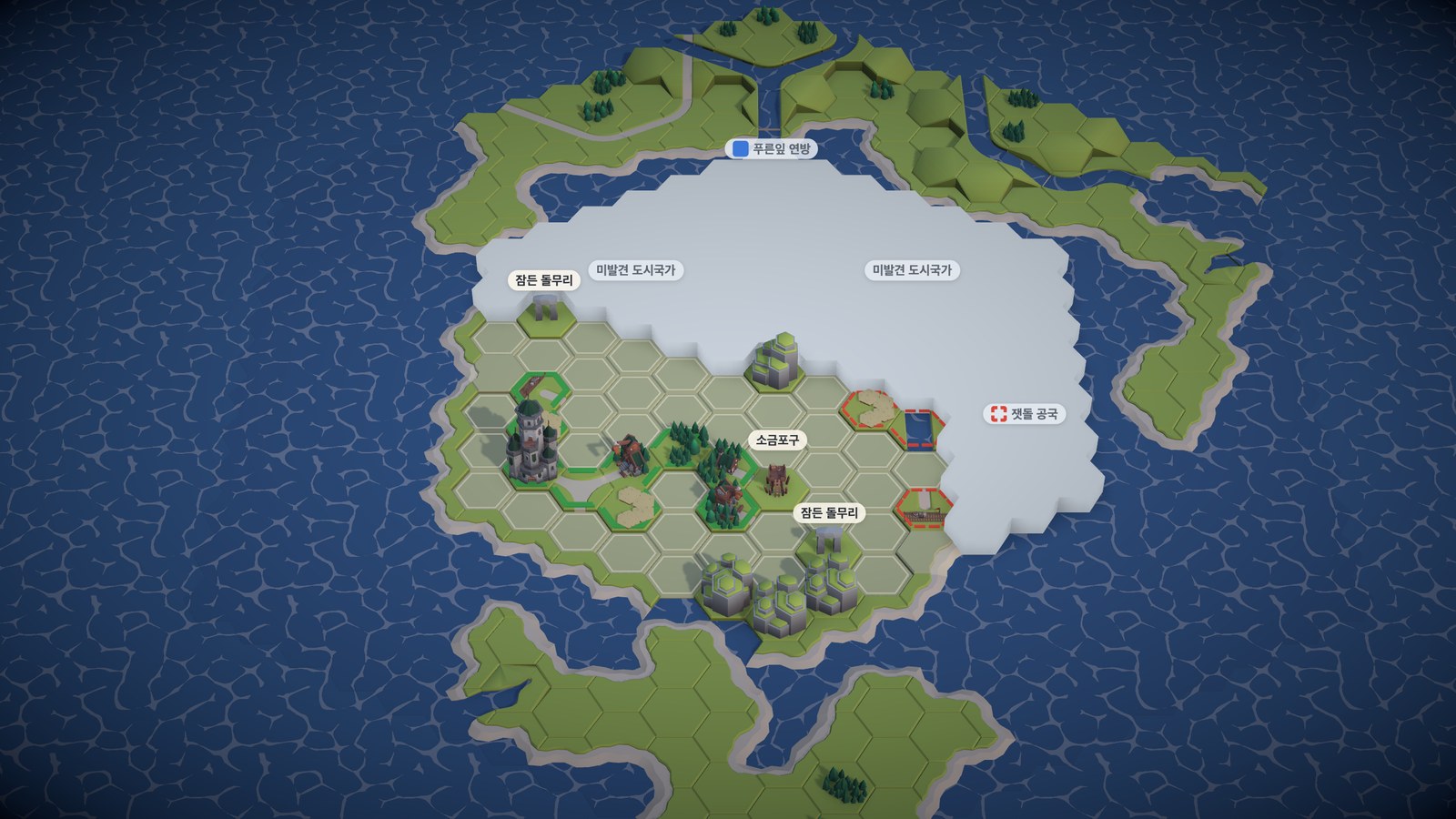
The first design said that meeting a civilization would reveal where its capital is. That did not survive the symmetric map: with two players your rival is always directly opposite, so there is no secret to reveal. I chose fairness. The layout is public, capitals and city-states are marked from the start, and meeting someone reveals who owns a capital, plus their token count. Until then a rival is a neutral gray unknown civilization to the northeast with only a total score.
Fog is easy to draw and hard to keep: leaks hide in the helpful parts of the interface. One test runs every cell, rotation and token choice past two judges, one that sees the whole game and one that sees only a seat’s view, and demands identical answers. It found three leaks in the reasons given for an illegal move. A road tile on a cell not touching your land, beside a mountain still in fog, was rejected for two reasons, and the second one, that roads cannot run into a mountain, gave the mountain away. A token aimed at an unseen cell could come back “too close to a rival”. An unseen cell could be reported as occupied. The fix is an order: off the map, occupied (only if you can see it or it touches your land), adjacency or the token’s vision condition, then edges, and once a check fails nothing later is reported. Tokens also need the target cell and all six neighbors in view, so their checks only ever look at what you can see.
Other leaks were subtler. During a re-placement, public numbers were recomputed from the current map and briefly exposed placements made out of sight; now they stay frozen at their start-of-round values. The reason someone passed says something about their tokens, so it goes only to players who have met them. And the score preview has a third state: if a placement might uncover a landmark you have not found, that line reads unknown (fog) instead of a confident zero. Before the first commit, fifteen review passes by a separate review agent checked the code against the rulebook, each finding with a script that reproduced it and a regression test after the fix. When round-time leaks kept turning up, the test changed from checking paths to checking a property: for any seat that is not re-placing, its whole visible state during a round, apart from its own move and announced passes, must equal its state at the start of that round.
Opponents that see what you see
The computer opponents get the same visible state a person does, through the same functions. They never read the full game and do not know upcoming offers.
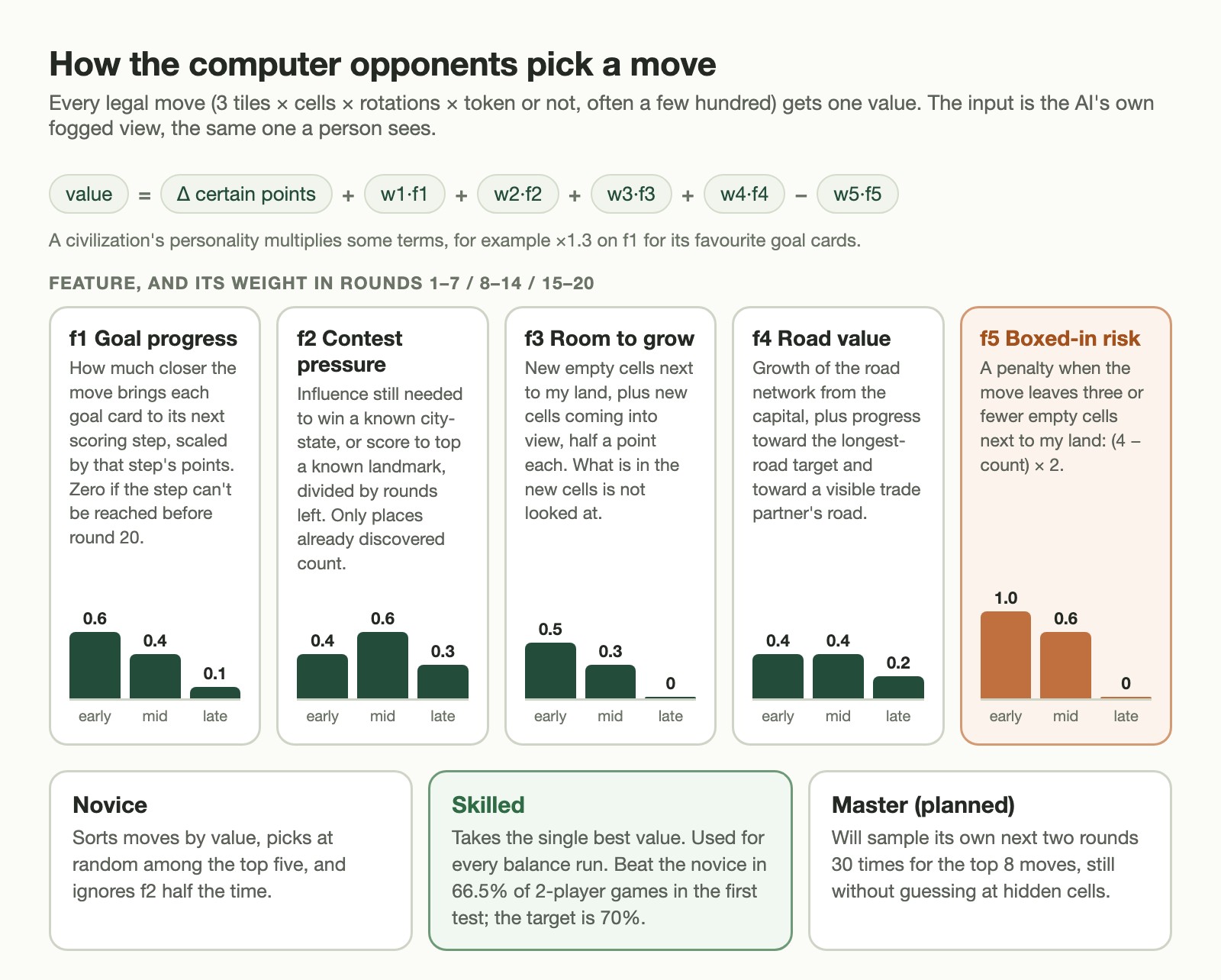
Each legal move, usually a few hundred, gets the points it would certainly gain plus five features weighted by the stage of the game. Early on, not getting boxed in weighs most; in the last six rounds the features fade and real points dominate. The bugs were instructive. The trade-route distance once returned zero both for “no partner in sight” and for “can’t reach”, so the AI happily blocked its own open road ends. Another bug left the AI blind on Great Plains, whose curve is flat between one and two tiles, so it saw no next step and ignored the card. The fix raised that card’s three-player average from 8.4 to 10.6 points, which showed the curve itself was too generous; the blind spot had been hiding it.
Balance testing needs thousands of games, so speed mattered. Previewing every candidate for one seat first took 18 to 40 milliseconds. Placing and removing one tile instead of copying the map, caching rotated tiles and computing a shared baseline once brought it to 2 to 6, and a test confirms the fast preview matches a full recalculation for every candidate. Now 600 four-player games finish in 98 seconds on 12 worker processes.
Balancing with simulated games
No one outside has played Sestet yet. What exists is a simulator that pits skilled AIs against each other, 600 games per player count on fixed seeds, and reports the fairness measures from the design document.
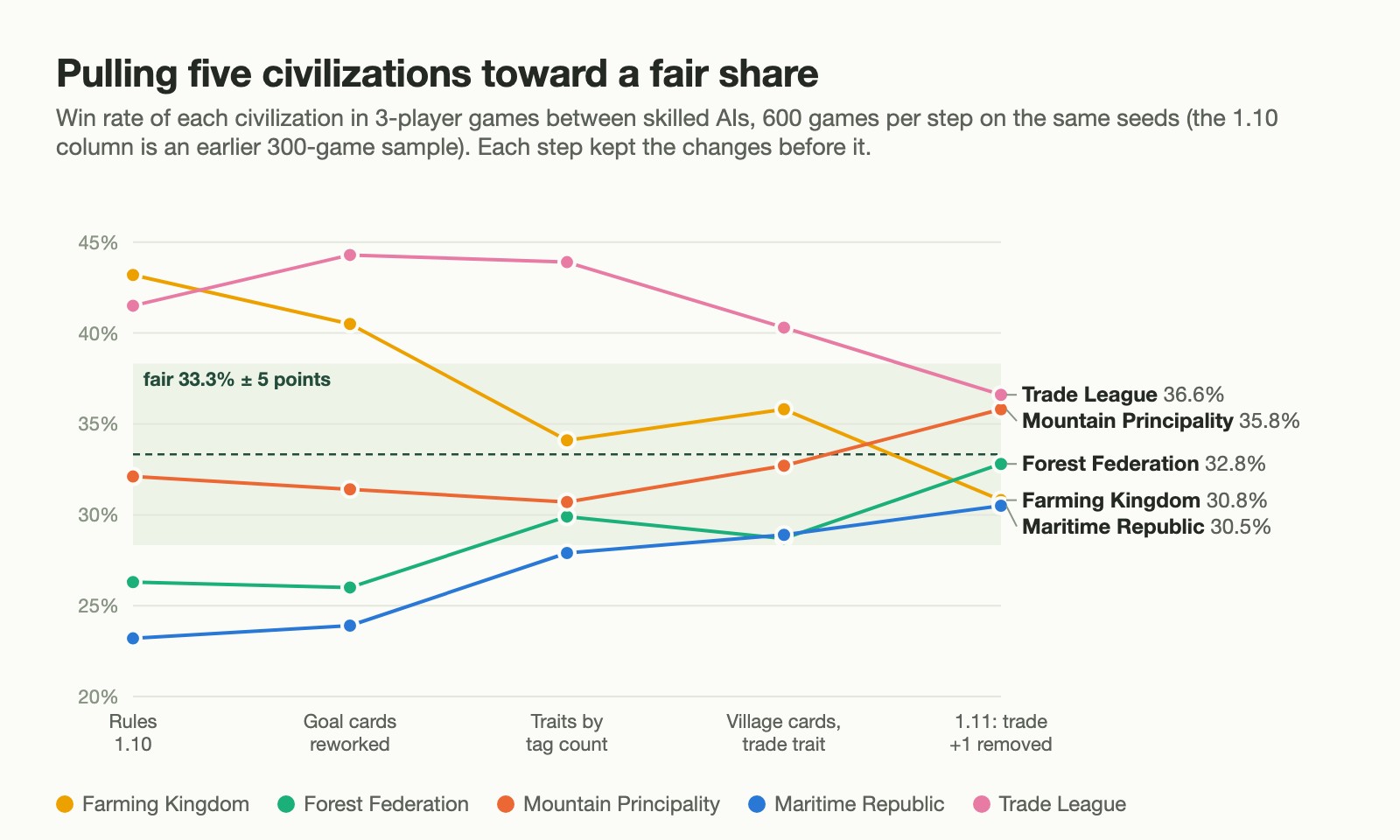
The first full run, under rules 1.10, was humbling. Goal card averages ran from almost nothing to the full 15: Great Plains maxed out in practically every game, Trade Port gave almost zero. One curve for every card could not work because tags are not equally common. Almost every road, village, river, mine and harbor tile counts as grassland, forest comes next, and farmland is rarest. So each card got its own curve or price. Win rates by civilization ran from 23% to 43%, mostly because of traits: the farming kingdom averaged 5.7 trait points, the maritime republic 1.3. Traits were rebuilt to count tags.
- The trade league stayed strong. With a weaker trait it still won 40% of three-player games, and switching off its AI personality changed nothing, so the cause was a rule. The league had +1 influence at city-states. Its average score was only 1.5 points higher than the others, but that +1 decided close alliances. Removing it brought the league to 36.6%. The bonus had also leaked: a city-state showing 1 influence with no visible tile around it pointed to the trade league before you had met it.
- A weak card is a dead card. Far Frontier pays for tiles separated from your mainland. At 1 point per tile it averaged 2.3 and the AI never built separate territory. At 2 per tile it averages 11 to 12.5, the highest card. I kept it: a strong optional card beats one nobody plays.
- Swapping two numbers swapped two cards. Windmill Village and Forest Village needed two and three neighbors; swapping the requirements simply swapped their averages, 10.4 and 4.9 to 4.6 and 10.7. Both now need two.
Under rules 1.11 most measures pass. No single score line averages more than 23% of a total. Passes almost never happen. A city-state changes hands about twice a game. Some measures still fail. The first-priority seat in two-player games wins 46.2%, outside 47 to 53%. Only nine to eleven of the sixteen cards land within 20% of the average. The leader at round 10 wins 51% of four-player games, under the 55 to 70% I wanted, which means more late reversals than planned; that may even be fun, so it waits for human players. With 600 games the standard error is two to three points, so the next step is 10,000 games per condition before touching anything near the line.
Drawing the board
The client uses three.js and Vite, with no UI framework. Rendering follows my fork of hex-map-wfc by Felix Turner (MIT): a WebGPU renderer with a WebGL2 fallback, HDR lighting, camera-following shadows, caustic water, ambient occlusion and a narrow telephoto camera that makes the board look like a model. I first simplified it to standard WebGL materials, and it looked so much worse that I went back; phones get a lighter setting instead. The tiles and buildings are Kay Lousberg’s KayKit Medieval Hexagon Pack (CC0), converted by an importer that merges static parts, keeps windmill blades on their own pivots and records each mesh’s source with a SHA-256 hash. The palette comes from my other hex game, Rill & Reef; the water textures from hex-map-wfc; the sky light is Poly Haven’s CC0 Venice Sunset HDR.
The rules use flat-topped hexes and the meshes are pointy-topped, so every mesh turns 30°. For each tile the client picks the KayKit mesh whose road and river exits match the rules, and a test checks all 25 tiles in all six rotations, so a road on screen always leads where the rules say. The fog shaped the art too. Coast pieces are chosen from known neighbors only, with fogged ones treated as water, so a coastline never reveals unseen land. The scenery around the map comes from hex-map-wfc’s wave function collapse solver, which fills a ring of cells so every tile fits its neighbors; I pin the whole map edge to water first, because feeding it the real edge would draw the hidden coast from outside. KayKit buildings come in four colors, so color follows the seat, and each seat also has its own border pattern so ownership never depends on color alone.
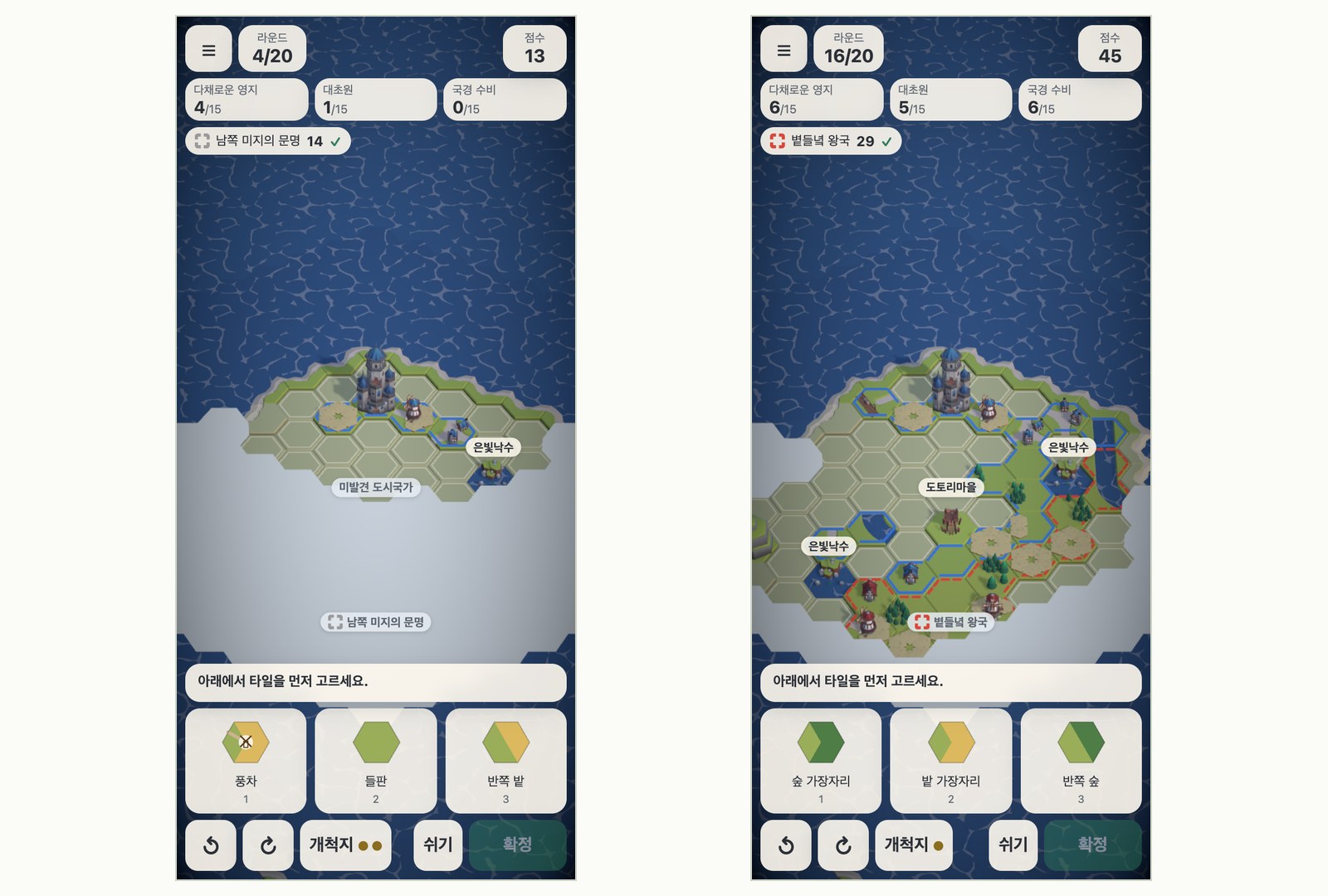
A touchscreen has no hover, so a tap places a tile tentatively and a second tap on the same cell turns it to the next legal rotation.
Ideas that did not make it
The decision log keeps a list of ideas that are deliberately out. Conquest was the big one: capturing tiles by development level, annexing land by surrounding it, taking a capital to win. Each version brought attack and defense modifiers and pulled the game toward fighting. It is postponed, and if it returns it will be a recorded change of scope, not something slipped into the scoring game. Dice-driven production and resource trading, a supply puzzle per village, civilization-only tiles, level-up trait cards, a longest-river record and city-states that grow on their own were set aside too, each because it added a second system to manage.
Smaller cuts came while writing exact rules. Separate lakes went, because defining their size and shape complicated the generator for little effect on decisions; the waterfall lake landmark carries that look now. Passing because the timer ran out stopped earning a token, which would have let players stall through a bad round for a free point.
Where it is now
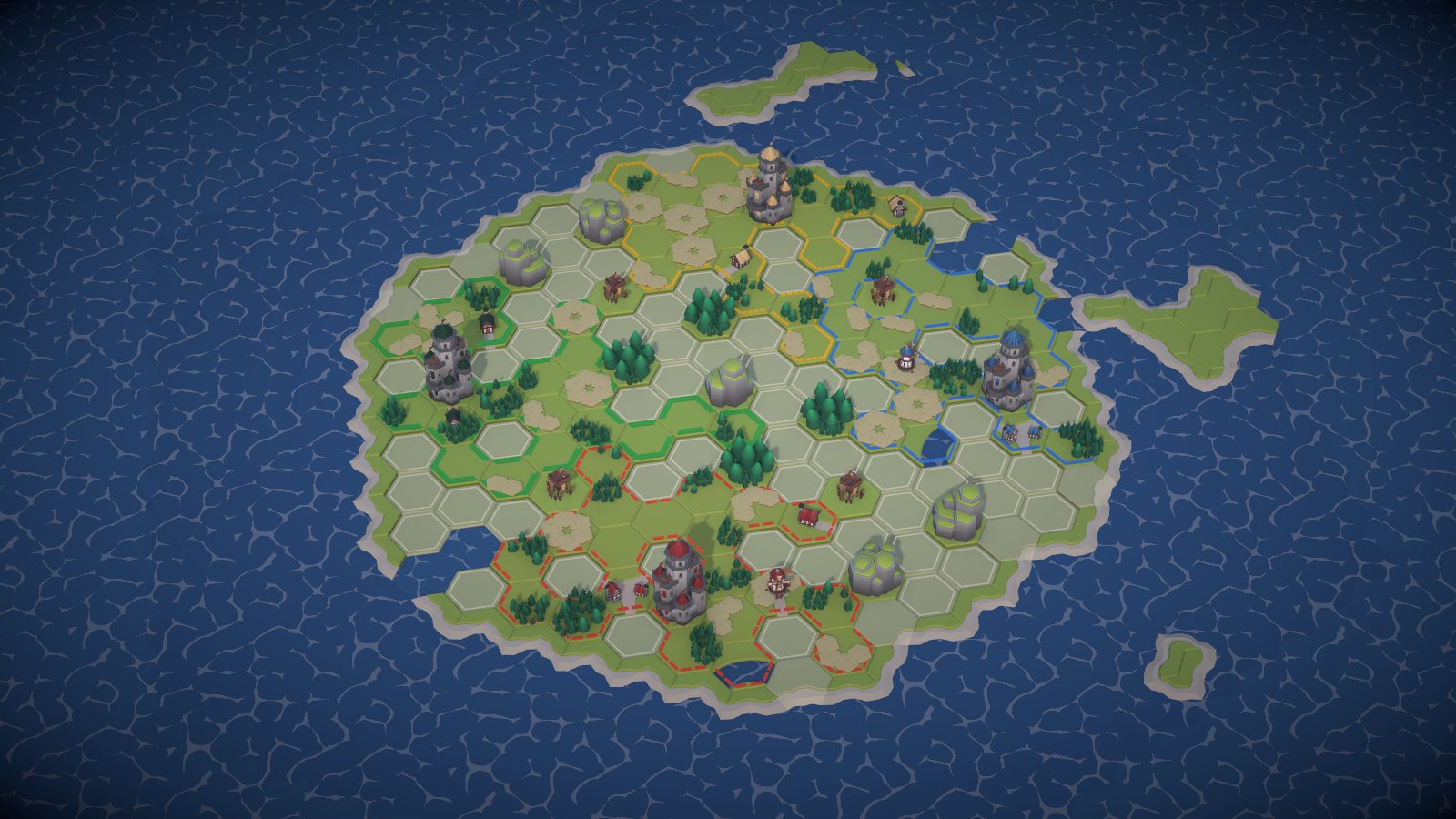
The rules engine implements the whole rulebook and passes 96 tests. The browser build plays solo expeditions, the daily map and matches against one to three AIs on desktop and phone, and has been played through to the results screen in every mode. It saves the move record after each round, and continuing a game replays that record from the seed. Not built yet: the tutorial, online play with friends, the planned master-level AI, sound, the English interface and most animations. The next step is the one a simulator cannot replace: people outside the project playing it, to see whether they start a second game without being asked.
Update, November 2026. The code has not changed since this note. Rerunning the map generator over 2,000 seeds for every player count and theme, 24,000 maps in all, found 35 that needed one retry and none that needed the fallback map.