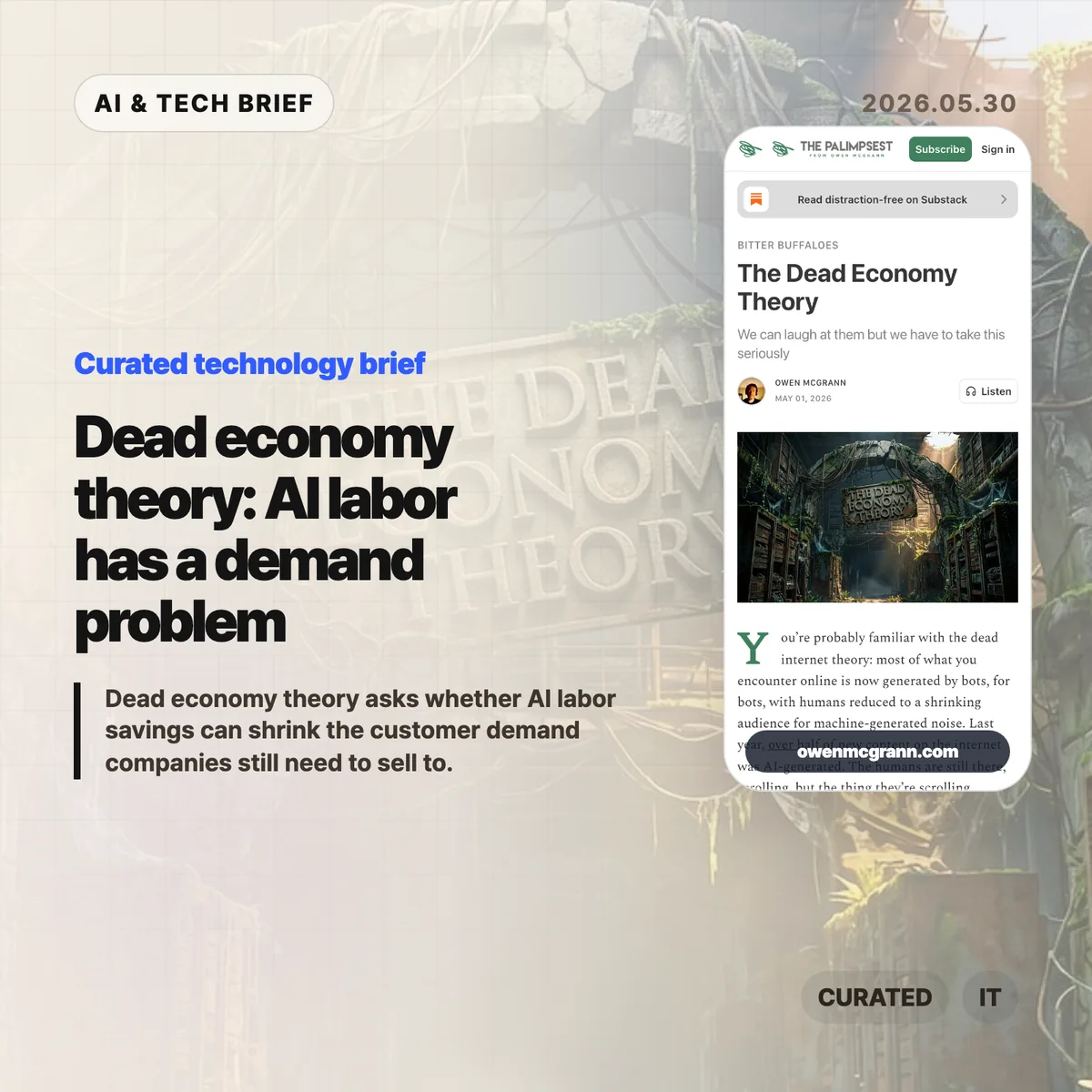
Dead economy theory is a useful name for a blunt question: if AI labor savings come from replacing workers, who keeps buying the goods and software those companies sell? Owen McGrann’s essay pushes past the usual productivity story and follows the money after the layoffs. The uncomfortable part is that a rational choice for one company can still weaken demand for everyone else.
Table of Contents
The short version
- McGrann argues that large AI valuations make the most sense if investors expect a huge share of labor spending to move from payroll to software.
- The demand problem is simple: workers are also customers, and broad layoffs can cut the spending that businesses rely on.
- The related “AI Layoff Trap” paper models this as an automation arms race where firms automate more than is healthy for the whole economy.
- Hacker News readers pushed back on the essay’s assumptions, but the thread kept returning to the same worry: past automation is not proof that every future shock will land gently.
What happened
Owen McGrann published “The Dead Economy Theory” on The Palimpsest, framing it as an economic cousin of the dead internet theory. The essay starts from the way AI firms sell themselves to investors and enterprise buyers. Words like copilot and assistant sound harmless, but the business case often points toward doing more work with fewer people.
That framing matters because the biggest possible market for AI is not better autocomplete. It is labor spend. McGrann connects that to benchmarks such as OpenAI’s GDPVal, which evaluates model performance on economically valuable work, and to a newer paper called “The AI Layoff Trap.” The paper argues that firms can get stuck in a competitive automation race even when they understand that mass displacement may reduce consumer demand.
The dead economy theory is not a forecast with a date attached. It is a stress test for the AI investment story. If software replaces labor faster than new income channels appear, the savings show up before the missing demand does.
Why this is worth watching
The best version of the AI productivity argument says automation raises output, lowers prices, and eventually creates new work. That has happened before. Mechanized farming, factory automation, and computers all hurt some workers while expanding other parts of the economy.
The weaker version skips the transition cost. It assumes the people displaced from cognitive work will quickly find new work that pays enough to support the same consumption. That is a large assumption, especially if AI systems also chase the next white collar task those workers might move into.
How dead economy theory changes the AI sales pitch
For readers tracking AI companies, dead economy theory is a way to separate product language from financial logic. If an AI tool is priced and marketed around headcount reduction, the macro question is not a side issue. It is part of the product’s long-run market size.
There is also a builder angle. AI app and agent teams should be careful about promising pure labor removal when the healthier pitch may be workflow capacity, error reduction, or work that would not have been done at all. That distinction matters for customers, regulators, and platform marketplaces. For more AI business coverage, see the IT & AI archive.
What Hacker News readers are arguing about
The Hacker News discussion was large and messy, which fits the topic. One camp saw the essay as a dressed-up recession story: firms cut costs, workers spend less, and demand falls. Their objection was that this is not unique to AI and that previous waves of automation did not end employment.
The stronger skeptical point was about history. Several readers argued that farms and factories automated without making everyone permanently jobless. Others answered that this does not settle the AI case. Past transitions took decades, hurt real people, and depended on new sectors absorbing displaced workers. If AI keeps moving into those sectors too, the usual escape route gets narrower.
Another thread focused on whether an economy even needs human consumers. Some commenters imagined a machine-heavy economy where AI firms sell compute, energy, data, and services to one another. That idea sounded extreme, but it exposed the core dispute: is the economy supposed to serve human demand, or can capital keep circulating after most people lose market power?
The most practical comments were less dramatic. They asked who pays for the data centers, GPUs, electricity, and subscriptions if the middle class gets weaker. They also pointed out that consumption-based pricing does not solve much unless the consuming agents are attached to customers with money. The discussion is not evidence, but it shows where technical readers are uneasy.
The practical read
Dead economy theory does not prove that AI will destroy demand. It does make one test harder to ignore: does an AI product create new output, or does it mostly move wages into vendor spend and shareholder margin?
Founders should be specific about that answer. If the product helps a small team handle work it could not otherwise touch, the demand story is different from a product sold mainly as a layoff machine. Investors should ask the same question from the other side. A market built on replacing customers’ payrolls may be large, but it can also be self-limiting if too many buyers make the same move at once.
Policy people will read the piece differently. The “AI Layoff Trap” paper argues for an automation tax, while noting that basic income, worker equity, and retraining do not fully remove the competitive incentive to automate. You do not have to accept that policy answer to see the problem. The incentive to cut labor is immediate. The cost of weaker demand arrives later and gets shared.