Tag: Future of Work

  • Dead economy theory: AI labor has a demand problem

    Dead economy theory: AI labor has a demand problem

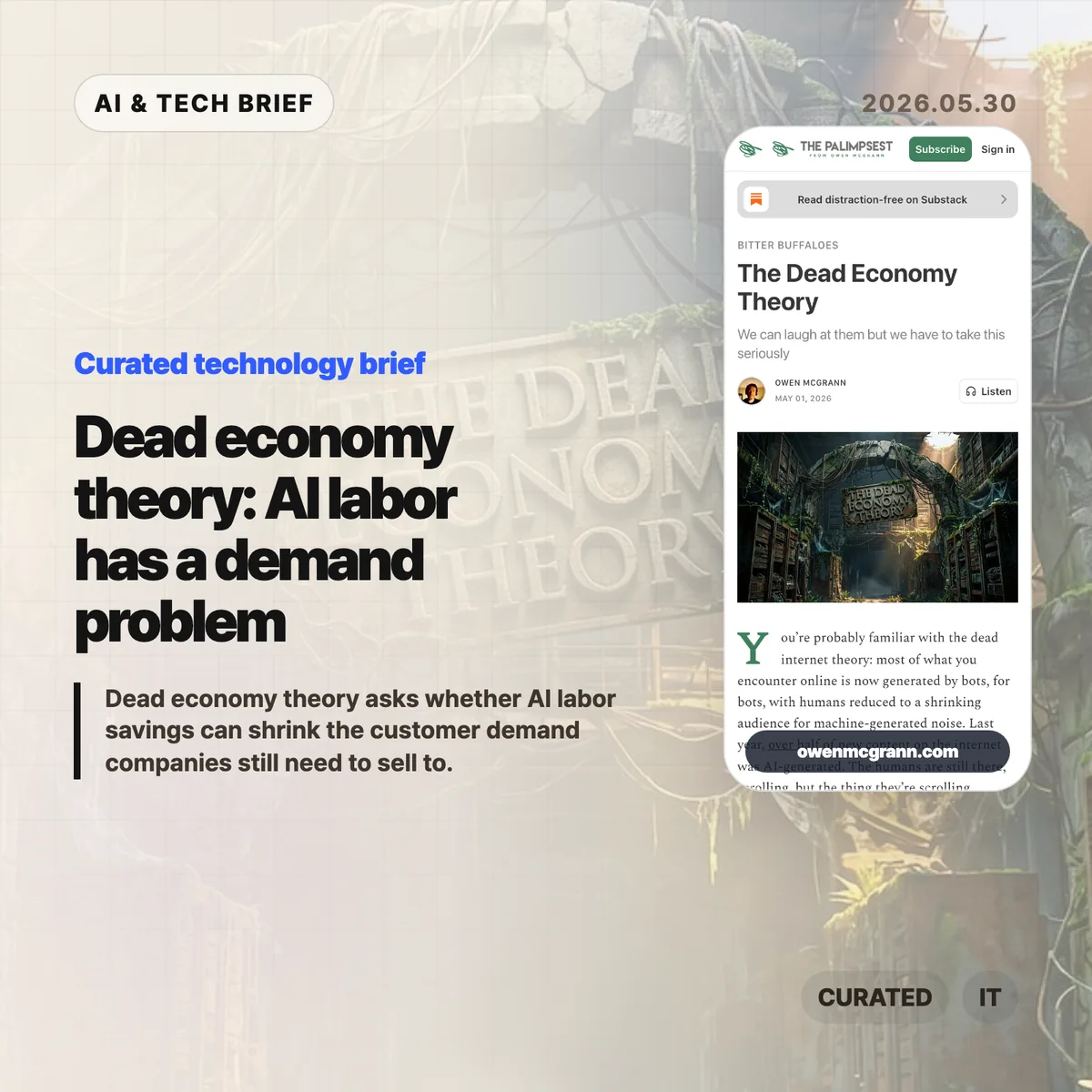
    Dead economy theory is a useful name for a blunt question: if AI labor savings come from replacing workers, who keeps buying the goods and software those companies sell? Owen McGrann’s essay pushes past the usual productivity story and follows the money after the layoffs. The uncomfortable part is that a rational choice for one company can still weaken demand for everyone else.

    The short version

    • McGrann argues that large AI valuations make the most sense if investors expect a huge share of labor spending to move from payroll to software.
    • The demand problem is simple: workers are also customers, and broad layoffs can cut the spending that businesses rely on.
    • The related “AI Layoff Trap” paper models this as an automation arms race where firms automate more than is healthy for the whole economy.
    • Hacker News readers pushed back on the essay’s assumptions, but the thread kept returning to the same worry: past automation is not proof that every future shock will land gently.

    What happened

    Owen McGrann published “The Dead Economy Theory” on The Palimpsest, framing it as an economic cousin of the dead internet theory. The essay starts from the way AI firms sell themselves to investors and enterprise buyers. Words like copilot and assistant sound harmless, but the business case often points toward doing more work with fewer people.

    That framing matters because the biggest possible market for AI is not better autocomplete. It is labor spend. McGrann connects that to benchmarks such as OpenAI’s GDPVal, which evaluates model performance on economically valuable work, and to a newer paper called “The AI Layoff Trap.” The paper argues that firms can get stuck in a competitive automation race even when they understand that mass displacement may reduce consumer demand.

    The dead economy theory is not a forecast with a date attached. It is a stress test for the AI investment story. If software replaces labor faster than new income channels appear, the savings show up before the missing demand does.

    Why this is worth watching

    The best version of the AI productivity argument says automation raises output, lowers prices, and eventually creates new work. That has happened before. Mechanized farming, factory automation, and computers all hurt some workers while expanding other parts of the economy.

    The weaker version skips the transition cost. It assumes the people displaced from cognitive work will quickly find new work that pays enough to support the same consumption. That is a large assumption, especially if AI systems also chase the next white collar task those workers might move into.

    How dead economy theory changes the AI sales pitch

    For readers tracking AI companies, dead economy theory is a way to separate product language from financial logic. If an AI tool is priced and marketed around headcount reduction, the macro question is not a side issue. It is part of the product’s long-run market size.

    There is also a builder angle. AI app and agent teams should be careful about promising pure labor removal when the healthier pitch may be workflow capacity, error reduction, or work that would not have been done at all. That distinction matters for customers, regulators, and platform marketplaces. For more AI business coverage, see the IT & AI archive.

    What Hacker News readers are arguing about

    The Hacker News discussion was large and messy, which fits the topic. One camp saw the essay as a dressed-up recession story: firms cut costs, workers spend less, and demand falls. Their objection was that this is not unique to AI and that previous waves of automation did not end employment.

    The stronger skeptical point was about history. Several readers argued that farms and factories automated without making everyone permanently jobless. Others answered that this does not settle the AI case. Past transitions took decades, hurt real people, and depended on new sectors absorbing displaced workers. If AI keeps moving into those sectors too, the usual escape route gets narrower.

    Another thread focused on whether an economy even needs human consumers. Some commenters imagined a machine-heavy economy where AI firms sell compute, energy, data, and services to one another. That idea sounded extreme, but it exposed the core dispute: is the economy supposed to serve human demand, or can capital keep circulating after most people lose market power?

    The most practical comments were less dramatic. They asked who pays for the data centers, GPUs, electricity, and subscriptions if the middle class gets weaker. They also pointed out that consumption-based pricing does not solve much unless the consuming agents are attached to customers with money. The discussion is not evidence, but it shows where technical readers are uneasy.

    The practical read

    Dead economy theory does not prove that AI will destroy demand. It does make one test harder to ignore: does an AI product create new output, or does it mostly move wages into vendor spend and shareholder margin?

    Founders should be specific about that answer. If the product helps a small team handle work it could not otherwise touch, the demand story is different from a product sold mainly as a layoff machine. Investors should ask the same question from the other side. A market built on replacing customers’ payrolls may be large, but it can also be self-limiting if too many buyers make the same move at once.

    Policy people will read the piece differently. The “AI Layoff Trap” paper argues for an automation tax, while noting that basic income, worker equity, and retraining do not fully remove the competitive incentive to automate. You do not have to accept that policy answer to see the problem. The incentive to cut labor is immediate. The cost of weaker demand arrives later and gets shared.
    Sources

  • AI productivity should buy back Friday before output

    AI productivity should buy back Friday before output

    AI productivity is usually sold as faster work, cheaper work, or more work. Mike Su asks the more awkward question: if AI can turn a week of white collar output into a much shorter sprint, can workers take Friday off? The post is short and playful, but the argument lands because it goes straight at the missing line in most AI adoption decks: who gets the saved time?

    The short version

    • Mike Su’s “Can we have the day off?” asks whether claimed 10x AI productivity should translate into a four-day workweek for white collar workers.
    • The strongest version of the argument is about distribution, not model capability. If AI agents compress work, employees will ask for time, pay, or both.
    • Hacker News readers turned the joke into a labor debate: some saw a serious bargaining question, while others argued market competition will push companies to demand more output instead.
    • For builders, the product lesson is blunt. AI tools that only promise management more throughput may make employees feel less secure, even when the software is useful.

    AI productivity and the four-day workweek

    Su’s post starts from a familiar claim: AI is supposed to raise white collar productivity by a large multiple. If that premise is true, he asks, why should the gain only appear as more output for the employer?

    The concrete proposal is deliberately simple. People work Monday through Thursday. On Thursday they prepare prompts and tasks. On Friday, AI agents keep working while the humans take the day off. It is partly a joke, but it exposes a real gap in the current workplace conversation.

    Most companies talk about AI productivity as capacity. Ship faster. Write more. Support more customers. Close more tickets. Employees hear a different message: use the same hours to do more, with no guarantee of higher pay, more leave, or better job security.

    That is why the Friday framing works. It turns an abstract productivity claim into a payroll and calendar question.

    What happened

    The original essay, published on May 27, 2026, is a short personal blog post titled “Can we have the day off?” Su writes that if AI can produce the same work in a fraction of the time, then a four-day schedule should be a reasonable ask. He even imagines Friday as an “AI workers’ day,” where agents run while humans are out of the office.

    The post does not present a benchmark or a policy plan. It is closer to a pressure test for the way AI is being marketed inside companies. If executives believe AI can multiply output, employees can reasonably ask whether some of that gain becomes time off.

    That makes the piece useful beyond the joke. For more IT and AI workplace briefs, the IT & AI archive tracks similar shifts in automation, developer tools, and product operations.

    Why this is worth watching

    AI productivity gains are easy to claim and hard to divide. A team can adopt coding assistants, research agents, summarizers, and workflow bots without ever agreeing on what happens to the saved hours.

    That silence creates a management problem. If a company tells employees that AI will make them vastly more productive, but keeps the same schedule and raises the output target, the tool starts to look like surveillance with a nicer interface. If the company offers a share of the gain, through shorter workweeks, better compensation, or fewer low-value tasks, adoption has a better chance of feeling like a deal instead of a threat.

    The four-day workweek is only one possible answer. The larger question is whether AI productivity becomes a worker benefit, an owner benefit, or a mix of both. That question will shape how teams talk about agents, copilots, and automation over the next few years.

    What Hacker News readers are arguing about

    The Hacker News thread was large: more than 1,300 points and hundreds of comments when checked. The first serious thread picked up the post’s main point almost exactly. If employees help introduce AI into their workflows, one commenter argued, they should ask what they get in return: days off, higher pay, or some other concrete share of the gain.

    A second camp was more cynical. They argued that productivity gains usually flow to owners, especially when workers are worried about layoffs. Several comments connected the issue to older automation cycles: computers, software, and the internet made many tasks faster, but the standard workweek did not shrink much for most employees.

    The useful objection in the discussion is competition. Some readers argued that a company offering Fridays off could be outpaced by rivals that use AI to work faster all week. Others pushed back, pointing out that many companies already waste huge amounts of time on busy work, weak coordination, and rework. More hours do not automatically mean more useful output.

    There was also a policy thread. Some readers moved from employer-level bargaining to unions, worker protections, taxes, UBI, and social safety nets. That jump matters because it suggests the four-day workweek may be hard to win company by company if the market rewards whoever turns AI into raw output first.

    Treat the thread as sentiment, not proof. But the sentiment is clear enough: workers are starting to ask whether AI productivity will give them leverage or simply raise the bar.

    The practical read

    If you run a team, do not pitch AI productivity only as acceleration. Say what happens to the saved time. Will it reduce after-hours work? Remove recurring busy work? Change sprint scope? Create a trial four-day schedule after the team proves the workflow? Vague promises will not survive contact with calendars.

    If you build AI tools, this is a product positioning issue. A tool that says “your manager can get 10x more from you” and a tool that says “your team can finish the same work with fewer wasted hours” may have similar features, but they land very differently.

    For employees, the move is to make the bargain explicit. Track which tasks AI actually shortens, how much review work remains, and where quality still depends on humans. Then ask for a share of the gain in terms that can be measured: time off, compensation, narrower scope, or fewer low-value meetings.

    AI productivity will not automatically create a shorter workweek. Someone has to ask for it, price it, and design the workflow around it.

    Sources

  • AI productivity claims are running ahead of the work

    AI productivity claims are running ahead of the work

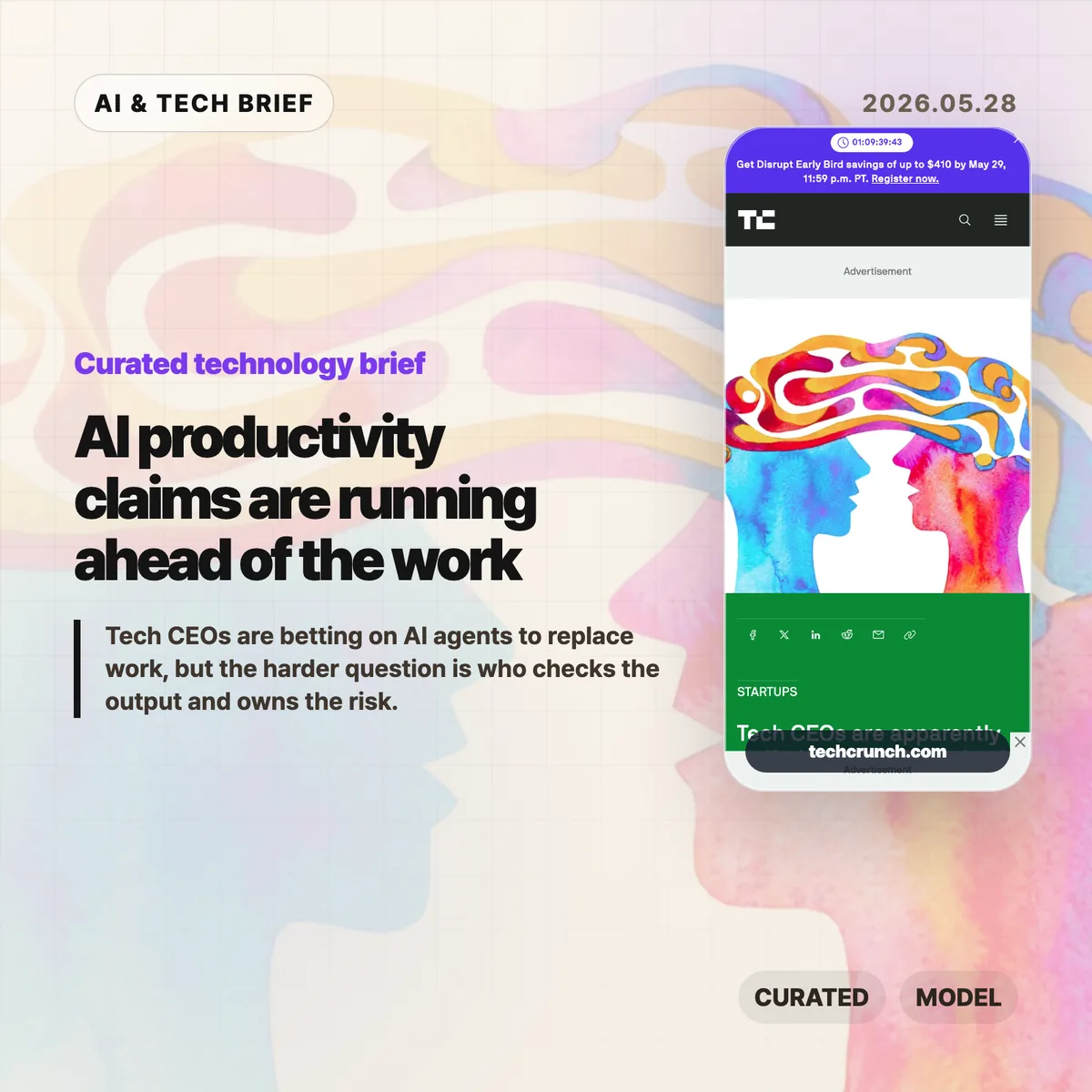
    TechCrunch’s report on Aaron Levie’s warning about “AI psychosis” among CEOs lands because it names a familiar gap: executives see a strong demo, while teams still have to make the work correct, safe, and shippable. AI productivity claims can sound persuasive before that last-mile work is counted. The issue is not whether AI agents are useful. They are. The question is whether companies can tell the difference between a good prototype and a finished business process.

    The short version

    • Box CEO Aaron Levie argued that CEOs are especially vulnerable to overestimating AI because they sit far from the last mile of work.
    • Layoffs.fyi counted 115,430 tech layoffs across 152 companies in the first five months of 2026, close to the 124,636 total it tracked for all of 2025.
    • ClickUp CEO Zeb Evans said the company cut 22% of staff after deploying roughly 3,000 AI agents, a useful case study in how quickly the narrative is moving.
    • The hard part is measurement: more drafts, tickets, pull requests, or proposals do not automatically mean better output.
    • Hacker News readers mostly argued about two things: whether “psychosis” is a fair label, and whether executives understand the review work that AI creates.

    What happened

    The TechCrunch piece starts with Levie’s claim that CEOs are “uniquely prone to AI psychosis” because they are far enough away from frontline work to miss the remaining labor needed to turn AI output into value. That is the sharpest point in the article. A CEO can ask an agent to draft a contract, generate HTML, summarize a customer call, or produce a product mockup. Those outputs can look convincing in a meeting. They still need review, context, policy checks, security judgment, and someone willing to be accountable when the answer is wrong.

    The article also puts that argument next to a rough labor-market backdrop. Layoffs.fyi’s tracker shows 115,430 tech layoffs from 152 companies in the first five months of 2026. That does not prove AI caused the layoffs. It does show why the story is sensitive: AI is becoming part of the language companies use when they explain smaller teams, faster execution, and new operating models.

    ClickUp is the most concrete example in the report. CEO Zeb Evans said the company had deployed about 3,000 AI agents and reduced staff by 22%, while trying to build what he called a “100x org.” That framing is exactly why this debate matters for builders. If agents become part of the org chart, companies need a much better answer to a basic operating question: who reviews the agent’s work, and what happens when the agent is confidently wrong?

    Why this is worth watching for AI productivity claims

    The useful read is that AI adoption is moving faster than AI measurement. A team can count how many agent runs completed. It can count the number of documents, tickets, or pull requests generated. Those are activity metrics. They do not say much about whether the work reduced customer pain, lowered error rates, increased revenue per employee, or freed experts from low-value chores.

    That distinction matters because the research record is still mixed. California Management Review’s summary of AI productivity evidence warns against easy claims that AI adoption produces broad productivity gains by itself. An NBER paper on executives and AI productivity points to a gap between perceived gains and measured outcomes. MIT FutureTech’s labor-task research also suggests that many tasks remain harder to automate at human-level quality than the demo cycle implies.

    The management bottleneck may simply move. Harvard Business Review has made a similar point: if AI increases the volume of output, managers can become the constraint because more work needs to be read, compared, approved, or rejected. Anyone who has reviewed AI-generated code or AI-written legal text knows the pattern. The first draft arrives faster. The expensive part is deciding whether it can be trusted.

    For more briefs on AI products, software teams, and workplace automation, see the IT & AI archive.

    What Hacker News readers are arguing about

    The Hacker News thread around the TechCrunch article is active and messy in the usual useful way. A large part of the discussion focuses on the word “psychosis.” Some readers called it clickbait or a cheap use of medical language. Others defended it as a cultural shorthand for executives becoming detached from what AI can actually do. The split is worth noting because it mirrors the broader AI debate: people agree there is overconfidence, then fight over how harshly to name it.

    The more practical thread is about distance from the work. Several commenters argued that this is not new. Executives have long seen a toy example, assumed the hard part was solved, and pushed a rollout that frontline teams had to absorb. The AI-specific twist is that LLMs can flatter the user while producing a plausible artifact. A CEO who prompts a chatbot into a small front-end demo may come away feeling closer to engineering than they really are.

    There was also a strong operator objection: AI can create review debt. One commenter described a CEO who hit real walls around data architecture and deployment after experimenting with AI prototyping. That is the sane version of the story. The tool helped explore an idea, then exposed the need for human-designed infrastructure. Another repeated concern was failure rate. If a model gets 80% or 90% of text tasks right, the remaining errors can still be disastrous in legal, security, finance, support, or production engineering contexts.

    The thread is not evidence, but it is a useful sentiment check. Builders are not rejecting AI agents outright. They are rejecting the jump from “this generated something impressive” to “this can replace the people who know where the traps are.”

    The practical read

    Companies should treat AI productivity claims like product claims. Define the workflow, the baseline, the quality bar, and the failure mode before tying the result to headcount. If an agent writes support replies, measure refund errors, escalation rates, customer satisfaction, and policy violations. If it writes code, measure review time, defect rate, rollback frequency, and maintenance cost. If it drafts contracts, measure legal review burden and clause-level risk.

    For AI agent startups and workplace apps, the pitch also needs to mature. “We deployed 3,000 agents” is a flashy number, but buyers will eventually ask which agents survived contact with real work. The products that win will probably be the boring ones that make review easier, preserve audit trails, route uncertain cases to humans, and prove that cycle time improved without hiding risk.

    For workers, the signal is more personal. The safer skill is not prompt fluency by itself. It is judgment over the last 20%: checking the output, knowing the domain constraints, spotting the quiet mistake, and deciding when automation should stop.

    Sources