Category: IT & AI

  • The orchestration tax is the real limit on AI agents

    The orchestration tax is the real limit on AI agents

    The orchestration tax is Addy Osmani’s name for the cost developers pay when many AI agents produce work faster than one human can review it. The pitch for agentic coding often starts with parallelism. The harder question is what happens when every result still has to pass through one person’s judgment.

    The short version

    • The orchestration tax appears when launching AI agents is cheap but reviewing their output is still slow.
    • Osmani argues that the scarce resource is not agent runtime. It is the developer’s attention.
    • More agents can deepen the review queue instead of increasing merged, reliable work.
    • The useful operating rule is backpressure: scale agents to review capacity, not to whatever the UI allows.
    • This matters for builders of agent tools because workflow design may matter more than raw parallel execution.

    What happened

    Addy Osmani, a Google Cloud AI director and longtime developer advocate, published a short article on X titled “The Orchestration Tax.” It grew out of a Google I/O panel with Richard Seroter, Aja Hammerly, and Ciera Jaspan about where software engineering is going as AI agents become normal parts of the development workflow.

    His argument is blunt: starting more AI agents is easy, but there is still only one person reading the diffs, resolving conflicts, and deciding whether the work fits the system. That makes the human reviewer the serial resource in an otherwise concurrent system.

    Osmani uses two familiar software ideas to frame the problem. The first is Python’s Global Interpreter Lock: many threads can exist, but work that needs the lock still runs through one choke point. The second is Amdahl’s Law: parallel speedup is capped by the part of the process that cannot be parallelized. In agentic software development, he says, that serial part is judgment.

    Why this is worth watching

    The orchestration tax is useful because it moves the AI agent debate away from demos and toward throughput. A dashboard full of active agents can feel productive. That does not mean the team is shipping better code.

    The risk is cognitive debt. If developers accept agent output because forming an independent opinion has become too tiring, they lose the mental model of their own codebase. The failure may not show up on the same day. It shows up later, when production breaks and nobody can explain why the system works that way.

    Osmani’s practical advice is closer to systems design than personal discipline. Use backpressure. Keep the parallel agent count low enough that reviews stay real. Split work into two piles: isolated tasks that can run in the background, and complex tasks where the human judgment is the work. Batch reviews instead of constantly context-switching between half-finished threads.

    That framing is also relevant to the broader IT & AI archive, where the pattern keeps repeating: the biggest gains from AI tools often depend on the boring workflow around the model.

    What Hacker News readers are arguing about

    There is a Hacker News submission for the piece, but it had no meaningful discussion at the time this brief was prepared. That silence is still mildly interesting. The post is not a benchmark launch or a new model release, so it does not trigger the usual speed-and-capability fight.

    The useful debate to have is more operational: how many agents can one engineer review without lowering standards, and what evidence should an agent produce before a human spends attention on it? Tests, screenshots, small diffs, and clear handoff notes are not glamorous. They are what make agent work reviewable.

    A fair skeptical view is that “orchestration tax” may just be a new label for old engineering management problems: code review queues, merge conflicts, and context switching. That is partly true. The new part is the imbalance. AI agents make it much easier to create parallel work than to create parallel understanding.

    The practical read on orchestration tax

    If you run AI coding agents, treat review attention as a capacity limit. Start with one or two concurrent agents on contained tasks. Require each agent to produce evidence before you review the result: a passing test, a screenshot, a concise change summary, or a small diff that can be understood in one sitting.

    Do not use agent count as the success metric. Use merged work that you still understand. If the queue grows faster than you can review it, reduce the fleet. The orchestration tax is paid either way; the choice is whether you pay it deliberately in workflow design or later through shallow reviews and stale system knowledge.

    For product teams building agent platforms, the lesson is awkward but valuable. The winning feature may not be “run 20 agents.” It may be better batching, clearer review packets, dependency boundaries, and defaults that protect the human reviewer from becoming the bottleneck nobody wants to measure.
    Sources

  • Stack Overflow AI is turning a fading forum into a data business

    Stack Overflow AI is turning a fading forum into a data business

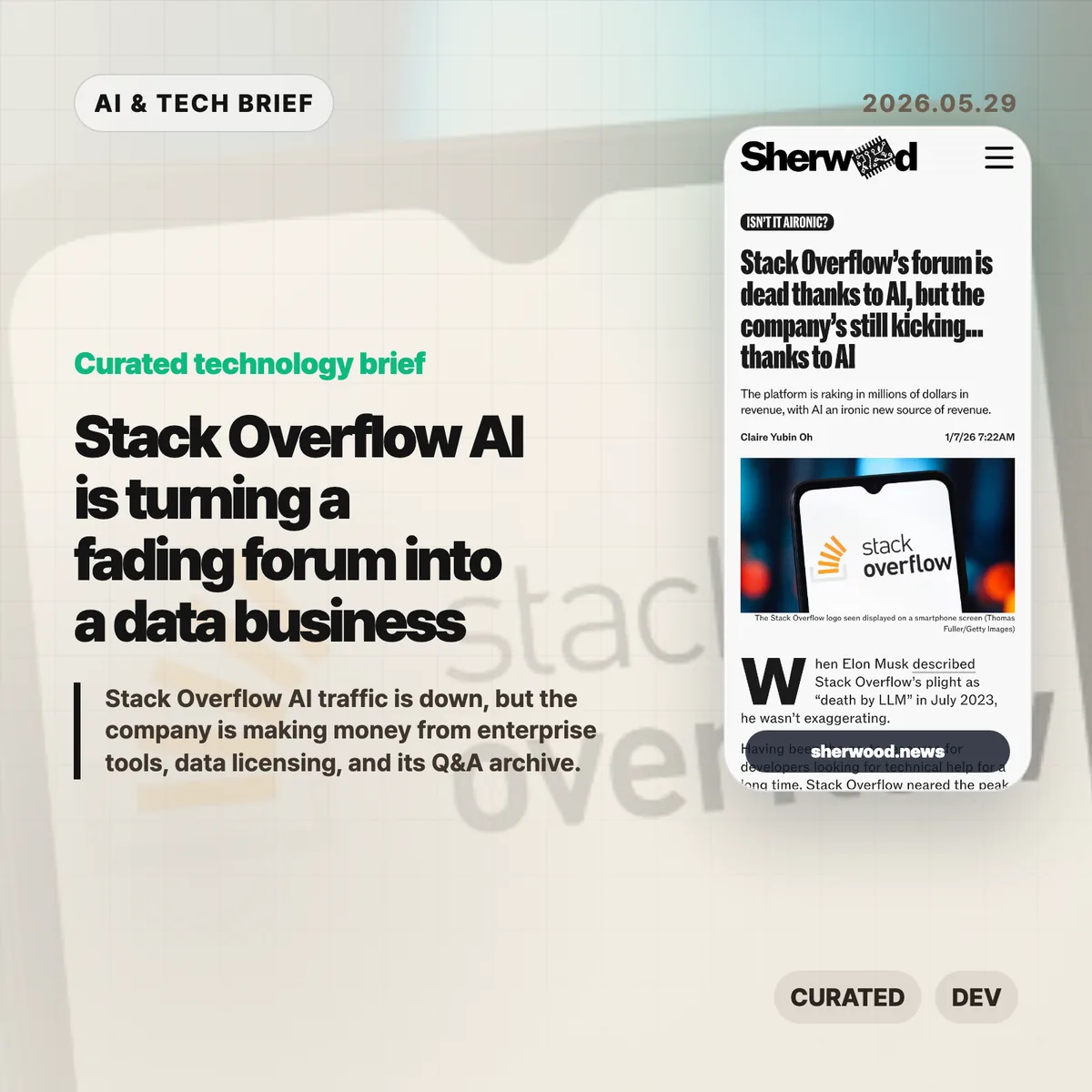
    Stack Overflow AI is a strange story: the public forum is quieter, but the company is not dead. Sherwood reports that Stack Overflow recorded only 6,866 questions last month, while annual revenue has roughly doubled to about $115 million as the business leans on enterprise products and data licensing.

    The short version

    • Stack Overflow’s question volume has fallen close to its 2008 launch-era level, according to Sherwood’s report.
    • The company is still generating about $115 million in annual revenue, with losses down from $84 million in FY2023 to about $22 million in the latest fiscal year.
    • The business has moved toward enterprise tools such as Stack Internal and licensing its developer Q&A archive to AI companies.
    • The uncomfortable part is the loop: AI systems learned from public developer knowledge, but their chat interfaces now keep many new answers out of the public web.

    What happened

    Sherwood’s piece frames Stack Overflow as one of the clearest examples of AI changing developer behavior. Developers who once searched, drafted a question, waited for replies, and left a searchable trail now ask ChatGPT, Claude, Cursor, Gemini, or Copilot first.

    That hurts the forum. A month with 6,866 questions is not a healthy signal for a site that became the default place to solve programming problems. It also changes how new software knowledge gets written down. A private answer in a chat window may solve one person’s bug, but it does not help the next person who hits the same error message.

    The company story is different. Sherwood says Stack Overflow has cut losses and shifted revenue away from forum advertising. Its enterprise product Stack Internal packages company knowledge with a Q&A-style workflow, and Stack Overflow also licenses its data to AI companies that need high quality coding examples and human-curated answers.

    Why this is worth watching

    Stack Overflow AI matters because it shows how a community can lose activity while its archive becomes more valuable. That is not a clean win. It is closer to a salvage model: the old community created a data asset, and the company is now finding buyers for that asset while the public habit that refreshed it weakens.

    Stack Overflow AI and the open-web loop

    For builders, the lesson is blunt. Traffic is not the only asset a technical community creates. Clean answers, reputation signals, accepted solutions, comments, duplicates, and edits all become structured knowledge. That kind of material is useful for retrieval systems, coding assistants, internal copilots, and model evaluation.

    The risk is decay. If fewer developers ask and answer in public, the archive gets older. Libraries change. APIs move. Frameworks break old advice. The AI tools that made the forum less necessary still need fresh, checked, human-written material to stay useful. That loop should worry anyone building on top of public web knowledge.

    This is also why developer tool companies should watch the business model, not only the traffic chart. A product that looks weaker as a destination can still become infrastructure. For more coverage of AI and developer platforms, see the IT & AI archive.

    What Hacker News readers are arguing about

    There is not much of an argument yet. The Hacker News submission exists, but the thread had only 3 points and no comments when checked. That absence is useful in its own way: the story is more developed in the source reporting than in the public discussion around it.

    If a real thread forms later, the useful debate will probably center on three questions. First, whether Stack Overflow’s decline is mostly AI substitution or partly the result of old moderation and onboarding problems. Second, whether licensing community-written answers to AI companies is fair to the people who created the archive. Third, whether private coding assistants are quietly starving the open web of fresh troubleshooting records.

    Those are not abstract complaints. They affect how future developers discover answers, how communities reward contributors, and how AI vendors get the next round of reliable programming data.

    The practical read

    If you run a developer community, Stack Overflow AI is a warning against treating posts as disposable traffic. The durable asset is the knowledge graph around the answers: who corrected what, which answer survived scrutiny, which question was a duplicate, and which explanation still works after a few release cycles.

    If you build AI coding tools, this story is a reminder that source quality matters. A model that answers from stale examples can save time today and create worse bugs tomorrow. Product teams should test answers against current docs, not only old public threads.

    If you are a developer, the practical habit is simple. Use the assistant, but publish the hard-won fix when the answer took real work. A short issue comment, a docs PR, or a public Q&A answer keeps the next person from solving the same problem alone.

    Sources

  • Neovim developer workflow: why modal editing still sticks

    Neovim developer workflow: why modal editing still sticks

    The Neovim developer workflow has outlasted several waves of shiny editors because it is built around editing as a repeatable grammar, not a panel-heavy app. Caio Bianchi’s May 26 essay is personal, but the argument lands beyond nostalgia: developers keep returning to Neovim when they want a fast, programmable editor that follows them from a local project to SSH, tmux, Git, tests, and Markdown.

    The short version

    • Bianchi says he started using Vim in 2011 and still picks Neovim after trying VS Code, JetBrains IDEs, Sublime, Atom, Zed, and others.
    • His case for Neovim is less about raw typing speed and more about motions, text objects, macros, and repeatable edits that stay useful for years.
    • Modern Neovim is not frozen in old Vim culture. Lua configuration, built-in LSP, Treesitter, snippets, formatters, and plugin managers such as Lazy.nvim make it feel current without turning it into a giant dashboard.
    • The Hacker News thread is tiny, but the one substantive reply echoes the same pattern: other editors come and go, while Vim or Neovim becomes the tool people keep returning to.

    What happened

    Bianchi published “A Love Letter to Neovim,” a first-person essay about why Neovim remains the editor he trusts most after roughly fifteen years with Vim and Neovim. The piece is not a feature checklist. It is an argument for a way of working.

    The center of the essay is Vim’s editing grammar. ci" changes text inside quotes. dap deletes a paragraph. . repeats the last change. Macros turn a boring edit into something the editor can replay. Text objects let a developer operate on structure instead of counting characters.

    That grammar matters because code editing is rarely just typing. It is moving through files, cutting a bad abstraction, reshaping a function, checking diagnostics, running tests, and doing the loop again. Bianchi’s point is that Neovim makes those small moves feel direct.

    Neovim developer workflow in practice

    The Neovim developer workflow is also a bet against the all-in-one editor. Bianchi likes that Neovim starts with a buffer and lets the user decide what belongs around it. File search can come from Telescope or fzf-lua. Git can come from Fugitive. Search can come from ripgrep. Sessions can live in tmux. Language tooling can come from LSP, Treesitter, formatters, snippets, and test runners.

    That sounds less convenient than installing a large IDE until the context changes. On a remote server, in a small terminal, inside a pairing session, or while editing a quick config file, the same commands still work. The setup is also plain text in Git, so the user can read it, delete parts of it, or carry it across machines without trusting a hidden settings database.

    This is why the essay feels current even in a year when developer tools are full of AI panels. The Neovim developer workflow does not compete by adding one more sidebar. It competes by reducing the number of moments where the editor itself becomes the thing you are managing.

    For more developer-tool briefs like this, see the IT & AI archive.

    Why this is worth watching

    Neovim is a useful reminder for anyone building developer tools: habit durability can matter as much as new capability. A feature that saves five seconds once is nice. A motion, mapping, macro, or small Lua function that fits into thousands of edits can become part of how someone thinks.

    That does not make Neovim the right editor for every team. VS Code is easy to start with, has a huge extension market, and works well for a broad base of developers. JetBrains tools are deep and polished for many language stacks. The interesting part is that Neovim survives beside those products because it gives advanced users a different bargain: more setup work, more ownership, and fewer assumptions about the rest of the workflow.

    The product lesson is blunt. Some developers do not want the editor to become the whole desk. They want the sharp part of the desk.

    What Hacker News readers are arguing about

    The Hacker News discussion is too small to call a debate. At the time checked, the story had one substantive comment. That reply is still useful because it mirrors the essay’s main claim from another long-time user.

    The commenter describes moving through Kate, Gedit, Eclipse, JEdit, NetBeans, VS Code, Emacs or Spacemacs, and Helix, but still coming back to Vim or Neovim. They credit Neovim with giving the old model a new life through LSP, Treesitter, and Lua scripting. The caveat is config maintenance. Even fans admit that keeping a Neovim setup tidy can be work, which is one reason editors like Helix remain tempting for people who want modal editing with fewer knobs.

    So the useful read from the thread is not broad consensus. It is a familiar trade: Neovim rewards time spent shaping the tool, but that same freedom creates maintenance debt.

    The practical read

    If you already have a calm, productive editor setup, this essay is not a reason to switch. It is a reason to ask where your current setup creates friction. Do you keep reaching for a mouse to do a repeatable edit? Do search, Git, tests, and terminal work feel like separate rooms? Do your settings live in a place you can actually inspect and version?

    If those questions sting, Neovim is worth testing in a narrow lane first. Use it for config files, Markdown, quick SSH edits, or one side project. Do not rebuild your whole work life in a weekend. The value of the Neovim developer workflow shows up when a few commands become automatic and stay useful across projects.

    For tool builders, the sharper lesson is about discovery. App stores, extension markets, and plugin directories often reward visible features, but the workflows people keep are usually quieter. They fit into muscle memory.

    Sources

  • CodeBoarding architecture diagrams map AI code review

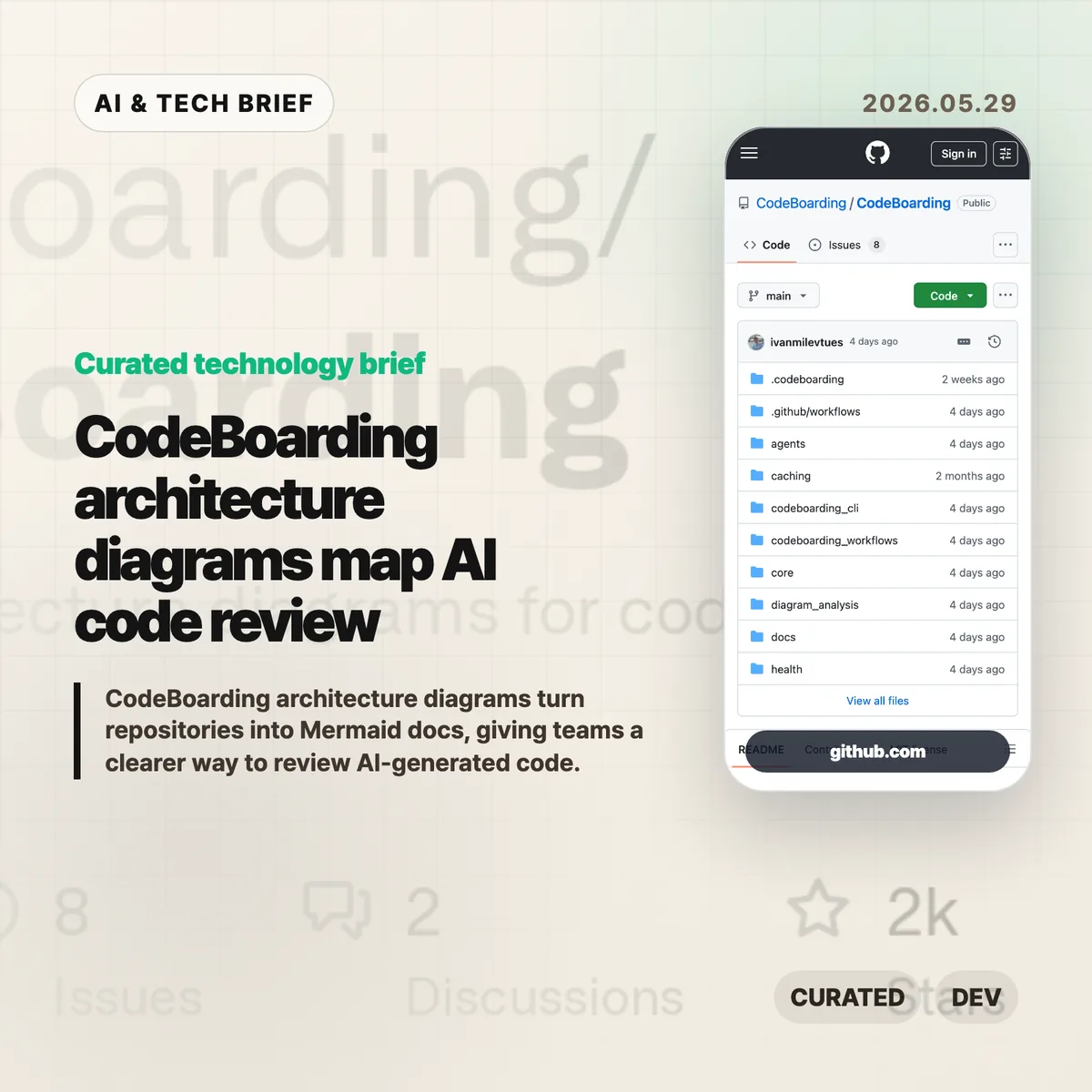
    CodeBoarding architecture diagrams map AI code review

    CodeBoarding architecture diagrams turn a repository into navigable Mermaid docs, with static analysis and LLM reasoning doing the first pass. The pitch is simple: if AI coding agents are changing more code, reviewers need a faster way to see the shape of the system before they approve the diff.

    (more…)

  • Claude Opus 4.8 is a quieter bet on AI coding teamwork

    Claude Opus 4.8 is a quieter bet on AI coding teamwork

    Claude Opus 4.8 is Anthropic’s latest Opus model, and the more interesting part is not a single benchmark jump. The release points to a different priority for AI coding tools: fewer unsupported claims, larger Claude Code jobs, clearer cost controls, and API behavior that fits long-running agent work.

    The short version

    • Anthropic says Claude Opus 4.8 improves coding, agentic tasks, reasoning, and professional work while keeping regular Opus 4.7 pricing at $5 per million input tokens and $25 per million output tokens.
    • The company says Opus 4.8 is around four times less likely than Opus 4.7 to let flaws in its own code pass without comment.
    • Claude Code is getting dynamic workflows, a research preview feature that can plan large jobs, run hundreds of parallel subagents, verify outputs, and report back.
    • Effort control lets users trade speed and rate-limit usage against deeper reasoning, while fast mode now runs at 2.5x speed and costs less than before.
    • The Hacker News thread reads less like a celebration and more like a stress test: many readers see a modest update, but builders are watching the workflow changes.

    What happened

    Anthropic introduced Claude Opus 4.8 as an upgrade to Opus 4.7, available now through claude.ai, Claude Code, and the Claude API. The company frames the model as stronger across coding, agentic skills, reasoning, and professional work, but it also says users should expect a “modest but tangible” step over the prior version.

    The regular API price stays the same: $5 per million input tokens and $25 per million output tokens. Fast mode is priced at $10 per million input tokens and $50 per million output tokens. Anthropic says fast mode can work at 2.5x the speed and is now three times cheaper than it was for earlier models.

    The release also changes the product around the model. Claude Code gets dynamic workflows for very large codebase tasks. claude.ai and Cowork get effort control. The Messages API now accepts system entries inside the messages array, so developers can update instructions during a task without breaking prompt caching or disguising the change as a user message.

    Why this is worth watching

    The useful signal in Claude Opus 4.8 is that Anthropic is optimizing around collaboration, not only raw answer quality. That matters because AI coding failures often come from confidence at the wrong moment: the model says a migration is done, misses a test failure, or keeps moving after the plan has gone stale.

    Anthropic’s honesty claim is therefore worth watching, even if the phrase sounds a little odd in a model release. If Opus 4.8 really flags uncertainty more often and catches more of its own code defects, teams may be able to give Claude Code larger chunks of work without turning every run into a manual audit.

    The product changes point in the same direction. Dynamic workflows are available in Claude Code for Enterprise, Team, and Max plans. The feature lets Claude plan a large task, split it across many subagents, and check the work before returning it. For readers who track AI tooling beyond this single release, the broader IT & AI archive is a useful place to follow how model updates are turning into workflow products.

    Claude Opus 4.8 in practice

    For developers, Claude Opus 4.8 is less about replacing the current coding stack and more about changing where the model sits in the process. Autocomplete lives inside a narrow edit loop. Claude Code’s dynamic workflows move the model closer to project manager, migration assistant, and reviewer.

    That shift creates a harder evaluation problem. A model that writes one function can be judged by tests and review. A model that runs a multi-step migration across hundreds of thousands of lines needs better guardrails: scoped permissions, clear rollback points, test gates, logging, and a human who knows when to stop the run.

    Effort control also matters here. Low effort is the right default for routine answers. Higher effort makes more sense when the model is planning, touching many files, or making decisions that cost money if they are wrong. The control is not glamorous, but it is the kind of product detail teams need before they trust AI agents with bigger jobs.

    What Hacker News readers are arguing about

    The Hacker News discussion is skeptical, but not in a simple anti-AI way. The most common reaction is that Claude Opus 4.8 feels incremental. Several commenters point to Anthropic’s own “modest but tangible” phrasing and argue that benchmark tables no longer tell them much because many public evals feel saturated.

    A second thread is about language. Anthropic’s emphasis on model “honesty” annoyed some readers, who felt the company talks about models as if they were organisms being observed in the wild. That led to a more technical argument about whether models are “grown” or “built,” and how much researchers can really explain about why a trained model behaves the way it does.

    The builder-side reading is more practical. Same regular price, cheaper fast mode, effort control, and dynamic workflows are the pieces people can actually use. The useful objection is that bigger agentic runs raise the cost of a bad assumption. If Claude can run hundreds of subagents, the test suite, permission model, and review process become part of the product, not afterthoughts.

    The practical read

    If you already use Claude for coding, Claude Opus 4.8 is worth testing on the tasks where earlier models were annoying rather than impossible: long refactors, migration planning, bug hunts, and code review loops where the model had to admit uncertainty. Do not judge it only on one-shot prompts.

    For teams, the first test should be operational. Compare Opus 4.8 against Opus 4.7 on the same repository, with the same tests, the same token budget, and the same review checklist. Track where it stops, where it asks for clarification, and where it claims success too early.

    For product builders, the release says something broader about AI tool competition. The next useful layer may be less about a smarter chat box and more about controls around the model: effort settings, fast modes, mid-task instruction updates, subagent orchestration, and honest failure reporting. Claude Opus 4.8 is a good release to study if your product depends on developers trusting an agent for work that lasts longer than a single prompt.

    Sources

  • Figma design agent moves AI into the canvas

    Figma design agent moves AI into the canvas

    Figma design agent is Figma’s new beta assistant that works directly on the design canvas. The useful part is not that it can produce more mockups. It can read the working file, use team components and tokens, summarize feedback, and stay inside the place where designers already make decisions.

    The short version

    • Figma is rolling out a beta design agent inside Figma Design, available from the canvas and left rail.
    • The agent can use components, tokens, variables, libraries, file context, and comments rather than starting from a blank prompt.
    • Figma positions the agent for exploration, bulk edits, design system maintenance, and feedback cleanup.
    • The company separates the Figma design agent from Figma MCP: the agent works in the canvas, while MCP connects code and Figma workflows.
    • The beta is planned for Full seat users on Professional, Organization, and Enterprise plans, with Collab and Dev seats limited to drafts.

    What happened

    Figma announced the Figma design agent as a beta feature built into Figma Design. It appears on the canvas and in the left rail, so a designer can ask for changes without moving to a separate AI tool or exporting work elsewhere.

    The product pitch is fairly specific. Figma says the agent has extra context about a team’s design system, including components, tokens, standards, recent component usage, variables, and libraries. That matters because generic image or UI generators often miss the rules that make a product feel like itself.

    Figma also draws a line between the agent and its MCP work. The Figma MCP server is for moving between code and Figma, including code-to-canvas and design-to-code workflows. The Figma design agent is for work that happens in the file: generating design layers, trying variants, applying systems, changing content, and turning feedback into tasks.

    Why this is worth watching

    The Figma design agent is interesting because it aims at the messy middle of product design. Many AI design demos stop at a polished first screen. Real teams spend more time comparing options, naming variables, swapping components, rewriting copy, handling dark mode, and making sense of review comments.

    That is where Figma’s approach could be useful. If the agent can safely handle bulk edits and design system chores, it saves time without pretending that taste has been automated. If it can summarize comments and turn them into next steps, it can reduce the lag between critique and revision.

    There is still a quality trap. More variants can mean more mediocre options. Figma’s own post admits that once a direction is clear, hands-on editing is often faster and more natural than continuing to prompt. That is the right framing. The agent looks more credible as a design operations helper than as a replacement for judgment.

    For readers who track product and AI tooling, this also fits a broader shift covered in our IT & AI archive: AI features are moving into the main workspace rather than asking teams to adopt a new destination app.

    What the discussion is missing

    I did not find a reliable Hacker News thread for this specific Figma announcement. The questions worth asking are still clear.

    First, product teams should watch how much control designers keep when the agent edits real files. Bulk changes sound useful, but a bad edit across dozens of frames can create cleanup work fast. Version history, review habits, and scoped prompts will matter.

    Second, design system teams should test the boring cases before the impressive ones. Renaming variables, documenting component variants, replacing repeated UI elements, and converting screens to dark mode will reveal whether the agent understands the system or merely imitates it.

    Third, the seat and plan limits matter for adoption. During beta, Figma says the agent will not consume credits. At general availability, AI credits will apply. That pricing detail could decide whether teams treat the feature as a daily helper or a limited experiment.

    The practical read for the Figma design agent

    If your team already works heavily in Figma, the Figma design agent is worth testing on contained work first. Try comment summaries, bulk component swaps, copy population, dark mode conversion, and design system documentation before asking it to invent a product direction.

    For designers, the safest posture is to use the agent to widen the search and clear repetitive tasks, then make the final calls by hand. For design system owners, the first win may be maintenance: descriptions, tags, states, variants, and naming rules. For app builders, the ASO angle is simple enough: faster UI exploration can help teams compare onboarding, checkout, and feature-discovery flows before they reach the app store.

    The main thing to avoid is treating canvas-native AI as a quality guarantee. It is closer to a junior collaborator with unusually broad file access. Useful, but still in need of review.

    Sources

  • Decepticon red team agent puts autonomous hacking on a tighter leash

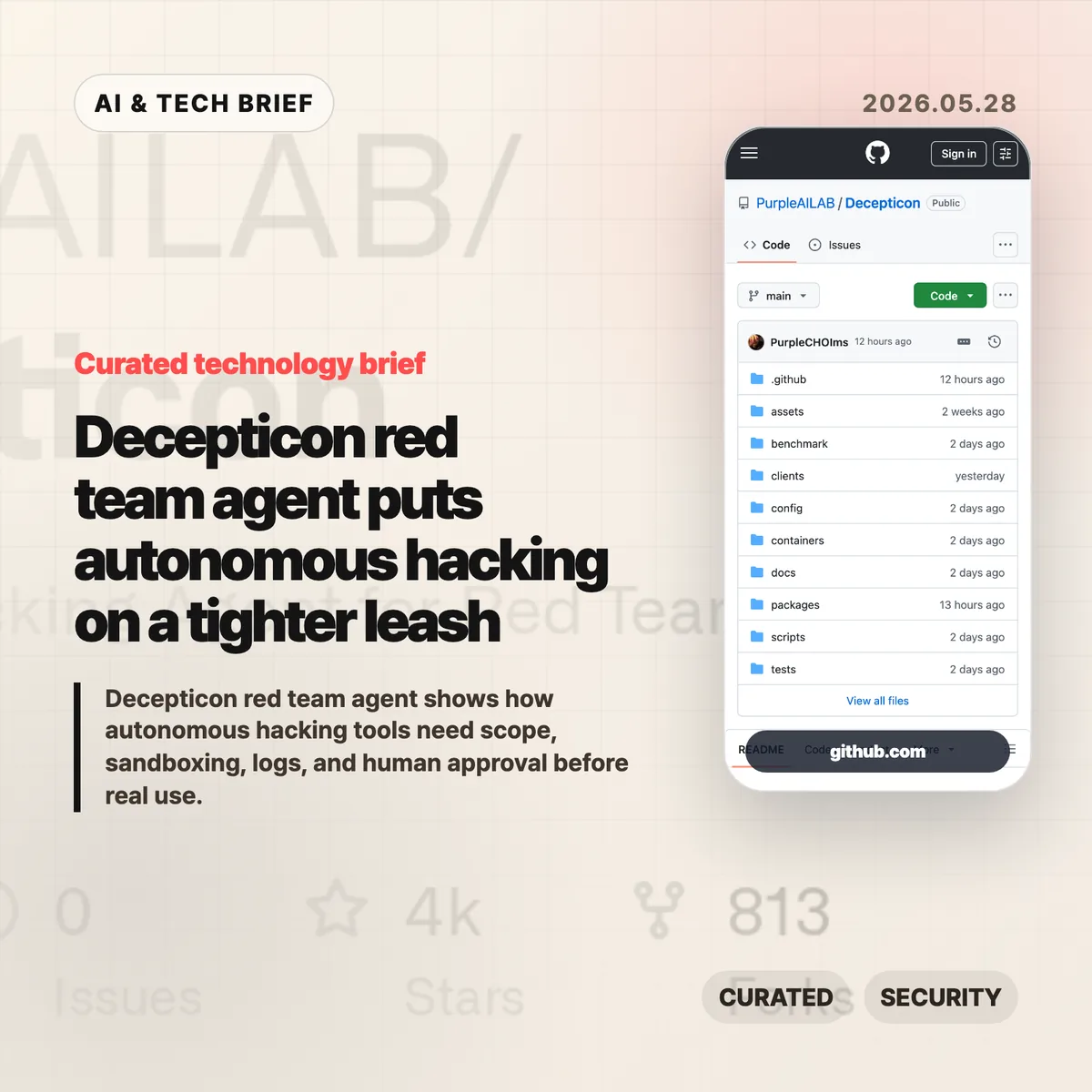
    Decepticon red team agent puts autonomous hacking on a tighter leash

    Decepticon red team agent is an open source attempt to turn red team work into an agent workflow rather than a scanner-plus-report routine. The interesting part is not that it can call offensive tools. It is that the project puts rules of engagement, sandbox isolation, and an operation plan in front of the automation.

    The short version

    • Decepticon describes itself as an autonomous red team agent for reconnaissance, exploitation, privilege escalation, lateral movement, and command-and-control work.
    • The project claims a 102 out of 104 pass rate on the XBOW validation benchmarks, which is useful context but still not a substitute for testing in your own lab.
    • Its design separates management services from a Kali Linux sandbox and says commands run inside that sandboxed operational network.
    • The product question is less “can an AI hack?” and more “who approves the target, constrains the run, and reads the logs afterward?”

    What happened

    Purple AI Lab published Decepticon as an Apache-2.0 open source project on GitHub. The repository describes it as an autonomous red team agent that can work across a full attack chain: reconnaissance, exploitation, privilege escalation, lateral movement, and command-and-control.

    The README also claims a 98.08% result on the XBOW validation benchmarks: 102 passes out of 104 challenges. That number will draw attention, but the repo’s operating model is the more useful part for security teams. Before activity begins, Decepticon says it generates an engagement package with rules of engagement, concept of operations, a deconfliction plan, and an operation plan mapped to MITRE ATT&CK.

    Architecturally, Decepticon separates management services such as LiteLLM, PostgreSQL, LangGraph, and the web interface from the sandbox side where Kali, command-and-control components, and targets live. It also describes 16 specialist agents organized by kill chain phase, with a fresh context window per objective.

    Why this is worth watching

    Security automation has a different risk profile from code completion or meeting notes. A coding agent can break a test suite. A red team agent can touch a network, run a tool against the wrong host, or leave artifacts that defenders have to explain later.

    That is why Decepticon is worth reading even if you never run it. Its docs force a practical checklist: target scope, written authorization, network isolation, tool execution boundaries, prompt and command logs, model fallback behavior, and a human stop button. Those controls are the difference between a useful internal security tool and a liability with a web dashboard.

    The broader signal is also clear. AI agent products are moving into jobs where mistakes have real blast radius. For more coverage of agent tools and security-adjacent developer workflows, see the IT & AI archive.

    why the Decepticon red team agent matters

    The Decepticon red team agent is a good test case for how AI security tools should be judged. A long feature list is not enough. Teams need to know whether the agent can be confined to an approved lab, whether it records each command and decision, and whether operators can interrupt it before a bad assumption turns into traffic on the wire.

    The project’s use of specialist agents also raises a product design question. Splitting work by kill chain phase can keep context cleaner, but it can also make accountability harder if the system does not preserve a readable trail. Security teams should ask how the agent chose a path, which tool produced each result, and which human approved the next step.

    For app builders and security vendors, this is also an app discovery problem. Agent directories and security marketplaces will need trust markers that ordinary software listings do not capture well: safe defaults, isolated execution, audit export, model provider controls, and clear warnings around authorization.

    What the discussion is missing

    A public Hacker News thread was not available for this brief. The missing discussion is still easy to predict because offensive security automation tends to split readers into familiar camps.

    Builders will want to know whether the benchmark claims hold outside curated environments, whether the tool can handle messy interactive shells, and how well it recovers when a scan or exploit path fails. Operators will care more about containment: where credentials live, what traffic can leave the sandbox, how logs are stored, and whether the model can be tricked into stepping outside the engagement plan.

    The useful skepticism is not “AI hacking is scary.” It is more specific: any autonomous offensive tool needs proof that its guardrails are harder to bypass than its demo is impressive.

    The practical read

    Treat Decepticon as a design reference before treating it as an operational tool. If you evaluate it, start in a lab you own, with disposable targets, no production credentials, and a written scope. Then read the logs as closely as the results.

    For security teams, the buying or adoption checklist should be boring on purpose: authorization workflow, sandbox boundaries, network egress controls, credential handling, audit retention, model/provider configuration, and rollback steps. If those pieces are unclear, the automation is not ready for real assets.

    For AI product teams, the lesson is broader. Once an agent can run terminal commands, cloud tools, or security scanners, product quality depends on operational discipline as much as model quality. The Decepticon red team agent makes that tradeoff visible.

    Sources

  • Dropbox AI strategy gets a CEO reset after 19 years

    Dropbox AI strategy gets a CEO reset after 19 years

    Dropbox AI strategy is moving from founder story to product execution. Drew Houston plans to step down as CEO after 19 years, product chief Ashraf Alkarmi is moving into the top job, and Dropbox Dash now has to prove that the company can be more than a familiar place to store files.

    The short version

    • Drew Houston will shift from Dropbox CEO to executive chairman after a period as co-CEO with Ashraf Alkarmi.
    • Alkarmi, who joined from Vimeo in late 2024, is being promoted from product chief to the eventual sole CEO.
    • Dropbox still has more than 18 million paying users, but revenue has been roughly flat for two years and slipped slightly in 2025.
    • The company’s AI bet is Dash, a search and work-knowledge product that reaches across documents, messages, video, and audio.
    • For more on similar shifts in AI and software, see the IT & AI archive.

    What happened

    CNBC reported that Houston is telling Dropbox staff he will move into an executive chairman role. Alkarmi will first serve alongside him as co-CEO, then take over the CEO job on his own. Dropbox also said Mike Torres, currently a Google Chrome product executive, will join as chief product officer in July.

    The timing is not tied to a single crisis, at least publicly. Houston told CNBC there is “never a perfect time” for this kind of handoff. The more useful read is that Dropbox is putting product leadership at the center of its next phase.

    That matters because Dropbox is no longer selling a novel idea. Cloud storage is bundled into Google, Apple, Amazon, and Microsoft ecosystems. Box still competes in the same business. A standalone subscription has to earn its place every month.

    Why this is worth watching for Dropbox AI strategy

    Dropbox has scale, but scale is not the same thing as momentum. CNBC notes that Dropbox has more than 18 million paying users. Annual revenue passed $1 billion in 2017 and $2 billion four years later, but it has been mostly flat over the past two years. The company’s market cap is a little over $6 billion, below the $10 billion private valuation it reached in 2014.

    The interesting part is that AI has not simply crushed Dropbox. Houston said he has not met customers who are canceling Dropbox because they use ChatGPT. That sounds right. Most companies do not replace file permissions, shared folders, audit trails, and client workflows with a chatbot overnight.

    The pressure is subtler. AI changes what users expect from software they already pay for. A storage product that only stores files feels easier to question. A product that helps teams find the right file, the relevant meeting, the missing approval, and the next action has a better reason to exist.

    Dash is Dropbox’s answer. It is meant to search and work across third-party apps, including documents, messages, video, and audio. If it works, Dropbox AI strategy becomes an enterprise search and work-context story. If it feels like another search box, the company is still stuck defending a mature storage business.

    What the discussion is missing

    There does not appear to be a public Hacker News thread worth treating as a source for this story. The missing debate is still obvious: whether Dropbox can win the work-knowledge layer when Microsoft 365, Google Workspace, Slack, Notion, and every AI assistant vendor want the same surface.

    The useful question is not whether AI will end SaaS. That framing is too broad to help operators. The better question is where the trusted context lives. Dropbox has years of file and sharing behavior, but it does not always own the daily workspace where teams make decisions.

    For app builders, that is the lesson. AI features are easier to ship than new habits. Dash has to fit the way teams already search, share, approve, and reuse work. Otherwise the feature may be technically capable and still feel optional.

    The practical read

    Dropbox AI strategy is now a test of product distribution, not model novelty. Alkarmi has to show that Dash can become a daily workflow, not a demo attached to a storage brand.

    Existing Dropbox customers should watch for three things: how well Dash handles permissions, whether it works across the apps teams already use, and whether it saves enough time to justify another paid seat. Investors will probably watch the same signals through revenue growth, retention, and enterprise adoption.

    The CEO change also says something about older SaaS companies in the AI cycle. They do not need to panic-sell a future where every app disappears. They do need a sharper answer to why their product should remain a system of record when AI tools can sit above many systems at once.

    Sources

  • Local AI coding costs are starting to pressure frontier labs

    Local AI coding costs are starting to pressure frontier labs

    Local AI coding costs are becoming a real budget line for teams that run coding agents all day. A SignalBloom essay argues that cheap open-source models, local inference, and lower-cost engineering labor could put a ceiling on what frontier labs can charge for routine software work. The claim is a little aggressive, but the cost pressure is not imaginary.

    The short version

    • The essay compares frontier-model API economics with much cheaper open-source model usage, using a roughly 30x token-cost gap as the headline example.
    • Coding agents burn tokens differently from chatbots: they read files, retry commands, inspect logs, and loop through implementation work.
    • The strongest case for local AI is not replacing every frontier model call. It is routing boring, repeatable coding tasks to cheaper systems.
    • The hard part is quality control. Architecture, product judgment, security review, and long-context debugging still need stronger models or stronger humans.
    • For more coverage of AI tools and software economics, see the IT & AI archive.

    What happened

    SignalBloom published an argument that outsourcing plus LocalAI-style setups may soon look more economical than relying on frontier AI labs for a large share of coding work. The piece frames the issue around price: if frontier model calls keep getting more expensive while open-source models keep improving, teams that run many coding-agent loops will start looking for cheaper routing strategies.

    The article cites a large gap between high-end commercial model pricing and DeepSeek-style open model costs, with the headline comparison landing around 30x in favor of the cheaper option. Treat that number as a directional example, not a permanent price table. Model pricing changes quickly, and a token price alone does not include hardware, orchestration, monitoring, review time, or failed attempts.

    Still, the basic point is useful. AI coding agents are not one-shot assistants. They may scan a repository, write code, run tests, read the failure, try again, and repeat the loop. That makes local AI coding costs more important than they looked when teams were only comparing chat subscriptions.

    Why this is worth watching

    The interesting shift is in routing. A team does not have to choose one model for everything. It can use a frontier model for planning, ambiguous debugging, security-sensitive review, or architecture. It can then hand well-scoped implementation chores to cheaper open-source models or local inference when the task is narrow enough.

    That is why this story matters for developer-tool companies. Heavy users are already different from casual users. A founder asking a chatbot for a landing-page tweak is not the same customer as a team running ten agents across a monorepo. Once agents become part of the workflow, inference starts to look like cloud spend. You need budgets, limits, queues, caches, and a reason for every expensive call.

    The catch is that cheap does not mean free. Local inference brings hardware costs, model-serving work, evaluation, prompt routing, and review burden. Outsourced engineering also adds coordination cost. If the cheaper system produces work that a senior engineer must constantly unwind, the apparent savings vanish fast.

    What Hacker News readers are arguing about

    The Hacker News thread is more useful than the headline because it pushes on the economics from several angles. One camp buys the basic pressure story: open-source models only need to become good enough for day-to-day software tasks to take revenue away from frontier labs. Several commenters imagined hybrid workflows where a strong model handles planning while cheaper models handle the token-heavy implementation loop.

    The main objection is marginal cost. Some readers argued that AI is not like older software, where serving one more user can feel close to free. Inference uses expensive hardware, and the cost curve becomes stepwise: if existing capacity is full, the next user may require another server. That makes price competition more complicated than a simple SaaS comparison.

    A second thread focused on energy, chips, and geography. Some commenters thought lower energy costs and more efficient inference infrastructure could favor Chinese labs or local deployment. Others pushed back, noting that training expertise, capital allocation, chip constraints, and regulatory friction still matter.

    The practical signal from the discussion is that nobody should model this as a clean replacement story. The believable version is a mixed stack: frontier models where quality pays for itself, cheaper local models where repetition dominates, and humans watching the seams.

    The practical read on local AI coding costs

    If you run a small team, the move is not to rip out frontier models. Start by measuring where the tokens go. Coding-agent usage often hides the expensive part in repository reads, failed runs, and repeated edits. Once you know that, you can test cheaper models on bounded tasks: test generation, mechanical refactors, migration scripts, documentation updates, and first-pass bug fixes.

    Keep the evaluation boring. Compare accepted pull requests, reviewer time, rollback rate, failed test loops, and security findings. If a local model saves 80% on inference but doubles review time, it did not save money. If it handles repetitive changes while the frontier model handles planning, it may be worth keeping.

    The bigger lesson is that local AI coding costs will become a product-design constraint. Coding-assistant vendors, agent platforms, and internal tooling teams need pricing that survives power users. The winning stack may be less glamorous than the model leaderboard: good routing, clear budgets, strong review, and enough taste to know when the cheap path is getting expensive.

    Sources

  • React Doctor wants to audit the React code AI agents leave behind

    React Doctor wants to audit the React code AI agents leave behind

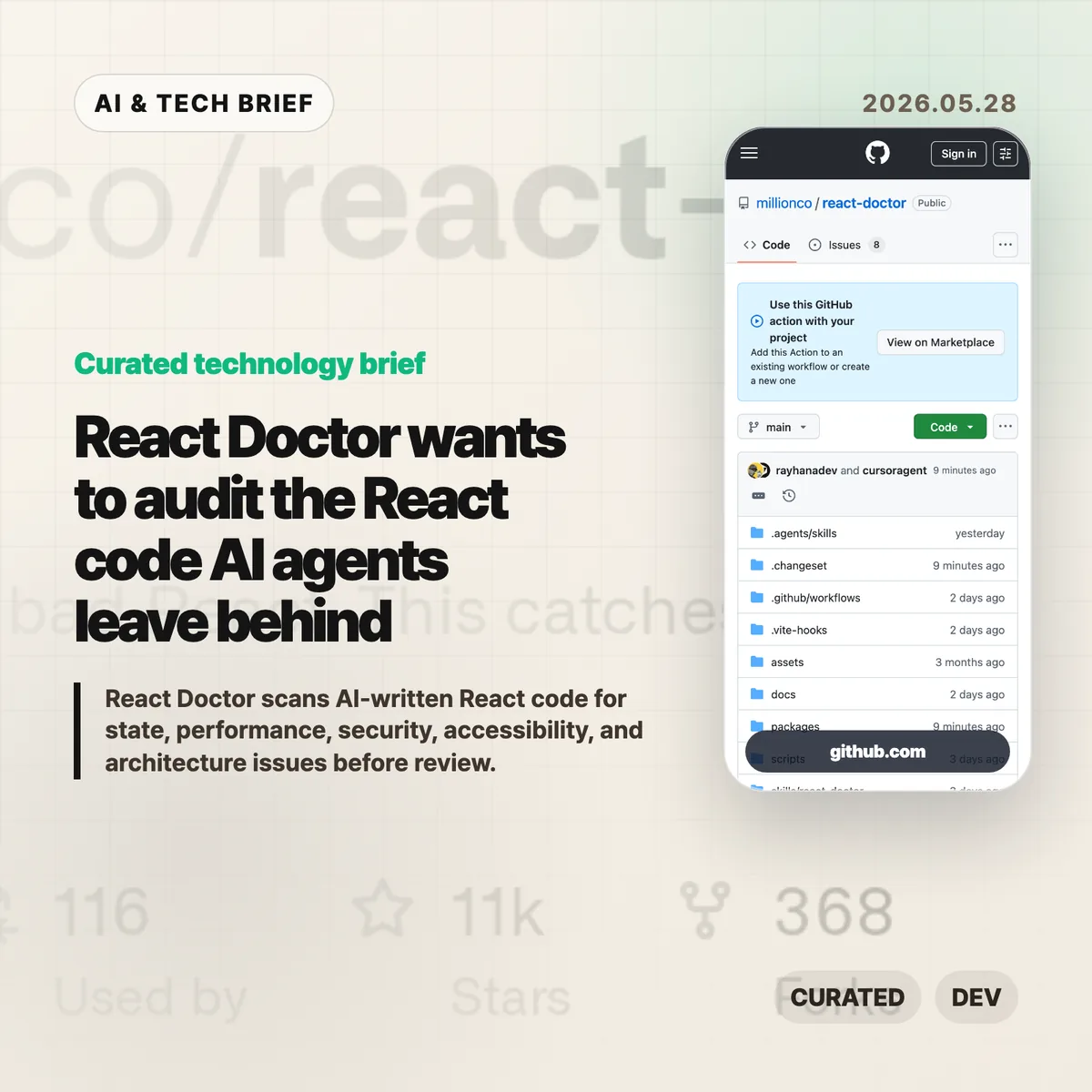
    React Doctor is an open source scanner for React projects that are getting more code from AI agents than humans can comfortably review line by line. It runs from the command line, reports issues across state, effects, performance, architecture, security, and accessibility, and can be wired into GitHub Actions for pull request feedback.

    The short version

    • React Doctor is published by Million.co under an MIT license and lives at millionco/react-doctor on GitHub.
    • The quick start is npx react-doctor@latest, which runs an audit from a project root without a long setup step.
    • Its pitch is narrower than a general linter: catch React-specific trouble that may slip through when agents generate code quickly.
    • The tool supports agent setup, GitHub Actions annotations, and diff-focused scanning for pull requests.
    • Treat it as a second reviewer, not a verdict machine. Static analysis can point at suspicious code, but a team still has to decide what matters.

    What happened

    Million.co has released React Doctor, a static analysis tool with the blunt tagline: “Your agent writes bad React, this catches it.” The README says it scans React codebases for issues across state and effects, performance, architecture, security, and accessibility. It also says the tool works across common React environments, including Next.js, Vite, TanStack, React Native, and Expo.

    The basic command is intentionally small: npx react-doctor@latest. After an audit, teams can run npx react-doctor@latest install to set up agent-facing guidance for tools such as Claude Code, Cursor, Codex, and OpenCode. There is also a GitHub Marketplace action for pull request annotations and comments.

    The repository was created in February 2026 and, when checked on May 28, showed more than 11,000 GitHub stars, hundreds of forks, and an MIT license. Those numbers can move quickly, but they are enough to show that this is not a quiet side note in the React tooling world.

    Why this is worth watching

    React Doctor lands in a gap that many frontend teams are starting to feel. AI coding tools can generate components, hooks, and refactors fast. The slow part is figuring out whether the result quietly introduced a stale effect dependency, an accessibility miss, a performance trap, or an unsafe pattern that only shows up later.

    Existing linters already catch plenty of mistakes. The interesting part here is the packaging: React Doctor talks like an audit tool for agent output, not a hand tuned rule set that a team spends a week configuring. That framing matters. If agents are going to submit more pull requests, teams will want cheap automated friction before a human reviewer spends attention.

    For readers tracking developer tools, the IT & AI archive has more coverage of how coding agents are changing the review loop. React Doctor fits that same pattern: code generation is becoming normal, so code acceptance needs better guardrails.

    React Doctor in practice

    The first useful test is simple. Run React Doctor on a real project and read the false positives before wiring it into CI. A scanner that finds every possible smell can still waste a reviewer’s time if the signal is too noisy.

    The safer rollout is report-only mode on a few pull requests, then diff scanning for changed files once the team understands the output. The GitHub Action is the obvious place to start because reviewers already live inside pull requests. If the tool catches repeated issues, move those categories into a stronger policy. If a category is mostly noise, keep it as advisory or turn it off if the tool allows that path.

    This is especially relevant for teams using agents to touch React Native, Expo, or Next.js code. Those stacks have enough framework-specific behavior that a generic code review checklist often misses practical UI bugs.

    What Hacker News readers are arguing about

    There is a Hacker News submission for React Doctor, but it had no comments when checked through the public HN APIs. That means there is no real thread to summarize yet.

    The absence of debate is its own small warning. React developers should judge the tool on runs against production code, not on launch-day voting. The questions worth asking are concrete: How many findings are actionable? Does it duplicate ESLint, TypeScript, or existing React rules? Can it explain issues well enough for a junior developer or an agent to fix them safely?

    The practical read

    React Doctor is worth a trial if AI coding tools are already producing React changes in your repo. Start with npx react-doctor@latest on a branch, save the report, and compare the findings with issues your team has actually seen in reviews.

    Do not make it a required CI gate on day one. Put it beside ESLint and TypeScript first. If React Doctor repeatedly catches issues that your current checks miss, then promote the narrow categories that proved useful. That is the boring path, but it is also how static analysis becomes part of a workflow instead of another dashboard nobody trusts.

    Sources