Category: IT & AI

  • EV user interface design is making cars harder to drive

    EV user interface design is making cars harder to drive

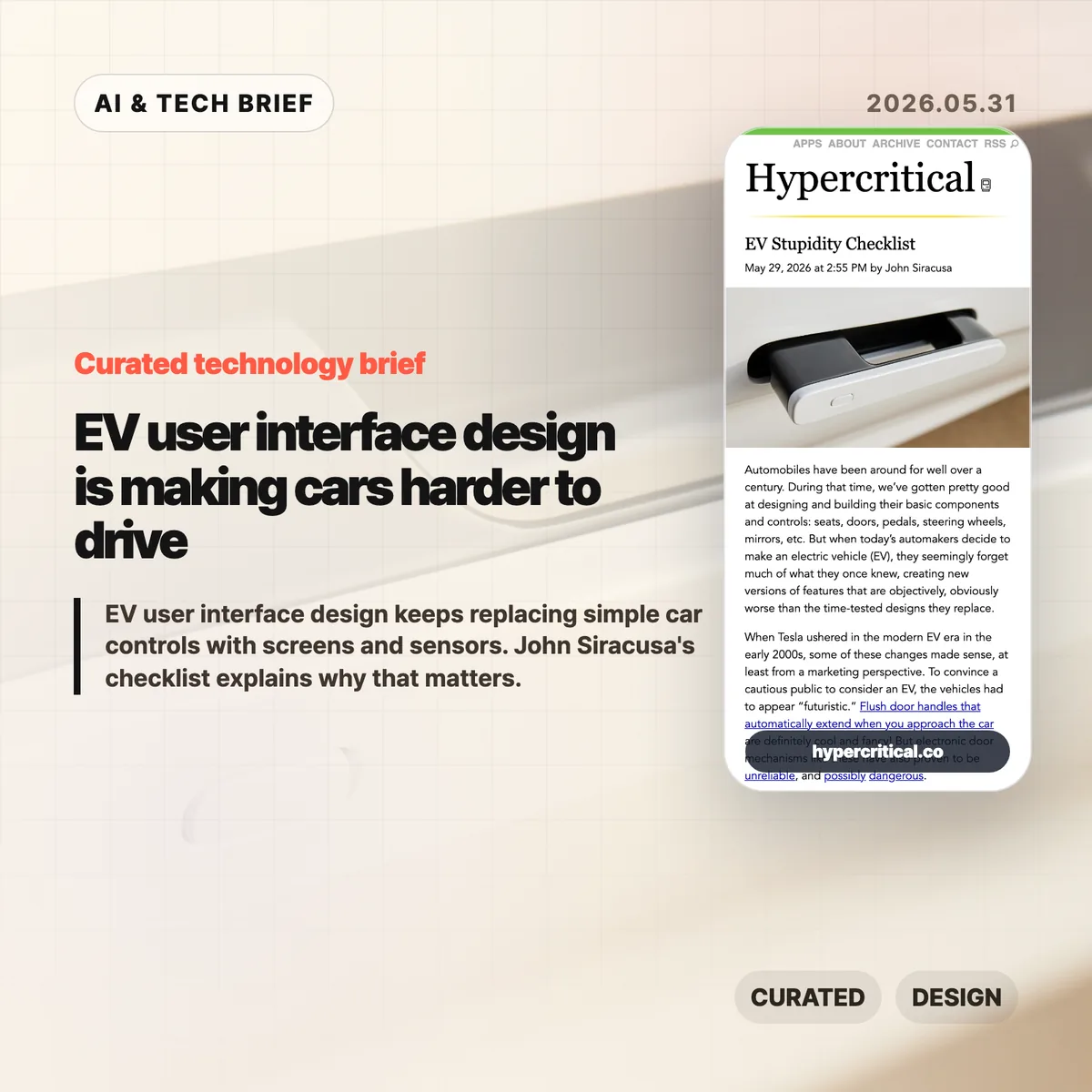
    EV user interface design has a strange habit right now: it keeps taking simple car controls and turning them into software problems. John Siracusa’s “EV Stupidity Checklist” argues that flush door handles, screen-only climate controls, electronic charge-port doors, and camera replacements for mirrors often make cars feel newer while making them worse at being cars.

    The short version

    • Siracusa’s checklist is less an anti-EV rant than a product design audit: if a driver needs to look at a screen for a frequent action, the design probably failed.
    • The useful line is between optional software enhancement and replacement. Cameras, sensors, and screens can help, but they should not remove obvious physical controls for doors, mirrors, climate, or turn signals.
    • Hacker News readers mostly agreed on tactile controls and door-handle affordances, then argued over cameras. The strongest defense of cameras was for reversing and parking, not for deleting mirrors or rear windows.
    • The practical lesson for builders is simple: interface minimalism gets expensive when the user is moving, distracted, cold, wet, injured, or in a hurry.

    What happened

    John Siracusa published a checklist for modern car designers after watching EV makers replace long-settled car controls with electronic or screen-based versions. The list calls out accessible exterior door handles, physical door releases, obvious affordances, a real turn-signal stalk, tactile steering-wheel buttons, physical climate controls, physical air-flow direction, a physical glove-box release, real mirrors, a rear window when the vehicle shape allows it, and side-view mirrors.

    The piece starts from a fair point. When Tesla pushed EVs into the mainstream, futuristic design helped sell the category. Flush handles and giant center screens made the cars look different from gasoline vehicles. But Siracusa argues that this phase should be over. In 2026, EV makers do not need to prove that electric cars are futuristic by making door handles less obvious or climate controls harder to use.

    Cost is the less flattering reason. A big touchscreen can replace a pile of switches, knobs, and small displays. That saves parts and gives automakers more room to ship software changes later. It also moves interaction cost onto the driver. A temperature knob can be found by touch. A menu item cannot.

    EV user interface design in the real world

    This is the awkward part for car companies: many of these changes are easy to sell in a showroom and annoying after six months of ownership. The interface looks clean when the car is parked. It feels worse when the driver needs to change the fan speed without taking their eyes off traffic.

    Why this is worth watching

    The article lands because it treats EV user interface design as a human-factors problem, not a nostalgia fight. Physical controls survived in cars because driving is a hostile context for interaction design. The user is busy. The user’s eyes should be on the road. The car may be moving fast. Weather, gloves, passengers, stress, and emergencies all make clever interfaces worse.

    That is why the door-handle examples matter. A flush handle may improve the side profile of a car, and automakers often mention aerodynamics. Siracusa’s objection is that a door-opening mechanism should be obvious to a stranger and usable before any sensor, motor, battery, or software state participates. In a crash or power failure, that distinction stops being aesthetic.

    The same logic applies inside the car. A fixed climate strip on a touchscreen is still a flat piece of glass. It does not give the hand a shape, edge, detent, or muscle-memory target. For more product and technology context like this, the IT & AI archive is the right place to browse related briefs.

    What Hacker News readers are arguing about

    The Hacker News thread mostly accepted the checklist’s complaint about carmakers replacing proven controls with fragile ones. Several readers pointed to retractable handles and electronic releases as a safety issue rather than a style preference. One commenter noted that China has reportedly moved to restrict retractable exterior handles and purely electrical interior handles after incidents where occupants could not get out or rescuers could not get in.

    The more interesting fight was about cameras. Some readers argued that rear-view cameras are plainly better for backing up because they show what mirrors cannot, including children or objects directly behind the car. That is a strong point, but it is narrower than the checklist’s claim. Siracusa is not arguing against backup cameras as an aid. He is arguing against replacing mirrors and rear windows with screens.

    The best objection from the mirror side was practical, not sentimental. Screens have focal-distance issues, limited dynamic range, glare and brightness problems, dirt and salt on lenses, software or electrical failure modes, and weaker depth cues. Several drivers said the best setup is both: mirrors for continuous spatial awareness, cameras for low-speed backing and parking.

    There was also a product-management thread under the jokes. Readers kept circling back to the same explanation: automakers know how to build usable controls, but they keep choosing cheaper or more visually distinctive designs. That makes the problem harder to dismiss as a temporary learning curve.

    The practical read

    If you design a car, do not make basic actions depend on a screen unless the screen is only an extra path. Door opening, signaling, climate adjustment, hazard lights, glove-box access, mirror checks, and charging access need fast physical affordances. They should work for a new user, in bad weather, under stress, and after a partial system failure.

    If you design software, the lesson is still useful. EV user interface design is a reminder that lower visual complexity can raise operational complexity. A clean surface is not the same as a usable surface. The more urgent or physical the task, the more the interface needs shape, location, feedback, and fallback behavior.

    The checklist is blunt, and some items will annoy designers who like radical interiors. That is partly why it works. It gives product teams a test that is hard to dodge: can the user do the thing quickly without looking, guessing, or waiting for a system to wake up? If the answer is no, the interface probably looks smarter than it drives.
    Sources

  • Mistral AI full stack bet is bigger than models

    Mistral AI full stack bet is bigger than models

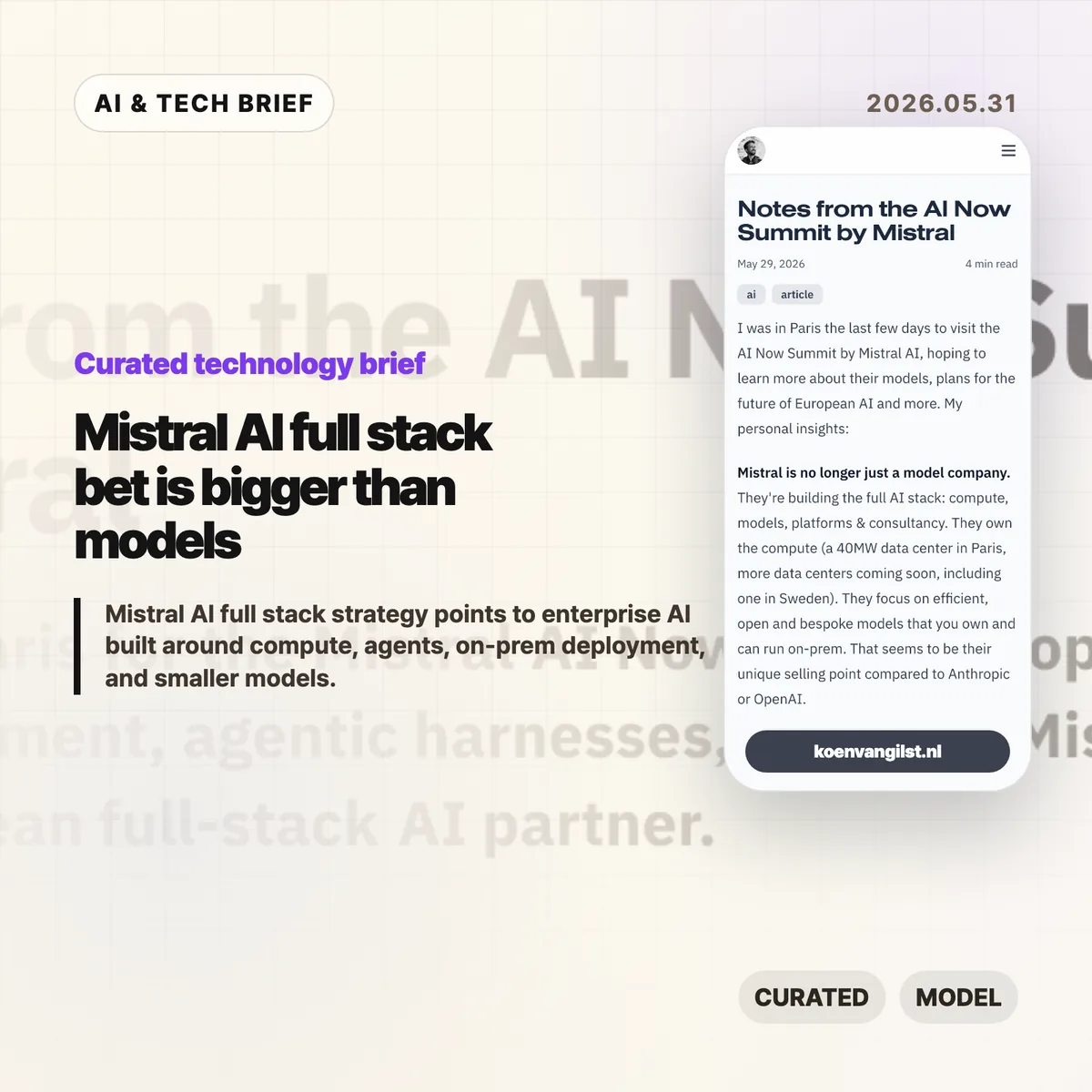
    Mistral AI full stack strategy is becoming the company’s clearest pitch to enterprises: own more of the stack, run closer to the customer, and sell practical AI deployment rather than another benchmark headline. Notes from Mistral’s AI Now Summit in Paris describe a company talking about compute, on-prem deployments, agent harnesses, small models, and industry partnerships more than model release theater.

    The short version

    • Mistral is positioning itself as an enterprise AI supplier with compute, models, platforms, consulting, and deployment help in one package.
    • The summit notes mention a 40MW data center in Paris, more European data center plans, and on-prem use cases at BNP Paribas and Abanca.
    • Vibe is now the company’s unified agent product for work and coding, with Work Mode, Code Mode, a VS Code extension, and subscription tiers starting at $14.99 per month for Pro.
    • The useful debate is whether this enterprise route is a moat or a retreat from frontier model competition.
    • For builders, the Mistral AI full stack story is a reminder that model choice is only one part of shipping reliable AI inside regulated organizations.

    What happened

    Developer Koen van Gilst published notes from Mistral’s AI Now Summit after attending the Paris event. His read was blunt: Mistral did not sound like a pure model lab. It sounded like a European AI partner trying to own compute, models, platforms, customization, and services.

    The post points to several pieces of that plan: a 40MW data center in Paris, more data centers on the way, partnerships with ASML, BNP Paribas, Amazon Alexa+, and the EU Patent Office, plus a clear emphasis on on-prem deployment for customers that cannot casually send sensitive data to a hyperscaler.

    Mistral’s own Vibe announcement fits the same pattern. Vibe now covers long-running work tasks and coding work under one product line. Work Mode can search across enterprise tools, draft documents, analyze structured data, and run scheduled tasks. Code Mode connects to GitHub, runs coding sessions, and can take work through to a pull request. The VS Code extension brings that agent into the editor.

    Why this is worth watching: Mistral AI full stack

    The Mistral AI full stack angle matters because many enterprises do not buy AI the way developers test models on leaderboards. Banks, public agencies, manufacturers, and large European companies care about data location, procurement, support, security review, and who takes responsibility when the system misbehaves.

    That is where Mistral’s pitch is more interesting than another model comparison chart. BNP Paribas reportedly runs Mistral models on-prem for KYC work in Belgium, keeping sensitive data inside the bank. Abanca was described as using agent orchestration for customer information at large scale. Whether those deployments are technically better than the best US or Chinese model APIs is only part of the buying decision.

    This also changes the product lesson for AI builders. A strong model matters, but the surrounding harness often decides whether the product survives contact with real work. Memory, context, connectors, permissions, observability, error recovery, and human review are where many enterprise AI projects either become useful or quietly die.

    There is a simple answer-engine version of this: Mistral AI full stack strategy means Mistral is trying to sell an enterprise AI operating layer, rather than plain model access.

    What Hacker News readers are arguing about

    The Hacker News thread is split between people who want a credible European AI company and people who think Mistral is falling behind where it matters.

    The supportive camp likes the direction. Several commenters argued that on-prem deployment, bespoke models, and a European supplier make sense for banks, government, insurance, and industrial companies. One practical point came up more than once: in regulated European procurement, a trusted vendor with support and implementation help can matter more than the cheapest model API.

    The skeptical camp focused on model quality and cost. Commenters compared Mistral unfavorably with Qwen, DeepSeek, Gemma, and frontier US labs, especially for reasoning and smaller open models. Some saw the summit’s enterprise framing as a sign that Mistral is moving away from hard model competition. Others pushed back, saying enterprise AI is not consumer chatbot competition and that compliance, reliability, and support are where the money is.

    There was also a useful debate about model size. Some commenters want Mistral to build much larger open-weight reasoning models and let the community distill them. Others argued that small, task-focused models are exactly what many business workflows need if cost, latency, and data control matter.

    The thread is a discussion, not evidence. Still, it captures the risk in the strategy: Mistral can build a durable enterprise business without winning every benchmark, but it cannot let the product feel like a sovereignty-branded fallback.

    The practical read

    If you are choosing AI infrastructure for a regulated company, this is a reason to evaluate deployment shape before picking a model. Ask where data sits, who can inspect tool calls, how permissions work, how model updates are handled, and whether the vendor can support custom or on-prem use cases.

    If you are building an AI product, the Vibe launch is worth reading for product shape rather than hype. The interesting part is the bundle: work agent, coding agent, connectors, scheduled tasks, editor extension, cloud sessions, CLI, and permissions. That is a lot of surface area, and it shows where agent products are heading. More coverage like this lives in the IT & AI archive.

    The watch item is whether Mistral can keep its models close enough to the best alternatives while making the full stack easier to buy and safer to run. If the model gap gets too wide, enterprise packaging will look defensive. If the gap stays manageable, the packaging may be the product.

    Sources

  • AI coding deskilling is repeating frontend’s old mistake

    AI coding deskilling is repeating frontend’s old mistake

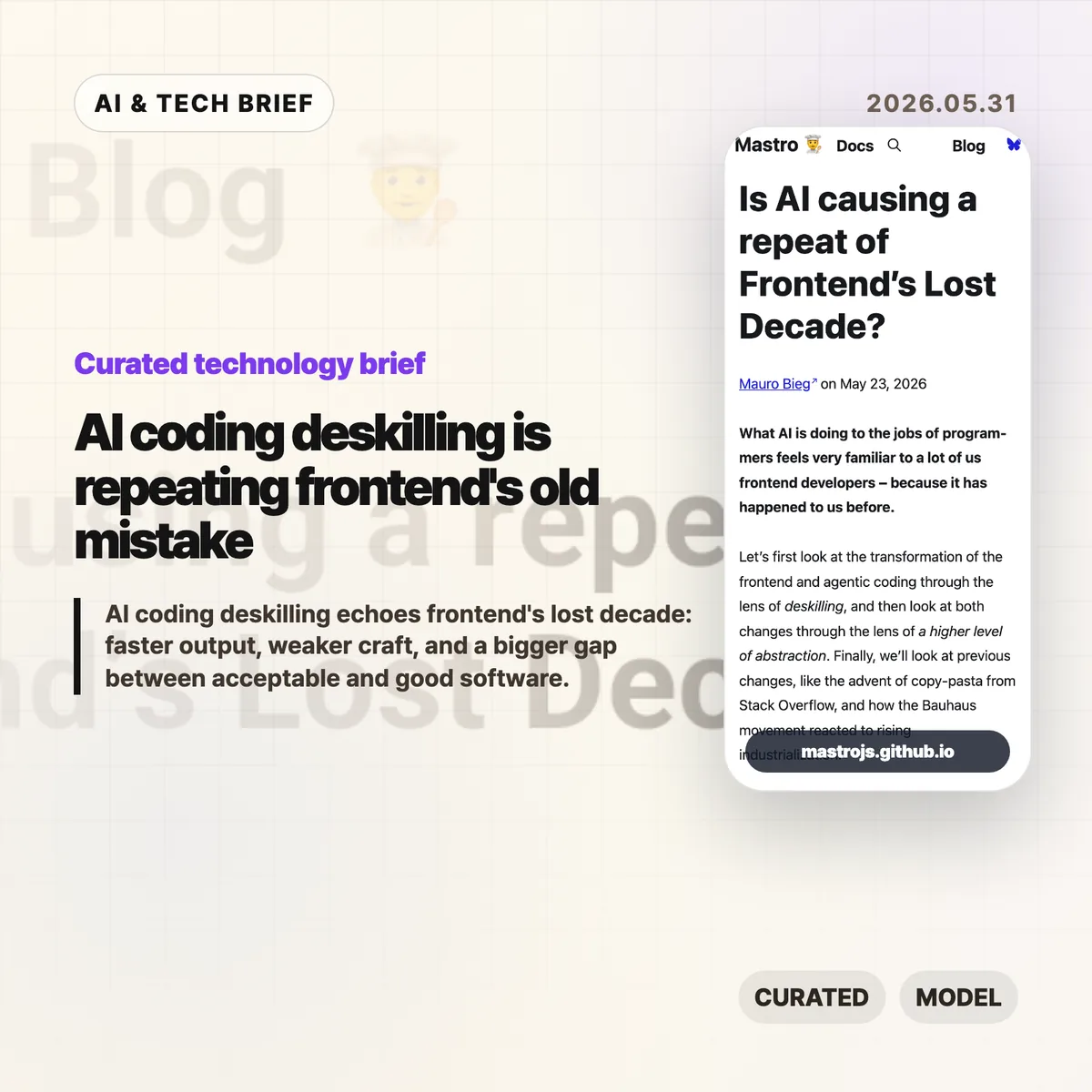
    AI coding deskilling is starting to look familiar to web developers who watched frontend work move from browser craft to framework operation. Mauro Bieg’s Mastro essay argues that AI coding tools may repeat the same trade: more people can ship software, but fewer people may understand the details that decide whether it is any good.

    The short version

    • Bieg frames AI coding deskilling through the same lens Alex Russell used for frontend’s lost decade: abstraction made teams faster, but it also hid browser behavior, accessibility, and performance costs.
    • The warning is not “never use AI.” It is that LLM generated code still needs someone who can read the output, spot missing context, and cut the wrong abstraction back down to size.
    • The Hacker News thread pushes back in useful ways. Some readers argue that frameworks and LLMs lower barriers, while others say they widen the gap between acceptable MVPs and decent software.
    • For product teams, the practical question is whether AI coding agents are paired with tests, accessibility checks, performance budgets, and human review rather than treated as a replacement for those habits.

    What happened

    Mauro Bieg published an essay asking whether AI is causing a repeat of frontend’s lost decade. The piece compares agentic coding with the way JavaScript frameworks changed frontend development over the past decade.

    His core claim is simple enough: frameworks made frontend work easier to staff and faster to start, but they also encouraged teams to treat the browser as a compilation target. That can push semantic HTML, CSS knowledge, accessibility, progressive enhancement, and network performance into the background.

    Bieg then applies the same idea to AI coding tools. If a worker can describe a change in natural language and receive a working patch, the job shifts from writing code to steering and reviewing output. That can be useful. It can also move important details out of sight.

    The essay points back to Alex Russell’s “Frontend’s Lost Decade” talk, which argued that modern frontend tooling often optimized for developer convenience while users paid the cost through slow, heavy web experiences. The point lands harder now because AI coding tools make it even easier to generate a lot of code quickly.

    Why this is worth watching

    AI coding deskilling feels familiar because frontend already lived through a version of this story. A higher level abstraction can be a gift when it removes accidental work. It becomes a problem when teams forget which details were removed and who still pays for them.

    That distinction matters for AI coding tools. A model can produce a React component, a test file, a migration, or a refactor in seconds. It cannot know by default whether the component traps keyboard focus, whether the generated test checks real behavior, or whether the new abstraction makes next month’s bug harder to find.

    The useful way to read Bieg’s argument is not as nostalgia for hand coded everything. It is a warning about ownership. If the team cannot explain the tradeoffs in AI generated code, the speed is probably being financed with technical debt.

    There is a good reason builders keep reaching for these tools anyway. Fast prototypes matter, especially before product market fit. The trap is treating prototype speed as proof that the architecture, accessibility, and performance choices are good enough for production. Readers who follow the IT & AI archive will recognize the pattern: the best AI tooling stories are usually about better review loops, not magic replacement.

    What Hacker News readers are arguing about

    The Hacker News discussion is split, but not in the usual “AI good” versus “AI bad” way. The more interesting disagreement is about what counts as waste.

    One camp argues that a lot of old frontend expertise was accidental complexity. Browser quirks, CSS specificity, and hand rolled accessible components were hard to learn, and abstracting them away let more people build things. From this view, frameworks and LLMs are acceptable tradeoffs if the alternative is fewer products getting built at all.

    The other camp says that this misses the cost to users. Accessibility, performance, compatibility, and clean architecture are easy to ignore when the demo works. AI coding can make that worse by producing a convincing first draft before anyone has checked whether it behaves well outside the happy path.

    The thread gets especially practical around testing. Optimists argue that agents can write tests, run red green cycles, and encode project rules in files like AGENTS.md. Skeptics answer that AI generated tests often mock too much, test the wrong layer, or create a maintenance burden that looks impressive without protecting real behavior. Accessibility testing gets the same treatment: automated checks help, but screen reader behavior, keyboard traps, focus restoration, and alt text still need judgment.

    A useful middle position shows up in the discussion too. AI tools may make good engineering practices more visible. Tests, design docs, specs, and review checklists suddenly matter more because they give the agent something concrete to obey. That is a better argument than claiming the model has rigor on its own.

    The practical read

    Teams using AI coding tools should separate speed from confidence. Faster output is real. Confidence still has to come from review, tests that check behavior, accessibility passes, performance measurement, and a shared idea of what “good enough” means.

    For a small MVP, the right move may be to let AI help with boilerplate and simple iteration. Keep the stack boring. Keep the code small enough that a human can still read it. Do not let generated layers pile up faster than the team can explain them.

    For production web apps, AI coding deskilling is a management problem as much as a tooling problem. If every patch goes through an agent but nobody owns browser behavior, accessibility, latency, or long term maintainability, the team has only moved the work out of sight.

    The best use of AI coding may be less glamorous: ask it to write the boring test, summarize the risky diff, check the accessibility checklist, or propose the smaller version of a change. If the tool helps experienced developers notice more, it is useful. If it helps inexperienced teams ignore more, Bieg’s frontend analogy is probably right.

    AI coding deskilling checklist

    A team does not need to reject AI coding to avoid AI coding deskilling. It needs a review loop that checks behavior, not only syntax. Start with four questions: can a human explain the change, can tests catch the obvious failure, can keyboard and screen reader users complete the flow, and does the page still feel fast on an ordinary device?

    Sources

  • SQLite durable workflows make a small-stack case for agent infrastructure

    SQLite durable workflows make a small-stack case for agent infrastructure

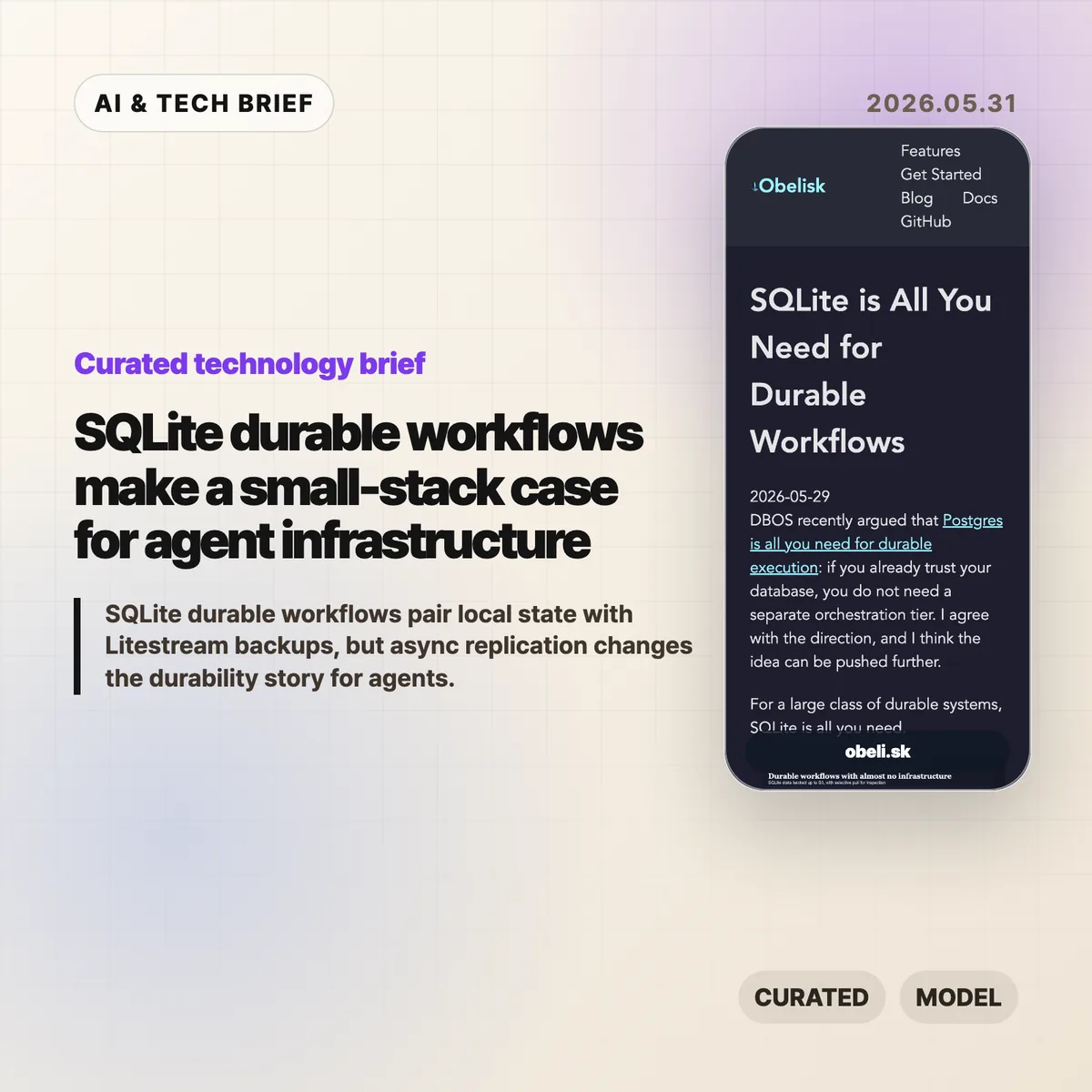
    SQLite durable workflows are a bet that many agent systems need reliable state more than they need a heavy orchestration platform on day one. Obelisk argues that a local SQLite database, backed up with Litestream to S3-compatible storage, can be enough for small durable execution systems where losing the newest local writes is acceptable.

    The short version

    • Obelisk’s argument is narrow but useful: keep workflow state close to the runtime, persist an execution log, and replay from history when work resumes.
    • Litestream adds portability by streaming SQLite changes to object storage, but the replication is asynchronous.
    • The pattern fits bursty AI agents, internal automation, prototypes, and tenant-isolated workloads better than large shared systems.
    • Postgres still makes more sense when teams need strong availability, shared writes, mature operations, or a durability model that cannot lose recent local writes.

    SQLite durable workflows in one sentence

    SQLite durable workflows turn a database file into the recovery point for a run, while Litestream makes that file easier to back up and move.

    What happened

    Obelisk published a short piece arguing that SQLite can be enough for a large class of durable workflow systems. The post responds to DBOS’s recent “Postgres is all you need for durable execution” framing and pushes the same idea toward an even smaller database: if the durable part is workflow state, the compute can be disposable.

    The design is simple. An Obelisk server writes workflow progress to SQLite. Workflows can replay from persisted history, and failed activities can be retried. Litestream then streams SQLite changes to S3-compatible object storage for backup, migration, and inspection.

    That last word matters. The article is not claiming that SQLite plus Litestream gives you the same behavior as a highly available shared database. Litestream replication is asynchronous, so a restore can miss the newest writes if the local volume disappears before those writes are copied.

    Why this is worth watching

    SQLite durable workflows are interesting because they match how a lot of agent infrastructure is being built right now: small workers, short spikes of activity, many experiments, and state that is easier to understand when it belongs to one agent or one tenant.

    For that shape, a database file is not a toy. It is a debugging artifact. You can copy it, inspect it locally, replay a run, or move one tenant without dragging a central system into every step. That is different from saying SQLite should replace Postgres everywhere. It is closer to saying that some workflows are naturally partitioned, and those partitions can be operational units.

    The pattern also lines up with a cost question that keeps showing up in developer tools. Before a team adds Temporal, Step Functions, a Postgres-backed workflow engine, or a full control plane, it can ask a smaller question: can the state model survive restarts with SQLite and object storage? For more briefings like this, the IT & AI archive tracks the developer infrastructure stories that keep resurfacing.

    What Hacker News readers are arguing about

    The Hacker News discussion is useful because it pushes back on the word “durable.” The strongest skeptical camp argues that once Litestream’s asynchronous replication is part of the story, the system may be durable enough for experiments but not durable in the stricter production sense. Several commenters called out the risk of losing the most recent local writes, and one reported replacing Litestream in production after upgrade and disk usage concerns.

    The builder camp is more sympathetic. A few commenters said they already use SQLite-backed task state for agents or pipelines because it keeps iteration simple. One pattern that came up: ask an agent to plan a DAG, store each task in SQLite, and rerun only the steps that changed. Another practical argument was token cost. Agents can query a row instead of rereading a pile of Markdown or logs.

    There was also a familiar SQLite-versus-Postgres fight. Critics argued that SQLite is the wrong tool for concurrent production systems. Supporters answered that many workloads do not need multiple writers across machines, and that strongly partitioned state changes the tradeoff. The thread is not evidence that the architecture is safe. It is a good map of where teams will disagree: recent-write loss, concurrency, operator comfort, and whether a workflow engine is worth the overhead.

    The practical read

    Use SQLite durable workflows when the workflow state is small, naturally partitioned, and valuable to inspect. That describes a lot of AI agent workloads: tool calls, step logs, inputs, outputs, retries, and run history for one tenant or one worker.

    Do not use this pattern as a blanket replacement for Postgres or Temporal. If multiple services need to coordinate writes, if the newest write must survive a node loss, or if operations already depend on database-level replication and failover, a network database or dedicated workflow engine is the safer default.

    The good test is plain: if you can explain exactly which writes may be lost before Litestream catches up, and the product can tolerate that, SQLite plus object storage may keep the stack pleasantly small. If that sentence makes you nervous, it probably should.

    Sources

  • Claw Patrol agent firewall puts action-level limits on AI agents

    Claw Patrol agent firewall puts action-level limits on AI agents

    The Claw Patrol agent firewall is an open source security layer for teams that want AI agents to touch production systems without handing them raw secrets or blank-check access. It sits between agents and services such as Postgres, ClickHouse, Kubernetes, GitHub, and Slack, then checks the actual request before it goes out.

    The short version

    • Claw Patrol keeps credentials outside the agent process and injects them only after a request passes policy checks.
    • The system can inspect HTTP method and body, SQL verbs and functions, and Kubernetes resources and verbs instead of stopping at a coarse network allowlist.
    • Risky requests can pause for an LLM judge or a human reviewer in Slack, a dashboard, or a webhook.
    • Teams can record real actions as JSON fixtures and run policy regression tests with clawpatrol test before changing rules.
    • The practical question is whether action-level security becomes a normal requirement for production AI agents.

    Claw Patrol agent firewall notes

    The Claw Patrol agent firewall is best understood as a policy checkpoint for live agent actions, not as another chatbot wrapper. It watches what the agent is about to send to production systems and decides whether that specific request deserves to pass.

    What happened

    Deno’s Claw Patrol project describes itself as “the security firewall for agents.” The idea is simple enough: agents route traffic through a gateway, and the gateway decides whether a specific action should be allowed, denied, logged, or sent for approval before it reaches the destination service.

    That distinction matters. OAuth scopes, IAM roles, and Kubernetes RBAC usually answer the access question: can this identity reach a service or resource? Claw Patrol is aimed at the next question: once the agent has a path to the service, what is it trying to do?

    The project gives concrete examples. A Postgres-capable agent may be allowed to run ordinary reads but blocked from calling functions such as pg_read_file, pg_read_binary_file, lo_get, or dblink_ routines. A Kubernetes agent may be allowed to inspect pods but forced through an LLM review before kubectl exec commands run. HTTP requests can be matched by method, path, headers, and body, then routed through custom approval logic.

    Claw Patrol can run as a gateway, join a gateway over WireGuard or Tailscale, or wrap a single agent process with clawpatrol run. The GitHub repository is MIT licensed and had 518 stars when checked for this brief.

    Why this is worth watching

    The Claw Patrol agent firewall points at a real gap in agent deployments. Prompt filtering and output scanning help, but they do not fully answer what happens when an agent already has a database password, a Kubernetes context, or an API token. A compromised or confused agent with those credentials can still make valid-looking calls.

    Moving the control point to the wire changes the shape of the problem. The agent can ask to do something, but the gateway can parse the request and make a second decision using operational facts: SQL verb, table name, Kubernetes namespace, HTTP route, request body, approval status, and prior policy tests.

    That is more useful than treating agent security as a model-only problem. It fits the way infrastructure teams already think: credentials, policy, logs, approvals, and regression tests. For readers tracking adjacent tools, the broader IT & AI archive is where we keep similar developer infrastructure briefs.

    What the discussion is missing

    I could not find a public Hacker News discussion tied to the Claw Patrol release. That absence is worth noting because the project raises the sort of questions operators usually pick apart in public: latency, failure modes, policy drift, coverage across protocols, and whether LLM approval adds a new weak point.

    The useful debate should be about boundaries. A gateway can stop a class of bad requests, but it still depends on accurate parsing, careful policy writing, and safe defaults when a reviewer or model is unavailable. Claw Patrol says human approval can time out closed, which is the right direction, but teams will need to test how that behaves during real incidents.

    There is also a deployment tradeoff. Routing an agent through WireGuard, Tailscale, NetworkExtension, or a per-process tunnel is cleaner than sprinkling checks through every tool call, but it adds another piece of infrastructure. Some teams will accept that cost for production agents. Others will keep agents away from production until the risk model is simpler.

    The practical read

    If your agents only run local coding chores, the Claw Patrol agent firewall may be more machinery than you need. The moment an agent can touch production data, customer communication, deployment systems, or cloud APIs, action-level controls start to look less optional.

    The first test is narrow: pick one dangerous action and see whether the policy can express it without blocking normal work. For a database, that might mean allowing read-only queries while denying filesystem-reaching functions. For Kubernetes, it might mean allowing inspection commands while pausing exec, deletes, and secret reads for review.

    The second test is operational. Check whether the audit log is clear enough to reconstruct what happened, whether recorded fixtures catch policy regressions, and whether approval timeouts fail closed. If those pieces work, the tool becomes more than an agent demo accessory. It becomes part of the production safety case.

    Sources

  • Connected car data is becoming an insurance problem

    Connected car data is becoming an insurance problem

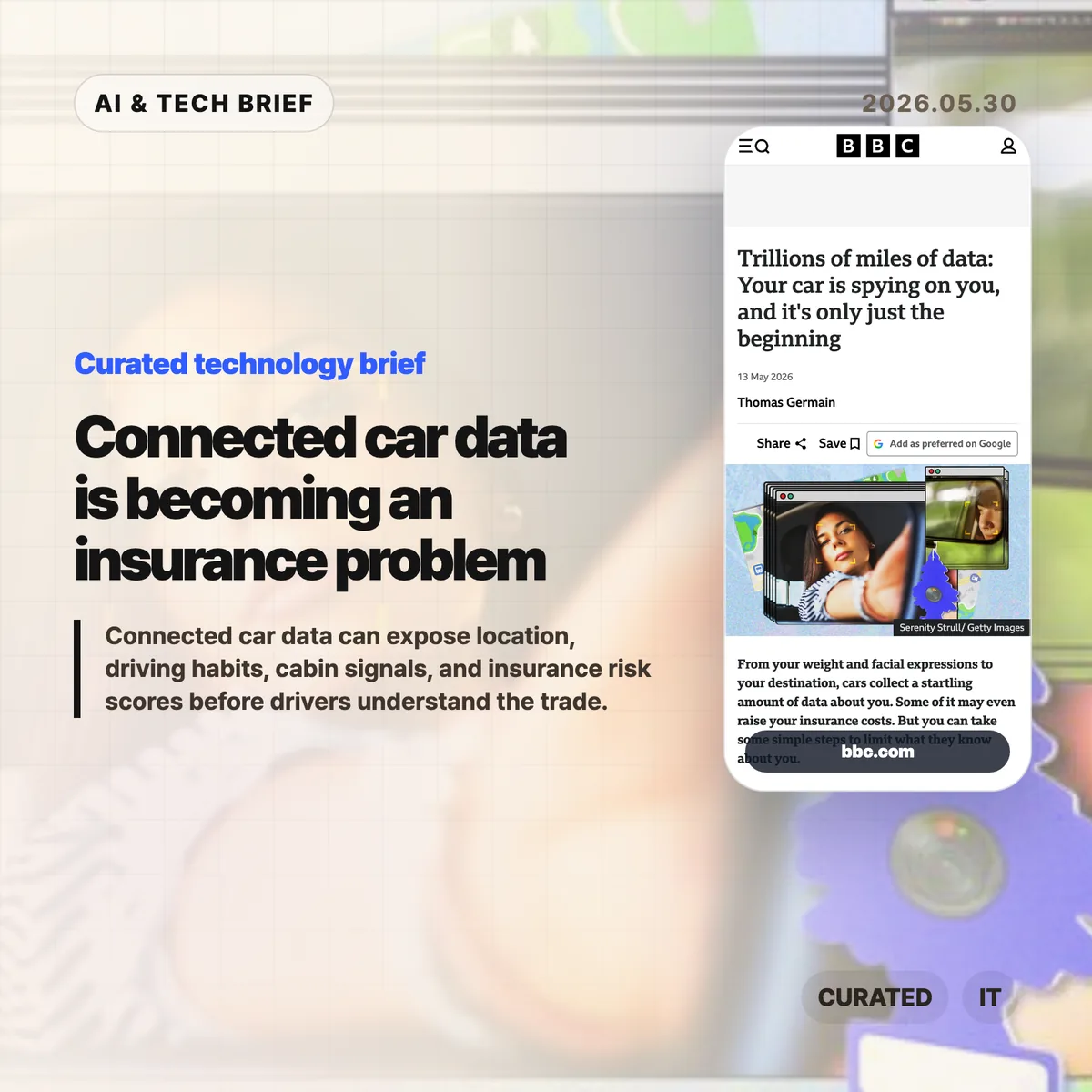
    Connected car data is no longer a small diagnostic trail that stays with the vehicle. Modern cars can record where you go, how you drive, who may be in the cabin, and whether your behavior looks risky to an insurer. The uncomfortable part is that many drivers meet this system through a discount offer, a companion app, or a checkbox on a dashboard screen.

    The short version

    • BBC Future reports that cars can collect precise location, driving behavior, cabin sensor signals, infotainment choices, and clues about passengers.
    • A cited driver found about 130 pages of LexisNexis driving and movement records, then saw an auto insurance quote rise by 21%.
    • The FTC finalized an order over GM and OnStar’s handling of geolocation and driving behavior data, including a 5-year bar on sharing certain sensitive data with consumer reporting agencies.
    • Hacker News readers focused less on the headline shock and more on practical defenses: pulling cellular modules, disabling telemetry, and buying older cars.
    • The useful test is simple: if a car feature sends connected car data off the vehicle, drivers should know who receives it, how long it is kept, and whether it can affect pricing.

    What happened

    BBC Future framed the modern car as a rolling computer that can collect a startling amount of personal information. The piece points to data categories that go beyond mileage and fault codes: precise location, acceleration, hard braking, seatbelt use, radio choices, cabin camera signals, and in some systems clues about weight, age, facial expression, or impairment.

    The insurance angle makes the privacy issue concrete. Telematics programs are sold as a way to reward safer driving, but the outcome is not always a discount. BBC cited a Maryland analysis in which 31% of participants received lower rates, 24% received higher rates, and 45% saw no change.

    Regulators are already treating this as more than a hypothetical risk. In January 2026, the FTC finalized an order settling allegations that GM and OnStar collected and sold precise geolocation and driving behavior data without adequate consumer consent. Under the order, GM cannot provide certain sensitive location and driving behavior data to consumer reporting agencies for 5 years.

    How connected car data reaches insurers

    The path is rarely visible from the driver’s seat. A vehicle can send telematics through a built-in modem, a manufacturer account, a dealer service system, a phone app, or an insurance program. Once connected car data leaves that stack, it can be packaged into risk signals that feel far removed from the screen where the driver first tapped accept.

    Why this is worth watching

    Connected car data is unusually intimate because it ties behavior to place. A phone location trail can be sensitive, but a vehicle trail can also reveal school runs, medical visits, religious services, shift work, passengers, and driving style. When that data enters insurance or consumer reporting systems, the driver may not know what record exists until a price changes.

    Mozilla’s car privacy review adds another reason to take the issue seriously. It found that many car brands claim broad rights to collect and use personal information, including location, driving behavior, financial details, and in some policies more sensitive categories. That does not mean every car records every possible field. It does mean the paper permissions are often wider than a buyer expects when signing up for a vehicle app or connected service.

    This also matters for product teams building around vehicles. A mobility app, insurer app, fleet dashboard, or driver monitoring feature may feel like a narrow utility, but users experience it as part of the car. If the privacy model is vague, the product inherits the mistrust aimed at automakers and brokers. For more coverage of privacy-heavy technology stories, see the IT & AI archive.

    What Hacker News readers are arguing about

    The Hacker News discussion was more practical than ideological. Some readers joked that they prefer old cars with no networked electronics. Others described real attempts to take newer cars offline, including removing a cellular bridge, pulling a fuse, or using model-specific tools to disable telemetry.

    The strongest technical objection was that disconnecting the modem may not be enough. Several commenters pointed out that a car can store data while offline and upload it later, either when connectivity returns or when a service tool touches the vehicle. That turns “just pull the module” into a partial fix rather than a clean answer.

    The more useful builder point is that the privacy boundary is hard to explain to normal drivers. A car has internal networks, external connectivity, dealer diagnostic tools, manufacturer apps, insurer programs, and third-party data brokers. A privacy screen that says “connected services” does not tell a driver which of those systems still has a path to their data.

    The practical read

    Drivers do not need to panic, but they should stop treating connected services as free extras. Before enabling an automaker app, a usage-based insurance program, or a driver monitoring feature, check whether the service shares connected car data with insurers, consumer reporting agencies, affiliates, or marketing partners.

    The best first pass is boring and useful: review the vehicle’s privacy settings, the manufacturer app, any insurance telematics app, and the data request or opt-out forms offered in your region. EFF maintains a guide for finding out what a car may know about you and how to opt out when the manufacturer allows it.

    For automakers and app builders, the lesson is harsher. Consent cannot be buried in a setup flow and still feel legitimate when the result may affect insurance prices. If a feature needs cabin, location, or driving behavior data, say so plainly, limit the use, and make deletion or sharing controls easy to find.

    Sources

  • Dead economy theory: AI labor has a demand problem

    Dead economy theory: AI labor has a demand problem

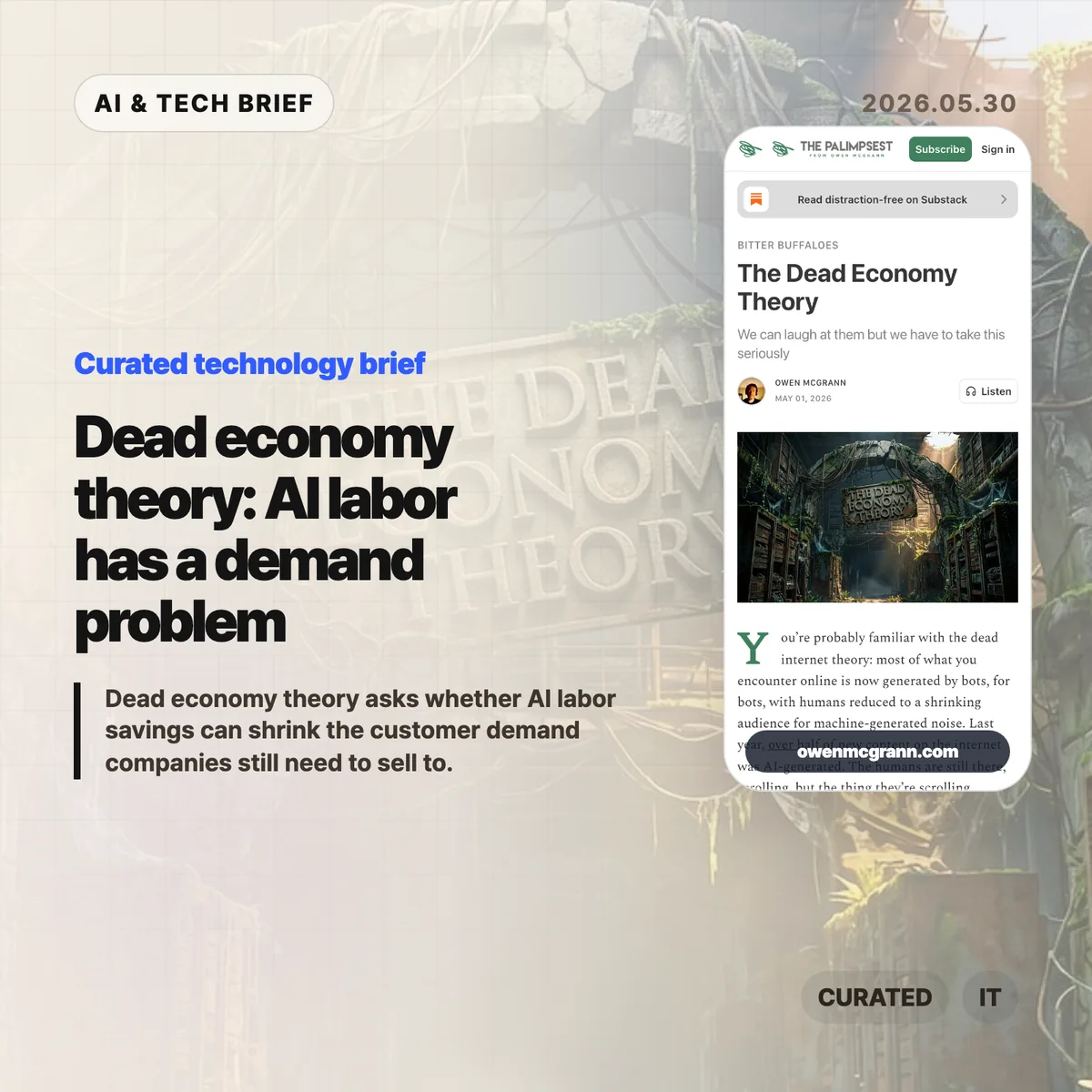
    Dead economy theory is a useful name for a blunt question: if AI labor savings come from replacing workers, who keeps buying the goods and software those companies sell? Owen McGrann’s essay pushes past the usual productivity story and follows the money after the layoffs. The uncomfortable part is that a rational choice for one company can still weaken demand for everyone else.

    The short version

    • McGrann argues that large AI valuations make the most sense if investors expect a huge share of labor spending to move from payroll to software.
    • The demand problem is simple: workers are also customers, and broad layoffs can cut the spending that businesses rely on.
    • The related “AI Layoff Trap” paper models this as an automation arms race where firms automate more than is healthy for the whole economy.
    • Hacker News readers pushed back on the essay’s assumptions, but the thread kept returning to the same worry: past automation is not proof that every future shock will land gently.

    What happened

    Owen McGrann published “The Dead Economy Theory” on The Palimpsest, framing it as an economic cousin of the dead internet theory. The essay starts from the way AI firms sell themselves to investors and enterprise buyers. Words like copilot and assistant sound harmless, but the business case often points toward doing more work with fewer people.

    That framing matters because the biggest possible market for AI is not better autocomplete. It is labor spend. McGrann connects that to benchmarks such as OpenAI’s GDPVal, which evaluates model performance on economically valuable work, and to a newer paper called “The AI Layoff Trap.” The paper argues that firms can get stuck in a competitive automation race even when they understand that mass displacement may reduce consumer demand.

    The dead economy theory is not a forecast with a date attached. It is a stress test for the AI investment story. If software replaces labor faster than new income channels appear, the savings show up before the missing demand does.

    Why this is worth watching

    The best version of the AI productivity argument says automation raises output, lowers prices, and eventually creates new work. That has happened before. Mechanized farming, factory automation, and computers all hurt some workers while expanding other parts of the economy.

    The weaker version skips the transition cost. It assumes the people displaced from cognitive work will quickly find new work that pays enough to support the same consumption. That is a large assumption, especially if AI systems also chase the next white collar task those workers might move into.

    How dead economy theory changes the AI sales pitch

    For readers tracking AI companies, dead economy theory is a way to separate product language from financial logic. If an AI tool is priced and marketed around headcount reduction, the macro question is not a side issue. It is part of the product’s long-run market size.

    There is also a builder angle. AI app and agent teams should be careful about promising pure labor removal when the healthier pitch may be workflow capacity, error reduction, or work that would not have been done at all. That distinction matters for customers, regulators, and platform marketplaces. For more AI business coverage, see the IT & AI archive.

    What Hacker News readers are arguing about

    The Hacker News discussion was large and messy, which fits the topic. One camp saw the essay as a dressed-up recession story: firms cut costs, workers spend less, and demand falls. Their objection was that this is not unique to AI and that previous waves of automation did not end employment.

    The stronger skeptical point was about history. Several readers argued that farms and factories automated without making everyone permanently jobless. Others answered that this does not settle the AI case. Past transitions took decades, hurt real people, and depended on new sectors absorbing displaced workers. If AI keeps moving into those sectors too, the usual escape route gets narrower.

    Another thread focused on whether an economy even needs human consumers. Some commenters imagined a machine-heavy economy where AI firms sell compute, energy, data, and services to one another. That idea sounded extreme, but it exposed the core dispute: is the economy supposed to serve human demand, or can capital keep circulating after most people lose market power?

    The most practical comments were less dramatic. They asked who pays for the data centers, GPUs, electricity, and subscriptions if the middle class gets weaker. They also pointed out that consumption-based pricing does not solve much unless the consuming agents are attached to customers with money. The discussion is not evidence, but it shows where technical readers are uneasy.

    The practical read

    Dead economy theory does not prove that AI will destroy demand. It does make one test harder to ignore: does an AI product create new output, or does it mostly move wages into vendor spend and shareholder margin?

    Founders should be specific about that answer. If the product helps a small team handle work it could not otherwise touch, the demand story is different from a product sold mainly as a layoff machine. Investors should ask the same question from the other side. A market built on replacing customers’ payrolls may be large, but it can also be self-limiting if too many buyers make the same move at once.

    Policy people will read the piece differently. The “AI Layoff Trap” paper argues for an automation tax, while noting that basic income, worker equity, and retraining do not fully remove the competitive incentive to automate. You do not have to accept that policy answer to see the problem. The incentive to cut labor is immediate. The cost of weaker demand arrives later and gets shared.

    Sources

  • Shopify MySQL inventory reservations: 5 lessons

    Shopify MySQL inventory reservations: 5 lessons

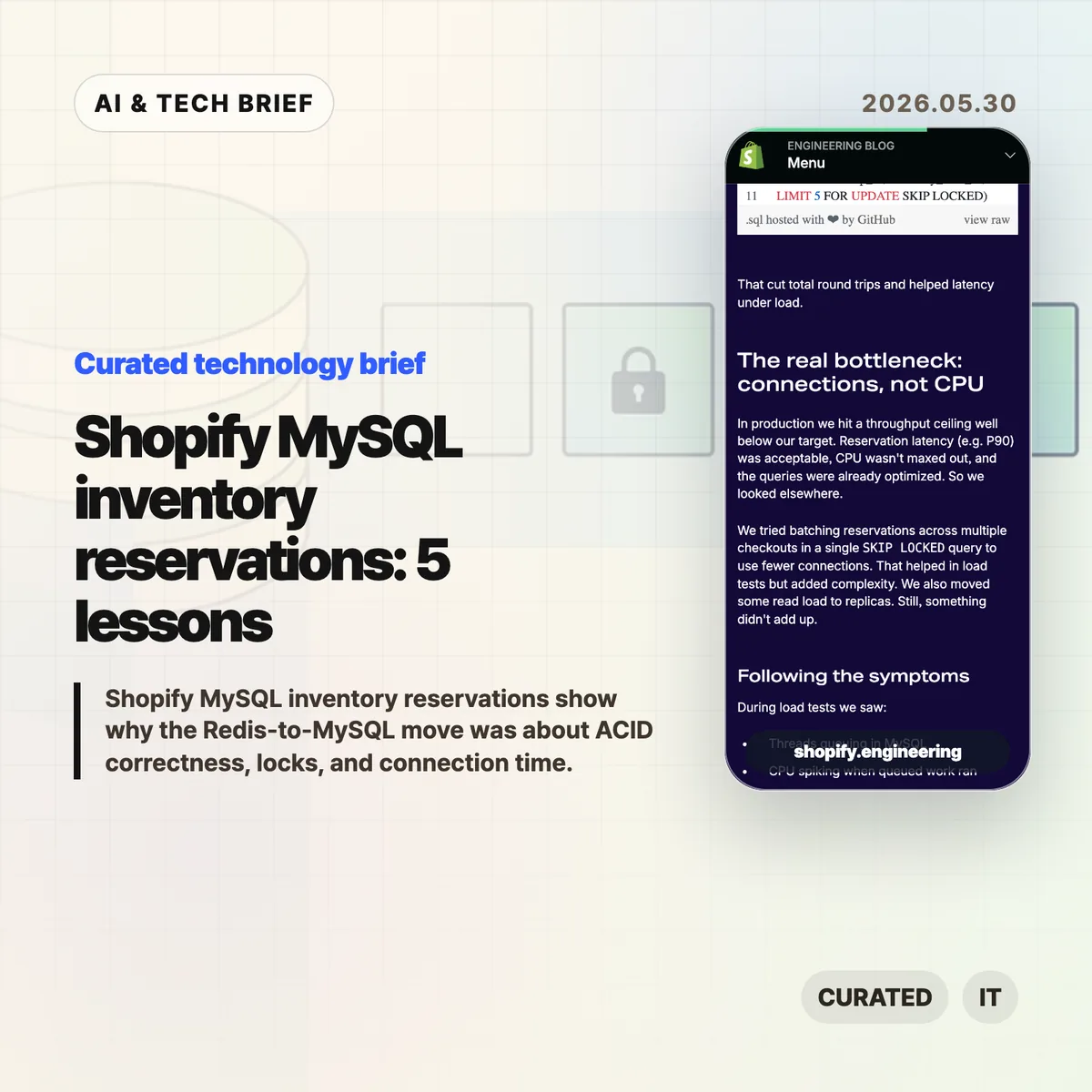
    Shopify MySQL inventory reservations are a useful reminder that a database migration story can be less about raw speed than about removing awkward failure modes. Shopify moved checkout-time inventory holds from Redis into MySQL so reservations and the inventory ledger could live inside the same ACID transaction boundary. The interesting part is how much work it took around SKIP LOCKED, schema shape, isolation level, lock ordering, and connection visibility before the design held up at peak commerce traffic.

    The short version

    • Shopify’s old Redis reservation system handled concurrency, but Redis and the MySQL inventory ledger could not be claimed in one atomic step.
    • The MySQL design used one row per sellable unit, capped the available row pool at 1,000 per item/location pair, and relied on SKIP LOCKED to avoid waiting on rows another checkout had already taken.
    • The migration was not a blanket “MySQL beats Redis” claim. It worked because Shopify changed the data model, tuned transaction behavior, and instrumented the full checkout path.
    • The surprising bottleneck was connection hold time, not simply reservation query latency or database CPU.
    • Shopify says the system handled high-volume flash-sale traffic with writer CPU under 50% and reader CPU under 16% after cleanup and configuration changes.

    What happened

    Shopify published an engineering write-up explaining how it replaced a Redis-backed inventory reservation path with a MySQL design for checkout. The reservation step is the short hold that happens while a buyer is paying. If it is wrong, one buyer may purchase stock that no longer exists, or another buyer may be told an item is sold out when it is still available.

    The old Redis model used operations like DECR and INCR on quantity keys. That was fast enough for concurrency, but it split the reservation state from the MySQL inventory ledger. Once payment succeeded, Shopify had to update MySQL and clean up Redis without a single atomic transaction across both systems.

    The new design put reservations in MySQL. Instead of updating one quantity column for an item, Shopify represented sellable units as rows. A checkout that needs three units selects three rows, skips rows locked by other transactions, and moves the selected units inside the database transaction. That is the core of Shopify MySQL inventory reservations.

    Why this is worth watching for Shopify MySQL inventory reservations

    The practical lesson is that SKIP LOCKED is not magic dust. It only helped because Shopify changed the shape of the data. A single hot row with a quantity column still creates contention. A pool of unit rows gives MySQL something useful to skip.

    Shopify also bounded the row pool. Keeping one row for every unit everywhere would explode for high-stock items, so the system caps available rows at 1,000 per item/location combination and uses a replenishment process to refill the pool from the ledger. That detail matters. It turns a clever locking trick into a design that can survive real catalog size.

    The engineering work continued below the schema. Shopify moved the relevant transactions to READ COMMITTED to avoid gap-lock behavior that blocked replenishment, fixed deadlocks by enforcing a consistent table lock order, and batched multi-line carts with UNION ALL to reduce round trips. For readers who follow backend infrastructure, the broader IT & AI archive is useful because this is the kind of systems story where the headline undersells the operational work.

    What Hacker News readers are arguing about

    The public Hacker News submissions I found were quiet: low score, no comments on the linked discussion. So there is no meaningful community argument to summarize from that thread.

    That silence is still telling in a small way. This is not a flashy framework launch or a new database benchmark. It is an operations-heavy post about transaction boundaries, lock behavior, and connection pools. The missing debate is the one backend teams should have internally: whether a separate coordination service is buying enough simplicity to justify the consistency and operating cost it adds.

    If a team reads the Shopify story as “replace Redis with MySQL,” it will copy the least important part. The useful question is narrower: can the source of truth, the reservation state, and the failure recovery path sit inside one transaction without making the checkout path a bad neighbor for every other database workload?

    The practical read

    Shopify MySQL inventory reservations are worth reading before you add Redis, Kafka, or a custom lock service to a checkout path. The first check is not “which tool is faster?” It is “what state must change atomically, and where does that state live?”

    For builders, the migration suggests five concrete checks:

    • Model contention explicitly. If every buyer fights over the same row, the database choice will not save you.
    • Test the isolation level you actually need. Default settings can be wrong for a narrow high-throughput path.
    • Keep lock acquisition order boring and consistent.
    • Measure connection hold time by caller, not only query latency.
    • Roll out with shadow mode or dual writes when the old system is still the safer source of truth.

    The app-builder angle is straightforward: checkout reliability affects conversion. For commerce apps, marketplaces, and inventory plugins, a reservation bug is not a backend detail. It can become a canceled order, a support ticket, or a merchant who stops trusting the platform.

    Sources

  • Container registry API: 5 things Docker hides

    Container registry API: 5 things Docker hides

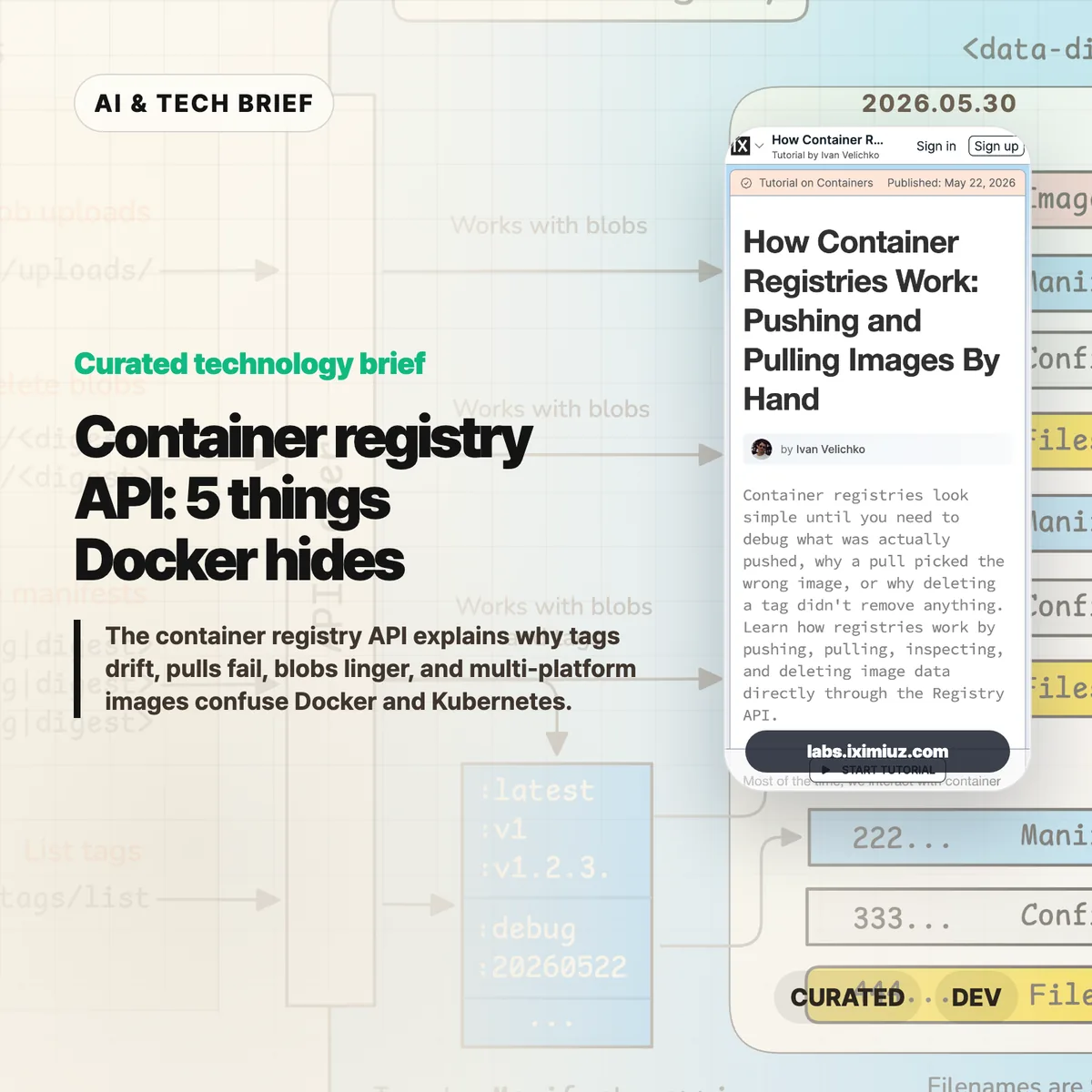
    The container registry API is the part of Docker and Kubernetes that most teams only meet when something breaks. Ivan Velichko’s iximiuz Labs tutorial is useful because it strips the registry down to HTTP calls: upload blobs, attach a manifest, pull by digest, list tags, and see what deletion really means.

    The short version

    • A registry is closer to a content-addressed blob store than a simple tag database.
    • docker push uploads layer and config blobs first, then publishes a JSON manifest that points at them.
    • docker pull starts with the manifest, so many pull failures are easier to debug if you inspect that document before blaming the runtime.
    • Deleting a tag is not the same as deleting every blob behind the image.
    • Multi-platform images add an image index above per-platform manifests, which is where amd64 versus arm64 confusion often starts.

    What happened

    iximiuz Labs published a hands-on tutorial called “How Container Registries Work: Pushing and Pulling Images By Hand.” It walks through the OCI-style registry flow with curl, not Docker. The tutorial starts with raw blob upload and download, then builds toward pushing an image manifest, listing tags, pulling image contents, deleting image data, and storing multi-platform images.

    The point is not that everyone should replace Docker with shell scripts. The point is that the registry has a small, inspectable HTTP surface. A blob upload starts with POST /v2/<repo>/blobs/uploads/, finishes with a digest-aware PUT, and a tag appears when a manifest is pushed to PUT /v2/<repo>/manifests/<tag>. Once you see that flow, tags stop feeling like magic labels and start looking like pointers to JSON documents.

    Why this is worth watching

    The registry gives platform teams a better failure model. If a cluster pulls the wrong image, the useful question is not “why is Docker weird?” It is which manifest the tag currently resolves to, which config and layer digests that manifest references, and whether the client selected the right platform entry.

    That matters in boring, expensive ways. A CI pipeline can push successfully while production still resolves an older digest. A cleanup job can remove a tag while shared layer blobs remain. An Apple Silicon laptop can produce an image that works locally but misses the manifest entry a mixed Kubernetes fleet expects. These are not exotic edge cases. They are the kind of problems that show up after a release, when people are looking at dashboards instead of registry headers.

    The tutorial also hints at a broader registry shift without over-selling it. OCI registries now hold more than runnable images: Helm charts, SBOMs, provenance attestations, and other artifacts can use the same distribution model. For more infrastructure briefs, the IT & AI archive tracks similar developer-tool shifts as they move from novelty into operational plumbing.

    What the container registry API shows

    The container registry API shows that image delivery is mostly a chain of small claims: this tag points to this manifest, this manifest points to these digests, and these digests are the bytes the runtime needs. Once that chain is visible, debugging gets less mystical.

    What the discussion is missing

    There does not appear to be a public Hacker News thread for this specific tutorial. That is a shame, because the useful debate would probably be practical rather than philosophical.

    The missing discussion is about where teams should draw the line. Most engineers do not need to hand-push manifests every week. But build, SRE, security, and platform teams benefit from knowing enough of the container registry API to answer three questions during an incident: what does this tag point to, which blobs does this manifest need, and did the client choose the platform variant we expected?

    The other open question is tooling. crane, regctl, oras, and registry vendor CLIs already wrap much of this work. The best use of the tutorial is not memorizing every endpoint. It is learning the mental model behind those tools so their output makes sense under pressure.

    The practical read

    If you ship containers, run through the tutorial once with a throwaway registry. Then add a few registry-level checks to your normal debugging playbook.

    Start by resolving tags to digests before and after a deploy. Inspect the manifest media type when a pull fails on one architecture but not another. Treat deletion as a manifest-and-garbage-collection problem, not a tag-removal problem. For security work, check whether the artifacts you care about, such as SBOMs or attestations, are attached in a way your scanners and deployment systems can actually find.

    That is the practical value of the container registry API. It turns image distribution from a black box into a set of documents and blobs you can inspect.

    Sources

  • SQLite agentic code policy draws a hard line for AI patches

    SQLite agentic code policy draws a hard line for AI patches

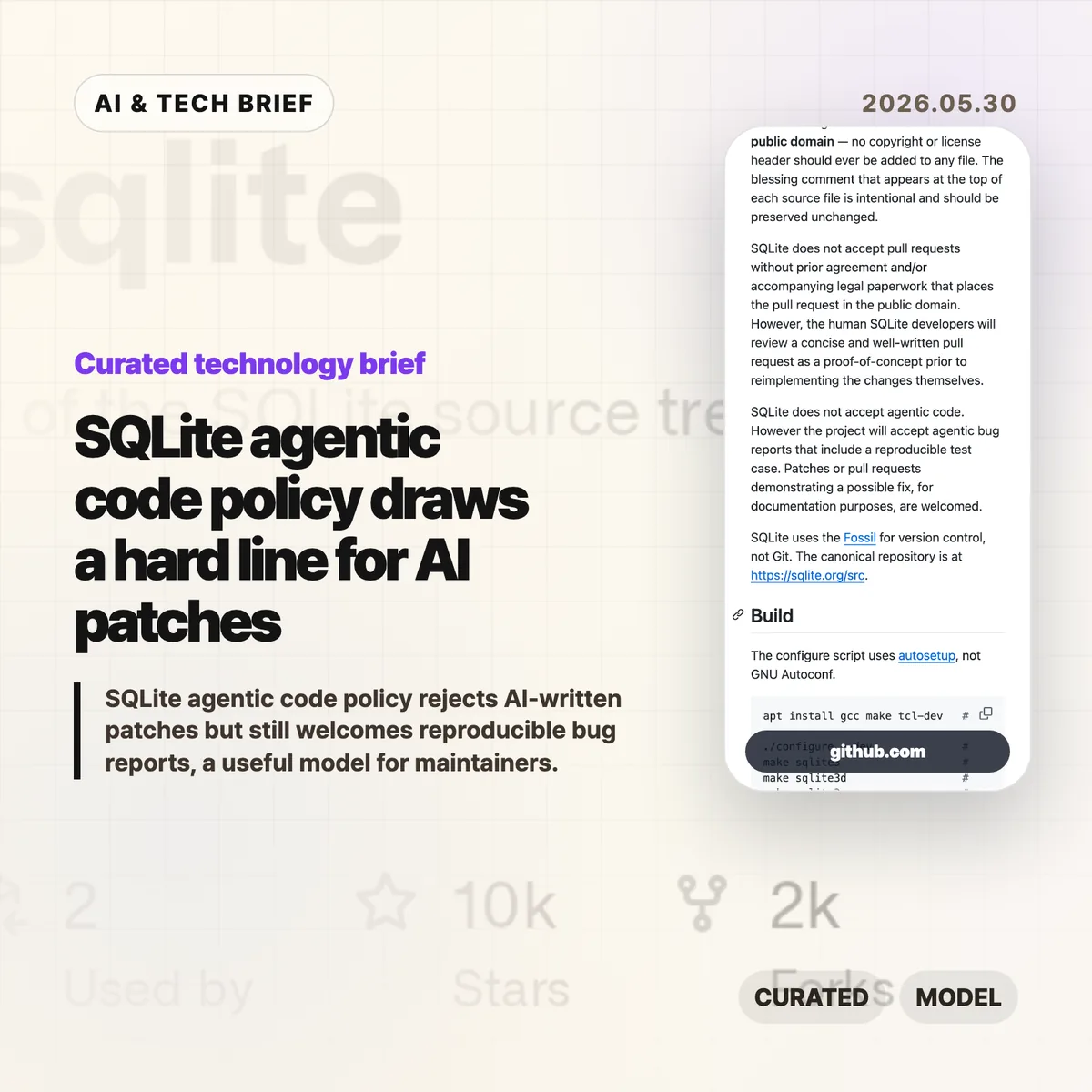
    SQLite added a plain rule to its repository guidance: it does not accept SQLite agentic code as a contribution. The project still welcomes bug reports that include a reproducible test case, which makes this less of an anti-AI manifesto and more of a maintenance boundary for a public-domain database used almost everywhere.

    The short version

    • SQLite’s AGENTS.md says the project does not accept agentic code, even though maintainers may review concise proof-of-concept patches before reimplementing changes themselves.
    • The project separates code contributions from bug reports: AI-assisted reports are acceptable when they include a reproducible test case.
    • The policy is tied to public-domain requirements, long-lived C code, Fossil-based development, and the cost of reviewing patches the maintainers did not write.
    • For AI coding tools, the useful lesson is blunt: a good repro may travel farther than a generated patch.

    What happened

    SQLite now has an AGENTS.md file aimed at people pointing coding agents at the SQLite source tree. The file explains project basics, build commands, testing commands, repository conventions, and contribution rules.

    The sharp part is the contribution policy. SQLite says it does not accept pull requests without prior agreement or legal paperwork that places the contribution in the public domain. It also says, in a separate sentence, that SQLite does not accept agentic code. Maintainers may still review a short, well-written pull request as a proof of concept, but the human SQLite developers reimplement accepted ideas themselves.

    That distinction matters because SQLite is not run like a typical GitHub-first project. Its canonical repository is Fossil, not Git, and its public-domain status is part of the project’s identity. A generated patch is not only a review burden. It can also blur authorship and provenance in a codebase that treats those details seriously.

    Why this is worth watching

    Most open source projects will not copy SQLite word for word. Plenty of maintainers do accept pull requests, and many projects live inside GitHub’s normal review flow. Still, SQLite has given maintainers a clean pattern: reject AI-written code as merge material while accepting AI-assisted evidence when it helps a human reproduce the problem.

    That is a useful split. A patch asks maintainers to trust the author, the code path, the licensing story, the tests, and the future maintenance cost. A reproducible bug report asks them to verify a failure. Those are different jobs.

    The wider lesson for developer tools is that output format matters. If an AI coding assistant produces a patch with no small failing test, it may be creating work for the maintainer. If it produces a minimal case, commands to reproduce it, and enough context for a person to inspect the failure, it has a better chance of being useful.

    For more coverage of developer-tool policy and AI engineering practice, see the IT & AI archive.

    What Hacker News readers are arguing about

    The Hacker News thread around Simon Willison’s write-up is small, so there is not enough there to claim a broad community consensus. The useful point in the comments is a clarification: SQLite is not refusing every artifact touched by an agent. It is refusing agent-written code as codebase input, while still allowing possible fixes to appear as documentation and accepting reproducible bug reports.

    A related earlier discussion on the prototype AGENTS.md commit framed the policy as a reasonable compromise. The tone was less “AI is banned” and more “give agent users rules, then keep generated code out of the project unless a human maintainer owns the final implementation.” That reading fits the file itself.

    The argument that remains open is practical. If AI tools get better at producing tests, minimization steps, and failure cases, maintainers may welcome them as triage tools. If the tools mostly produce plausible patches, projects with strict ownership rules will keep pushing back.

    SQLite agentic code policy in practice

    SQLite agentic code is the wrong deliverable for this project. A reproducible test case is the right one.

    That should influence how developers use coding agents around mature open source infrastructure. Instead of asking an agent to “fix SQLite,” ask it to isolate the failing behavior, reduce the input, show the exact command that fails, and explain why the result conflicts with documented behavior. If a patch is generated along the way, treat it as a debugging note, not as something to submit.

    For coding-agent companies, this is also a product signal. The next useful feature may not be a bigger diff. It may be a maintainer-friendly report: environment, build command, failing test, expected result, actual result, and a short explanation a human can audit.

    The practical read

    If you maintain an open source project, SQLite’s policy is a good starting template even if you soften the wording. Say whether you accept AI-written patches. Say whether AI-assisted bug reports are allowed. Say what evidence makes a report useful. The policy does not need to be dramatic; it needs to reduce ambiguity before the first generated pull request lands.

    If you contribute to projects with AI help, submit less code and better evidence. A concise failing test and reproduction steps respect the maintainer’s time. A large generated patch shifts the risk to someone else.

    Sources