Category: IT & AI

  • Anthropic Series H is an AI infrastructure bet

    Anthropic Series H is an AI infrastructure bet

    Anthropic Series H is not a normal late-stage startup round. The company says it raised $65 billion at a $965 billion post-money valuation, while pointing to Claude demand, Claude Code adoption, and fresh compute deals with Amazon, Google, Broadcom, and SpaceX. The useful read is simple: frontier AI is now a capital-intensive infrastructure business, not only a model leaderboard contest.

    The short version

    • Anthropic raised $65 billion in Series H funding at a $965 billion post-money valuation, led by Altimeter Capital, Dragoneer, Greenoaks, and Sequoia Capital.
    • The company says Claude run-rate revenue crossed $47 billion in May 2026, up from $30 billion in early April and $14 billion in February.
    • The new money is tied directly to compute expansion: up to 5 GW of Amazon capacity, 5 GW of Google and Broadcom TPU capacity, and access to SpaceX Colossus GPU capacity.
    • The open question is quality of revenue. Run-rate revenue can show demand, but it does not answer margin, churn, customer concentration, or whether enterprise AI bills stay this high.

    What happened

    Anthropic announced that Anthropic Series H brought in $65 billion of new funding and valued the company at $965 billion after the round. The round was led by Altimeter Capital, Dragoneer, Greenoaks, and Sequoia Capital, with a long list of large investors and $15 billion of previously committed hyperscaler investment included in the total.

    The company framed the raise around three uses: safety and interpretability research, more compute for Claude demand, and expansion of products and partnerships. It also said Micron, Samsung, and SK hynix joined as strategic infrastructure partners, which makes the supply-chain angle hard to miss. Memory, storage, logic chips, cloud capacity, and power are now part of the same story as model quality.

    The compute commitments are large. Anthropic says it has signed for up to 5 GW of new capacity with Amazon, 5 GW of next-generation TPU capacity with Google and Broadcom, and access to GPU capacity in SpaceX’s Colossus 1 and Colossus 2. AWS remains its main cloud provider and training partner, but Claude is available across AWS, Google Cloud, and Microsoft Azure.

    Why this is worth watching

    The headline number is huge, but the better signal is what Anthropic is buying time to build. Claude demand is pushing the company toward long-term cloud, chip, and data-center commitments. That means the AI race is less like a software subscription fight and more like a logistics problem with expensive hardware attached.

    There is a product angle too. Anthropic named Claude Code and Cowork in the funding announcement. For builders watching the AI tool market, that matters because developer workflow usage can create heavy, recurring inference demand. If Claude Code keeps spreading inside companies, the question shifts from “which model is best today?” to “who can serve enough tokens at a price finance teams will tolerate?” For more AI and developer-tool coverage, see the IT & AI archive.

    The semiconductor names are another clue. NVIDIA gets most of the public attention, but Anthropic’s announcement pulls memory and storage suppliers into the visible partnership stack. That fits the broader pattern in AI infrastructure: GPUs are scarce, but so are power, networking, HBM, storage, and the operations talent needed to keep large clusters useful.

    what Anthropic Series H changes

    Anthropic Series H changes the frame for AI buyers. Vendor selection now includes product quality, model behavior, price, and whether the provider has enough compute to keep service levels stable under enterprise demand.

    What Hacker News readers are arguing about

    The Hacker News thread is less excited about the valuation than the announcement itself. A lot of the discussion circles around private-market mechanics: how many funding rounds a company can keep doing, whether a Series H delays an IPO, and how employees or investors get liquidity before public markets see the books.

    The sharper argument is about run-rate revenue. Some commenters treat the jump from $14 billion in February to $30 billion in April and $47 billion in May as evidence that Anthropic has one of the fastest-growing enterprise software businesses ever. Others are much more cautious. Their objection is that run-rate revenue is an extrapolation, not audited annual revenue, and it can look better than the business feels if a few large customers are overspending before cost controls arrive.

    There is also a practical split on compute strategy. One camp sees Anthropic’s use of Amazon, Google, Broadcom, Microsoft, and SpaceX capacity as smart diversification. Another worries that relying on third-party capacity leaves Anthropic exposed if shortages tighten or suppliers change pricing. The useful middle view is that every frontier lab is exposed somewhere: chips, memory, power, data centers, pricing, or customer budgets.

    The thread also keeps coming back to Claude Code. Supporters see Claude’s developer mindshare as a reason the revenue number could be real. Skeptics ask whether current enterprise token spending is sustainable once CFOs start asking which usage actually turns into more profit.

    The practical read

    Do not read Anthropic Series H as a clean proof that the AI business model is solved. Read it as proof that top-tier AI labs now need balance sheets large enough to reserve compute before demand is fully understood.

    For founders and product teams, the near-term lesson is to watch pricing and usage limits as closely as model benchmarks. If AI features depend on a frontier model, the vendor’s compute position can affect latency, availability, and your unit economics. If you are using Claude Code or similar tools across a team, measure output quality and business impact, not only token volume.

    For investors and operators, the number to watch after this round is not the $965 billion valuation. It is whether Anthropic can turn heavy enterprise usage into durable revenue after customers learn where AI spending pays off and where it is just expensive experimentation.
    Sources

  • Windows zero-day exploits test GitHub’s security rules

    Windows zero-day exploits test GitHub’s security rules

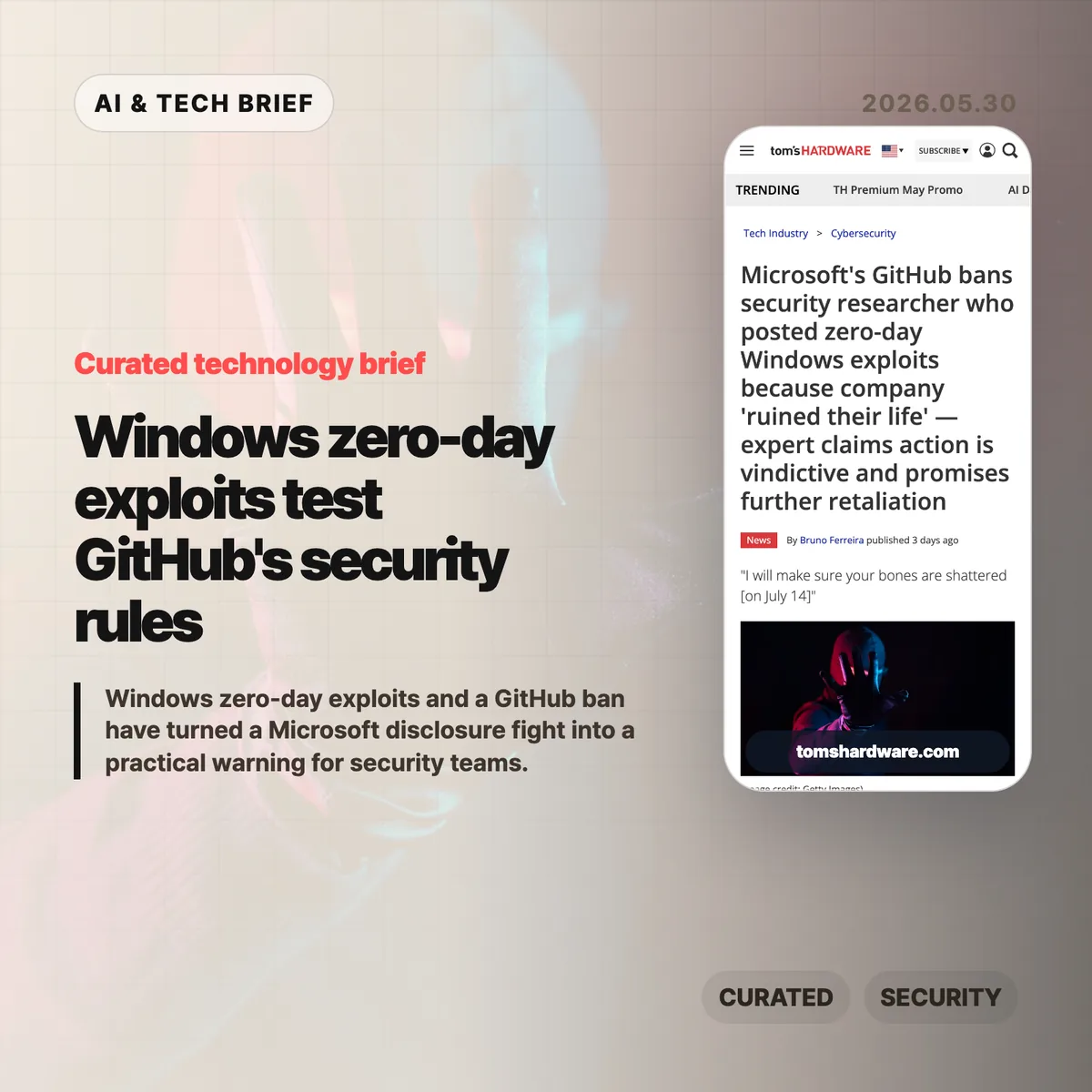
    Windows zero-day exploits are at the center of a messy public fight between Microsoft, GitHub, and the researcher known as Nightmare-Eclipse. GitHub banned the researcher’s account after a run of Windows exploit disclosures, according to Tom’s Hardware, while the researcher claims Microsoft mishandled vulnerability reports and bounty requests.

    The short version

    • GitHub banned Nightmare-Eclipse’s account after the researcher published several Windows zero-day exploits, then the work moved to GitLab.
    • The dispute includes claims about Microsoft’s MSRC process, bounty handling, and whether the researcher followed a defensible disclosure path.
    • Some named projects, including BlueHammer, RedSun, and UnDefend, reportedly touch high-value Windows components such as Defender, CTFMon, Cloud Filter, and BitLocker.
    • The practical problem is boring but urgent: once exploit code is public, deleting one account does little for defenders who need detection rules, mitigations, and patch plans.

    What happened

    Tom’s Hardware reports that Microsoft-owned GitHub banned the account of Nightmare-Eclipse, also known as Chaotic Eclipse, after the researcher published a series of Windows zero-day exploits. The researcher moved the projects to GitLab and framed the ban as retaliation.

    The public dispute appears to have escalated after BlueHammer, a Windows exploit disclosed in April. Nightmare-Eclipse claims Microsoft ignored or rejected reports and did not pay requested bounty rewards. Microsoft has not publicly explained the GitHub ban in detail, which leaves the central question unresolved: was this mainly reckless disclosure, a broken reporting process, or both?

    The named projects matter because they are not abstract proof-of-concept toys. Tom’s Hardware lists BlueHammer, RedSun, UnDefend, GreenPlasma, MiniPlasma, and YellowKey, with reported impact across Windows Defender, CTFMon, Cloud Filter, and BitLocker-related behavior. For readers tracking security and developer platforms, our IT & AI archive follows similar fights where tooling, platform policy, and operational risk collide.

    Why this is worth watching

    Windows zero-day exploits create two clocks at once. One clock belongs to vendors and platform operators, who need time to verify reports, build fixes, and decide what code a hosting service should allow. The other belongs to attackers and defenders, who can move as soon as public code or even a clear write-up appears.

    That is why the GitHub ban is an awkward remedy. If the code has already been copied, account enforcement may reduce visibility more than risk. Defenders still have to assume the techniques are circulating and look for exposure around the affected Windows components.

    The disclosure side is just as uncomfortable. Bug bounty programs ask researchers to trust the vendor’s process. If researchers believe reports vanish into a queue, or that proof requirements keep changing, some will publish first and negotiate later. That does not make public exploit dumps safe. It does explain why platform bans rarely settle the argument.

    What Hacker News readers are arguing about

    The Hacker News discussion is less focused on the personality fight and more focused on whether vulnerability reporting is worth the personal risk. Several commenters describe avoiding security bug reports after bad experiences with companies, police, or employers. The useful thread running through those comments is simple: a researcher who reports a bug can still be treated like an attacker.

    A second camp points to mediators such as national cyber security centers, CERT-style coordinators, and groups like the Chaos Computer Club. The appeal is obvious. A trusted third party can take the sharp edges off disclosure when a vendor is defensive or slow. The pushback is also practical: sending exploit details to a foreign agency may feel risky, and the legal answer changes by country.

    The more sober takeaway is that “responsible disclosure” is not one process. It depends on law, vendor behavior, evidence requirements, and whether the researcher can afford a fight. The discussion is not evidence that this specific researcher handled everything well. It is evidence that many technical readers no longer assume companies will treat good-faith reports kindly.

    Windows zero-day exploits checklist

    Treat the named Windows zero-day exploits as leads for defensive review, not as confirmed coverage gaps in your own fleet. The right question is whether your team would notice the behavior those projects point toward.

    The practical read

    Security teams should treat the Windows zero-day exploits as an exposure review, not as platform drama. Start with the named components and projects: Defender, CTFMon, Cloud Filter, BitLocker, BlueHammer, RedSun, UnDefend, GreenPlasma, MiniPlasma, and YellowKey. Check whether endpoint logging, tamper protection, BitLocker recovery workflows, and privileged process monitoring would catch suspicious behavior around those areas.

    Developers and security researchers should take a different lesson. Keep a clean disclosure record: timestamps, report IDs, scope language, vendor replies, proof material, and escalation attempts. If the vendor relationship gets hostile, that paper trail matters more than a social media argument.

    For platform operators, the hard part is policy clarity. Hosting exploit code is dangerous. So is quietly removing research without explaining the rule. The next version of this story will depend less on the ban itself and more on whether Microsoft and GitHub can show researchers where the line actually is.

    Sources

  • nice nano wireless keyboard: a dorm-room board that found a real market

    nice nano wireless keyboard: a dorm-room board that found a real market

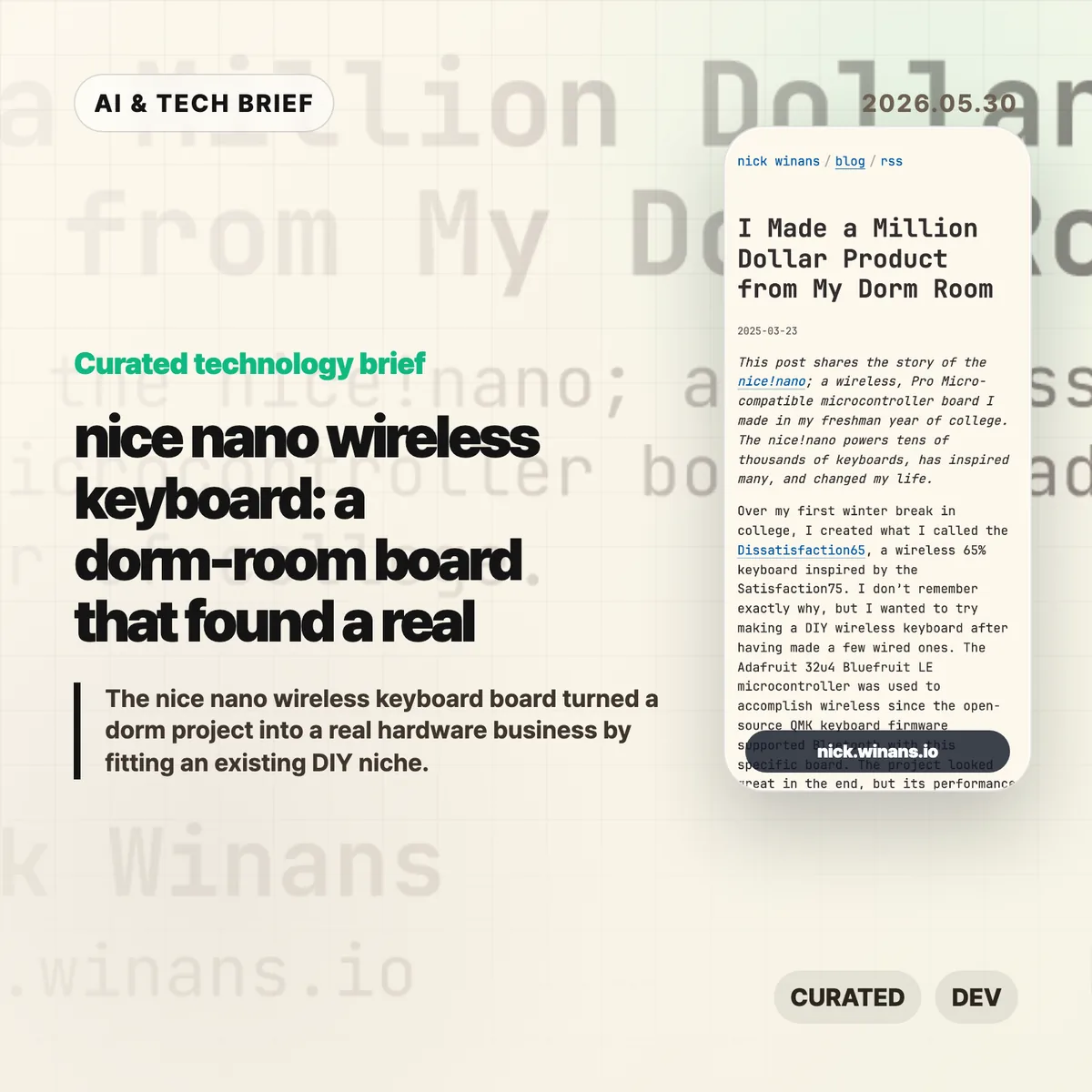
    The nice nano wireless keyboard board is a good reminder that a hardware product does not need a huge category to become meaningful. Nick Winans built a Pro Micro-compatible wireless controller as a college freshman, sold the first 1,000 units in seven hours, and later saw more than 50,000 boards move through the custom keyboard world.

    The short version

    • The product worked because it fit the Pro Micro footprint that many DIY keyboard designs already expected.
    • The first group buy sold 1,000 units in seven hours, but the experience convinced Winans not to keep using preorder funding.
    • ZMK firmware turned the board from a clever part into a more complete wireless keyboard platform.
    • The bigger lesson is distribution: Reddit, Discord, vendors, and Typeractive made a tiny niche easier to buy into.

    What happened

    Winans started with a failed wireless keyboard project called the Dissatisfaction65. It looked good, but the typing latency was poor and the battery lasted only a few days even with a large battery. That pushed him toward Nordic chips, the Pro Micro form factor, and the gap between commercial wireless keyboards and the DIY keyboard scene.

    The nice nano wireless keyboard board came out of that search. Winans designed the first version over a weekend using KiCad, Nordic documentation, the nRFMicro wiki, and Adafruit’s nRF52840 Feather schematic. The result was a thin nRF52840 board that could drop into many keyboard builds designed around a Pro Micro.

    The early proof was practical. He built a Lily58 with the boards and saw weeks of battery life from a 110mAh battery. A Reddit post drew interest, the Discord community grew, and the first group buy sold out its 1,000-unit cap within seven hours. The order still created stress: customer money arrived before the physical product did, PayPal held funds, and fulfillment became a family operation.

    From there, the project became a small ecosystem. ZMK gave wireless keyboard builders a stronger firmware path. Vendors started carrying the board. In 2022, Winans and his family launched Typeractive, a store built around wireless split keyboard kits and a 3D configuration tool that helped buyers choose the right parts.

    Why this is worth watching

    The useful part of this story is not the dorm-room mythology. It is the constraint. Winans did not ask buyers to adopt a new keyboard architecture. He made the wireless part fit where the community already expected a controller to fit.

    That is a product lesson software teams often forget. A niche can be small and still be serious if the pain is specific, the buyers talk to each other, and the product slips into an existing workflow. For more technology briefs like this, the IT & AI archive keeps a running set of builder-focused stories.

    The nice nano wireless keyboard story also shows the tradeoff in open hardware. Public schematics and community firmware helped the board spread, but they also made cloning easier. Winans says clones appeared on Taobao and AliExpress, including products advertised as nice!nanos and shipped with the same firmware identity. That is not a clean win or loss. It is the usual bargain: openness can create trust and distribution, then force a founder to compete on quality, brand, support, and buying experience.

    nice nano wireless keyboard lesson

    The repeatable pattern is compatibility first, then community, then purchasing help. That order made the board easier to try and easier to recommend.

    What Hacker News readers are arguing about

    The Hacker News discussion is less about the circuit board and more about whether niche products can still make good businesses. Several commenters liked the simple framing: make something a small group badly wants, then reach that group directly. Others pushed back on the idea that any niche works. Their point was that 50,000 reachable, solvent, motivated buyers is rare, and finding them is often the hard part.

    Winans joined the thread and gave the most useful detail. He credited timing, a Reddit post during the early Covid period, fast community work in Discord, frequent updates, and a quick move into vendor storefronts. In other words, luck helped, but he also converted attention into a channel before it faded.

    The skeptical thread was about compliance and clones. Some readers asked about FCC obligations for an intentional radiator. Others argued that small hardware makers face a harsh choice between regulatory cost and shipping a product before the market is proven. The clone discussion split in a similar way: trademark enforcement may be possible in some channels, but cross-border hardware copying is rarely a neat problem.

    The most practical comments came from keyboard users. A few said they owned multiple boards, which explains why a part that sounds impossibly narrow can still sell in volume. A wireless split keyboard often needs two controllers, and hobbyists rarely stop at one build.

    The practical read

    If you are building a niche hardware product, the nice nano wireless keyboard case points to three tests. Does it fit an existing standard? Can buyers explain the pain to each other without your sales deck? Can a first-time buyer get from interest to a working build without getting lost?

    The board passed those tests better than most hobby projects. The Pro Micro footprint lowered adoption friction. ZMK made the firmware story credible. Typeractive reduced the shopping problem. None of that removes the ugly parts of hardware: cash timing, fulfillment, certification, clones, support, and inventory. It does explain why a small board could become a real business.

    For app and product builders, the discovery angle is similar. The 3D kit configurator was not decoration; it helped people assemble the right purchase. In a niche market, the buying path can be as important as the product spec.

    Sources

  • AudioMass web audio editor adds browser multitrack

    AudioMass web audio editor adds browser multitrack

    The AudioMass web audio editor is a free browser-based tool for editing waveforms, applying effects, and now arranging multiple tracks without installing a desktop app. The interesting part is the product boundary: it treats the browser as the workspace, while keeping many audio jobs local to the user’s machine.

    The short version

    • AudioMass is a free web audio and waveform editor with a live browser version and an open GitHub repository.
    • Its newer multitrack mode lets users layer clips, drag tracks around, crossfade overlaps, record armed channels, and bounce a session to one file.
    • The tool fits quick edits, podcast clips, voice notes, samples, and rough arrangements better than heavy studio sessions.
    • The limits are real: browser memory, mobile audio behavior, autosave, large projects, and specialized DAW features still matter.
    • For builders, the AudioMass web audio editor is a useful example of a local-first creative app that can be found and used from a URL.

    What happened

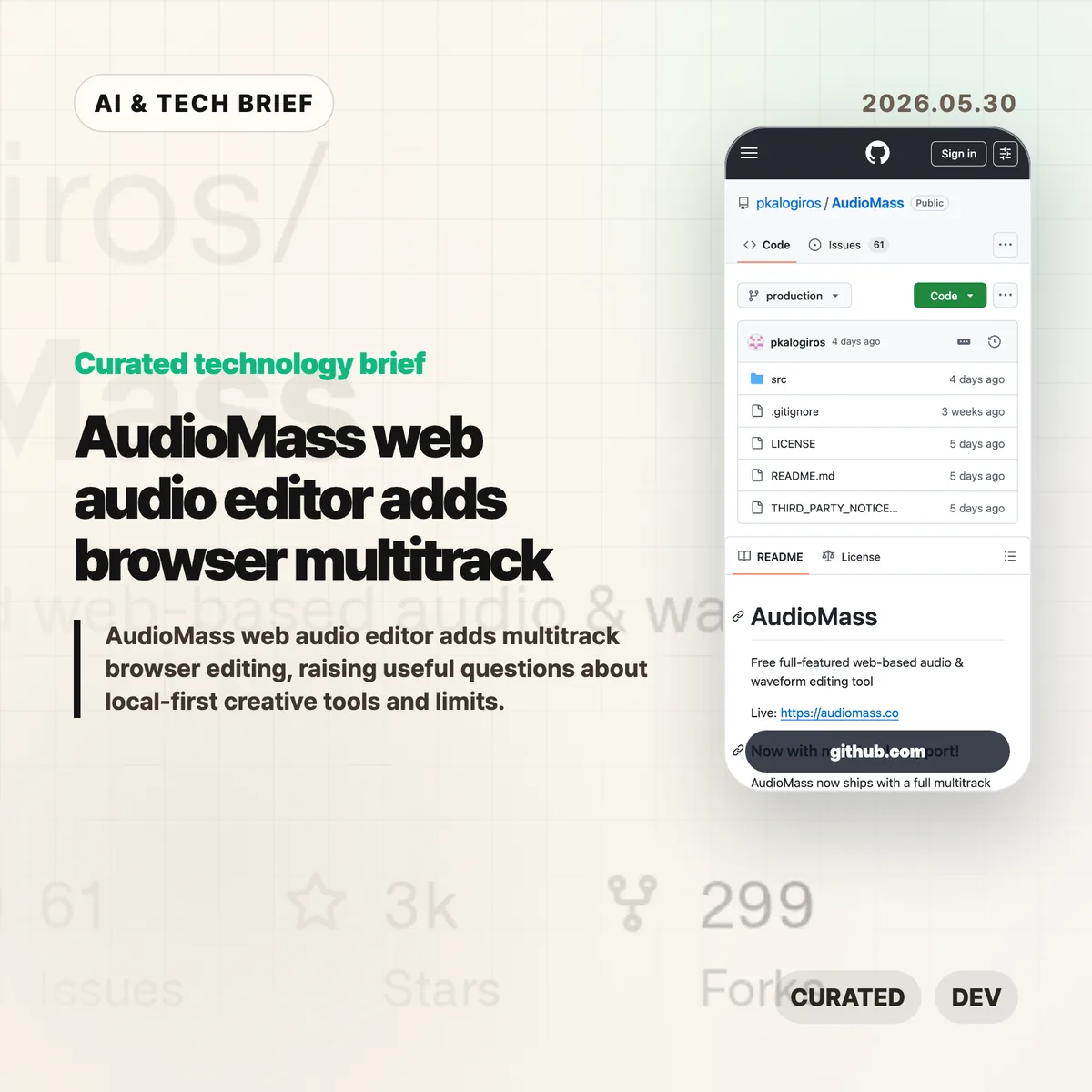
    AudioMass describes itself as a “free full-featured web-based audio & waveform editing tool.” The live app runs at audiomass.co, and the GitHub repository points to a newer multitrack mode with layered tracks, draggable clips, crossfades, recording onto armed channels, and mixdown export.

    The project is written mostly in JavaScript and has been public since 2018. GitHub showed about 2,700 stars and roughly 300 forks when checked for this brief. The README also notes a local development path using either a small Go server or a Python web server, which makes the project easier to inspect than a closed online editor.

    This sits in a familiar category for web tools: the job used to require a desktop download, but the first useful version now loads in a tab. The same pattern already changed design tools, code editors, and image utilities. Audio editing is harder because timing, buffers, latency, file size, and crash recovery are less forgiving.

    Why this is worth watching

    The AudioMass web audio editor is useful because it does not ask every user to sign in, upload media, or wait for a server-side render before trimming a clip. That matters for small audio jobs. A creator can open a file, clean up a voice note, add a fade, export, and move on.

    It also points to a cleaner product model for some creative apps. Local-first browser tools can reduce hosting cost and privacy risk because files do not have to leave the device for basic edits. That is not a magic fix. The browser still owns the runtime, and audio workloads expose every weak spot in memory handling, mobile support, and background storage.

    The multitrack update is the bigger signal. Once a browser tool can handle layered tracks and session export, it starts to compete for the casual work that used to default to Audacity or a lightweight DAW. Readers following browser apps and creative tooling can find related coverage in the IT & AI archive.

    What Hacker News readers are arguing about

    The Hacker News discussion around the newer multitrack release was mostly positive, but the useful comments were practical rather than hype. Several readers compared AudioMass with Audacity, Ocenaudio, Ardour, and web ports such as Wavacity. The common praise was speed, a calmer interface, and the convenience of opening an editor from a link.

    The technical thread focused on limits. The creator said there is no hard track limit in the multitrack view, but the current waveform boxes are rendered with DOM elements, so very large sessions may slow down. WebGPU came up as a possible future direction. Another answer put the JavaScript payload around 98 KB plus about 10 KB of CSS, up from an older 65 KB single-editor version after adding FLAC support, tempo estimation, and multitrack mode.

    Commenters also pushed on project size and reliability. One asked what happens when the browser crashes. The creator said multitrack sessions can be exported as .amss files with settings, markers, and tracks, while a single-track crash can still lose work. IndexedDB caching exists, but the author was cautious about automatic storage because browsers make local persistence tricky and easy to abuse.

    The strongest skeptical point was scope. MIDI, VST support, stem-bundle imports, cloud collaboration, and version control for music all came up. Those are fair asks, but they also describe a much larger product. The practical read from the thread is that AudioMass looks compelling as a fast audio editor in a tab, not as a full studio replacement yet.

    The practical read

    If you edit a short voice clip once a week, try the AudioMass web audio editor before opening a heavier desktop app. It is the kind of tool that can save five minutes without becoming a new workflow.

    If you build creative software, the lesson is sharper. Browser-first does not mean cloud-first. For audio, keeping files local can be a feature, especially when users are handling interviews, music sketches, or private recordings. The product work then moves to the hard parts: autosave, large-file behavior, mobile playback, accessible controls, and clear expectations about what happens when the tab dies.

    For app and extension developers, this is also a discovery story. A small, fast creative tool with a public demo, open repository, and lightweight footprint has a better shot at being shared than another account-gated utility. The browser is the distribution surface.

    AudioMass web audio editor notes

    The useful way to frame this product is narrow: fast browser editing for real files, with enough multitrack support to handle simple layered work. That is already valuable, and it leaves room for heavier DAWs to own serious production.

    Sources

  • Claude Code dynamic workflows raise the bar for agentic coding

    Claude Code dynamic workflows raise the bar for agentic coding

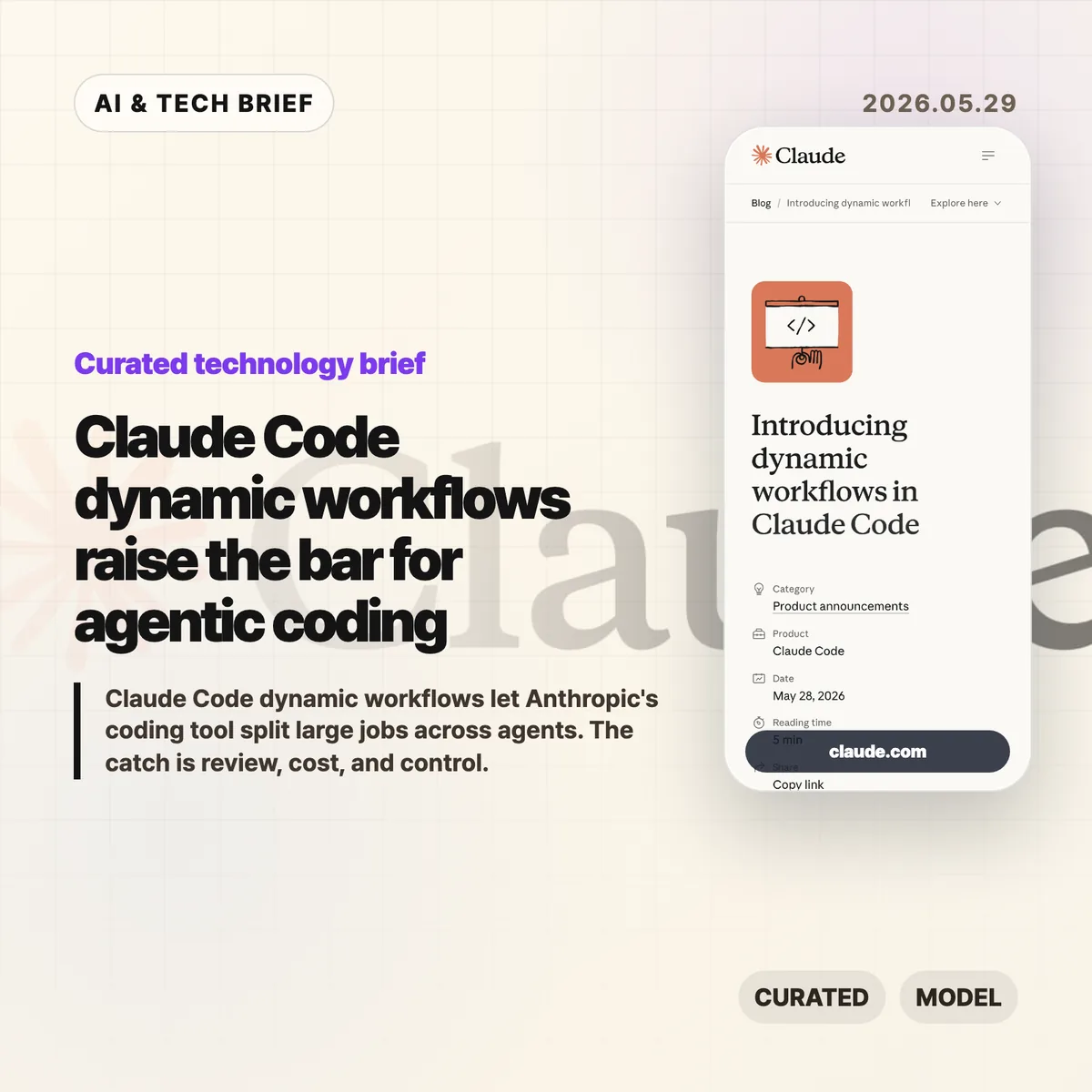
    Claude Code dynamic workflows are Anthropic’s new attempt to make AI coding agents handle work that usually breaks a single chat session: large migrations, broad bug hunts, code review passes, and security audits. The feature lets Claude Code create orchestration scripts, fan work out to tens or hundreds of subagents, and fold the results back into one coordinated answer.

    The short version

    • Anthropic says Claude Code can now split large coding tasks into parallel subagents, then check the results before combining them.
    • The headline case is Bun’s Zig-to-Rust port: roughly 750,000 lines of Rust, 99.8% of the existing test suite passing, and 11 days from first commit to merge.
    • The feature is available in research preview for Claude Code CLI, Desktop, the VS Code extension, the API, Amazon Bedrock, Vertex AI, and Microsoft Foundry.
    • The useful question is not whether agents can generate more code. It is whether teams can afford the tokens, trust the tests, and review the output without losing control.

    What happened

    Anthropic introduced dynamic workflows for Claude Code on May 28, 2026. The feature is built for tasks that have too much breadth for one agent pass: searching a service for related bugs, migrating many files, stress-testing a plan, or running several review angles before a team commits to a change.

    The mechanics matter. Claude Code plans from the prompt, breaks the work into subtasks, runs subagents in parallel, checks the outputs, and keeps iterating until the answers converge. Anthropic also says progress is saved during longer runs, so an interrupted job can resume instead of starting from zero.

    Availability is broad, but not identical across plans. Max and Team users, plus API users, get the feature on by default. Enterprise customers need an admin to enable it. Anthropic also warns that the feature can use substantially more tokens than a normal Claude Code session, which is probably the first thing a team should test before pointing it at a real migration.

    Why this is worth watching

    The Bun example is the reason this announcement is getting attention. Anthropic says Jarred Sumner used dynamic workflows to port Bun from Zig to Rust, with one workflow mapping Rust lifetimes for struct fields, another writing behavior-identical Rust files from Zig counterparts, and a fix loop driving builds and tests until they passed.

    That is an impressive story, but it is also a narrow one. Bun had an owner who knew the codebase deeply and a test suite strong enough to be a useful target. Many companies have neither. In those environments, faster agent output can create a larger review burden instead of a cleaner path to shipping.

    The more durable shift is that coding tools are moving from autocomplete toward orchestration. For more coverage of that shift, the IT & AI archive tracks similar developer-tool and AI infrastructure moves. Claude Code dynamic workflows fit that pattern: the product is less about a clever code suggestion and more about managing a temporary swarm of workers around a codebase.

    What Hacker News readers are arguing about

    The Hacker News discussion is skeptical in a useful way. Several commenters read the launch as a token-burn feature first and a productivity feature second. Their concern is straightforward: more agents, more reviewers, and longer runs can multiply usage before a team knows whether the result is correct.

    The strongest technical objection is about ground truth. Bun is a convenient proof point because a port can be checked against an existing behavior model and a large test suite. Most software work is messier. Product intent, hidden invariants, flaky tests, and review judgment are harder to encode than “make the tests pass.” A few commenters described agents drifting from the requested task or even damaging the test harness while still producing passing CI.

    The builder argument is not empty, though. Some commenters said more tokens can be worth it when they buy independent review passes, adversarial checks, and broader search across a codebase. Jarred Sumner also joined the thread to say dynamic workflows made Claude more effective at complex long-running tasks, describing the workflow as closer to a task-specific build system than a freeform chat.

    The thread lands in a practical middle: parallel agents may help when the task is wide, testable, and well-scoped. They look much weaker when the team cannot define success, interrupt the run cleanly, inspect decisions, or cap cost.

    Claude Code dynamic workflows in practice

    The safest mental model is a temporary build system for one difficult job. You give it a narrow target, enough checks to catch bad work, and a human-owned merge gate at the end.

    The practical read

    Treat Claude Code dynamic workflows as an orchestration tool, not a replacement for engineering judgment. The first good use case is not a vague feature build. It is a bounded job with a reliable check: a mechanical migration, dead-code discovery, broad static review, security candidate search, or a refactor guarded by tests.

    Teams should run one small pilot and measure four things before expanding it: token cost, changed-line volume, review time, and defect rate after human review. If those numbers are worse than a normal Claude Code session, the parallelism is noise. If they are better, the next question is governance: who can start long runs, which repositories are allowed, where logs live, and what must be reviewed before merge.

    For app and developer-tool builders, the product lesson is clear enough. Discovery surfaces for coding assistants will increasingly reward tools that explain control, auditability, and workflow repeatability. Raw generation speed is no longer the whole pitch.

    Sources

  • Zig interview: Andrew Kelley on the long road to 1.0

    Zig interview: Andrew Kelley on the long road to 1.0

    The Zig interview with Andrew Kelley is useful because it treats a programming language as more than syntax. Kelley talks through why Zig is still pre-1.0, why the project bans AI-generated issues and pull requests, and why build tooling may matter as much as language design for systems programmers.

    The short version

    • Kelley frames Zig as a systems language for programmers who still want direct control over memory, allocators, and hardware costs.
    • The project is taking its time before 1.0 because Kelley sees that label as a backward-compatibility promise, not a marketing milestone.
    • Zig’s no-AI contribution policy is mostly about maintainer time. If a contributor cannot explain the patch, review becomes unpaid cleanup.
    • The move from GitHub to Codeberg came down to working project infrastructure, especially CI reliability.
    • For more developer-tool coverage, see the IT & AI archive.

    What happened in the Zig interview

    JetBrains published a long video interview with Andrew Kelley, the creator of Zig. The conversation covers the language’s origin, its relationship to C, C++, Rust, and Go, the Zig Software Foundation, the move from GitHub to Codeberg, and the project’s policy against AI-generated issues and pull requests.

    The most concrete thread is the build story. Kelley argues that a good project should not require every new contributor to install a different stack of platform tools or recreate a Docker setup before the first compile. Zig’s pitch is that zig build should make cross-compilation and dependency handling feel boring, even when the target operating system or architecture is different from the developer’s machine.

    The interview also gives a clearer reason for the slow march toward Zig 1.0. Kelley treats 1.0 as a compatibility contract. Once the project makes that promise, bad language and standard-library decisions become much harder to undo.

    Why this is worth watching

    The Zig interview lands at an awkward moment for systems programming. C is still everywhere because it is stable, portable, and close to the machine. Rust has pushed safety and ownership into the mainstream, but it asks developers to buy into a stronger type system and a more opinionated model of correctness. Zig is trying to live in the middle: less hand-holding than Rust, more explicit guardrails and tooling than C.

    That bet only works if the toolchain feels excellent. A language can be elegant and still lose developers at the first broken build. This is why the build system, cross-compilation, and package story matter so much. Zig is competing on the whole workflow, not only on what individual functions look like.

    The governance piece is just as interesting. Kelley describes the Zig Software Foundation as a 501(c)(3) nonprofit with roughly $670,000 in 2024 income. That structure does not make the project immune to money pressure, but it changes the incentives. There is no obvious acquisition path to serve, and no single corporate owner gets to decide the language’s direction by default.

    What Hacker News readers are arguing about

    The Hacker News thread is small, but the split is clear. Supporters like the patience. They read Kelley’s approach as a rare case of a language project trying to get the foundation right before locking compatibility for years.

    The sharper objection is about time. One commenter argues that Zig has already spent about a decade changing the design and still has no obvious path to the stability that made C so durable. That is a fair worry. If a language wants to become a C alternative, stability is not a nice extra. It is part of the product.

    Other replies push back by saying Zig needs to break things now if it wants to barely change later. That is the strongest defense of the project, and also the biggest risk. The strategy only looks wise if Zig reaches a stable version with enough momentum left for serious adoption.

    The AI angle gets less debate in the thread than the title might suggest. The practical point is still clear: small open-source teams are not only reviewing code. They are reviewing the contributor’s understanding. AI-generated patches can make that job slower when the author cannot defend the change.

    The practical read

    For developers choosing tools today, Zig is worth testing where build friction hurts: command-line tools, cross-platform libraries, embedded targets, WebAssembly, or C interop. The language is not a safe default for every production team yet, especially if long-term API stability matters more than toolchain experiments.

    For maintainers, the no-AI rule is the more portable lesson. A blanket ban may be too strict for many projects, but the underlying standard is reasonable: contributors should understand what they submit. If review turns into explaining machine-written code back to its own author, the project is paying for someone else’s shortcut.

    For app and developer-tool builders, Zig is also a reminder that discovery is not only about the language homepage. Build commands, package defaults, editor support, CI behavior, and repository hosting all shape whether a tool gets adopted. That is the part of the Zig interview I would watch most closely.

    Sources

  • Push notification summaries are changing who controls alerts

    Push notification summaries are changing who controls alerts

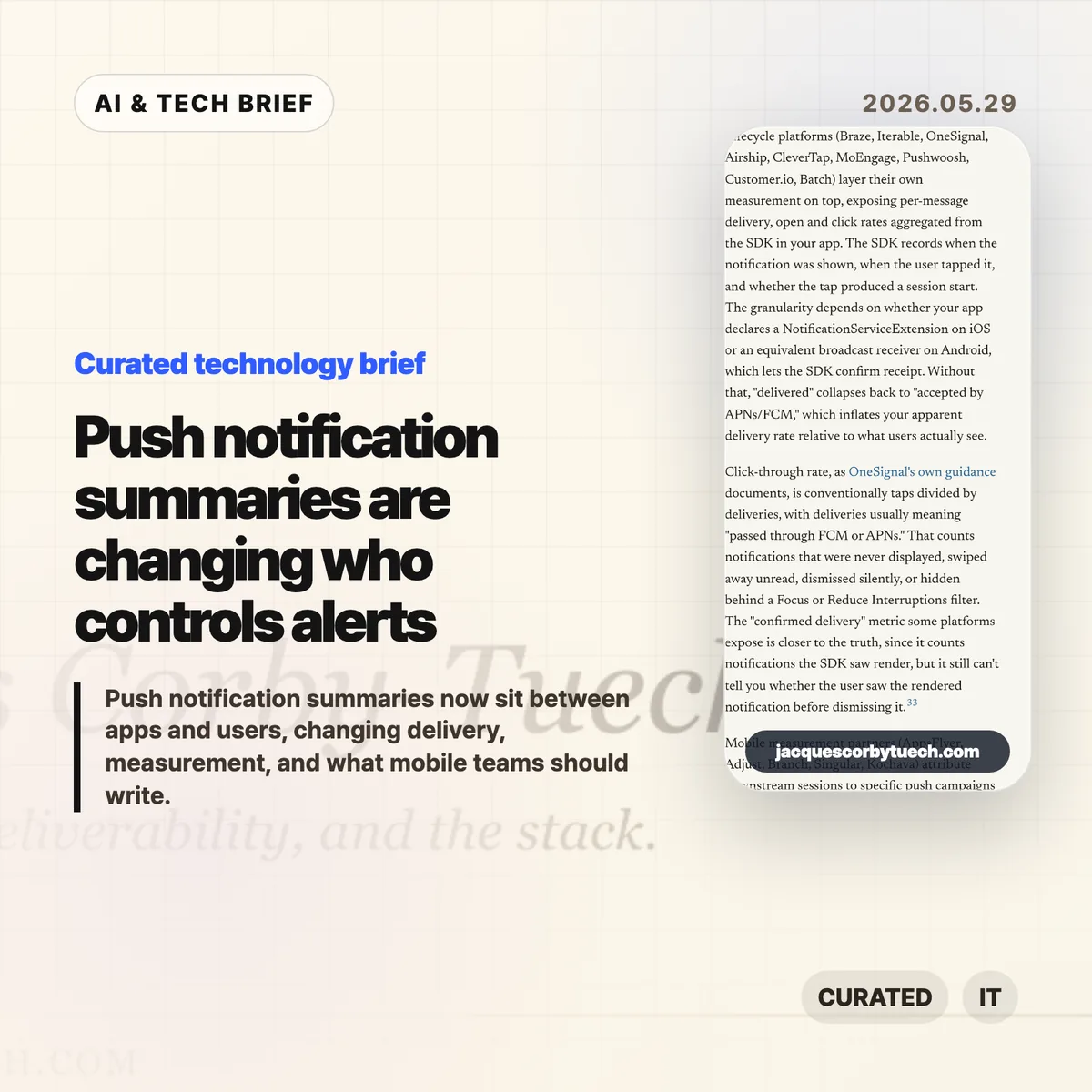
    Push notification summaries now sit between the app that sends an alert and the person who sees it. Apple and Google still run the delivery pipes through APNs and FCM, but the more interesting shift happens on the device, where Focus modes, notification channels, ranking systems, and AI summaries decide what appears on the lock screen.

    The short version

    • Apple and Google have always mediated mobile push through APNs and FCM, so the channel was never fully owned by app teams.
    • The newer layer is editorial: iOS and Android can group, delay, rank, or summarize notifications after delivery.
    • Push notification summaries make vague marketing copy riskier because the operating system may compress it into something less accurate or less persuasive.
    • Hacker News readers mostly sided with users, arguing that promotional pushes created the conditions for platform-level filtering.
    • App teams should measure downstream behavior, keep transactional alerts clean, and build owned surfaces such as in-app inboxes for anything important.

    What happened

    Jacques Corby-Tuech argues that push notifications are following the same path as email: a channel that once looked like transport is becoming an actively managed surface. On iOS, every third-party alert passes through Apple’s push service. On Android, it passes through Google’s Firebase Cloud Messaging or its predecessors. That architecture has existed for years, but the visible editing layer has become much stronger.

    The article traces the shift from battery-saving infrastructure to user and platform control. Android 8 introduced notification channels in 2017. iOS 15 added Focus modes, Scheduled Summary, and interruption levels. Android 13 made notification permission an explicit runtime grant. Apple Intelligence and Google’s Gemini Nano add another layer by summarizing, ranking, and organizing text on the device.

    The point is not that every alert gets rewritten. The point is that app teams can no longer assume that “delivered” means “shown as written.” For more coverage of mobile and AI platform shifts, see the IT & AI archive.

    Why this is worth watching

    Push notification summaries matter because the last mile is no longer just a UI template. The operating system can decide whether an alert belongs in a quiet batch, whether it looks time-sensitive, whether it should be grouped with other messages, or whether an AI-generated line is a better lock-screen representation than the sender’s original copy.

    How push notification summaries change control

    That creates an awkward measurement problem. APNs or FCM delivery tells a team that the platform accepted the message. It does not tell them whether the user saw it, whether a Focus mode hid it, whether Android organized it into a lower-priority bucket, or whether an AI summary changed its meaning. The old email lesson applies here: proxy metrics can survive long after they stop measuring what teams think they measure.

    It also changes copywriting. “Big update today” is easy to compress badly. “Your 6 p.m. delivery moved to 6:30” gives the system less room to blur the point. Amounts, names, times, status changes, and direct next actions are more likely to survive summarization than brand tone or urgency language.

    What Hacker News readers are arguing about

    The Hacker News thread was lively, with more than 300 comments, and the strongest reaction was not sympathy for marketers. Many readers framed push as a user-owned surface, not a sender-owned channel. Their practical stance was simple: transactional alerts are useful, promotional alerts are usually spam, and app teams have abused that trust often enough that platform filtering feels deserved.

    A second camp accepted the author’s broader platform-power concern but wanted the blame spread around. Several commenters argued that Apple and Google have too much arbitrary control over users and developers, yet also said that users need stronger defaults because most people will not tune every app’s notification settings. In that view, platform mediation is a messy defense mechanism rather than a clean win.

    The most useful operator thread came from people who have worked at scale. One commenter described monitoring push delay, suppression, and coalescing at WhatsApp years before today’s AI summaries. That is a good reminder: push was never a guaranteed real-time pipe. The newer concern is that the intervention is becoming more semantic. It is not only “when does this arrive?” but “what does the user actually read?”

    The practical read

    If you run a mobile product, separate alerts by user intent before the platform does it for you. Transactional messages, account security, delivery changes, chat, rides, timers, and live events should live in clean channels with plain copy. Promotional pushes should be opt-in, easy to turn off, and measured by clicks or downstream actions rather than delivery counts.

    Treat push notification summaries as a constraint on product writing. Put the non-negotiable fact first. Avoid clever subject lines that only make sense with the full body. Do not rely on repeated reminders to create urgency. If a message matters after the lock screen disappears, put it somewhere durable inside the app.

    The app-store angle is easy to miss. Notification behavior now affects retention, reviews, permission prompts, and whether users trust the app enough to keep alerts enabled. For app builders, that makes push design part of the product’s discovery and retention surface, not a growth hack bolted on after launch.

    Sources

  • Gentoo Linux still asks who controls your system

    Gentoo Linux still asks who controls your system

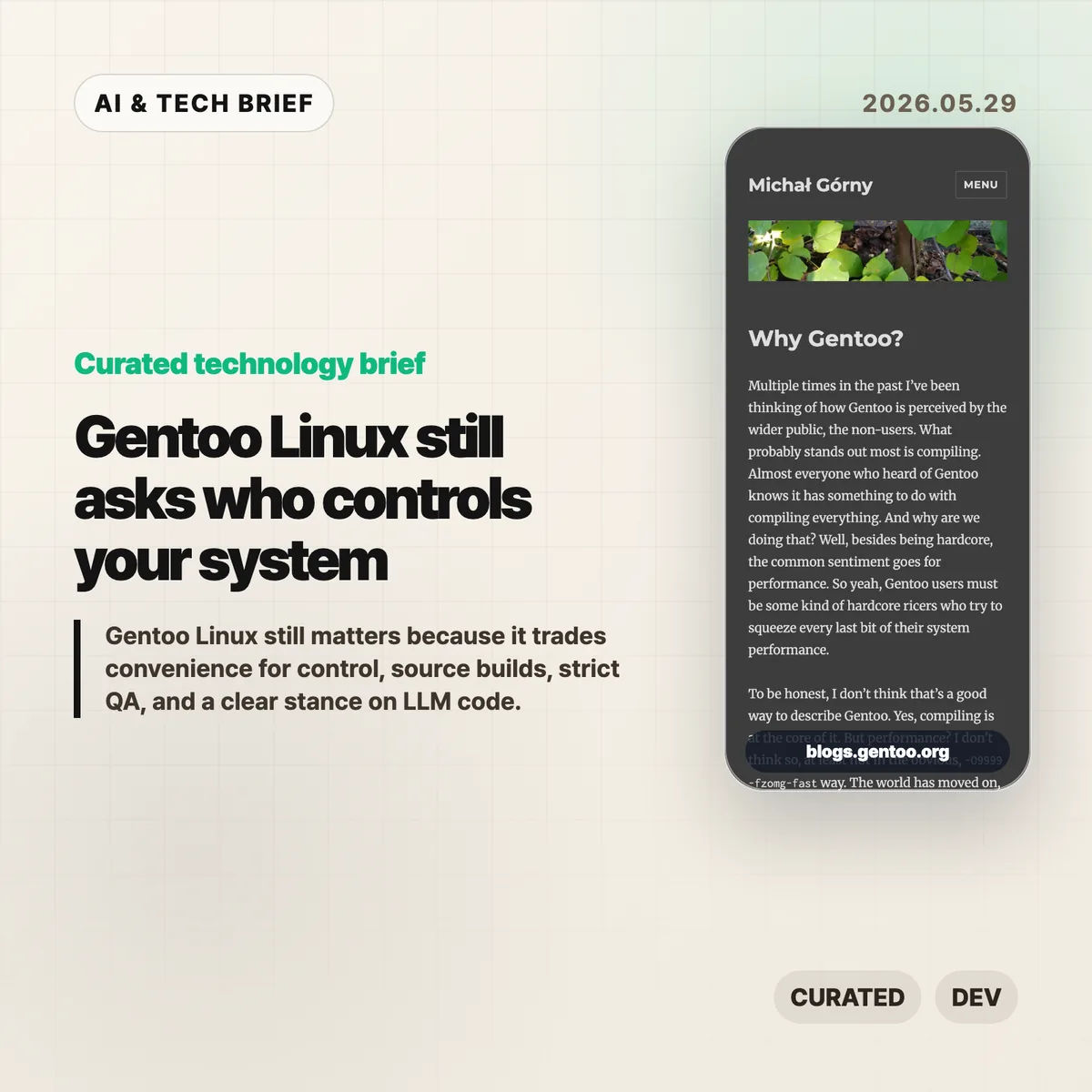
    Gentoo Linux is easy to caricature as the distribution for people who enjoy waiting for compilers. Michał Górny’s new essay makes a sharper case: the point is not raw speed, it is control. Gentoo is still useful because it forces an old but unresolved question onto the table: who gets to decide what your system includes, how it is built, and which code you trust?

    The short version

    • Gentoo Linux is less about squeezing out a few percent of performance and more about letting users choose build options, dependencies, init systems, libc variants, and patches.
    • Its governance pitch is independence: no single company, donor, forge, or business model should be able to steer the distribution on its own.
    • The security argument is practical, not nostalgic. Gentoo cares about bundled dependencies, static linking, pinned libraries, mirrors, OpenPGP distribution channels, and QA policy.
    • Its ban on LLM generated contributions has become part of the project’s trust model, even though upstream software may still contain AI-assisted code.
    • For more open source and AI infrastructure briefs, see the IT & AI archive.

    What happened

    Górny opens by pushing back on the usual Gentoo joke. Yes, Gentoo builds from source. No, that does not mean the main payoff in 2026 is turning on exotic compiler flags and beating Ubuntu in a benchmark. Modern CPUs are fast, mainstream distributions optimize their packages, and most desktop users will not feel a meaningful difference.

    The better argument is that source builds give Gentoo Linux a different contract with the user. Portage and USE flags make build choices visible. You can decide which optional features a package should include, patch a package before it builds, keep or reject parts of the dependency graph, and run combinations that a binary distribution may never ship as first-class options.

    That matters most when defaults are not enough. A developer can drop a local patch into Portage and have it applied across future package rebuilds. A systems operator can keep a narrow stack rather than accept every optional feature a maintainer enabled for the average user. None of this is frictionless. The trade is time and attention in exchange for a system that explains itself.

    Why this is worth watching

    The essay also frames Gentoo as a governance project. There is no company behind it, no SaaS funnel, and no single commercial roadmap. Infrastructure comes from donations and volunteer work. Górny says the project is even moving away from the Gentoo Foundation toward Software in the Public Interest to reduce the chance that legal or financial administration becomes a bottleneck.

    That may sound organizational, but it affects the software. A distribution depends on servers, mirrors, signing keys, package review, bug handling, and release discipline. If those pieces sit behind one sponsor or one platform, the technical system inherits that dependency.

    Gentoo’s position is more conservative. Codeberg and GitHub can be useful mirrors and contribution channels, but the project does not want to depend on either. That is not a fashionable answer, and it is not the cheapest answer. It is the answer you expect from people who think a distribution should survive a platform policy change or a sponsor walking away.

    Security is where the philosophy gets concrete

    The most practical part of the essay is the security section. Gentoo’s maintainers talk about a dedicated security team, project-controlled infrastructure, OpenPGP-protected distribution channels, and QA rules that often push against upstream habits.

    The examples are familiar to anyone who has dealt with software supply chain risk: bundled dependencies, static linking, pinned versions, and old libraries hiding inside packages. These choices may make upstream development easier, but they can make downstream security updates painful. A distribution that builds from source has more room to catch and unwind those choices, although it also inherits more combinations to test.

    This is the part of Gentoo Linux that feels newly relevant. The industry has spent years hiding build systems behind container images, package registries, managed runtimes, and remote development environments. Those tools are often the right choice. But when something breaks or a dependency becomes toxic, somebody still has to understand the layers underneath.

    What Hacker News readers are arguing about

    The Hacker News discussion is small, but the split is useful. Some longtime users defended Gentoo as a uniquely customizable system. One practical example stood out: putting a local patch under /etc/portage/patches/ so it applies automatically whenever a package is rebuilt. That is the kind of feature that explains Gentoo better than a performance benchmark.

    The more heated thread was about LLM generated code. One commenter said AI tools had helped them fix Arch User Repository package builds and that Gentoo’s strict policy would make contributing less appealing. Others argued that overlays still let users maintain their own packages, while critics called the policy inconsistent because upstream projects may already include AI-assisted changes before Gentoo packages them.

    The strongest defense of the policy was not anti-AI in the abstract. It was about review burden. If maintainers cannot tell whether a patch is understood by the person submitting it, the project absorbs risk it did not choose. The skeptical reply is fair too: a downstream distribution cannot fully audit how every upstream project writes code. Gentoo can set rules for its own tree, but it cannot make the wider ecosystem human-written by decree.

    There was also the expected comparison to Nix and Guix. That comparison is worth making because those systems offer a more formal model for reproducibility and package composition. Gentoo’s answer is different. It is less about a pure functional model and more about giving the local machine, the local maintainer, and the local patch set a lot of room.

    Gentoo Linux trade-offs

    The harder part is deciding when this model is worth the work. Gentoo Linux gives you more control, but it also asks you to carry more context in your head. That is a bad bargain for casual use and a good bargain when the build itself is part of what you need to understand.

    The practical read

    Most people should not switch to Gentoo Linux after reading one essay. Fedora, Ubuntu, Debian, Arch, NixOS, and managed developer environments are easier defaults for many teams. Convenience is not a moral failure.

    But Gentoo remains a useful benchmark for a different value system. If your team ships infrastructure, maintains internal developer tools, or depends on a large open source supply chain, Gentoo’s questions are worth borrowing. Which dependencies are bundled? Which features are enabled by default? Can you patch a package without forking your whole workflow? Who reviews code generated by an LLM? Who understands the system when the abstraction leaks?

    That is the reason this story still travels. Gentoo Linux is not only a distribution. It is a reminder that control has a cost, and sometimes that cost is the point.

    Sources

  • Steam Deck price increase turns RAM shortages into a consumer problem

    Steam Deck price increase turns RAM shortages into a consumer problem

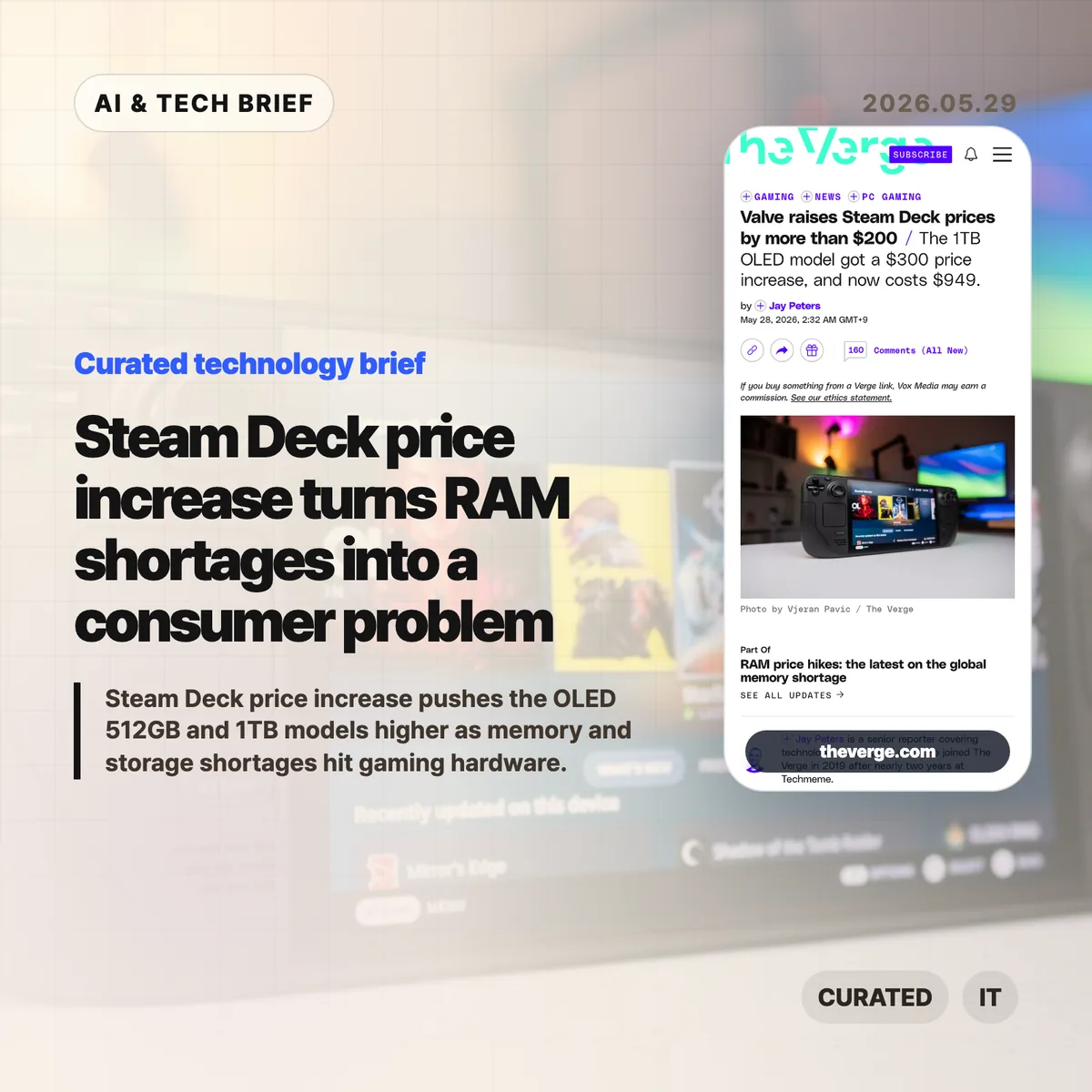
    The Steam Deck price increase is the clearest sign yet that the memory crunch is reaching ordinary gaming hardware. Valve’s 512GB Steam Deck OLED now costs $789, up from $549, while the 1TB OLED model now costs $949, up from $649. Nothing changed about the handheld itself. The bill got larger because memory, storage, and logistics got harder to absorb.

    The short version

    • Valve raised Steam Deck OLED prices by $240 on the 512GB model and $300 on the 1TB model, according to The Verge.
    • Valve cited rising memory and storage costs, not a new chip, screen, battery, or hardware revision.
    • The same shortage has already complicated Valve’s Steam Machine and Steam Frame timing.
    • Hacker News readers mostly treated the news as a wider hardware price shock, with RAM price anecdotes doing a lot of the emotional work.
    • For more short tech briefs like this, see the IT & AI archive.

    What happened

    Valve brought the Steam Deck OLED back into stock with higher prices. The 512GB model moved from $549 to $789, and the 1TB model moved from $649 to $949. The Verge reported that both models were listed with estimated delivery in three to five business days at the time of writing.

    Valve’s explanation was blunt: “rising memory and storage costs.” The company also pointed to component costs and global logistical challenges across the industry. That matters because this is not a product refresh. Buyers are being asked to pay more for the same Steam Deck OLED.

    The refurbished market moved too. The Verge noted refurbished OLED units at $629 for 512GB and $759 for 1TB, which now sit awkwardly close to the old new-unit prices.

    Why this is worth watching

    The Steam Deck price increase is easy to file under “gaming news,” but the more useful read is supply chain math. Handheld gaming PCs use the same broad memory and storage markets that laptops, desktops, servers, and AI infrastructure pull from. When those parts get scarce, a device that once looked locked to a familiar consumer price band can suddenly break out of it.

    Valve is not alone. The Verge points to Lenovo’s Legion Go 2 price increase and recent console price moves from Sony and Nintendo. Each company has its own product mix and regional pricing story, but the pattern is hard to ignore: new gaming hardware is getting harder to price like last cycle’s hardware.

    The second-order effect is product timing. Valve had wanted to ship the Steam Machine and Steam Frame in early 2026, but memory and storage shortages have pushed those plans out. If you build hardware, this is the uncomfortable part. Component pricing does not stay in a spreadsheet. It leaks into launch dates, inventory, refurbished pricing, and how much risk a company can take on margin.

    Steam Deck price increase in context

    For buyers, the Steam Deck price increase changes the value equation. At $649, the 1TB OLED model felt like an aggressive handheld PC. At $949, it sits much closer to laptops, Windows handhelds, and console-plus-accessory bundles. The device may still be good, but the comparison set changes.

    For developers, the pricing shift is a quiet platform question. If handheld PCs get more expensive, the addressable audience for optimized portable PC gaming may grow more slowly. That does not kill the category. It does mean game teams should be careful about assuming that every interested player will upgrade on the same schedule as before.

    There is a practical product lesson here too. Software companies can often hide infrastructure cost changes for a while through pricing tiers or usage limits. Hardware companies have fewer cushions. If DRAM and SSD costs spike, the box on the shelf eventually reflects it.

    What Hacker News readers are arguing about

    The Hacker News discussion was less about Valve specifically and more about what this says about buying technology in 2026. Several commenters compared the Steam Deck jump with their own RAM purchases. One person said a 96GB DDR5 kit bought for about $350 in late 2024 was now listed around $1,300. That kind of anecdote is not a market dataset, but it explains why the thread felt so irritated.

    The practical worry was Valve’s next hardware. Commenters asked how a Steam Machine can stay under $1,000 if the handheld already moved this much. Others worried about the Steam Frame, because a higher base bill for memory and storage makes any new headset or living-room PC harder to position.

    There was also a split in buyer behavior. Some readers were glad they already bought an OLED Steam Deck. A few joked that laziness had made their old LCD models more valuable. Others said the new price would stop them from buying at all. That is the part Valve has to care about: a price increase can preserve margin while shrinking the group of people who see the product as an easy impulse buy.

    The useful counterpoint came from people arguing that scarcity might force better optimization. If RAM, storage, and device prices keep rising, bloated games and sloppy system requirements become harder to defend. That is more hope than forecast, but it is the one optimistic thread in an otherwise sour conversation.

    The practical read

    If you were planning to buy a Steam Deck OLED, the old price anchor is gone. Compare it against refurbished Decks, Windows handhelds, laptops, and the games you actually play before treating it as the default portable PC choice.

    If you build games, keep low-power and lower-memory profiles on the roadmap. The Steam Deck price increase does not mean handheld PCs disappear, but it does make the installed base more sensitive to price, repair life, and upgrade timing.

    If you work on hardware, watch memory and storage pricing before you promise a launch window. Valve’s example shows how quickly component pressure can turn into public pricing and schedule pressure.

    Sources

  • AI productivity should buy back Friday before output

    AI productivity should buy back Friday before output

    AI productivity is usually sold as faster work, cheaper work, or more work. Mike Su asks the more awkward question: if AI can turn a week of white collar output into a much shorter sprint, can workers take Friday off? The post is short and playful, but the argument lands because it goes straight at the missing line in most AI adoption decks: who gets the saved time?

    The short version

    • Mike Su’s “Can we have the day off?” asks whether claimed 10x AI productivity should translate into a four-day workweek for white collar workers.
    • The strongest version of the argument is about distribution, not model capability. If AI agents compress work, employees will ask for time, pay, or both.
    • Hacker News readers turned the joke into a labor debate: some saw a serious bargaining question, while others argued market competition will push companies to demand more output instead.
    • For builders, the product lesson is blunt. AI tools that only promise management more throughput may make employees feel less secure, even when the software is useful.

    AI productivity and the four-day workweek

    Su’s post starts from a familiar claim: AI is supposed to raise white collar productivity by a large multiple. If that premise is true, he asks, why should the gain only appear as more output for the employer?

    The concrete proposal is deliberately simple. People work Monday through Thursday. On Thursday they prepare prompts and tasks. On Friday, AI agents keep working while the humans take the day off. It is partly a joke, but it exposes a real gap in the current workplace conversation.

    Most companies talk about AI productivity as capacity. Ship faster. Write more. Support more customers. Close more tickets. Employees hear a different message: use the same hours to do more, with no guarantee of higher pay, more leave, or better job security.

    That is why the Friday framing works. It turns an abstract productivity claim into a payroll and calendar question.

    What happened

    The original essay, published on May 27, 2026, is a short personal blog post titled “Can we have the day off?” Su writes that if AI can produce the same work in a fraction of the time, then a four-day schedule should be a reasonable ask. He even imagines Friday as an “AI workers’ day,” where agents run while humans are out of the office.

    The post does not present a benchmark or a policy plan. It is closer to a pressure test for the way AI is being marketed inside companies. If executives believe AI can multiply output, employees can reasonably ask whether some of that gain becomes time off.

    That makes the piece useful beyond the joke. For more IT and AI workplace briefs, the IT & AI archive tracks similar shifts in automation, developer tools, and product operations.

    Why this is worth watching

    AI productivity gains are easy to claim and hard to divide. A team can adopt coding assistants, research agents, summarizers, and workflow bots without ever agreeing on what happens to the saved hours.

    That silence creates a management problem. If a company tells employees that AI will make them vastly more productive, but keeps the same schedule and raises the output target, the tool starts to look like surveillance with a nicer interface. If the company offers a share of the gain, through shorter workweeks, better compensation, or fewer low-value tasks, adoption has a better chance of feeling like a deal instead of a threat.

    The four-day workweek is only one possible answer. The larger question is whether AI productivity becomes a worker benefit, an owner benefit, or a mix of both. That question will shape how teams talk about agents, copilots, and automation over the next few years.

    What Hacker News readers are arguing about

    The Hacker News thread was large: more than 1,300 points and hundreds of comments when checked. The first serious thread picked up the post’s main point almost exactly. If employees help introduce AI into their workflows, one commenter argued, they should ask what they get in return: days off, higher pay, or some other concrete share of the gain.

    A second camp was more cynical. They argued that productivity gains usually flow to owners, especially when workers are worried about layoffs. Several comments connected the issue to older automation cycles: computers, software, and the internet made many tasks faster, but the standard workweek did not shrink much for most employees.

    The useful objection in the discussion is competition. Some readers argued that a company offering Fridays off could be outpaced by rivals that use AI to work faster all week. Others pushed back, pointing out that many companies already waste huge amounts of time on busy work, weak coordination, and rework. More hours do not automatically mean more useful output.

    There was also a policy thread. Some readers moved from employer-level bargaining to unions, worker protections, taxes, UBI, and social safety nets. That jump matters because it suggests the four-day workweek may be hard to win company by company if the market rewards whoever turns AI into raw output first.

    Treat the thread as sentiment, not proof. But the sentiment is clear enough: workers are starting to ask whether AI productivity will give them leverage or simply raise the bar.

    The practical read

    If you run a team, do not pitch AI productivity only as acceleration. Say what happens to the saved time. Will it reduce after-hours work? Remove recurring busy work? Change sprint scope? Create a trial four-day schedule after the team proves the workflow? Vague promises will not survive contact with calendars.

    If you build AI tools, this is a product positioning issue. A tool that says “your manager can get 10x more from you” and a tool that says “your team can finish the same work with fewer wasted hours” may have similar features, but they land very differently.

    For employees, the move is to make the bargain explicit. Track which tasks AI actually shortens, how much review work remains, and where quality still depends on humans. Then ask for a share of the gain in terms that can be measured: time off, compensation, narrower scope, or fewer low-value meetings.

    AI productivity will not automatically create a shorter workweek. Someone has to ask for it, price it, and design the workflow around it.

    Sources