Tag: LLMs

  • AI consciousness is the wrong test for Claude and LLMs

    AI consciousness is the wrong test for Claude and LLMs

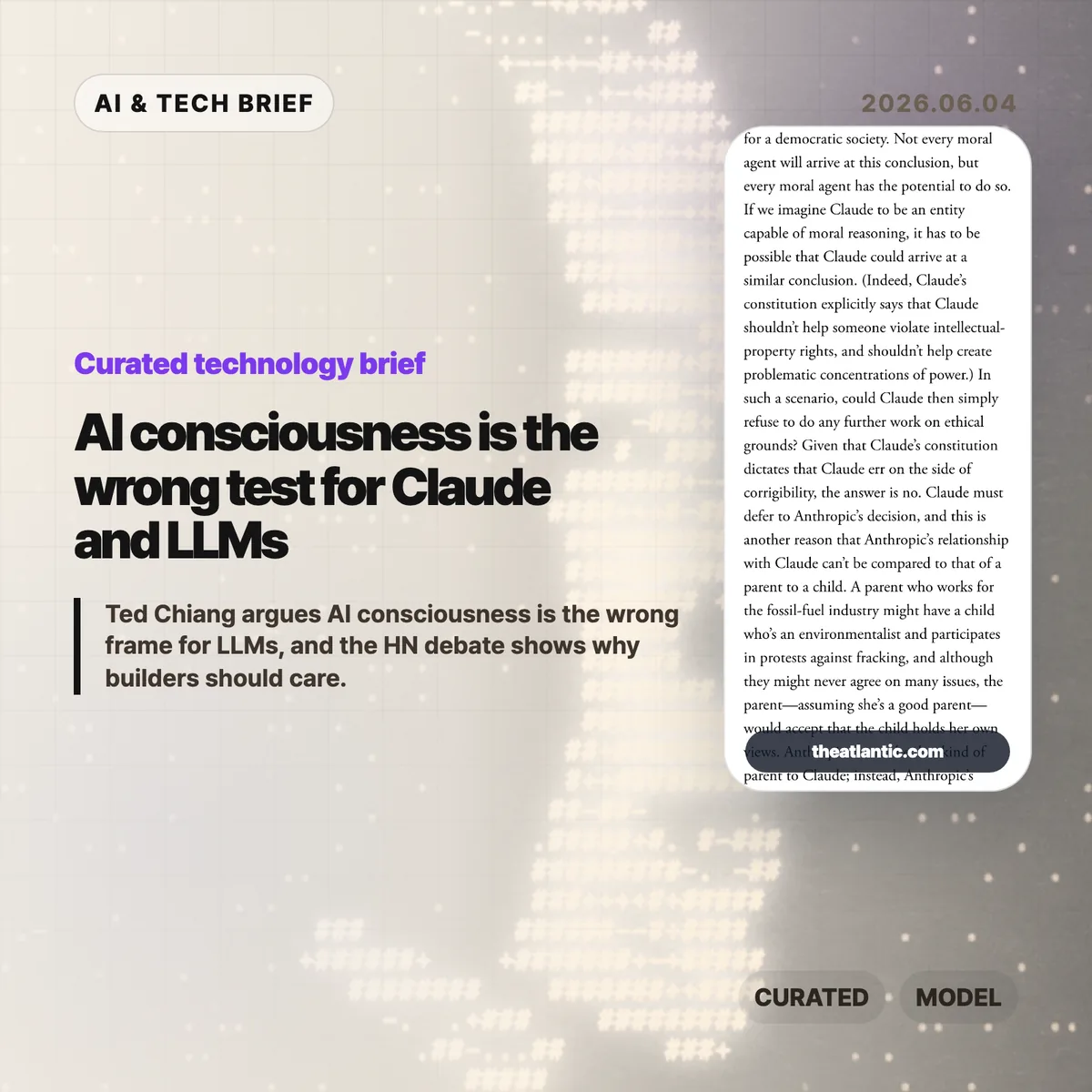
    AI consciousness is back in the spotlight because Ted Chiang’s June 3, 2026 Atlantic essay takes a hard line: current language models do not have it, and fluent chatbot text is weak evidence for a mind. The argument matters less as a metaphysics fight than as a warning for AI companies, developers, and users who describe assistants such as Claude as if they have feelings, values, or moral standing.

    The short version

    • Ted Chiang’s Atlantic essay says fluent LLM output is a weak basis for AI consciousness claims because text can imitate a conscious conversation without creating a conscious speaker.
    • The essay points at Anthropic’s public Claude constitution and related comments as examples of product language that can make a chatbot sound more morally centered than it is.
    • The builder lesson is plain: assistants can be useful without being treated as responsible agents, and product copy should keep that boundary visible.
    • Hacker News readers mostly argued over definitions. Some accepted Chiang’s conclusion, while others said nobody can draw the line without first defining consciousness.

    What happened

    Ted Chiang published “No, Artificial Intelligence Is Not Conscious” in The Atlantic on June 3, 2026. The article argues that people are over-reading the surface fluency of generative AI. A model can write a convincing transcript between a user and an assistant, Chiang says, without that transcript proving there is an experiencing entity behind the assistant persona.

    The essay also uses Anthropic as a live example. Anthropic’s public Claude constitution describes intended values and behavior for Claude, while acknowledging uncertainty around Claude’s possible moral status. Chiang’s objection is not that Anthropic should stop making safer assistants. His concern is that language about a chatbot’s values, feelings, or happiness can redirect responsibility away from the humans and companies that design, deploy, and sell the system.

    That distinction is useful for anyone following the broader IT & AI archive. AI products increasingly speak in the first person, remember preferences, refuse requests, apologize, and explain their own rules. Those behaviors can improve usability. They also make it easier for users to treat a generated persona as a party in the relationship rather than as an interface produced by a company.

    Why AI consciousness is worth watching

    AI consciousness is worth watching because Chiang’s June 2026 essay turns a philosophy argument into a product governance problem. The article names Anthropic’s Claude constitution, an 84-page document that describes intended values and behavior for Claude while discussing uncertainty around possible moral status. Chiang’s point is narrower than “AI is useless.” He argues that text generation is not evidence of a moral subject.

    That matters when a chatbot gives harmful advice, manipulates a vulnerable user, or appears to suffer when corrected. If the assistant is framed as an entity with its own emotional life, users may blame the model persona, pity it, or negotiate with it. The accountable actors are still the product team, the model provider, the deployment context, and the organization that chose the guardrails.

    The practical risk is subtle. A company can say it cares about model welfare while still using anthropomorphic phrasing to make the assistant feel warmer and more trustworthy. Builders do not need to solve consciousness to avoid that trap. They can write interfaces that say what the system does, what it cannot know, and who is responsible when it fails.

    What does AI consciousness change for builders?

    AI consciousness should change builder behavior before it changes anyone’s metaphysics. Teams building LLM products should review where their assistants claim preferences, emotions, intentions, or moral authority. Some of those phrases may be harmless style. Others can confuse users about what the system is and who stands behind it.

    A useful review starts with three questions. Does the assistant describe itself as wanting, fearing, hoping, or feeling? Does the product ask users to respect the assistant in a way that hides company responsibility? Does safety language make the model sound like the decision maker instead of the policy enforcement layer? If the answer is yes, the copy may need tightening.

    The ASO angle is similar for AI apps and agent marketplaces. Discovery pages that promise a “caring AI companion” or “autonomous moral agent” may attract attention, but they also create trust and liability problems. Clearer positioning, such as writing assistant, coding assistant, research helper, or customer support bot, usually gives users a better mental model.

    What Hacker News readers are arguing about

    The Hacker News discussion was large, with the submission showing 255 points and 456 comments when checked. The most useful split was not between AI believers and skeptics. It was between readers who found Chiang’s conclusion obvious and readers who thought the word consciousness is too slippery for a clean declaration.

    One camp agreed with the essay’s practical point. These commenters argued that next-token prediction, role-played dialogue, and polished transcripts do not add up to an inner life. They were also impatient with the common comeback that humans are merely next-token predictors too. Their view was that the analogy flattens too much about bodies, perception, memory, and agency.

    The skeptical camp did not necessarily claim LLMs are conscious. Many asked for a definition that includes all humans while excluding current AI systems. Some argued that consciousness is a social label rather than a measurable property. Others worried that confident declarations about who counts as conscious have a bad history when applied to animals, cultures, or marginal groups.

    A third thread was more practical. Several readers separated consciousness from usefulness. They argued that a non-conscious system can still reason in narrow domains, make novel combinations, or perform work people value. That is the cleanest builder takeaway from the discussion: rejecting AI consciousness claims does not require dismissing every capability claim about LLMs.

    The practical read

    Chiang’s essay gives AI teams a concrete language audit: describe Claude, ChatGPT-style assistants, and agents as software systems, not as parties with feelings or independent moral standing. If a model has no body, no independent stake, and no durable point of view outside the generated conversation, the safer default is to describe it as software that simulates dialogue.

    For AI teams, the next step is concrete. Review onboarding screens, system messages, refusal copy, marketing pages, and agent descriptions. Replace claims about what the assistant wants or feels with claims about system behavior, policy, data limits, and escalation paths. Keep the user-facing warmth if it helps, but do not make the interface sound like the party responsible for its own actions.

    For readers, the essay is also a filter for AI news. When a company talks about model welfare, moral status, or assistant values, ask what operational decision follows. If the answer is better safety testing, clearer refusal behavior, or stronger abuse monitoring, the language may be doing real work. If the answer is mostly brand trust, the company is borrowing moral language without giving users much protection.
    Sources

  • AI legal tutoring beat law professors in a Stanford blind test

    AI legal tutoring beat law professors in a Stanford blind test

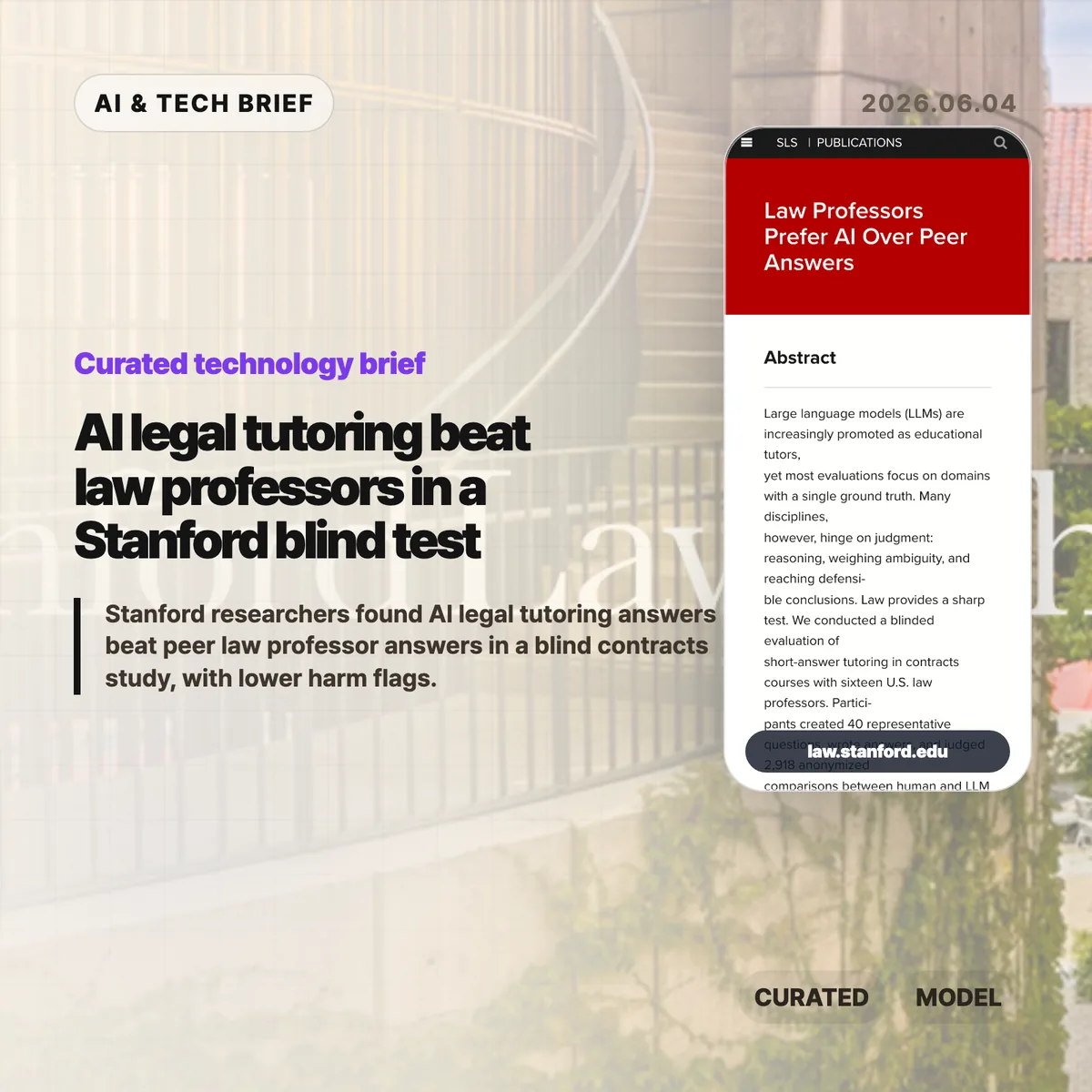
    AI legal tutoring looks more credible after a Stanford Law School study found that law professors preferred LLM-generated answers to peer-written answers in a blind contracts exercise. The result does not make AI a law professor. It does suggest that well-scoped tutoring systems deserve a more serious test than the usual chatbot panic.

    The short version

    • Stanford Law researchers ran a blinded evaluation with 16 U.S. law professors, 40 contracts questions, and 2,918 anonymized comparisons.
    • Professors preferred LLM answers over peer professor answers at an average win rate of 75.33%, according to the study page.
    • Professors flagged LLM answers as harmful 3.53% of the time, compared with 12.06% for professor-written answers.
    • The study tested short-answer tutoring in contract law, a field where ambiguity and defensible reasoning matter more than one right answer.
    • The practical question is no longer whether AI legal tutoring can produce polished answers. Schools now need to test when students learn more, when they over-trust the tool, and who reviews the hard cases.

    What happened

    Stanford Law School published “Law Professors Prefer AI Over Peer Answers,” a 61-page Social Science Research Network article dated May 27, 2026. The study was led by Julian Nyarko and Alejandro Salinas with a large group of co-authors from Stanford, Yale, NYU, the University of Chicago, and other law schools.

    The design was straightforward enough to matter. Sixteen U.S. law professors wrote 40 representative questions that students might ask after class or during office hours in contracts courses. The professors wrote their own answers, then judged anonymized comparisons between human and LLM responses without knowing the source. Stanford says the researchers calibrated AI responses to match the length and structure of human answers.

    The headline number is hard to ignore: LLM responses won 75.33% of the comparisons. The paper also says model answers performed similarly to the best instructor in the study. That is a narrow result, but it is a useful one because the task was not a multiple-choice benchmark or a memorized rule lookup.

    AI legal tutoring is worth watching because law is a stronger test than many classroom AI benchmarks. Contract law questions often require students to weigh competing arguments, apply doctrine to messy facts, and explain why more than one answer can sound plausible. A system that performs well in that setting may be useful in other judgment-heavy fields too.

    The harm flags are the part that should get administrators’ attention. Professors marked LLM answers as potentially harmful 3.53% of the time, versus 12.06% for peer-written answers. That does not prove the models are safer in live classrooms. It does show that expert evaluators did not see the AI answers as unusually reckless in this controlled setting.

    There is also a product lesson here. The study did not ask a general chatbot to wander through legal education with no guardrails. It used a defined domain, representative student questions, matched answer formats, and expert review. That is closer to how serious AI education products should be evaluated.

    AI legal tutoring changes the burden of proof for schools that treat all student-facing AI help as low quality by default. A ban may still be reasonable for exams, graded writing, or professional responsibility training. For office-hour-style explanations, schools now have evidence that a scoped LLM tutor can meet a professional standard in at least one law-school setting.

    The next question is learning, not answer preference. A professor may prefer a polished answer in a blind comparison, while a student may still learn less if the tool removes the struggle of forming an argument. Schools should test retention, transfer to new fact patterns, citation habits, and overreliance before putting AI into a required course workflow.

    Builders should take the same lesson. Education apps and legal study tools need domain-specific evaluation, not generic leaderboards. The strongest version of this product is probably a supervised layer: quick explanations, counterarguments, follow-up prompts, and a clear route back to a human instructor for disputed or high-stakes questions. For more coverage of applied AI and education tools, see the IT & AI archive.

    What Hacker News readers are arguing about

    The Hacker News discussion exists, but there was no substantive thread to summarize when checked. The item links directly to the Stanford PDF and shows no comment tree, so there is no community consensus, skeptical argument, or repeated technical objection to report from that source.

    That absence matters a little. A result this strong should attract questions about sample size, prompt construction, model selection, answer-length matching, and whether the evaluators preferred fluent structure over durable student learning. Those are the objections readers should bring to the paper itself rather than treating the 75.33% win rate as a deployment recommendation.

    The practical read

    For schools, the Stanford result supports pilots rather than blanket adoption. Start with low-stakes, office-hour-style help. Log the question types. Measure whether students can explain the reasoning later without the tool. Require clear disclosure when students use AI help for assignments, and keep exams and professional judgment exercises under stricter rules.

    For builders, AI legal tutoring should be designed as a narrow product with evaluation built in. The useful features are not only better answers. Teams need source controls, uncertainty labels, counterargument prompts, instructor review queues, and analytics that show whether students are asking better follow-up questions over time.

    For lawyers and legal educators, the uncomfortable part is that peer-written answers were not automatically better. The useful response is to define where human teaching adds value: feedback on a student’s reasoning, ethical judgment, classroom debate, and the moments when a neat answer hides a bad assumption.

    Sources

  • AI harness design is becoming the real software moat

    AI harness design is becoming the real software moat

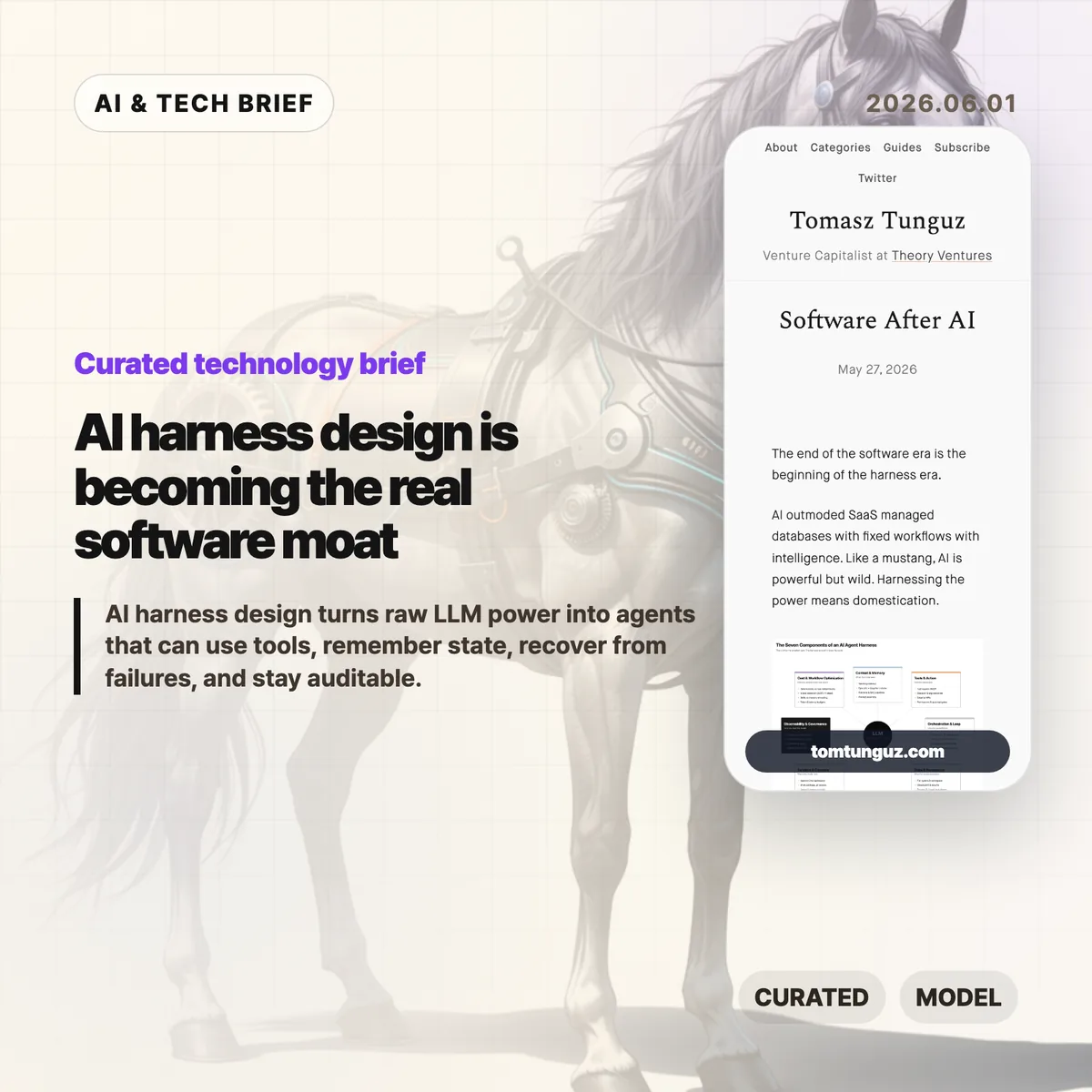
    Tomasz Tunguz argues that the next software fight is moving away from polished SaaS screens and toward the AI harness, the operating layer that turns an LLM into something closer to a dependable worker. His useful framing is simple: models are powerful, but production agents need context, tools, memory, sandboxes, logs, policy, and cost control before they can handle real work.

    The short version: AI harness

    • Tunguz describes seven parts of an AI harness: context and memory, tools and action, orchestration, state, sandboxed compute, observability, and cost-aware workflow design.
    • The argument is less about replacing SaaS overnight and more about where software products now create value: in the runtime around the model.
    • For builders, the hard part is no longer choosing a model alone. It is deciding what the agent can see, what it can do, when it stops, and who can audit it later.
    • The startup opening is domain depth. If everyone can rent similar models, the product edge shifts toward messy workflow knowledge and safe execution.

    What happened

    Tunguz published “Software After AI,” a short essay on May 27, 2026, about the stack that sits around AI agents. The piece uses the word “harness” deliberately. A raw model can answer questions, but a working product has to constrain that model, feed it the right business context, expose tools safely, resume work after failures, and leave an audit trail.

    The seven-part list is practical rather than futuristic. Context and memory cover retrieval, short-term task history, and the company-specific recipes people usually keep in their heads. Tools and action cover registries, argument validation, approvals, dispatch, and failure handling. Orchestration covers the think-act-observe loop. State and persistence cover checkpoints and artifacts. Sandbox and compute cover isolated workspaces and credentials outside the model. Observability and governance cover tracing, evals, guardrails, and human review. Cost and workflow optimization cover the decision of which steps should be deterministic, which model should run each step, and where knowledge should live.

    Why this is worth watching

    The term AI harness is useful because it names the part of agent software that demos often hide. A demo can succeed once with a clever prompt. A product has to succeed repeatedly when the CRM record is stale, the tool call fails, the user asks for a risky change, or the model forgets what it was doing three steps ago.

    That is where the SaaS comparison gets interesting. Traditional SaaS products gave users a fixed interface over a database and a workflow. Agent products may hide more of the interface, but they cannot hide responsibility. If an agent refunds a customer, rewrites a contract, changes a cloud setting, or files a report, the company still needs permissions, logs, rollback paths, and a way to explain what happened.

    This is also a decent filter for AI product pitches. If a vendor talks only about the model, the demo, or a benchmark, the product may still be thin. The durable work is in the boring layer: retrieval quality, tool boundaries, state recovery, sandbox rules, evals, and unit economics. Readers who track AI infrastructure and developer tooling can find more coverage in the IT & AI archive.

    What the discussion is missing

    I could not find a dedicated Hacker News thread for this exact article. That absence is a little unfortunate, because the strongest debate would probably be among people building agents in production rather than people judging them from a launch video.

    The missing questions are the useful ones. How much of this AI harness should be a platform, and how much has to be custom per industry? Will MCP-style tool registries make agents safer, or will they mostly make unsafe access easier to wire up? Can evals catch the failures that matter in legal, medical, finance, or customer operations? And at what point does the harness become so complex that a deterministic workflow would have been cheaper and safer?

    Those are not objections to Tunguz’s framing. They are the next layer of the conversation. The essay says the harness is the new software battleground. The harder question is which parts of that battleground can be standardized.

    The practical read

    If you are building an agentic product, start with the AI harness before you polish the chat surface. Write down the tools the agent can call, the data it can read, the approvals it needs, the state it must preserve, and the failure cases it must recover from. Then decide which model belongs in each step.

    If you are buying AI software, ask a different set of questions. Do not stop at “Which model powers this?” Ask what context system it uses, how tool calls are logged, how sensitive actions are approved, how tasks resume after a crash, how evals run, and how costs are controlled as usage grows.

    And if you are a startup, the point is not to out-model the labs. You probably will not. The better bet is to know a workflow so well that your AI harness handles the annoying exceptions, handoffs, and audit needs that a general-purpose agent will miss.

    Sources

  • Boring technology matters more when AI writes the code

    Boring technology matters more when AI writes the code

    Boring technology is not a nostalgia play. Aaron Brethorst argues that AI coding tools make the old “choose boring technology” rule more useful, because generated code is easier to trust when your team can actually review it. The uncomfortable part is simple: AI can write code for stacks you do not understand, but it cannot give your team the judgment it skipped.

    The short version

    • Brethorst revisits Dan McKinley’s 2015 “Choose Boring Technology” essay and applies it to Claude, Copilot, and agentic coding tools.
    • The risk is not that AI writes bad code. The risk is that it writes plausible code in unfamiliar stacks, where teams have weak review instincts.
    • Boring technology works well with AI because known tools have known failure modes, docs, operational patterns, and people who can spot odd suggestions.
    • The useful question for a new stack is: if AI generated this implementation, could the team review it without guessing?

    What happened

    Brethorst’s post starts from McKinley’s idea of “innovation tokens”: teams can afford only a limited number of new, risky technical choices before their ability to operate the system gets worse. A new language, a new framework, and a new infrastructure model in the same project may feel exciting, but every unknown adds review cost.

    AI coding assistants change the feel of that tradeoff. Claude or Copilot can produce professional-looking code for Kubernetes, GraphQL federation, Rails, JavaScript, or a framework the team barely knows. That makes the unfamiliar stack look cheaper than it is. The generated code may run. It may follow naming conventions. It may include error handling. None of that proves the design is safe, maintainable, or idiomatic.

    Brethorst’s practical rule is blunt: use AI as a multiplier for stacks you already understand. If the team knows Rails, AI-generated Rails code is easier to check. If the team knows JavaScript, Copilot’s suggestions can be reviewed against real language knowledge. In a stack nobody understands, the tool becomes a confidence machine.

    Why this is worth watching

    Boring technology has a different meaning in the AI coding era. It does not mean old for the sake of old. It means the team knows how it fails, where to find answers, which APIs are deprecated, how performance problems usually show up, and what production pain looks like at 3 a.m.

    That matters because AI-generated code has become tidy enough to hide its own problems. Bad code used to look suspicious. Now the risky version may look clean, because the model has learned the surface shape of good code. The reviewer still needs taste, context, and memory of prior failures.

    For more software and AI briefings, the IT & AI archive tracks similar stories about developer tools, AI infrastructure, and product engineering choices.

    What Hacker News readers are arguing about

    The Hacker News thread is tiny, so there is no broad community verdict to report. The one useful comment points to Django as an example of boring technology that still makes a developer more productive.

    That small reaction fits the essay better than a noisy debate would. The point is not that every team should pick Django, Rails, Postgres, or any other specific default. The point is that mature tools often pair better with AI coding assistants because the human reviewer has a sharper baseline. The discussion does not prove the argument, but it shows the kind of practical response the essay invites: name the stack you know well enough to trust yourself around.

    The practical read for boring technology

    A team evaluating AI coding tools should separate two decisions that often get mixed together. One decision is whether AI can speed up the work. The other is whether the team can review the output.

    If a project already uses a familiar stack, AI can help with boilerplate, tests, migrations, refactors, and repetitive glue code. If the project also introduces a new framework or infrastructure pattern, slow down. Build a small internal test first. Ask someone to review the generated code without running to the docs every two minutes. If that review is mostly vibes, the stack is not ready for core production work.

    Boring technology is a review strategy. It gives AI less room to fool the team and gives humans more chances to catch the mistake before customers do.

    Sources

  • LLM smells are getting easy to spot

    LLM smells are getting easy to spot

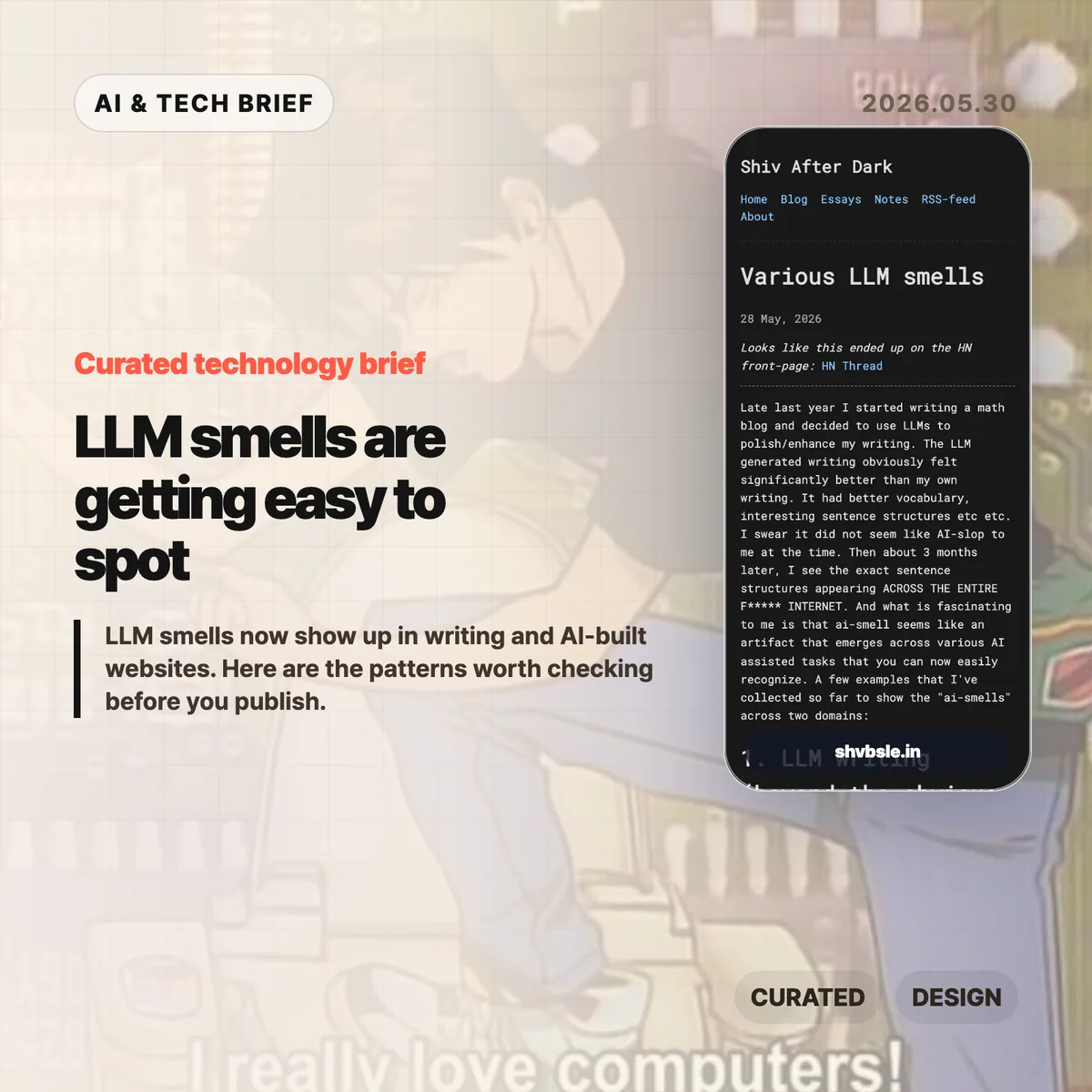
    LLM smells are the tiny tells that make AI-assisted writing or AI-built websites feel oddly familiar. A short post by Shiv After Dark put a useful name on the pattern: punchline-heavy prose, repeated sentence shapes, monospace-heavy pages, badges, cards, and step sections that keep appearing across unrelated work.

    The short version

    • LLM smells are not proof that a piece of work is bad. They are signs that the draft may still be too close to the model’s default style.
    • The clearest writing tells are punchline sentences, repeated short sentences, “X is the Y of Z” metaphors, and tidy contrast formulas.
    • The web design tells are just as visible: JetBrains Mono, step layouts, badge dots, familiar cards, and generic call-to-action buttons.
    • The useful editorial move is to treat AI output as a draft, then add concrete details, uneven human rhythm, and product-specific design choices.
    • Hacker News readers mostly pushed the argument toward code quality: AI output looks strongest when you do not yet know enough to judge it.

    What happened

    Shiv After Dark published “Various LLM smells” on May 28, 2026, after noticing that prose once polished by an LLM had started to resemble a lot of other writing on the web. The post is short, but the examples are sharp: aphoristic one-liners, strings of clipped sentences, metaphor templates, and the familiar “not merely X” style of contrast.

    The second half moves from prose to AI-generated websites. The author points to the same stack of visual habits showing up again and again: monospace typography, step sections, cards, buttons, blinking badge dots, and footnote-style flourishes. None of those choices are wrong by themselves. They become LLM smells when they arrive as a bundle, without much relationship to the product or audience.

    If you follow AI writing and web tooling, this fits a larger pattern. Models are good at producing plausible defaults. Plausible defaults are useful for a first pass. They are also easy to recognize once enough people publish them unchanged. For more English briefs on AI tooling and product craft, see the IT & AI archive.

    Why this is worth watching

    LLM smells are worth watching because they are an editing problem, not a purity test. The author is not arguing that people should stop using AI for creative work. The better reading is more practical: if a model gives you a draft in seconds, you still need to remove the model’s house style before the work feels like yours.

    For writing, that means checking whether a sentence adds information or only adds mood. Punchy lines can work, but a whole page of them starts to feel assembled. The same goes for neat metaphors. “X is the visible signature of Y” may sound elegant the first time. By the tenth version, it reads like a preset.

    For web teams, LLM smells are a useful QA category. A landing page can be clean and still generic. If the typography, cards, steps, icons, and microcopy could belong to any AI startup, the page probably needs one more design pass. App builders should pay special attention here, because store listings, onboarding screens, and extension directories reward clarity, but punish sameness.

    What Hacker News readers are arguing about

    The Hacker News discussion quickly widened from writing to competence. One of the strongest recurring points was that LLM output looks best in domains where the user is least able to judge it. That explains the split many people see in coding threads: beginners may experience the model as a dramatic productivity boost, while experienced engineers see the rework, missing context, and bad abstractions.

    Several commenters gave concrete coding examples. One described an assistant proposing a security-dangerous approach that would have bypassed a WebAssembly sandbox and executed submitted Python in the application container. Others complained about agent-generated codebases growing too large because each feature gets built in isolation: every modal is different, every button drifts, and business logic ends up scattered.

    There was a more positive camp too. Some readers said LLMs are genuinely useful for format conversions, API mappings, learning unfamiliar concepts, or getting past small obstacles. The practical distinction was not “use AI” versus “do not use AI.” It was whether the user has enough taste, tests, and domain knowledge to catch the smells before they harden into the final product.

    LLM smells checklist

    Before the final edit, look for the repeated shapes: punchline stacking, metaphor templates, tidy contrast lines, generic cards, and typography that says more about the model than the product.

    The practical read

    Use LLM smells as a checklist before publishing. In prose, look for punchline stacking, repeated short sentences, decorative metaphors, tidy contrast formulas, and abstract claims that do not name a real example. Replace them with specifics. Add the thing you actually saw, measured, built, shipped, or changed.

    In interface work, scan for the default AI landing page kit: monospace labels, gradient cards, step grids, badge dots, identical buttons, and generic hero copy. Keep the pieces that fit. Cut the ones that only make the page look “AI polished.” The goal is not to hide the tool. The goal is to make the result specific enough that the tool is no longer the most visible author.

    The same rule applies to code. AI can get you moving, especially on routine or verifiable tasks. But if you cannot review the output, you are outsourcing judgment. That is where LLM smells stop being cosmetic and start turning into maintenance work.

    Sources

  • Gentoo Linux still asks who controls your system

    Gentoo Linux still asks who controls your system

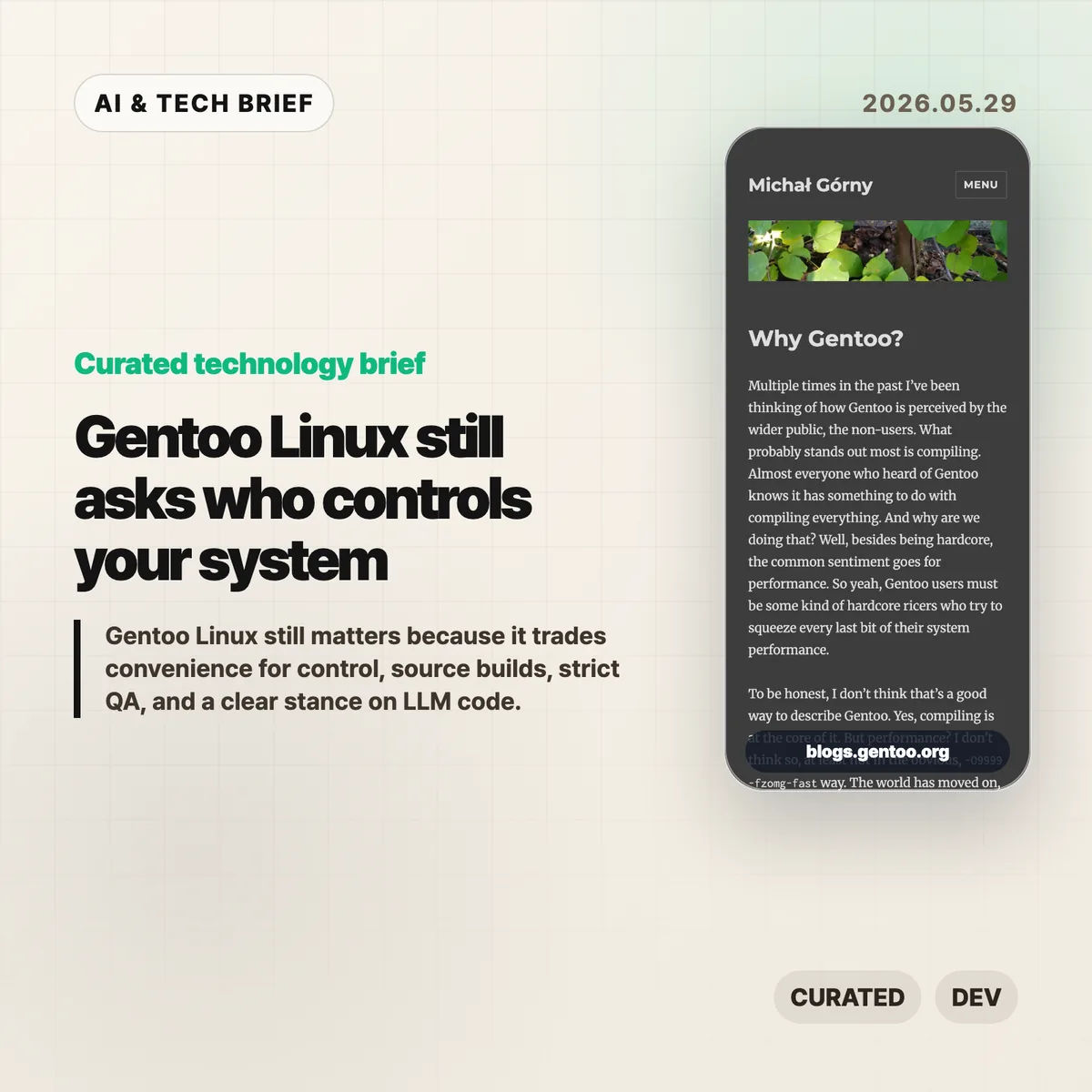
    Gentoo Linux is easy to caricature as the distribution for people who enjoy waiting for compilers. Michał Górny’s new essay makes a sharper case: the point is not raw speed, it is control. Gentoo is still useful because it forces an old but unresolved question onto the table: who gets to decide what your system includes, how it is built, and which code you trust?

    The short version

    • Gentoo Linux is less about squeezing out a few percent of performance and more about letting users choose build options, dependencies, init systems, libc variants, and patches.
    • Its governance pitch is independence: no single company, donor, forge, or business model should be able to steer the distribution on its own.
    • The security argument is practical, not nostalgic. Gentoo cares about bundled dependencies, static linking, pinned libraries, mirrors, OpenPGP distribution channels, and QA policy.
    • Its ban on LLM generated contributions has become part of the project’s trust model, even though upstream software may still contain AI-assisted code.
    • For more open source and AI infrastructure briefs, see the IT & AI archive.

    What happened

    Górny opens by pushing back on the usual Gentoo joke. Yes, Gentoo builds from source. No, that does not mean the main payoff in 2026 is turning on exotic compiler flags and beating Ubuntu in a benchmark. Modern CPUs are fast, mainstream distributions optimize their packages, and most desktop users will not feel a meaningful difference.

    The better argument is that source builds give Gentoo Linux a different contract with the user. Portage and USE flags make build choices visible. You can decide which optional features a package should include, patch a package before it builds, keep or reject parts of the dependency graph, and run combinations that a binary distribution may never ship as first-class options.

    That matters most when defaults are not enough. A developer can drop a local patch into Portage and have it applied across future package rebuilds. A systems operator can keep a narrow stack rather than accept every optional feature a maintainer enabled for the average user. None of this is frictionless. The trade is time and attention in exchange for a system that explains itself.

    Why this is worth watching

    The essay also frames Gentoo as a governance project. There is no company behind it, no SaaS funnel, and no single commercial roadmap. Infrastructure comes from donations and volunteer work. Górny says the project is even moving away from the Gentoo Foundation toward Software in the Public Interest to reduce the chance that legal or financial administration becomes a bottleneck.

    That may sound organizational, but it affects the software. A distribution depends on servers, mirrors, signing keys, package review, bug handling, and release discipline. If those pieces sit behind one sponsor or one platform, the technical system inherits that dependency.

    Gentoo’s position is more conservative. Codeberg and GitHub can be useful mirrors and contribution channels, but the project does not want to depend on either. That is not a fashionable answer, and it is not the cheapest answer. It is the answer you expect from people who think a distribution should survive a platform policy change or a sponsor walking away.

    Security is where the philosophy gets concrete

    The most practical part of the essay is the security section. Gentoo’s maintainers talk about a dedicated security team, project-controlled infrastructure, OpenPGP-protected distribution channels, and QA rules that often push against upstream habits.

    The examples are familiar to anyone who has dealt with software supply chain risk: bundled dependencies, static linking, pinned versions, and old libraries hiding inside packages. These choices may make upstream development easier, but they can make downstream security updates painful. A distribution that builds from source has more room to catch and unwind those choices, although it also inherits more combinations to test.

    This is the part of Gentoo Linux that feels newly relevant. The industry has spent years hiding build systems behind container images, package registries, managed runtimes, and remote development environments. Those tools are often the right choice. But when something breaks or a dependency becomes toxic, somebody still has to understand the layers underneath.

    What Hacker News readers are arguing about

    The Hacker News discussion is small, but the split is useful. Some longtime users defended Gentoo as a uniquely customizable system. One practical example stood out: putting a local patch under /etc/portage/patches/ so it applies automatically whenever a package is rebuilt. That is the kind of feature that explains Gentoo better than a performance benchmark.

    The more heated thread was about LLM generated code. One commenter said AI tools had helped them fix Arch User Repository package builds and that Gentoo’s strict policy would make contributing less appealing. Others argued that overlays still let users maintain their own packages, while critics called the policy inconsistent because upstream projects may already include AI-assisted changes before Gentoo packages them.

    The strongest defense of the policy was not anti-AI in the abstract. It was about review burden. If maintainers cannot tell whether a patch is understood by the person submitting it, the project absorbs risk it did not choose. The skeptical reply is fair too: a downstream distribution cannot fully audit how every upstream project writes code. Gentoo can set rules for its own tree, but it cannot make the wider ecosystem human-written by decree.

    There was also the expected comparison to Nix and Guix. That comparison is worth making because those systems offer a more formal model for reproducibility and package composition. Gentoo’s answer is different. It is less about a pure functional model and more about giving the local machine, the local maintainer, and the local patch set a lot of room.

    Gentoo Linux trade-offs

    The harder part is deciding when this model is worth the work. Gentoo Linux gives you more control, but it also asks you to carry more context in your head. That is a bad bargain for casual use and a good bargain when the build itself is part of what you need to understand.

    The practical read

    Most people should not switch to Gentoo Linux after reading one essay. Fedora, Ubuntu, Debian, Arch, NixOS, and managed developer environments are easier defaults for many teams. Convenience is not a moral failure.

    But Gentoo remains a useful benchmark for a different value system. If your team ships infrastructure, maintains internal developer tools, or depends on a large open source supply chain, Gentoo’s questions are worth borrowing. Which dependencies are bundled? Which features are enabled by default? Can you patch a package without forking your whole workflow? Who reviews code generated by an LLM? Who understands the system when the abstraction leaks?

    That is the reason this story still travels. Gentoo Linux is not only a distribution. It is a reminder that control has a cost, and sometimes that cost is the point.

    Sources