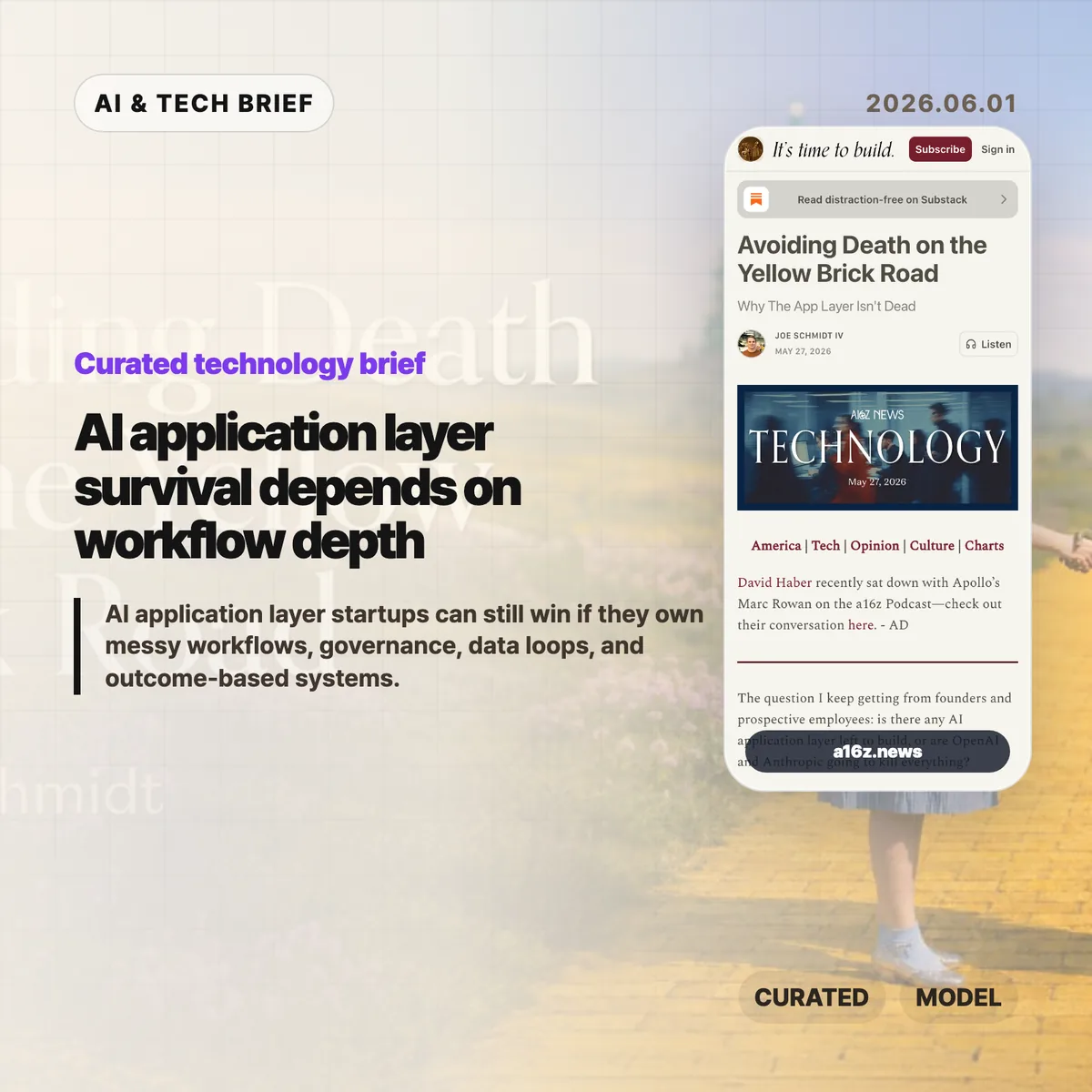
The AI application layer is not dead, but the easy part of it looks dangerous. Joe Schmidt IV at a16z argues that startups building generic model-plus-connector products are walking straight toward OpenAI and Anthropic, while companies that own messy business workflows still have room to build.
Table of Contents
The short version
- Horizontal AI tools for coding, writing, image creation, and simple connector workflows benefit directly from better frontier models.
- The safer AI application layer opportunities sit in vertical workflows where approvals, audits, legacy systems, and domain rules matter.
- a16z names four practical defenses: data loops, model routing, cost control, and governance.
- The Hacker News thread was small, but the useful objection was sharp: if the answer is bespoke vertical stacks, the road to broad automation is messier than the hype suggests.
What happened
Schmidt frames the current AI startup anxiety as a map. The “Yellow Brick Road” is the path the labs are already walking: strong models, standard connectors such as Google Drive, Slack, Salesforce, Notion, and GitHub, plus an agent orchestration layer. Products in that lane improve when the model improves, so the model owner has better margins, distribution, and pricing power.
The other side of the map is what he calls the rest of Oz. These are workflows where a model call is only one piece of the product. A sales agent, insurance underwriting tool, legal workflow, finance process, or healthcare operation may need role-specific sub-agents, deterministic software, approvals, audit trails, and integration with old systems that cannot be swapped out casually.
The argument is also a warning to founders. If a startup is selling a smarter chat interface over the same connectors as everyone else, it may be selling a feature the labs can bundle. If it becomes the system where work is routed, checked, logged, and improved, the AI application layer has a better shot at becoming durable software.
Why this is worth watching
The useful part of the piece is its test for depth. A tool that sits on top of a customer system is easier to replace. A system that runs the work, captures the data, and handles governance is harder to pull out.
AI application layer test for founders
Schmidt points to four defenses. First, production usage can create data and learning loops that do not exist on the public web. Second, a vertical company can route tasks across multiple model vendors, open-source fine-tunes, and cheaper tiers instead of depending on one lab’s stack. Third, it can tune cost against the level of intelligence each sub-task needs. Fourth, it can become the control plane for permissions, audit logs, and compliance in a specific industry.
That is also where the claim gets less glamorous. Much of the defensibility sounds like ordinary software work: deployment, edge cases, data cleanup, customer-specific configuration, permissions, and support. For more coverage of this kind of software shift, the IT & AI archive tracks related product and infrastructure stories.
What Hacker News readers are arguing about
The Hacker News discussion was tiny, so it should not be treated as a market signal. Still, one comment captured the strongest skeptical read: if the advice is to build bespoke vertical AI stacks, that sounds less like an imminent general-intelligence takeover and more like another generation of custom enterprise software.
The commenter also raised three practical blockers. Many business processes are fuzzy because they exist to absorb edge cases. Some of the most valuable domains have security or compliance limits that make third-party inference hard to adopt. And if companies need more programmers to rebuild workflows around AI, that complicates the simple story that agents will replace labor by themselves.
That objection does not kill the a16z thesis. It makes it more grounded. The AI application layer may survive because the hard work is not only model intelligence. It is the boring, expensive work of turning a messy process into software a customer can trust.
The practical read
Founders can use this as a quick filter. Count the steps in the workflow. Count the systems touched. Ask who approves the output, what gets logged, and what breaks if the model is wrong. If the answer is mostly “the user can rerun the prompt,” the product is probably on the road where labs have the advantage.
If the answer involves customer-specific rules, compliance, multiple handoffs, data rights, and measurable business outcomes, the product has a better chance. That does not make it easy. It means the moat is less about having a clever agent demo and more about owning the work surface where the customer actually operates.
For app builders, the ASO angle is similar: discovery will reward products that can explain a specific job and result, not another generic AI assistant claim. The AI application layer needs narrower promises and deeper execution.