Tag: SaaS

  • Product strategy questions: stop debating wide vs deep

    Product strategy questions: stop debating wide vs deep

    Product strategy questions can sound smart and still waste a room. Shreyas Doshi’s X article argues that “should we go wide or deep?” is often the wrong opening move, especially for an AI startup suddenly facing larger incumbents. The better question is smaller and harder: which customer, which pain, which feature, and which reason to buy?

    The short version

    • Doshi describes an AI startup founder whose team started debating whether to widen the product or deepen the current workflow after two large incumbents entered the space.
    • His advice is to reject the binary because it pulls teams into abstract language before they have named the customer bet.
    • The useful product strategy questions sit one level lower: what feature will resonate, who will buy because of it, and why will they stay?
    • For founders and PMs, the article is a reminder that frameworks do not rescue weak customer understanding.

    What happened

    Doshi published an X article titled “Get to the Core of the Thing” after advising a founder running an AI startup. The founder’s team was anxious because two established companies had moved into the same market. Their proposed frame was familiar: should the product expand its surface area, or should the team sharpen what it already had?

    Doshi’s answer was blunt. Drop the frame. In his view, a wide-versus-deep debate lets smart people sound strategic while avoiding the work that actually matters: naming the specific bet on a specific feature for a specific customer.

    That distinction matters because many product meetings drift upward. Teams start with a real market threat, then jump into platform versus point solution, CAC versus LTV, horizontal versus vertical, or whatever analogy sounds good that week. Those phrases can be useful later. They are dangerous when they arrive before the team has done the customer work.

    Why this is worth watching

    The article lands because AI product teams are living through exactly this kind of pressure. When a bigger company enters a category, a smaller team can feel pushed to look broader, more platform-like, or more defensible on a slide. That instinct is understandable. It can also blur the only question a customer cares about: does this product solve my problem better than the thing I already use?

    The piece is also useful for non-AI teams. “Wide or deep” is only one version of the trap. Founders can swap in “enterprise or SMB,” “workflow or infrastructure,” “self-serve or sales-led,” and still avoid the harder work. The language changes. The escape hatch is the same.

    A better meeting starts with product strategy questions that make the team prove what it knows. Which buyer felt the pain last week? What did they try before? Which feature would change the buying conversation? What can the team ship quickly enough to learn from real use?

    For more technology and AI briefs, the IT & AI archive tracks similar product and builder signals without turning every link into a trend forecast.

    What the discussion is missing

    There does not appear to be a Hacker News thread tied to this article. That is probably fine. Doshi’s post is less a news event than a product operating note, and the missing debate is the practical one inside teams: when is a framework helpful, and when is it camouflage?

    The useful objection is that teams still need high-level strategy. A startup cannot interview its way out of every positioning decision. The point is not to ban strategy language. It is to use it after the team can state the customer bet in plain language.

    The other open question is speed. Doshi says the team needs real differentiation and needs to build it quickly. That is the part many teams will agree with and still struggle to do. The test is whether the next roadmap meeting produces a feature bet someone can validate, or another hour of vocabulary.

    The practical read

    If your team is stuck in a wide-versus-deep debate, pause the labels and rewrite the agenda around product strategy questions.

    Ask who the customer is in a way that points to a real person or account, not a segment name. Ask what that customer is doing today instead of using your product. Ask which feature would change the purchase or retention decision. Ask whether your team can build enough of that feature to learn before the market moves again.

    If you cannot answer those questions, choosing “wide” or “deep” will not fix the product. It will only make the uncertainty sound organized. If you can answer them, the shape of the product usually becomes less mysterious. You go wider where the customer bet requires reach, and deeper where the buying reason requires depth.

    Product strategy questions to ask first

    Use these product strategy questions before the roadmap turns into a framing contest:

    • Which customer call, support ticket, renewal risk, or lost deal are we using as evidence?
    • Which feature would make that customer buy, stay, expand, or switch?
    • What do we believe competitors cannot copy quickly enough to erase the advantage?
    • What can we ship in the next cycle that will make the answer clearer?

    That is less glamorous than a strategy offsite. It is also harder to fake.
    Sources

  • AI application layer survival depends on workflow depth

    AI application layer survival depends on workflow depth

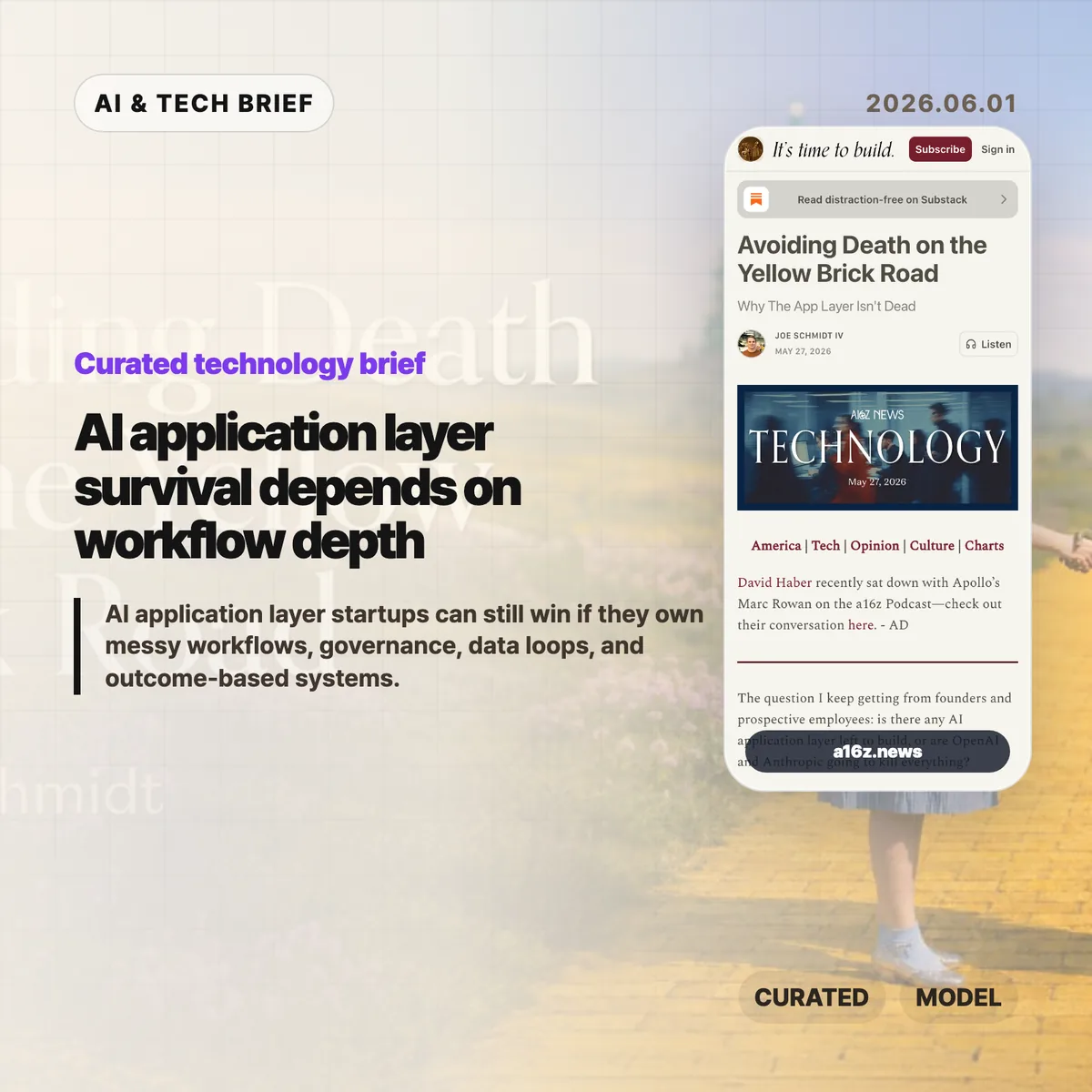
    The AI application layer is not dead, but the easy part of it looks dangerous. Joe Schmidt IV at a16z argues that startups building generic model-plus-connector products are walking straight toward OpenAI and Anthropic, while companies that own messy business workflows still have room to build.

    The short version

    • Horizontal AI tools for coding, writing, image creation, and simple connector workflows benefit directly from better frontier models.
    • The safer AI application layer opportunities sit in vertical workflows where approvals, audits, legacy systems, and domain rules matter.
    • a16z names four practical defenses: data loops, model routing, cost control, and governance.
    • The Hacker News thread was small, but the useful objection was sharp: if the answer is bespoke vertical stacks, the road to broad automation is messier than the hype suggests.

    What happened

    Schmidt frames the current AI startup anxiety as a map. The “Yellow Brick Road” is the path the labs are already walking: strong models, standard connectors such as Google Drive, Slack, Salesforce, Notion, and GitHub, plus an agent orchestration layer. Products in that lane improve when the model improves, so the model owner has better margins, distribution, and pricing power.

    The other side of the map is what he calls the rest of Oz. These are workflows where a model call is only one piece of the product. A sales agent, insurance underwriting tool, legal workflow, finance process, or healthcare operation may need role-specific sub-agents, deterministic software, approvals, audit trails, and integration with old systems that cannot be swapped out casually.

    The argument is also a warning to founders. If a startup is selling a smarter chat interface over the same connectors as everyone else, it may be selling a feature the labs can bundle. If it becomes the system where work is routed, checked, logged, and improved, the AI application layer has a better shot at becoming durable software.

    Why this is worth watching

    The useful part of the piece is its test for depth. A tool that sits on top of a customer system is easier to replace. A system that runs the work, captures the data, and handles governance is harder to pull out.

    AI application layer test for founders

    Schmidt points to four defenses. First, production usage can create data and learning loops that do not exist on the public web. Second, a vertical company can route tasks across multiple model vendors, open-source fine-tunes, and cheaper tiers instead of depending on one lab’s stack. Third, it can tune cost against the level of intelligence each sub-task needs. Fourth, it can become the control plane for permissions, audit logs, and compliance in a specific industry.

    That is also where the claim gets less glamorous. Much of the defensibility sounds like ordinary software work: deployment, edge cases, data cleanup, customer-specific configuration, permissions, and support. For more coverage of this kind of software shift, the IT & AI archive tracks related product and infrastructure stories.

    What Hacker News readers are arguing about

    The Hacker News discussion was tiny, so it should not be treated as a market signal. Still, one comment captured the strongest skeptical read: if the advice is to build bespoke vertical AI stacks, that sounds less like an imminent general-intelligence takeover and more like another generation of custom enterprise software.

    The commenter also raised three practical blockers. Many business processes are fuzzy because they exist to absorb edge cases. Some of the most valuable domains have security or compliance limits that make third-party inference hard to adopt. And if companies need more programmers to rebuild workflows around AI, that complicates the simple story that agents will replace labor by themselves.

    That objection does not kill the a16z thesis. It makes it more grounded. The AI application layer may survive because the hard work is not only model intelligence. It is the boring, expensive work of turning a messy process into software a customer can trust.

    The practical read

    Founders can use this as a quick filter. Count the steps in the workflow. Count the systems touched. Ask who approves the output, what gets logged, and what breaks if the model is wrong. If the answer is mostly “the user can rerun the prompt,” the product is probably on the road where labs have the advantage.

    If the answer involves customer-specific rules, compliance, multiple handoffs, data rights, and measurable business outcomes, the product has a better chance. That does not make it easy. It means the moat is less about having a clever agent demo and more about owning the work surface where the customer actually operates.

    For app builders, the ASO angle is similar: discovery will reward products that can explain a specific job and result, not another generic AI assistant claim. The AI application layer needs narrower promises and deeper execution.

    Sources

  • Dropbox AI strategy gets a CEO reset after 19 years

    Dropbox AI strategy gets a CEO reset after 19 years

    Dropbox AI strategy is moving from founder story to product execution. Drew Houston plans to step down as CEO after 19 years, product chief Ashraf Alkarmi is moving into the top job, and Dropbox Dash now has to prove that the company can be more than a familiar place to store files.

    The short version

    • Drew Houston will shift from Dropbox CEO to executive chairman after a period as co-CEO with Ashraf Alkarmi.
    • Alkarmi, who joined from Vimeo in late 2024, is being promoted from product chief to the eventual sole CEO.
    • Dropbox still has more than 18 million paying users, but revenue has been roughly flat for two years and slipped slightly in 2025.
    • The company’s AI bet is Dash, a search and work-knowledge product that reaches across documents, messages, video, and audio.
    • For more on similar shifts in AI and software, see the IT & AI archive.

    What happened

    CNBC reported that Houston is telling Dropbox staff he will move into an executive chairman role. Alkarmi will first serve alongside him as co-CEO, then take over the CEO job on his own. Dropbox also said Mike Torres, currently a Google Chrome product executive, will join as chief product officer in July.

    The timing is not tied to a single crisis, at least publicly. Houston told CNBC there is “never a perfect time” for this kind of handoff. The more useful read is that Dropbox is putting product leadership at the center of its next phase.

    That matters because Dropbox is no longer selling a novel idea. Cloud storage is bundled into Google, Apple, Amazon, and Microsoft ecosystems. Box still competes in the same business. A standalone subscription has to earn its place every month.

    Why this is worth watching for Dropbox AI strategy

    Dropbox has scale, but scale is not the same thing as momentum. CNBC notes that Dropbox has more than 18 million paying users. Annual revenue passed $1 billion in 2017 and $2 billion four years later, but it has been mostly flat over the past two years. The company’s market cap is a little over $6 billion, below the $10 billion private valuation it reached in 2014.

    The interesting part is that AI has not simply crushed Dropbox. Houston said he has not met customers who are canceling Dropbox because they use ChatGPT. That sounds right. Most companies do not replace file permissions, shared folders, audit trails, and client workflows with a chatbot overnight.

    The pressure is subtler. AI changes what users expect from software they already pay for. A storage product that only stores files feels easier to question. A product that helps teams find the right file, the relevant meeting, the missing approval, and the next action has a better reason to exist.

    Dash is Dropbox’s answer. It is meant to search and work across third-party apps, including documents, messages, video, and audio. If it works, Dropbox AI strategy becomes an enterprise search and work-context story. If it feels like another search box, the company is still stuck defending a mature storage business.

    What the discussion is missing

    There does not appear to be a public Hacker News thread worth treating as a source for this story. The missing debate is still obvious: whether Dropbox can win the work-knowledge layer when Microsoft 365, Google Workspace, Slack, Notion, and every AI assistant vendor want the same surface.

    The useful question is not whether AI will end SaaS. That framing is too broad to help operators. The better question is where the trusted context lives. Dropbox has years of file and sharing behavior, but it does not always own the daily workspace where teams make decisions.

    For app builders, that is the lesson. AI features are easier to ship than new habits. Dash has to fit the way teams already search, share, approve, and reuse work. Otherwise the feature may be technically capable and still feel optional.

    The practical read

    Dropbox AI strategy is now a test of product distribution, not model novelty. Alkarmi has to show that Dash can become a daily workflow, not a demo attached to a storage brand.

    Existing Dropbox customers should watch for three things: how well Dash handles permissions, whether it works across the apps teams already use, and whether it saves enough time to justify another paid seat. Investors will probably watch the same signals through revenue growth, retention, and enterprise adoption.

    The CEO change also says something about older SaaS companies in the AI cycle. They do not need to panic-sell a future where every app disappears. They do need a sharper answer to why their product should remain a system of record when AI tools can sit above many systems at once.

    Sources