Tag: Enterprise AI

  • Meta employee tracking turns AI agent training into a workplace trust test

    Meta employee tracking turns AI agent training into a workplace trust test

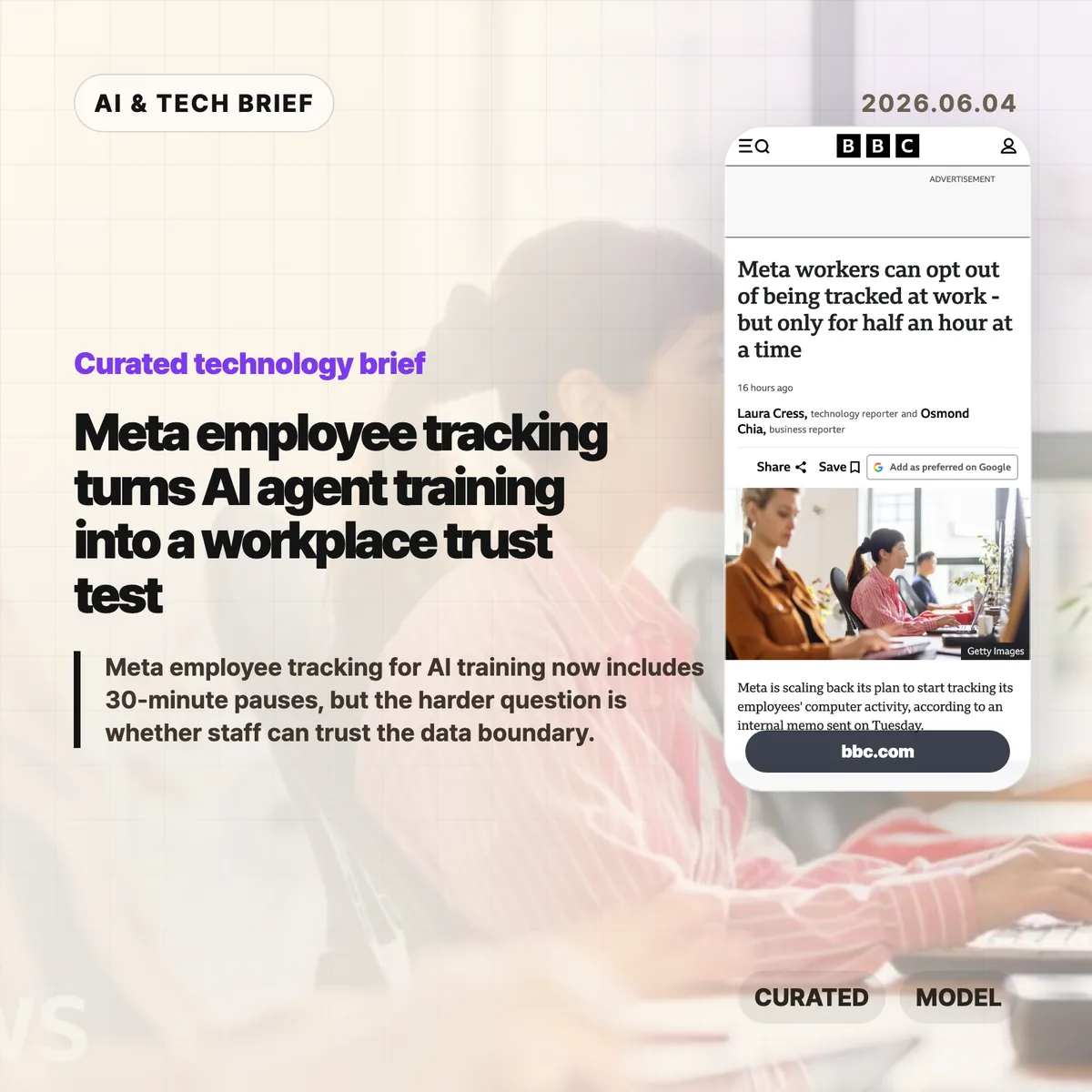
    Meta employee tracking moved from an internal AI training plan into a public workplace privacy fight after the company added limited controls for staff in June 2026. BBC News reported that Meta now lets employees pause collection of clicks and keystrokes for up to 30 minutes at a time, with a separate path to request a full exemption. That narrow opt-out raises the harder question for AI agent teams: how much real workplace behavior can a company collect before model training starts to feel like surveillance?

    The short version

    • Meta’s Model Capability Initiative was designed to collect employees’ keystrokes and mouse clicks so AI models could learn how people use computers at work, according to BBC News.
    • In June 2026, Meta added a pause control that can stop collection for up to 30 minutes at a time, plus a process for full exemptions.
    • BBC News reported that a staff petition against the program drew more than 1,500 signatures, after workers raised concerns about personal data, battery life, and control over capture.
    • Agent builders should treat consent, scope, retention, redaction, and opt-out records as product requirements, not policy cleanup after employees complain.

    What happened

    Meta scaled back part of an internal plan to record employees’ computer activity for AI training in June 2026, according to BBC News, which cited Reuters reporting and an internal memo. The system, called the Model Capability Initiative, was meant to capture examples of how staff use computers so Meta’s models could learn everyday software workflows. Meta had previously told the BBC that agents need real examples if they are going to help people complete tasks on computers.

    The new controls let employees pause collection for “up to 30 minutes at a time” and request an exemption from the initiative. Meta also said the data would not be used for another purpose and that safeguards were in place for sensitive content. Staff were still uneasy. The BBC story says more than 1,500 employees signed a petition, while named and unnamed workers raised concerns about personal data on work devices, battery life, and the feeling that AI was being pushed into daily work without enough trust.

    Why Meta employee tracking is worth watching

    Meta employee tracking is worth watching because it exposes the data trade-off behind computer-using AI agents. A chatbot can learn from documents and conversations. An agent that operates software needs examples of clicking through tools, filling forms, switching windows, correcting errors, and recovering when apps behave oddly. Those traces are closer to how work actually happens, which makes them useful for training and more sensitive than ordinary product analytics.

    For enterprise AI teams, the Meta case turns product design into labor policy. A pause button sounds like user control, but a 30-minute window does not answer who can see pause events, whether managers can infer that someone opted out, how long raw traces are stored, or how personal material on a work machine is filtered before training. Teams building similar systems need to write those boundaries before collection starts, not after employees organize against it. For more IT and AI coverage, see the IT & AI archive.

    What does Meta employee tracking change for agent builders?

    Meta employee tracking gives agent builders a practical warning: workflow data is valuable because it is messy, and that mess includes private context. A clickstream can reveal source code, customer records, HR screens, medical details, private messages, passwords in bad workflows, or simply the rhythm of a person’s day. Even if a company promises to use the data only for model training, employees may hear a second promise that was never made: that the same data will not affect performance reviews, investigations, or future automation decisions.

    Builders of enterprise agents should treat pause, opt-out, redaction, retention, audit logs, and purpose limits as core product requirements. The minimum viable policy is not a banner that says collection is happening. Teams need plain rules for which apps are in scope, which fields are masked, who can inspect raw traces, when data is deleted, and how an employee can challenge a capture. That matters for adoption as much as model quality.

    What Hacker News readers are arguing about

    The Hacker News discussion was overwhelmingly skeptical, with most of the heat aimed at the gap between a 30-minute pause and meaningful control. Several commenters treated the pause button as dark comedy: if employees need privacy for payroll, HR, legal work, or personal material on a work device, half an hour feels arbitrary. A repeated worry was that opt-outs themselves could become a management signal, even if Meta never says that is the purpose.

    The more useful builder argument in the thread was about culture. One commenter noted that modern companies can already use Jira, GitHub, chat logs, and LLM summaries to build a picture of an employee’s work. In that view, the danger is less the existence of telemetry and more whether leadership has earned enough trust to use it narrowly. Other comments were harsher, comparing the policy to surveillance tech being turned inward on the people who build it. It is a discussion, not evidence, but it captures why technical safeguards will not carry a workplace AI program if employees expect the data to be used against them.

    The practical read

    Teams building workplace AI agents should separate three questions before copying Meta’s approach. First, what behavior data is genuinely needed to improve the model? Second, can the same goal be met with synthetic tasks, volunteer sessions, narrow app-specific traces, or redacted recordings instead of broad background collection? Third, what would employees see if they audited the system after the fact?

    The 30-minute pause is a useful reminder that control surfaces can look generous while still feeling weak. A stronger design would make collection visible, narrow, revocable, and auditable. It would also protect the act of opting out, because a privacy control that creates a performance signal is not much of a privacy control. AI agent teams should test their data policy with the same seriousness they give latency, benchmarks, and tool reliability.
    Sources

  • OpenAI on AWS makes Codex a cloud-native enterprise bet

    OpenAI on AWS makes Codex a cloud-native enterprise bet

    OpenAI on AWS became generally available on June 3, 2026, giving Amazon Bedrock customers access to OpenAI frontier models and Codex inside AWS. The launch matters because it moves model access, coding-agent use, IAM, billing, procurement, and governance into one enterprise cloud workflow instead of forcing teams to bolt a separate OpenAI path onto production systems.

    The concrete products are easy to name: AWS lists GPT-5.5 and GPT-5.4 on its OpenAI Bedrock page, while OpenAI says Codex is used by more than 5 million people each week. Codex on Amazon Bedrock runs locally, sends requests to Bedrock, and authenticates with Bedrock API keys or AWS credentials. That makes this less about another model endpoint and more about whether enterprises can make AI coding agents fit their existing cloud controls.

    The short version

    • OpenAI says its frontier models and Codex are generally available on AWS as of June 3, 2026, with support for Commercial and GovCloud regions through the broader AWS path.
    • AWS lists GPT-5.5 and GPT-5.4 among the OpenAI model versions on its Bedrock OpenAI page, alongside open-weight and content-safety models.
    • OpenAI says Codex is used by more than 5 million people every week, and the Bedrock setup lets local Codex clients send model requests to Amazon Bedrock.
    • Codex on Amazon Bedrock uses AWS-native authentication: Bedrock API keys or the AWS SDK credential chain, not ChatGPT sign-in or OPENAI_API_KEY.
    • The limits still matter: Codex’s Bedrock path covers local workflows, while Codex web, cloud tasks, hosted GitHub delegation, Slack and Linear integrations, analytics, and some enterprise governance APIs are not available in this setup.

    For enterprise AI teams, the immediate question is whether AWS-native model access lowers enough friction to justify a pilot. The facts to test are specific: GPT-5.5 or GPT-5.4 availability in the target Region, IAM permission boundaries, Bedrock quota, latency, cost, and which Codex features the team loses when it picks the Bedrock-backed provider.

    What happened

    OpenAI announced that OpenAI on AWS is generally available for enterprises that want to use OpenAI capabilities through AWS instead of building a separate vendor path. The company framed the launch around production readiness: security, compliance, procurement, billing, and governance are often the parts that slow enterprise AI projects after a technical prototype works.

    AWS is presenting the same move as an Amazon Bedrock story. Its OpenAI page says Bedrock now offers frontier models for reasoning, coding, agentic workflows, and complex analysis. AWS lists GPT-5.5 as its most capable OpenAI model for coding, knowledge work, and multi-tool workflows, and GPT-5.4 as the price-performant option for high-volume production workloads.

    For more IT and AI briefings, the IT & AI archive tracks similar platform shifts where model access, cloud procurement, and developer workflows start to merge.

    Why OpenAI on AWS is worth watching

    OpenAI on AWS is worth watching because it moves the buying and operating question closer to the place enterprise teams already control. A model can be impressive in a demo and still fail an internal rollout if legal review, identity, network controls, logging, and billing sit outside the normal cloud process. Bedrock gives AWS customers a familiar path to test OpenAI models while keeping more of that operational work inside AWS.

    That does not make the launch automatic or friction-free. Teams still need to check model availability by region, account permissions, quota, logging requirements, data policy, and cost. The announcement is still important because it reduces one common source of delay: the gap between AI evaluation and the governance process that decides whether a system can touch real work.

    What does OpenAI on AWS change for developers?

    OpenAI on AWS changes the Codex workflow most directly for developers who already work inside AWS-controlled environments. The Codex Bedrock guide says Codex runs locally and sends model requests to Amazon Bedrock. Bedrock then provides an OpenAI-compatible Responses API implementation for supported OpenAI models. That means the OpenAI-hosted Responses API is not in the request path for this provider.

    Authentication also changes. Codex can use a Bedrock API key or the AWS SDK credential chain, including shared credentials, environment variables, AWS SSO profiles, or federated identity through credential_process. Developers do not use ChatGPT sign-in or OPENAI_API_KEY for this setup. In practice, that makes Codex easier to align with enterprise IAM and harder to treat as an unmanaged personal tool.

    The model IDs matter too. OpenAI’s developer guide tells users to select exact model IDs such as openai.gpt-5.5 and openai.gpt-5.4, then confirm the model is available in the configured AWS Region.

    Where the Codex Bedrock path is narrower

    Codex on Amazon Bedrock is a strong fit for local coding workflows, but it is not the full OpenAI-hosted Codex product. OpenAI’s developer guide says the Bedrock configuration supports local Codex workflows and that some features depending on OpenAI-hosted cloud services, hosted tools, or cloud-managed discovery are not currently available.

    The feature table is where buyers should slow down. Codex CLI, IDE extension use, local code review, sandboxing, permission controls, MCP, custom instructions, skills, plugins with limits, and subagents are listed as supported or partially supported. Codex web, Codex cloud tasks, hosted GitHub delegation, Slack and Linear cloud integrations, analytics, compliance APIs, and Codex Security for connected GitHub repositories are listed as unavailable in the Bedrock path.

    That split is not a deal breaker. It is a deployment choice. Teams that want local, credentialed coding assistance under AWS controls may like this path. Teams that need the hosted collaboration layer should check the missing features before standardizing on it.

    What the discussion is missing

    There was no reliable Hacker News thread available for this specific June 3, 2026 announcement at drafting time, so the useful debate has to come from the product details instead of community sentiment. The missing questions are practical: which AWS Regions get GPT-5.5 and GPT-5.4 first, how Bedrock pricing compares with direct OpenAI access, how latency behaves, and how much of Codex’s hosted product teams lose when they use the AWS-backed provider.

    The security story also needs testing. AWS-native credentials make procurement and identity cleaner, but generated code still needs review, test coverage, repository permissions, and a clear policy for what source code can be sent to a model endpoint. Codex on Amazon Bedrock does not use ChatGPT sign-in or OPENAI_API_KEY, but that only solves authentication shape. It does not decide who can approve generated changes, which repositories are allowed, or whether sensitive code should leave a developer machine.

    The practical read

    OpenAI on AWS is most useful for organizations that already run their AI platform review, identity, billing, and audit process through AWS. Those teams should treat the launch as a reason to run a controlled pilot: pick one coding workflow, one model ID, one AWS Region, and one permission boundary. Then measure latency, cost, review quality, and how often developers need unsupported Codex cloud features.

    Developers should start with the boring checks. Confirm Bedrock model access, Region support, IAM permission, and whether Codex is actually using the amazon-bedrock provider. Review generated code as if it came from any other assistant. The cloud wrapper helps with enterprise adoption, but it does not remove the need for tests, threat modeling, and code ownership.

    For app builders and developer-tool teams, the bigger signal is marketplace pressure. If AI coding agents can run through Amazon Bedrock, products that sell to enterprise developers will increasingly need cloud-native deployment paths, not only a standalone API key and a slick demo.

    Sources

  • AI application layer survival depends on workflow depth

    AI application layer survival depends on workflow depth

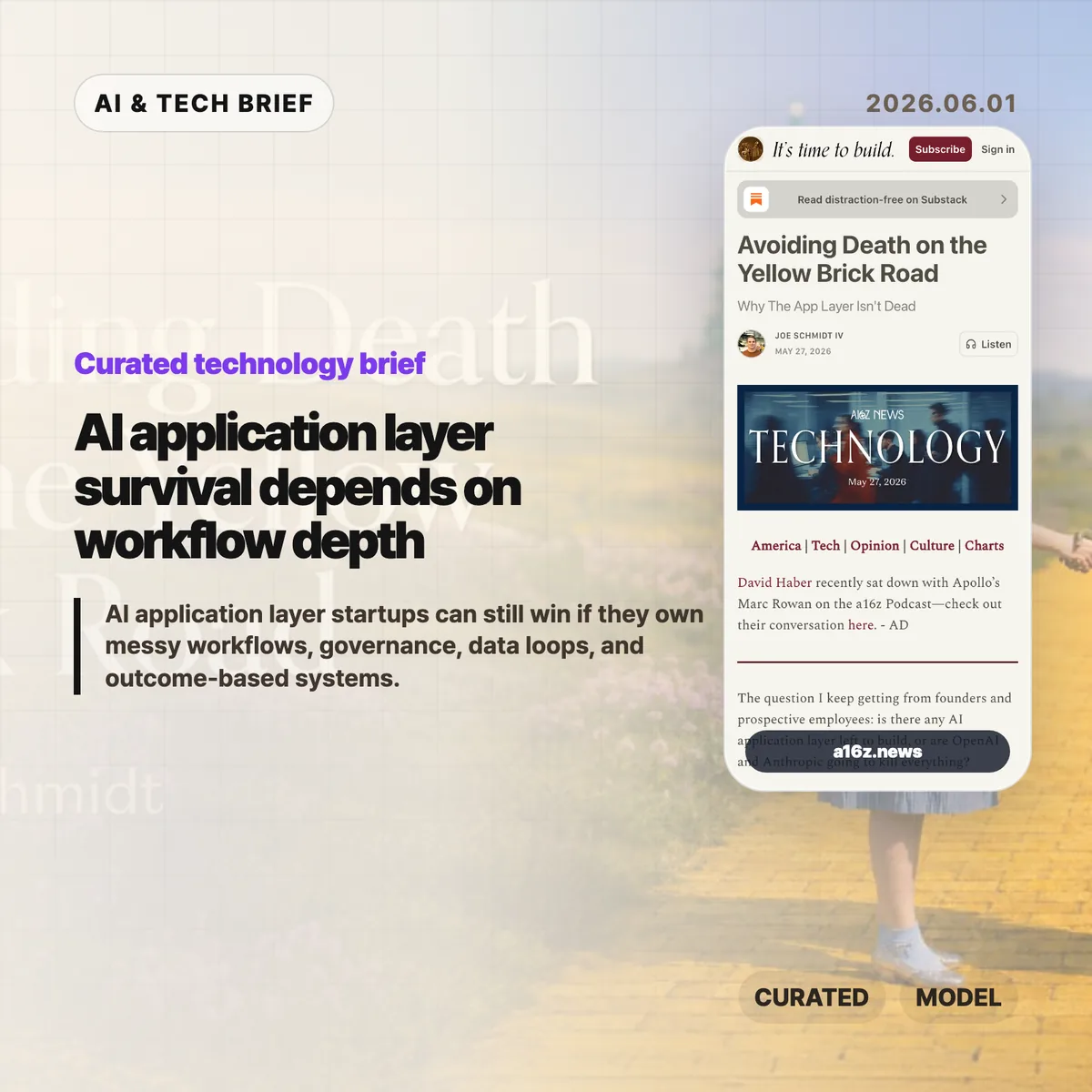
    The AI application layer is not dead, but the easy part of it looks dangerous. Joe Schmidt IV at a16z argues that startups building generic model-plus-connector products are walking straight toward OpenAI and Anthropic, while companies that own messy business workflows still have room to build.

    The short version

    • Horizontal AI tools for coding, writing, image creation, and simple connector workflows benefit directly from better frontier models.
    • The safer AI application layer opportunities sit in vertical workflows where approvals, audits, legacy systems, and domain rules matter.
    • a16z names four practical defenses: data loops, model routing, cost control, and governance.
    • The Hacker News thread was small, but the useful objection was sharp: if the answer is bespoke vertical stacks, the road to broad automation is messier than the hype suggests.

    What happened

    Schmidt frames the current AI startup anxiety as a map. The “Yellow Brick Road” is the path the labs are already walking: strong models, standard connectors such as Google Drive, Slack, Salesforce, Notion, and GitHub, plus an agent orchestration layer. Products in that lane improve when the model improves, so the model owner has better margins, distribution, and pricing power.

    The other side of the map is what he calls the rest of Oz. These are workflows where a model call is only one piece of the product. A sales agent, insurance underwriting tool, legal workflow, finance process, or healthcare operation may need role-specific sub-agents, deterministic software, approvals, audit trails, and integration with old systems that cannot be swapped out casually.

    The argument is also a warning to founders. If a startup is selling a smarter chat interface over the same connectors as everyone else, it may be selling a feature the labs can bundle. If it becomes the system where work is routed, checked, logged, and improved, the AI application layer has a better shot at becoming durable software.

    Why this is worth watching

    The useful part of the piece is its test for depth. A tool that sits on top of a customer system is easier to replace. A system that runs the work, captures the data, and handles governance is harder to pull out.

    AI application layer test for founders

    Schmidt points to four defenses. First, production usage can create data and learning loops that do not exist on the public web. Second, a vertical company can route tasks across multiple model vendors, open-source fine-tunes, and cheaper tiers instead of depending on one lab’s stack. Third, it can tune cost against the level of intelligence each sub-task needs. Fourth, it can become the control plane for permissions, audit logs, and compliance in a specific industry.

    That is also where the claim gets less glamorous. Much of the defensibility sounds like ordinary software work: deployment, edge cases, data cleanup, customer-specific configuration, permissions, and support. For more coverage of this kind of software shift, the IT & AI archive tracks related product and infrastructure stories.

    What Hacker News readers are arguing about

    The Hacker News discussion was tiny, so it should not be treated as a market signal. Still, one comment captured the strongest skeptical read: if the advice is to build bespoke vertical AI stacks, that sounds less like an imminent general-intelligence takeover and more like another generation of custom enterprise software.

    The commenter also raised three practical blockers. Many business processes are fuzzy because they exist to absorb edge cases. Some of the most valuable domains have security or compliance limits that make third-party inference hard to adopt. And if companies need more programmers to rebuild workflows around AI, that complicates the simple story that agents will replace labor by themselves.

    That objection does not kill the a16z thesis. It makes it more grounded. The AI application layer may survive because the hard work is not only model intelligence. It is the boring, expensive work of turning a messy process into software a customer can trust.

    The practical read

    Founders can use this as a quick filter. Count the steps in the workflow. Count the systems touched. Ask who approves the output, what gets logged, and what breaks if the model is wrong. If the answer is mostly “the user can rerun the prompt,” the product is probably on the road where labs have the advantage.

    If the answer involves customer-specific rules, compliance, multiple handoffs, data rights, and measurable business outcomes, the product has a better chance. That does not make it easy. It means the moat is less about having a clever agent demo and more about owning the work surface where the customer actually operates.

    For app builders, the ASO angle is similar: discovery will reward products that can explain a specific job and result, not another generic AI assistant claim. The AI application layer needs narrower promises and deeper execution.

    Sources

  • Mistral AI full stack bet is bigger than models

    Mistral AI full stack bet is bigger than models

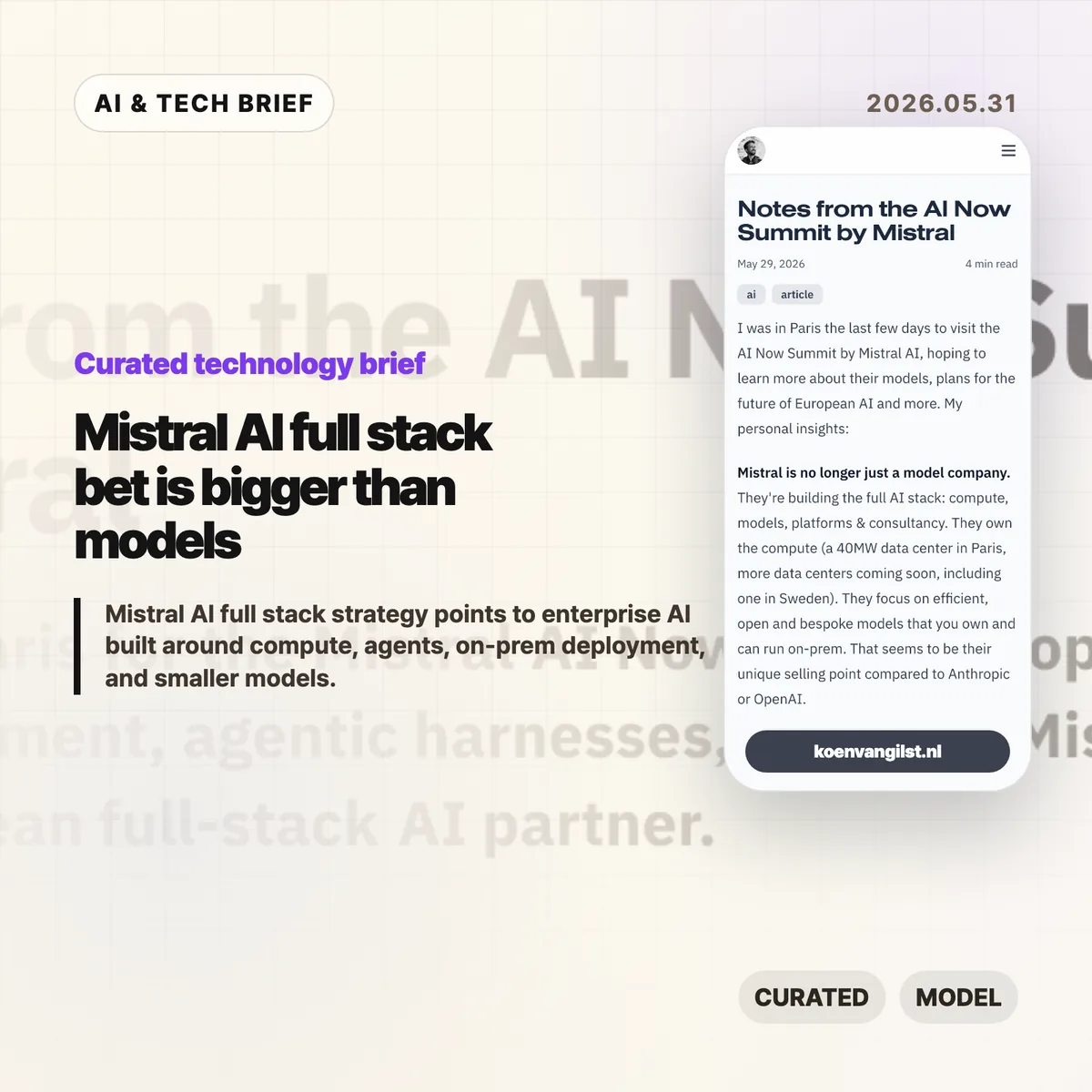
    Mistral AI full stack strategy is becoming the company’s clearest pitch to enterprises: own more of the stack, run closer to the customer, and sell practical AI deployment rather than another benchmark headline. Notes from Mistral’s AI Now Summit in Paris describe a company talking about compute, on-prem deployments, agent harnesses, small models, and industry partnerships more than model release theater.

    The short version

    • Mistral is positioning itself as an enterprise AI supplier with compute, models, platforms, consulting, and deployment help in one package.
    • The summit notes mention a 40MW data center in Paris, more European data center plans, and on-prem use cases at BNP Paribas and Abanca.
    • Vibe is now the company’s unified agent product for work and coding, with Work Mode, Code Mode, a VS Code extension, and subscription tiers starting at $14.99 per month for Pro.
    • The useful debate is whether this enterprise route is a moat or a retreat from frontier model competition.
    • For builders, the Mistral AI full stack story is a reminder that model choice is only one part of shipping reliable AI inside regulated organizations.

    What happened

    Developer Koen van Gilst published notes from Mistral’s AI Now Summit after attending the Paris event. His read was blunt: Mistral did not sound like a pure model lab. It sounded like a European AI partner trying to own compute, models, platforms, customization, and services.

    The post points to several pieces of that plan: a 40MW data center in Paris, more data centers on the way, partnerships with ASML, BNP Paribas, Amazon Alexa+, and the EU Patent Office, plus a clear emphasis on on-prem deployment for customers that cannot casually send sensitive data to a hyperscaler.

    Mistral’s own Vibe announcement fits the same pattern. Vibe now covers long-running work tasks and coding work under one product line. Work Mode can search across enterprise tools, draft documents, analyze structured data, and run scheduled tasks. Code Mode connects to GitHub, runs coding sessions, and can take work through to a pull request. The VS Code extension brings that agent into the editor.

    Why this is worth watching: Mistral AI full stack

    The Mistral AI full stack angle matters because many enterprises do not buy AI the way developers test models on leaderboards. Banks, public agencies, manufacturers, and large European companies care about data location, procurement, support, security review, and who takes responsibility when the system misbehaves.

    That is where Mistral’s pitch is more interesting than another model comparison chart. BNP Paribas reportedly runs Mistral models on-prem for KYC work in Belgium, keeping sensitive data inside the bank. Abanca was described as using agent orchestration for customer information at large scale. Whether those deployments are technically better than the best US or Chinese model APIs is only part of the buying decision.

    This also changes the product lesson for AI builders. A strong model matters, but the surrounding harness often decides whether the product survives contact with real work. Memory, context, connectors, permissions, observability, error recovery, and human review are where many enterprise AI projects either become useful or quietly die.

    There is a simple answer-engine version of this: Mistral AI full stack strategy means Mistral is trying to sell an enterprise AI operating layer, rather than plain model access.

    What Hacker News readers are arguing about

    The Hacker News thread is split between people who want a credible European AI company and people who think Mistral is falling behind where it matters.

    The supportive camp likes the direction. Several commenters argued that on-prem deployment, bespoke models, and a European supplier make sense for banks, government, insurance, and industrial companies. One practical point came up more than once: in regulated European procurement, a trusted vendor with support and implementation help can matter more than the cheapest model API.

    The skeptical camp focused on model quality and cost. Commenters compared Mistral unfavorably with Qwen, DeepSeek, Gemma, and frontier US labs, especially for reasoning and smaller open models. Some saw the summit’s enterprise framing as a sign that Mistral is moving away from hard model competition. Others pushed back, saying enterprise AI is not consumer chatbot competition and that compliance, reliability, and support are where the money is.

    There was also a useful debate about model size. Some commenters want Mistral to build much larger open-weight reasoning models and let the community distill them. Others argued that small, task-focused models are exactly what many business workflows need if cost, latency, and data control matter.

    The thread is a discussion, not evidence. Still, it captures the risk in the strategy: Mistral can build a durable enterprise business without winning every benchmark, but it cannot let the product feel like a sovereignty-branded fallback.

    The practical read

    If you are choosing AI infrastructure for a regulated company, this is a reason to evaluate deployment shape before picking a model. Ask where data sits, who can inspect tool calls, how permissions work, how model updates are handled, and whether the vendor can support custom or on-prem use cases.

    If you are building an AI product, the Vibe launch is worth reading for product shape rather than hype. The interesting part is the bundle: work agent, coding agent, connectors, scheduled tasks, editor extension, cloud sessions, CLI, and permissions. That is a lot of surface area, and it shows where agent products are heading. More coverage like this lives in the IT & AI archive.

    The watch item is whether Mistral can keep its models close enough to the best alternatives while making the full stack easier to buy and safer to run. If the model gap gets too wide, enterprise packaging will look defensive. If the gap stays manageable, the packaging may be the product.

    Sources

  • Enterprise AI agents are where OpenAI and Anthropic may finally get paid

    Enterprise AI agents are where OpenAI and Anthropic may finally get paid

    Enterprise AI agents are starting to look less like a subscription perk and more like a metered workplace bill. Simon Willison argues that OpenAI and Anthropic have found a version of product market fit through coding agents such as Codex and Claude Code, because companies are paying closer to API prices when employees use them heavily. The uncomfortable part is also the point: the bills are high because people are actually using the tools.

    The short version

    • Heavy personal plans can make Codex and Claude Code look cheap compared with API-equivalent token usage.
    • Enterprise AI agents change the business model because companies pay for team usage, contract terms, support, and usage controls.
    • Hacker News readers mostly agreed the usage is real, but argued hard about whether the economics can survive open models, cheaper providers, and missing ROI data.
    • The practical test is no longer whether a coding agent is impressive. It is whether a team can prove the agent is worth the tokens it burns.

    What happened

    Willison compared his own heavy usage of Anthropic Claude Code and OpenAI Codex with what the same token volume would cost at API prices. His estimate came to about $1,199.79 for Anthropic and $980.37 for OpenAI over 30 days, while he paid $200 total for two consumer plans.

    That gap matters because the enterprise side appears to be moving in the opposite direction. Willison points to Anthropic’s shift from broad seat-based expectations toward $20 per seat per month plus API-style usage, and to OpenAI’s Codex rate card, which says April 2026 pricing moved toward API token usage rather than per-message pricing. Anthropic also announced Claude Code for Team and Enterprise plans, with admin controls and higher business limits.

    The claim is not that every AI lab is suddenly healthy. It is narrower: enterprise AI agents give OpenAI and Anthropic a way to charge where the usage actually happens. Coding agents run longer jobs, inspect repositories, rewrite files, execute commands, and loop through fixes. That can consume far more tokens than a chat session.

    Why this is worth watching: enterprise AI agents

    Enterprise AI agents create a cleaner revenue story than consumer chat subscriptions. A consumer pays a flat monthly fee and may use far more inference than the plan costs. A company that rolls an agent into daily engineering work can be billed by usage, seats, support, and contract commitments.

    That also explains why the sales motion looks old-fashioned. Willison scraped job listings and found large chunks of OpenAI and Anthropic hiring tied to enterprise sales, customer support, account management, and forward deployed engineering. The irony is useful. The companies selling automation still need humans to close enterprise contracts, handle security reviews, and keep customers from turning a runaway token bill into a cancellation.

    For app and developer tool builders, the lesson is blunt. If an agent marketplace or coding platform wants durable revenue, discovery is only the start. Teams also need budgets, admin controls, usage reporting, and a way to tell whether the agent saved more money than it spent.

    For more coverage of software teams, AI products, and developer platforms, see the IT & AI archive.

    What Hacker News readers are arguing about

    The Hacker News thread was huge and messy, which fits the topic. The most useful split was between “usage proves demand” and “usage does not prove sustainable economics.”

    The bullish camp treated $200 per user per month as ordinary enterprise software pricing, especially compared with expensive engineering, CAD, cloud, or security tools. Some readers argued that the controversy itself proves the tools have entered real workflows. Nobody complains about a bill for software nobody uses.

    The skeptical camp kept coming back to ROI. Several commenters asked whether companies can show more shipped product, better features, or higher engineering output, instead of more commits and larger token bills. One recurring objection was that a 20% to 40% productivity lift may fail to support the scale of infrastructure spending implied by trillion-dollar valuations.

    A second line of skepticism was commoditization. Readers pointed to cheaper open-weight models, Chinese providers, caching, and alternative inference platforms. Their argument was not that Claude Code or Codex are useless. It was that API-priced usage may be a temporary window if “good enough” models keep getting cheaper.

    There was also a pricing trust issue. Some commenters pushed back on the idea of “$2,000 worth of tokens” as if token list prices were an objective measure of value. That is a fair caution. List price, marginal compute cost, customer value, and investor narrative are four different things.

    The practical read

    Enterprise AI agents are a budget conversation now. If you run engineering, the next step is to avoid both blanket bans and unlimited access. Put them in the same category as cloud spend: useful, measurable, and dangerous when nobody owns the bill.

    Track agent usage by team, task type, and outcome. Watch where agents save review time, test-writing time, migration effort, or support toil. Also watch where they create cleanup work. The argument for enterprise AI agents gets much weaker if the only metric is token volume.

    For OpenAI and Anthropic, the next year is a proof period. They have signs of demand, enterprise contracts, and tools that people use all day. Now they need to show that usage can turn into durable margins before cheaper models and procurement teams squeeze the story.

    Sources