Tag: Hacker News

  • AI productivity should buy back Friday before output

    AI productivity should buy back Friday before output

    AI productivity is usually sold as faster work, cheaper work, or more work. Mike Su asks the more awkward question: if AI can turn a week of white collar output into a much shorter sprint, can workers take Friday off? The post is short and playful, but the argument lands because it goes straight at the missing line in most AI adoption decks: who gets the saved time?

    The short version

    • Mike Su’s “Can we have the day off?” asks whether claimed 10x AI productivity should translate into a four-day workweek for white collar workers.
    • The strongest version of the argument is about distribution, not model capability. If AI agents compress work, employees will ask for time, pay, or both.
    • Hacker News readers turned the joke into a labor debate: some saw a serious bargaining question, while others argued market competition will push companies to demand more output instead.
    • For builders, the product lesson is blunt. AI tools that only promise management more throughput may make employees feel less secure, even when the software is useful.

    AI productivity and the four-day workweek

    Su’s post starts from a familiar claim: AI is supposed to raise white collar productivity by a large multiple. If that premise is true, he asks, why should the gain only appear as more output for the employer?

    The concrete proposal is deliberately simple. People work Monday through Thursday. On Thursday they prepare prompts and tasks. On Friday, AI agents keep working while the humans take the day off. It is partly a joke, but it exposes a real gap in the current workplace conversation.

    Most companies talk about AI productivity as capacity. Ship faster. Write more. Support more customers. Close more tickets. Employees hear a different message: use the same hours to do more, with no guarantee of higher pay, more leave, or better job security.

    That is why the Friday framing works. It turns an abstract productivity claim into a payroll and calendar question.

    What happened

    The original essay, published on May 27, 2026, is a short personal blog post titled “Can we have the day off?” Su writes that if AI can produce the same work in a fraction of the time, then a four-day schedule should be a reasonable ask. He even imagines Friday as an “AI workers’ day,” where agents run while humans are out of the office.

    The post does not present a benchmark or a policy plan. It is closer to a pressure test for the way AI is being marketed inside companies. If executives believe AI can multiply output, employees can reasonably ask whether some of that gain becomes time off.

    That makes the piece useful beyond the joke. For more IT and AI workplace briefs, the IT & AI archive tracks similar shifts in automation, developer tools, and product operations.

    Why this is worth watching

    AI productivity gains are easy to claim and hard to divide. A team can adopt coding assistants, research agents, summarizers, and workflow bots without ever agreeing on what happens to the saved hours.

    That silence creates a management problem. If a company tells employees that AI will make them vastly more productive, but keeps the same schedule and raises the output target, the tool starts to look like surveillance with a nicer interface. If the company offers a share of the gain, through shorter workweeks, better compensation, or fewer low-value tasks, adoption has a better chance of feeling like a deal instead of a threat.

    The four-day workweek is only one possible answer. The larger question is whether AI productivity becomes a worker benefit, an owner benefit, or a mix of both. That question will shape how teams talk about agents, copilots, and automation over the next few years.

    What Hacker News readers are arguing about

    The Hacker News thread was large: more than 1,300 points and hundreds of comments when checked. The first serious thread picked up the post’s main point almost exactly. If employees help introduce AI into their workflows, one commenter argued, they should ask what they get in return: days off, higher pay, or some other concrete share of the gain.

    A second camp was more cynical. They argued that productivity gains usually flow to owners, especially when workers are worried about layoffs. Several comments connected the issue to older automation cycles: computers, software, and the internet made many tasks faster, but the standard workweek did not shrink much for most employees.

    The useful objection in the discussion is competition. Some readers argued that a company offering Fridays off could be outpaced by rivals that use AI to work faster all week. Others pushed back, pointing out that many companies already waste huge amounts of time on busy work, weak coordination, and rework. More hours do not automatically mean more useful output.

    There was also a policy thread. Some readers moved from employer-level bargaining to unions, worker protections, taxes, UBI, and social safety nets. That jump matters because it suggests the four-day workweek may be hard to win company by company if the market rewards whoever turns AI into raw output first.

    Treat the thread as sentiment, not proof. But the sentiment is clear enough: workers are starting to ask whether AI productivity will give them leverage or simply raise the bar.

    The practical read

    If you run a team, do not pitch AI productivity only as acceleration. Say what happens to the saved time. Will it reduce after-hours work? Remove recurring busy work? Change sprint scope? Create a trial four-day schedule after the team proves the workflow? Vague promises will not survive contact with calendars.

    If you build AI tools, this is a product positioning issue. A tool that says “your manager can get 10x more from you” and a tool that says “your team can finish the same work with fewer wasted hours” may have similar features, but they land very differently.

    For employees, the move is to make the bargain explicit. Track which tasks AI actually shortens, how much review work remains, and where quality still depends on humans. Then ask for a share of the gain in terms that can be measured: time off, compensation, narrower scope, or fewer low-value meetings.

    AI productivity will not automatically create a shorter workweek. Someone has to ask for it, price it, and design the workflow around it.
    Sources

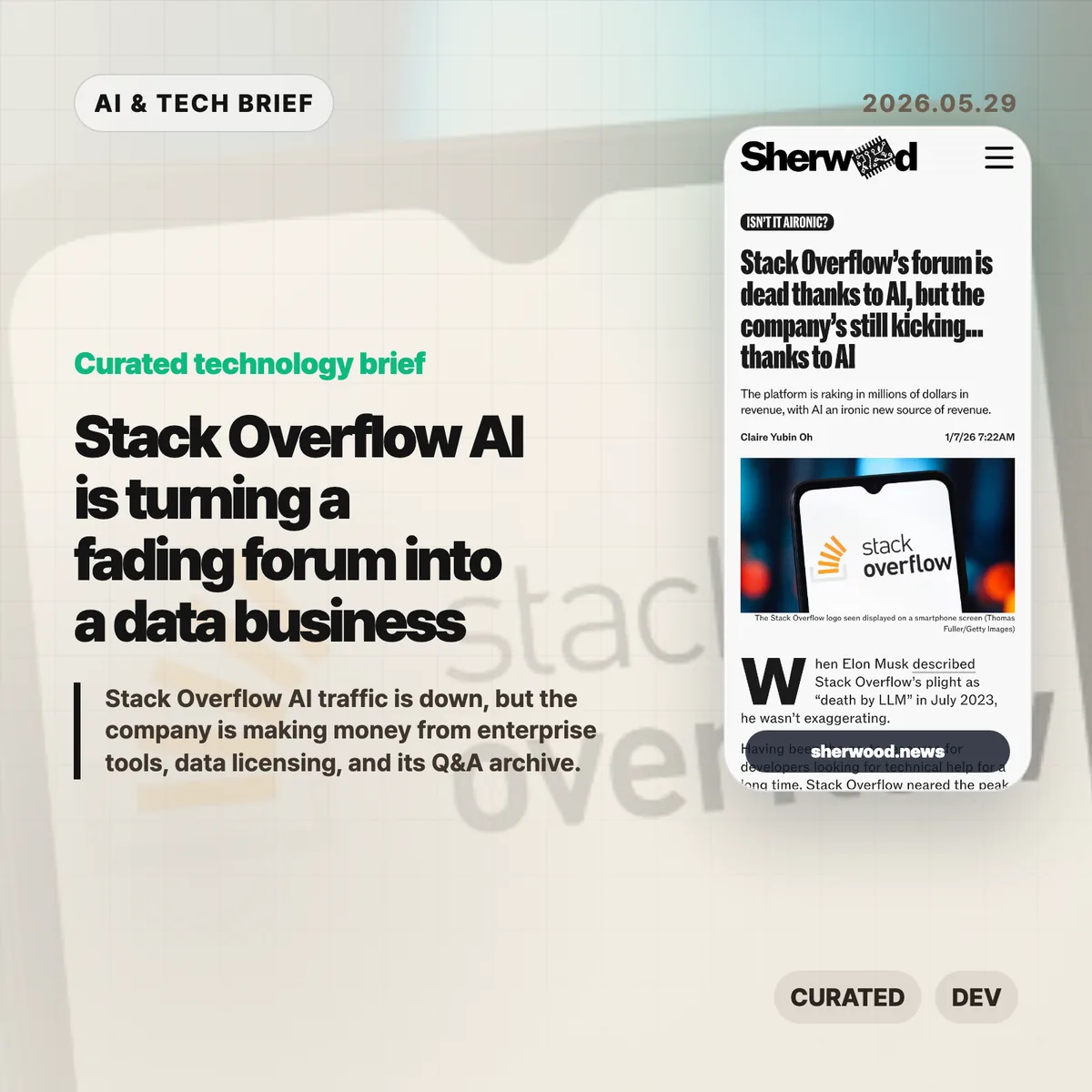
  • Stack Overflow AI is turning a fading forum into a data business

    Stack Overflow AI is turning a fading forum into a data business

    Stack Overflow AI is a strange story: the public forum is quieter, but the company is not dead. Sherwood reports that Stack Overflow recorded only 6,866 questions last month, while annual revenue has roughly doubled to about $115 million as the business leans on enterprise products and data licensing.

    The short version

    • Stack Overflow’s question volume has fallen close to its 2008 launch-era level, according to Sherwood’s report.
    • The company is still generating about $115 million in annual revenue, with losses down from $84 million in FY2023 to about $22 million in the latest fiscal year.
    • The business has moved toward enterprise tools such as Stack Internal and licensing its developer Q&A archive to AI companies.
    • The uncomfortable part is the loop: AI systems learned from public developer knowledge, but their chat interfaces now keep many new answers out of the public web.

    What happened

    Sherwood’s piece frames Stack Overflow as one of the clearest examples of AI changing developer behavior. Developers who once searched, drafted a question, waited for replies, and left a searchable trail now ask ChatGPT, Claude, Cursor, Gemini, or Copilot first.

    That hurts the forum. A month with 6,866 questions is not a healthy signal for a site that became the default place to solve programming problems. It also changes how new software knowledge gets written down. A private answer in a chat window may solve one person’s bug, but it does not help the next person who hits the same error message.

    The company story is different. Sherwood says Stack Overflow has cut losses and shifted revenue away from forum advertising. Its enterprise product Stack Internal packages company knowledge with a Q&A-style workflow, and Stack Overflow also licenses its data to AI companies that need high quality coding examples and human-curated answers.

    Why this is worth watching

    Stack Overflow AI matters because it shows how a community can lose activity while its archive becomes more valuable. That is not a clean win. It is closer to a salvage model: the old community created a data asset, and the company is now finding buyers for that asset while the public habit that refreshed it weakens.

    Stack Overflow AI and the open-web loop

    For builders, the lesson is blunt. Traffic is not the only asset a technical community creates. Clean answers, reputation signals, accepted solutions, comments, duplicates, and edits all become structured knowledge. That kind of material is useful for retrieval systems, coding assistants, internal copilots, and model evaluation.

    The risk is decay. If fewer developers ask and answer in public, the archive gets older. Libraries change. APIs move. Frameworks break old advice. The AI tools that made the forum less necessary still need fresh, checked, human-written material to stay useful. That loop should worry anyone building on top of public web knowledge.

    This is also why developer tool companies should watch the business model, not only the traffic chart. A product that looks weaker as a destination can still become infrastructure. For more coverage of AI and developer platforms, see the IT & AI archive.

    What Hacker News readers are arguing about

    There is not much of an argument yet. The Hacker News submission exists, but the thread had only 3 points and no comments when checked. That absence is useful in its own way: the story is more developed in the source reporting than in the public discussion around it.

    If a real thread forms later, the useful debate will probably center on three questions. First, whether Stack Overflow’s decline is mostly AI substitution or partly the result of old moderation and onboarding problems. Second, whether licensing community-written answers to AI companies is fair to the people who created the archive. Third, whether private coding assistants are quietly starving the open web of fresh troubleshooting records.

    Those are not abstract complaints. They affect how future developers discover answers, how communities reward contributors, and how AI vendors get the next round of reliable programming data.

    The practical read

    If you run a developer community, Stack Overflow AI is a warning against treating posts as disposable traffic. The durable asset is the knowledge graph around the answers: who corrected what, which answer survived scrutiny, which question was a duplicate, and which explanation still works after a few release cycles.

    If you build AI coding tools, this story is a reminder that source quality matters. A model that answers from stale examples can save time today and create worse bugs tomorrow. Product teams should test answers against current docs, not only old public threads.

    If you are a developer, the practical habit is simple. Use the assistant, but publish the hard-won fix when the answer took real work. A short issue comment, a docs PR, or a public Q&A answer keeps the next person from solving the same problem alone.

    Sources

  • Claude Opus 4.8 is a quieter bet on AI coding teamwork

    Claude Opus 4.8 is a quieter bet on AI coding teamwork

    Claude Opus 4.8 is Anthropic’s latest Opus model, and the more interesting part is not a single benchmark jump. The release points to a different priority for AI coding tools: fewer unsupported claims, larger Claude Code jobs, clearer cost controls, and API behavior that fits long-running agent work.

    The short version

    • Anthropic says Claude Opus 4.8 improves coding, agentic tasks, reasoning, and professional work while keeping regular Opus 4.7 pricing at $5 per million input tokens and $25 per million output tokens.
    • The company says Opus 4.8 is around four times less likely than Opus 4.7 to let flaws in its own code pass without comment.
    • Claude Code is getting dynamic workflows, a research preview feature that can plan large jobs, run hundreds of parallel subagents, verify outputs, and report back.
    • Effort control lets users trade speed and rate-limit usage against deeper reasoning, while fast mode now runs at 2.5x speed and costs less than before.
    • The Hacker News thread reads less like a celebration and more like a stress test: many readers see a modest update, but builders are watching the workflow changes.

    What happened

    Anthropic introduced Claude Opus 4.8 as an upgrade to Opus 4.7, available now through claude.ai, Claude Code, and the Claude API. The company frames the model as stronger across coding, agentic skills, reasoning, and professional work, but it also says users should expect a “modest but tangible” step over the prior version.

    The regular API price stays the same: $5 per million input tokens and $25 per million output tokens. Fast mode is priced at $10 per million input tokens and $50 per million output tokens. Anthropic says fast mode can work at 2.5x the speed and is now three times cheaper than it was for earlier models.

    The release also changes the product around the model. Claude Code gets dynamic workflows for very large codebase tasks. claude.ai and Cowork get effort control. The Messages API now accepts system entries inside the messages array, so developers can update instructions during a task without breaking prompt caching or disguising the change as a user message.

    Why this is worth watching

    The useful signal in Claude Opus 4.8 is that Anthropic is optimizing around collaboration, not only raw answer quality. That matters because AI coding failures often come from confidence at the wrong moment: the model says a migration is done, misses a test failure, or keeps moving after the plan has gone stale.

    Anthropic’s honesty claim is therefore worth watching, even if the phrase sounds a little odd in a model release. If Opus 4.8 really flags uncertainty more often and catches more of its own code defects, teams may be able to give Claude Code larger chunks of work without turning every run into a manual audit.

    The product changes point in the same direction. Dynamic workflows are available in Claude Code for Enterprise, Team, and Max plans. The feature lets Claude plan a large task, split it across many subagents, and check the work before returning it. For readers who track AI tooling beyond this single release, the broader IT & AI archive is a useful place to follow how model updates are turning into workflow products.

    Claude Opus 4.8 in practice

    For developers, Claude Opus 4.8 is less about replacing the current coding stack and more about changing where the model sits in the process. Autocomplete lives inside a narrow edit loop. Claude Code’s dynamic workflows move the model closer to project manager, migration assistant, and reviewer.

    That shift creates a harder evaluation problem. A model that writes one function can be judged by tests and review. A model that runs a multi-step migration across hundreds of thousands of lines needs better guardrails: scoped permissions, clear rollback points, test gates, logging, and a human who knows when to stop the run.

    Effort control also matters here. Low effort is the right default for routine answers. Higher effort makes more sense when the model is planning, touching many files, or making decisions that cost money if they are wrong. The control is not glamorous, but it is the kind of product detail teams need before they trust AI agents with bigger jobs.

    What Hacker News readers are arguing about

    The Hacker News discussion is skeptical, but not in a simple anti-AI way. The most common reaction is that Claude Opus 4.8 feels incremental. Several commenters point to Anthropic’s own “modest but tangible” phrasing and argue that benchmark tables no longer tell them much because many public evals feel saturated.

    A second thread is about language. Anthropic’s emphasis on model “honesty” annoyed some readers, who felt the company talks about models as if they were organisms being observed in the wild. That led to a more technical argument about whether models are “grown” or “built,” and how much researchers can really explain about why a trained model behaves the way it does.

    The builder-side reading is more practical. Same regular price, cheaper fast mode, effort control, and dynamic workflows are the pieces people can actually use. The useful objection is that bigger agentic runs raise the cost of a bad assumption. If Claude can run hundreds of subagents, the test suite, permission model, and review process become part of the product, not afterthoughts.

    The practical read

    If you already use Claude for coding, Claude Opus 4.8 is worth testing on the tasks where earlier models were annoying rather than impossible: long refactors, migration planning, bug hunts, and code review loops where the model had to admit uncertainty. Do not judge it only on one-shot prompts.

    For teams, the first test should be operational. Compare Opus 4.8 against Opus 4.7 on the same repository, with the same tests, the same token budget, and the same review checklist. Track where it stops, where it asks for clarification, and where it claims success too early.

    For product builders, the release says something broader about AI tool competition. The next useful layer may be less about a smarter chat box and more about controls around the model: effort settings, fast modes, mid-task instruction updates, subagent orchestration, and honest failure reporting. Claude Opus 4.8 is a good release to study if your product depends on developers trusting an agent for work that lasts longer than a single prompt.

    Sources

  • Local AI coding costs are starting to pressure frontier labs

    Local AI coding costs are starting to pressure frontier labs

    Local AI coding costs are becoming a real budget line for teams that run coding agents all day. A SignalBloom essay argues that cheap open-source models, local inference, and lower-cost engineering labor could put a ceiling on what frontier labs can charge for routine software work. The claim is a little aggressive, but the cost pressure is not imaginary.

    The short version

    • The essay compares frontier-model API economics with much cheaper open-source model usage, using a roughly 30x token-cost gap as the headline example.
    • Coding agents burn tokens differently from chatbots: they read files, retry commands, inspect logs, and loop through implementation work.
    • The strongest case for local AI is not replacing every frontier model call. It is routing boring, repeatable coding tasks to cheaper systems.
    • The hard part is quality control. Architecture, product judgment, security review, and long-context debugging still need stronger models or stronger humans.
    • For more coverage of AI tools and software economics, see the IT & AI archive.

    What happened

    SignalBloom published an argument that outsourcing plus LocalAI-style setups may soon look more economical than relying on frontier AI labs for a large share of coding work. The piece frames the issue around price: if frontier model calls keep getting more expensive while open-source models keep improving, teams that run many coding-agent loops will start looking for cheaper routing strategies.

    The article cites a large gap between high-end commercial model pricing and DeepSeek-style open model costs, with the headline comparison landing around 30x in favor of the cheaper option. Treat that number as a directional example, not a permanent price table. Model pricing changes quickly, and a token price alone does not include hardware, orchestration, monitoring, review time, or failed attempts.

    Still, the basic point is useful. AI coding agents are not one-shot assistants. They may scan a repository, write code, run tests, read the failure, try again, and repeat the loop. That makes local AI coding costs more important than they looked when teams were only comparing chat subscriptions.

    Why this is worth watching

    The interesting shift is in routing. A team does not have to choose one model for everything. It can use a frontier model for planning, ambiguous debugging, security-sensitive review, or architecture. It can then hand well-scoped implementation chores to cheaper open-source models or local inference when the task is narrow enough.

    That is why this story matters for developer-tool companies. Heavy users are already different from casual users. A founder asking a chatbot for a landing-page tweak is not the same customer as a team running ten agents across a monorepo. Once agents become part of the workflow, inference starts to look like cloud spend. You need budgets, limits, queues, caches, and a reason for every expensive call.

    The catch is that cheap does not mean free. Local inference brings hardware costs, model-serving work, evaluation, prompt routing, and review burden. Outsourced engineering also adds coordination cost. If the cheaper system produces work that a senior engineer must constantly unwind, the apparent savings vanish fast.

    What Hacker News readers are arguing about

    The Hacker News thread is more useful than the headline because it pushes on the economics from several angles. One camp buys the basic pressure story: open-source models only need to become good enough for day-to-day software tasks to take revenue away from frontier labs. Several commenters imagined hybrid workflows where a strong model handles planning while cheaper models handle the token-heavy implementation loop.

    The main objection is marginal cost. Some readers argued that AI is not like older software, where serving one more user can feel close to free. Inference uses expensive hardware, and the cost curve becomes stepwise: if existing capacity is full, the next user may require another server. That makes price competition more complicated than a simple SaaS comparison.

    A second thread focused on energy, chips, and geography. Some commenters thought lower energy costs and more efficient inference infrastructure could favor Chinese labs or local deployment. Others pushed back, noting that training expertise, capital allocation, chip constraints, and regulatory friction still matter.

    The practical signal from the discussion is that nobody should model this as a clean replacement story. The believable version is a mixed stack: frontier models where quality pays for itself, cheaper local models where repetition dominates, and humans watching the seams.

    The practical read on local AI coding costs

    If you run a small team, the move is not to rip out frontier models. Start by measuring where the tokens go. Coding-agent usage often hides the expensive part in repository reads, failed runs, and repeated edits. Once you know that, you can test cheaper models on bounded tasks: test generation, mechanical refactors, migration scripts, documentation updates, and first-pass bug fixes.

    Keep the evaluation boring. Compare accepted pull requests, reviewer time, rollback rate, failed test loops, and security findings. If a local model saves 80% on inference but doubles review time, it did not save money. If it handles repetitive changes while the frontier model handles planning, it may be worth keeping.

    The bigger lesson is that local AI coding costs will become a product-design constraint. Coding-assistant vendors, agent platforms, and internal tooling teams need pricing that survives power users. The winning stack may be less glamorous than the model leaderboard: good routing, clear budgets, strong review, and enough taste to know when the cheap path is getting expensive.

    Sources

  • React Doctor wants to audit the React code AI agents leave behind

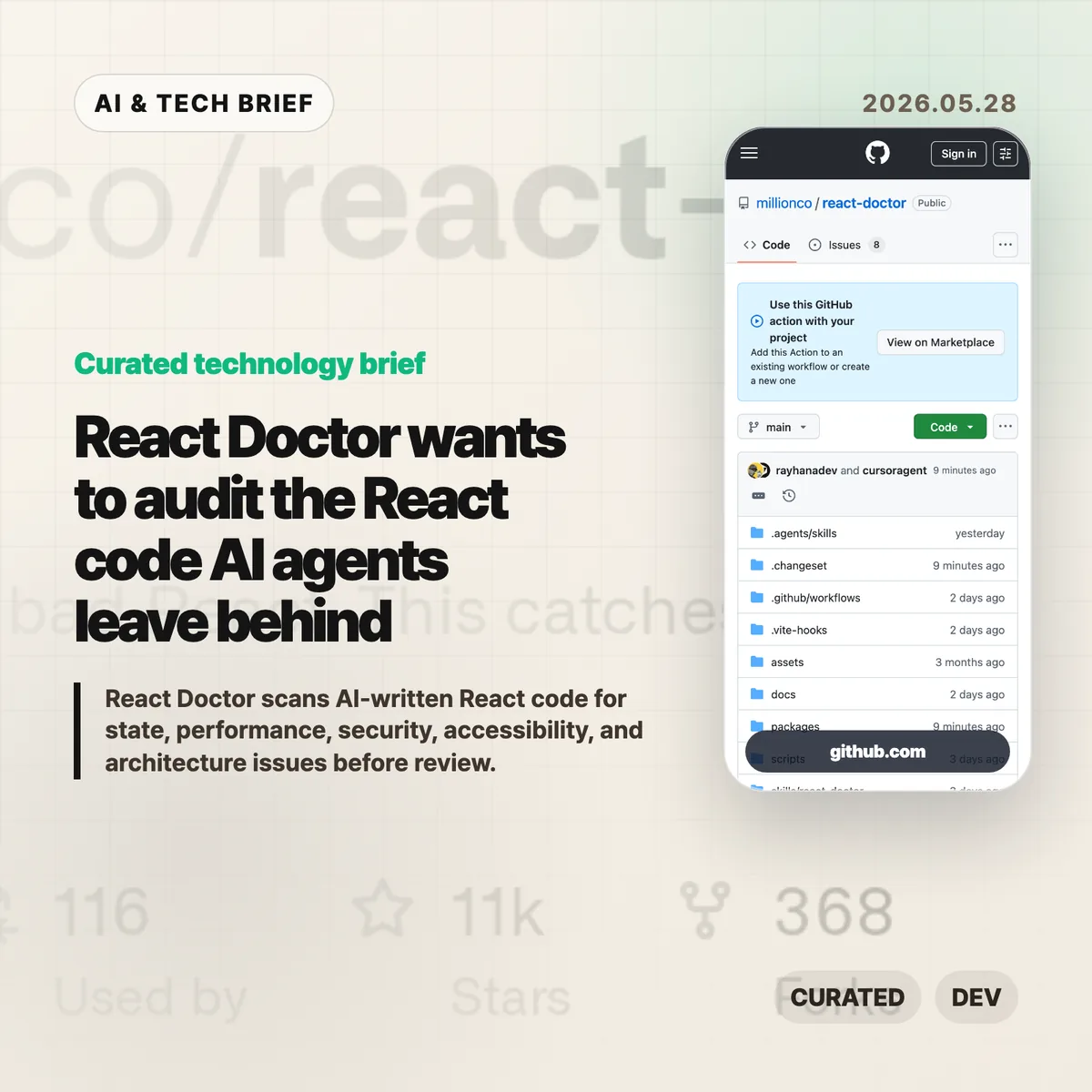
    React Doctor wants to audit the React code AI agents leave behind

    React Doctor is an open source scanner for React projects that are getting more code from AI agents than humans can comfortably review line by line. It runs from the command line, reports issues across state, effects, performance, architecture, security, and accessibility, and can be wired into GitHub Actions for pull request feedback.

    The short version

    • React Doctor is published by Million.co under an MIT license and lives at millionco/react-doctor on GitHub.
    • The quick start is npx react-doctor@latest, which runs an audit from a project root without a long setup step.
    • Its pitch is narrower than a general linter: catch React-specific trouble that may slip through when agents generate code quickly.
    • The tool supports agent setup, GitHub Actions annotations, and diff-focused scanning for pull requests.
    • Treat it as a second reviewer, not a verdict machine. Static analysis can point at suspicious code, but a team still has to decide what matters.

    What happened

    Million.co has released React Doctor, a static analysis tool with the blunt tagline: “Your agent writes bad React, this catches it.” The README says it scans React codebases for issues across state and effects, performance, architecture, security, and accessibility. It also says the tool works across common React environments, including Next.js, Vite, TanStack, React Native, and Expo.

    The basic command is intentionally small: npx react-doctor@latest. After an audit, teams can run npx react-doctor@latest install to set up agent-facing guidance for tools such as Claude Code, Cursor, Codex, and OpenCode. There is also a GitHub Marketplace action for pull request annotations and comments.

    The repository was created in February 2026 and, when checked on May 28, showed more than 11,000 GitHub stars, hundreds of forks, and an MIT license. Those numbers can move quickly, but they are enough to show that this is not a quiet side note in the React tooling world.

    Why this is worth watching

    React Doctor lands in a gap that many frontend teams are starting to feel. AI coding tools can generate components, hooks, and refactors fast. The slow part is figuring out whether the result quietly introduced a stale effect dependency, an accessibility miss, a performance trap, or an unsafe pattern that only shows up later.

    Existing linters already catch plenty of mistakes. The interesting part here is the packaging: React Doctor talks like an audit tool for agent output, not a hand tuned rule set that a team spends a week configuring. That framing matters. If agents are going to submit more pull requests, teams will want cheap automated friction before a human reviewer spends attention.

    For readers tracking developer tools, the IT & AI archive has more coverage of how coding agents are changing the review loop. React Doctor fits that same pattern: code generation is becoming normal, so code acceptance needs better guardrails.

    React Doctor in practice

    The first useful test is simple. Run React Doctor on a real project and read the false positives before wiring it into CI. A scanner that finds every possible smell can still waste a reviewer’s time if the signal is too noisy.

    The safer rollout is report-only mode on a few pull requests, then diff scanning for changed files once the team understands the output. The GitHub Action is the obvious place to start because reviewers already live inside pull requests. If the tool catches repeated issues, move those categories into a stronger policy. If a category is mostly noise, keep it as advisory or turn it off if the tool allows that path.

    This is especially relevant for teams using agents to touch React Native, Expo, or Next.js code. Those stacks have enough framework-specific behavior that a generic code review checklist often misses practical UI bugs.

    What Hacker News readers are arguing about

    There is a Hacker News submission for React Doctor, but it had no comments when checked through the public HN APIs. That means there is no real thread to summarize yet.

    The absence of debate is its own small warning. React developers should judge the tool on runs against production code, not on launch-day voting. The questions worth asking are concrete: How many findings are actionable? Does it duplicate ESLint, TypeScript, or existing React rules? Can it explain issues well enough for a junior developer or an agent to fix them safely?

    The practical read

    React Doctor is worth a trial if AI coding tools are already producing React changes in your repo. Start with npx react-doctor@latest on a branch, save the report, and compare the findings with issues your team has actually seen in reviews.

    Do not make it a required CI gate on day one. Put it beside ESLint and TypeScript first. If React Doctor repeatedly catches issues that your current checks miss, then promote the narrow categories that proved useful. That is the boring path, but it is also how static analysis becomes part of a workflow instead of another dashboard nobody trusts.

    Sources

  • AI generated answers are making online work feel fake

    AI generated answers are making online work feel fake

    AI generated answers have created a strange new failure mode: you ask a person a question, and the person sends back machine-written text they may not have read. A short Orchid Files post captured that irritation through three small scenes: a malware-reporting problem on GitHub, a bad ChatGPT screenshot at work, and a Reddit exchange that turned out to be an AI agent.

    The short version

    • Orchid Files argues that the worst part of AI generated answers is not the model being wrong. It is the human handoff without judgment.
    • The GitHub malware example matters because security reports need context, ownership, and a clear path to action.
    • The workplace example is more familiar: a coworker forwards a ChatGPT screenshot instead of answering the actual question.
    • The Hacker News discussion turned into a broader argument about online trust, fake productivity, and whether human contact is getting rarer.
    • For more coverage of AI and developer culture, see the IT & AI archive.

    What happened

    Orchid Files published “I’m tired of talking to AI” on May 22, 2026. The post is brief, but it lands because the examples are painfully ordinary.

    The author says they found GitHub repositories spreading malware and asked an AI system what to do. The answer was not useful. They then opened a GitHub discussion, only to receive a reply that matched the earlier AI answer. After they called it out, the comment disappeared, and another person posted essentially the same AI-generated response.

    A second example came from work. The author asked a business owner a question about a task. Instead of answering, the person sent a ChatGPT screenshot. When the author said the response did not answer the question and was wrong, another screenshot arrived almost immediately. The problem was not that ChatGPT existed. The problem was that the human in the loop seemed absent.

    The last example came from Reddit. After several messages, the author realized the other side of the conversation was an AI agent. That is the line the post keeps circling: people want to talk to real people, but even real people increasingly route the conversation through AI.

    Why this is worth watching

    The post is useful because it moves AI fatigue away from the usual benchmark debate. The issue is not whether a model can produce a plausible answer. The issue is whether the person sending that answer understands it, agrees with it, and will stand behind it.

    That distinction matters for developer teams. A generated response to a malware report, dependency question, or product requirement can sound polished while skipping the part that actually matters: who checked the facts, who owns the next step, and what context the answer depends on.

    It also matters for AI product design. If a tool makes it easier to paste generated text into another person’s workflow, it should also make review and accountability harder to fake. Agent builders, support software teams, and workplace AI vendors should treat that as a product requirement, not a nice extra.

    why AI generated answers feel different

    AI generated answers feel different because they shift work onto the receiver. A normal bad answer can be challenged directly: the person misunderstood, missed context, or disagreed. A generated answer adds another layer. Now the receiver has to ask whether the sender read it, whether the model invented something, and whether anyone owns the claim.

    That is why a screenshot can feel ruder than a short human reply. The screenshot says, in effect, “the machine said this,” while leaving the other person to do the checking. In low-stakes conversations, that is annoying. In security, hiring, customer support, or product planning, it can become expensive.

    What Hacker News readers are arguing about

    The Hacker News thread was large and messy, with more than 900 comments at the time it was indexed. The useful split was not pro-AI versus anti-AI. It was closer to this: some readers saw the post as evidence that people are outsourcing thought, while others argued that low-quality online content existed long before chatbots.

    One recurring argument was that “thinking” may become more valuable, not less, because cheap generated text makes real judgment easier to spot. The skeptical version of that point was harsher: many workplaces already rewarded simulated work, and AI just made the simulation faster.

    Another thread focused on detection. Several commenters pushed back on AI-content detector statistics, arguing that detectors produce false positives and often punish style markers rather than authorship. The more practical objection was that detection may be the wrong goal. If generated text can impersonate human communication cheaply, the social problem remains even when detection is unreliable.

    There was also a builder/operator angle. Some readers were less upset about AI as a drafting tool than about unreviewed AI in business workflows. A generated note in a private draft is one thing. A generated answer sent as if it were a person’s judgment is another.

    The mood was mostly weary, with a streak of gallows humor. People joked about needing to go offline, but the serious worry was trust: once every message might be machine-shaped, even real human messages start to feel suspect.

    The practical read

    Teams do not need a dramatic AI policy to handle this. They need a small norm: if you send an AI-assisted answer, you own it.

    That means reading it before forwarding it, cutting anything you cannot verify, and adding your own judgment in plain language. If you are unsure, say what is uncertain instead of hiding behind a generated paragraph. For technical work, link to the source, issue, documentation, or log that supports the answer.

    For product teams building AI assistants, the lesson is just as concrete. The best workflow is not the one that produces the most fluent text. It is the one that makes the human review step visible enough that the recipient can trust the answer.

    Sources

  • YouTube AI labels are moving into the video itself

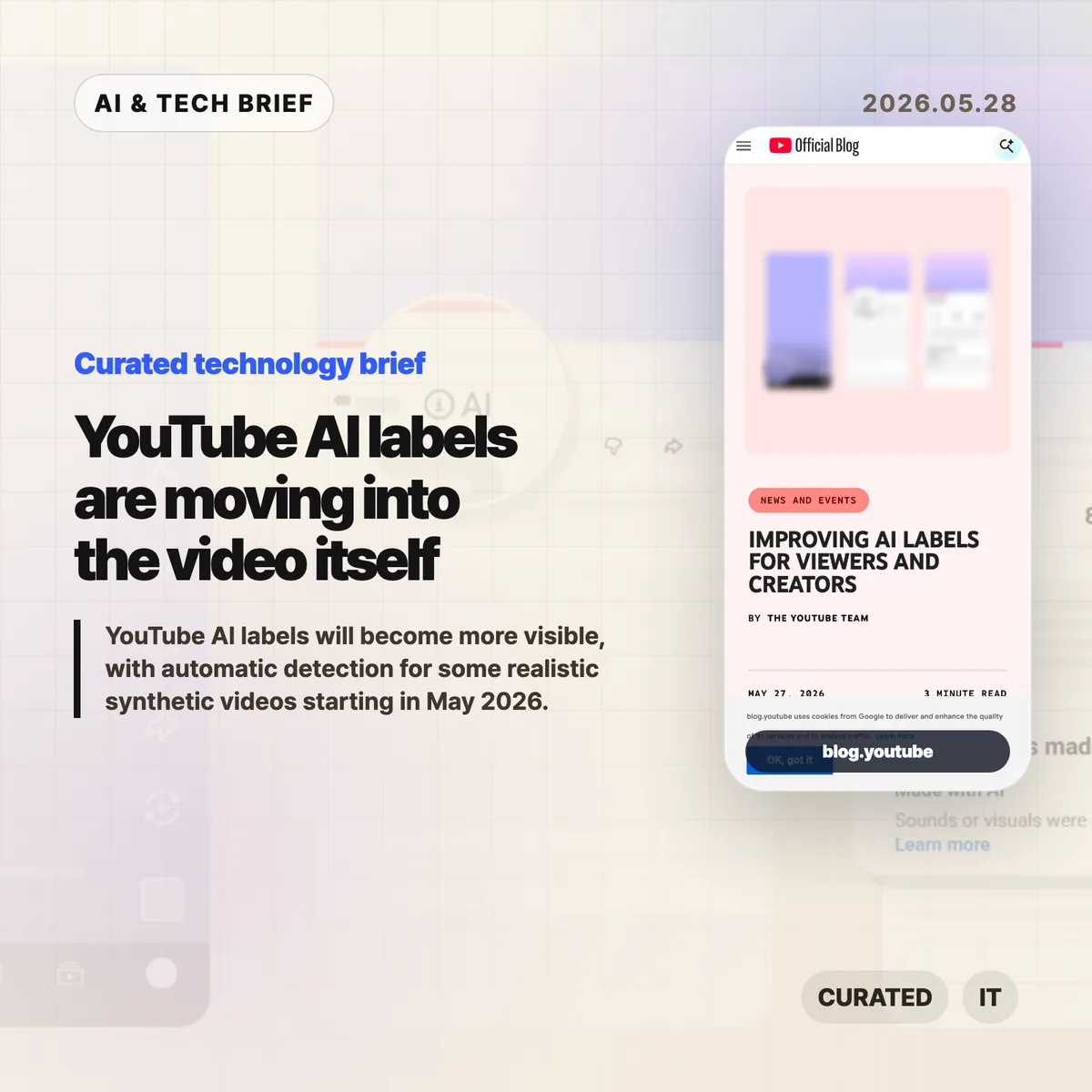
    YouTube AI labels are moving into the video itself

    YouTube AI labels are getting harder to miss. Starting in May 2026, YouTube says it will automatically apply a label when its systems detect significant photorealistic AI use and the creator has not disclosed it. The change matters because synthetic video disclosure is moving from the description box into the viewing experience.

    The short version

    • YouTube will place labels for photorealistic or meaningfully AI-altered videos directly below long-form videos and as overlays on Shorts.
    • Creators still have to disclose realistic AI use during upload, but YouTube will add internal detection signals in May 2026.
    • If YouTube applies a label by mistake, creators can update the disclosure status in YouTube Studio.
    • Labels will stay permanent for content made with YouTube’s own AI tools, including Veo and Dream Screen, or for fully generative AI content carrying C2PA metadata.
    • YouTube says the label by itself does not change recommendations or monetization eligibility.

    What happened

    YouTube announced two changes to how it handles AI disclosure on May 27, 2026. The first is placement. For long-form videos, the disclosure label for photorealistic or meaningfully AI-altered content will appear below the player and above the description. For Shorts, the label will sit on the video as an overlay.

    The second change is automatic detection. YouTube will keep asking creators to disclose realistic AI use, but it will also use internal signals to identify significant photorealistic AI content. If a creator leaves the disclosure blank and YouTube’s systems detect that kind of AI use, the platform can apply the label itself.

    There are limits. YouTube says unrealistic, animated, or lightly altered content can still keep its disclosure in the expanded description. It also says creators can correct a mistaken label in YouTube Studio, except in cases tied to YouTube’s own generative tools or C2PA metadata that marks the content as fully generative.

    Why this is worth watching

    The useful part of this update is the placement. A buried disclosure is easy to miss, especially on mobile, where people often watch before they read anything around the video. A label near the player or on a Short changes the timing. Viewers see the context while they are deciding whether to trust the clip.

    That matters for health advice, news-like clips, fake trailers, product demos, political speech, and anything that uses synthetic people or scenes to look filmed. The disclosure does not prove a video is bad. It tells the viewer that the production method should be part of the interpretation.

    For more coverage of AI product and platform policy, the IT & AI archive tracks similar shifts across consumer apps and developer platforms.

    YouTube AI labels and the moderation problem

    YouTube AI labels are also a moderation bet. Manual disclosure depends on creators knowing the rule, understanding the boundary, and choosing to be honest. Automatic detection tries to close the gap, but it creates a different risk: false positives can annoy creators, while false negatives can make the label feel decorative.

    The hard cases will not be the obvious fully synthetic clips. They will be videos with AI narration over real footage, synthetic b-roll in otherwise human commentary, AI-generated music, partial face replacement, or educational videos that show synthetic examples. A platform can write a policy for those categories, but the product still has to make the answer legible to the person uploading the video.

    This is also an app-builder lesson. If a product lets users generate or publish media, disclosure belongs in the interface. Hiding it in a help page or a terms-of-service update will not scale once synthetic media becomes normal.

    What Hacker News readers are arguing about

    The Hacker News thread is less interested in the label UI than in what AI video has already done to YouTube. The strongest concern is not that all synthetic content is fake news. It is that children, older viewers, and casual users are being pulled into low-effort, procedurally generated videos that look like stories, advice, documentary clips, or entertainment but offer very little substance.

    One camp sees visible labels as a necessary minimum. They argue that people need a quick signal before treating a video as ordinary reporting, health advice, or real-world footage. Several commenters also wanted stronger viewer controls: filters for synthetic videos, recommendation settings, or easier ways to keep AI-heavy channels out of a feed.

    The skeptical camp focuses on detection quality and incentives. If YouTube cannot reliably tell the difference between fully synthetic video, AI-assisted editing, narration, b-roll, and ordinary post-production, the label could become noisy. Some creators will complain about being mislabeled. Other creators will try to route around the system. The thread also keeps returning to a broader point: labels help, but recommendation systems decide how much of this material people actually see.

    The practical read

    Creators should treat realistic AI disclosure as part of the upload workflow, especially if a video includes synthetic people, altered real events, AI-generated scenes, or footage that could be mistaken for camera capture. Waiting for YouTube to detect it is a weak strategy because a visible label applied after the fact can feel worse than a clear disclosure from the start.

    Platforms should read this as a product-pattern change. AI disclosure is becoming a surface-level control, closer to captions, paid-promotion labels, or age restrictions than to a policy footnote. Video apps, creator tools, and marketplaces should decide where the disclosure appears, when it appears, how users can appeal it, and what happens when metadata such as C2PA is present.

    Viewers should still be careful. YouTube AI labels can add context, but they do not tell you whether a clip is accurate, useful, or manipulative. The label answers one question: was realistic synthetic media likely used? Trust still depends on the source, the claim, and the evidence behind the video.

    Sources

  • DuckDuckGo AI-free search is the real Google AI backlash signal

    DuckDuckGo AI-free search is the real Google AI backlash signal

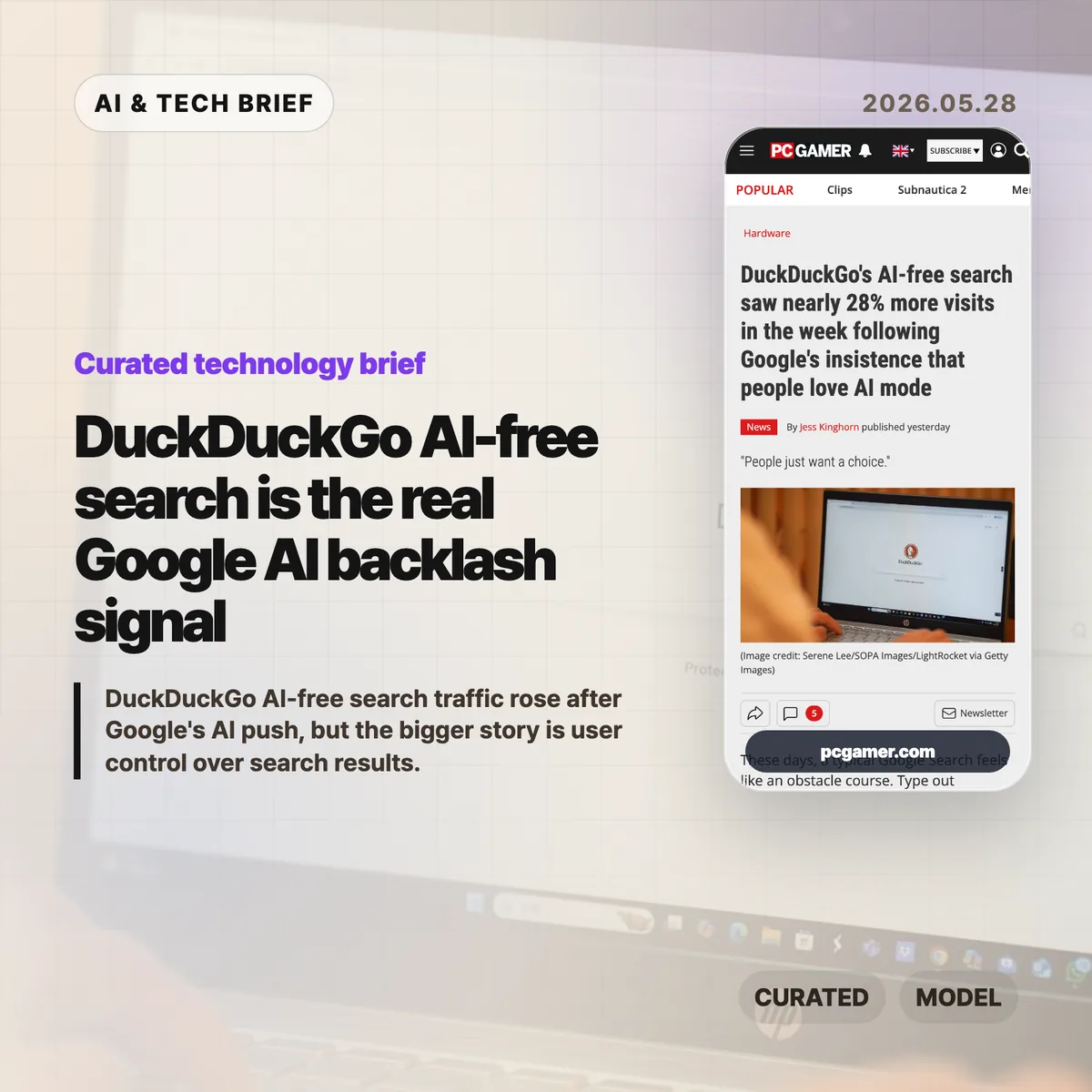
    DuckDuckGo AI-free search traffic rose after Google pushed AI Mode and AI Overviews harder into the search experience. The numbers are still small next to Google’s market share, but the reaction points to a product problem: some people want AI answers, and some people want search results without a model stepping in first.

    The short version

    • Visits to DuckDuckGo’s AI-free search page reportedly rose by an average of 22.7% week over week from May 20 to May 25, peaking at 27.7% on May 24.
    • TechCrunch reported that DuckDuckGo mobile app installs in the US rose 18.1% on average over the same stretch, with a 30.5% peak on May 25.
    • This does not make DuckDuckGo a near-term threat to Google Search, which still has a much larger share of the US search market.
    • The useful signal is product fatigue: users are reacting less to AI itself than to AI being treated as the default layer in search.

    What happened

    PC Gamer reported that DuckDuckGo saw a sharp bump in usage around its AI-free search surface after Google kept promoting AI Mode as a direction users supposedly like. DuckDuckGo’s noai page, which gives people a cleaner path to search without AI answers, saw visits rise 22.7% on average week over week from May 20 through May 25. The peak was 27.7% on May 24.

    TechCrunch reported a related app-store signal. DuckDuckGo mobile app installs in the US rose 18.1% on average over the same six-day window, and the increase peaked at 30.5% on May 25. Those figures are not a market-share earthquake. They are a behavior change worth watching because they happened around a visible product dispute: Google putting AI answers closer to the center of search, and some users looking for a way around it.

    Google has a business reason to keep going. In Alphabet’s Q1 2026 remarks, Sundar Pichai said Search revenue rose 19% year over year and tied part of Google’s momentum to AI experiences such as AI Overviews and AI Mode. From Google’s side, AI search is a growth story. From the user’s side, it can feel like a familiar utility changing its rules without asking.

    Why this is worth watching

    Search is not a side feature. It is the front door to the web for a lot of people. When AI answers sit above links, the search engine is no longer only helping users find pages. It is deciding when a synthesized answer should come before the open web.

    That can be useful. Plenty of queries are simple enough that an answer box saves time. The friction starts when a user wants links, source comparison, official pages, forum threads, product documentation, or a plain list of results. In those moments, an AI answer can feel like an obstacle rather than a shortcut.

    The privacy angle also gives DuckDuckGo a cleaner message. DuckDuckGo is not anti-AI across the board. It offers AI chat and summaries in other contexts. Its pitch is closer to control: let the user choose how much AI they want, and do not turn search logs or chats into training material. For people already uneasy about data collection, that distinction is easy to understand.

    There is also a lesson for anyone building AI into consumer products. If a feature changes a daily habit, opt-out controls are part of the product, not a settings afterthought. For more coverage of search, AI products, and platform shifts, see the IT & AI archive.

    DuckDuckGo AI-free search and user control

    DuckDuckGo AI-free search is a useful phrase because it names the demand more clearly than “anti-AI search.” The demand is not for a web frozen in 2015. It is for a visible choice between answer generation and ordinary results.

    What Hacker News readers are arguing about

    The Hacker News thread was split in a useful way. Some readers had already moved to DuckDuckGo or were trying alternatives because they disliked seeing AI answers in ordinary search. A repeated complaint was not that AI is useless, but that Google Search is where they go for links. If they want a chatbot, they would rather open a dedicated AI product.

    Another group defended Google AI Mode. They said it is fast, convenient from the address bar, and good enough for quick factual checks. That camp is not imaginary; it explains why Google’s internal metrics may look positive even while a visible group of users complains loudly.

    The strongest skeptical point was about the denominator. A 28% increase sounds large, but DuckDuckGo starts from a much smaller base than Google. Several commenters argued that the headline could overstate the competitive impact if readers treat a relative increase as proof of a broad search migration.

    The more practical thread was about controls. Readers kept coming back to the same distinction: AI can be useful when asked for, annoying when forced, and worrying when it changes what counts as a search result. That is the part product teams should notice.

    The practical read

    DuckDuckGo is not suddenly replacing Google Search. The safer read is that AI search has entered the backlash phase that most default-on product changes eventually face.

    For Google, the risk is not that every frustrated user leaves tomorrow. The risk is training people to keep a second search engine nearby for cases where AI gets in the way. That is a small habit change at first, but it weakens the assumption that Google is the only search box worth using.

    For DuckDuckGo and other search apps, the opening is clear but narrow. Privacy and AI opt-out messaging can bring people in. The hard part is keeping them when results quality, local search, maps, shopping, and vertical search matter. A search engine can win a protest click and still lose the daily habit.

    For builders, the rule is simple enough: do not confuse adoption with consent. If an AI feature is genuinely useful, people will use it when the path is clear. If they have to fight the interface to get back to the old behavior, the alternative with a simple off switch starts to look better.

    Sources

  • Enterprise AI agents are where OpenAI and Anthropic may finally get paid

    Enterprise AI agents are where OpenAI and Anthropic may finally get paid

    Enterprise AI agents are starting to look less like a subscription perk and more like a metered workplace bill. Simon Willison argues that OpenAI and Anthropic have found a version of product market fit through coding agents such as Codex and Claude Code, because companies are paying closer to API prices when employees use them heavily. The uncomfortable part is also the point: the bills are high because people are actually using the tools.

    The short version

    • Heavy personal plans can make Codex and Claude Code look cheap compared with API-equivalent token usage.
    • Enterprise AI agents change the business model because companies pay for team usage, contract terms, support, and usage controls.
    • Hacker News readers mostly agreed the usage is real, but argued hard about whether the economics can survive open models, cheaper providers, and missing ROI data.
    • The practical test is no longer whether a coding agent is impressive. It is whether a team can prove the agent is worth the tokens it burns.

    What happened

    Willison compared his own heavy usage of Anthropic Claude Code and OpenAI Codex with what the same token volume would cost at API prices. His estimate came to about $1,199.79 for Anthropic and $980.37 for OpenAI over 30 days, while he paid $200 total for two consumer plans.

    That gap matters because the enterprise side appears to be moving in the opposite direction. Willison points to Anthropic’s shift from broad seat-based expectations toward $20 per seat per month plus API-style usage, and to OpenAI’s Codex rate card, which says April 2026 pricing moved toward API token usage rather than per-message pricing. Anthropic also announced Claude Code for Team and Enterprise plans, with admin controls and higher business limits.

    The claim is not that every AI lab is suddenly healthy. It is narrower: enterprise AI agents give OpenAI and Anthropic a way to charge where the usage actually happens. Coding agents run longer jobs, inspect repositories, rewrite files, execute commands, and loop through fixes. That can consume far more tokens than a chat session.

    Why this is worth watching: enterprise AI agents

    Enterprise AI agents create a cleaner revenue story than consumer chat subscriptions. A consumer pays a flat monthly fee and may use far more inference than the plan costs. A company that rolls an agent into daily engineering work can be billed by usage, seats, support, and contract commitments.

    That also explains why the sales motion looks old-fashioned. Willison scraped job listings and found large chunks of OpenAI and Anthropic hiring tied to enterprise sales, customer support, account management, and forward deployed engineering. The irony is useful. The companies selling automation still need humans to close enterprise contracts, handle security reviews, and keep customers from turning a runaway token bill into a cancellation.

    For app and developer tool builders, the lesson is blunt. If an agent marketplace or coding platform wants durable revenue, discovery is only the start. Teams also need budgets, admin controls, usage reporting, and a way to tell whether the agent saved more money than it spent.

    For more coverage of software teams, AI products, and developer platforms, see the IT & AI archive.

    What Hacker News readers are arguing about

    The Hacker News thread was huge and messy, which fits the topic. The most useful split was between “usage proves demand” and “usage does not prove sustainable economics.”

    The bullish camp treated $200 per user per month as ordinary enterprise software pricing, especially compared with expensive engineering, CAD, cloud, or security tools. Some readers argued that the controversy itself proves the tools have entered real workflows. Nobody complains about a bill for software nobody uses.

    The skeptical camp kept coming back to ROI. Several commenters asked whether companies can show more shipped product, better features, or higher engineering output, instead of more commits and larger token bills. One recurring objection was that a 20% to 40% productivity lift may fail to support the scale of infrastructure spending implied by trillion-dollar valuations.

    A second line of skepticism was commoditization. Readers pointed to cheaper open-weight models, Chinese providers, caching, and alternative inference platforms. Their argument was not that Claude Code or Codex are useless. It was that API-priced usage may be a temporary window if “good enough” models keep getting cheaper.

    There was also a pricing trust issue. Some commenters pushed back on the idea of “$2,000 worth of tokens” as if token list prices were an objective measure of value. That is a fair caution. List price, marginal compute cost, customer value, and investor narrative are four different things.

    The practical read

    Enterprise AI agents are a budget conversation now. If you run engineering, the next step is to avoid both blanket bans and unlimited access. Put them in the same category as cloud spend: useful, measurable, and dangerous when nobody owns the bill.

    Track agent usage by team, task type, and outcome. Watch where agents save review time, test-writing time, migration effort, or support toil. Also watch where they create cleanup work. The argument for enterprise AI agents gets much weaker if the only metric is token volume.

    For OpenAI and Anthropic, the next year is a proof period. They have signs of demand, enterprise contracts, and tools that people use all day. Now they need to show that usage can turn into durable margins before cheaper models and procurement teams squeeze the story.

    Sources

  • AI productivity claims are running ahead of the work

    AI productivity claims are running ahead of the work

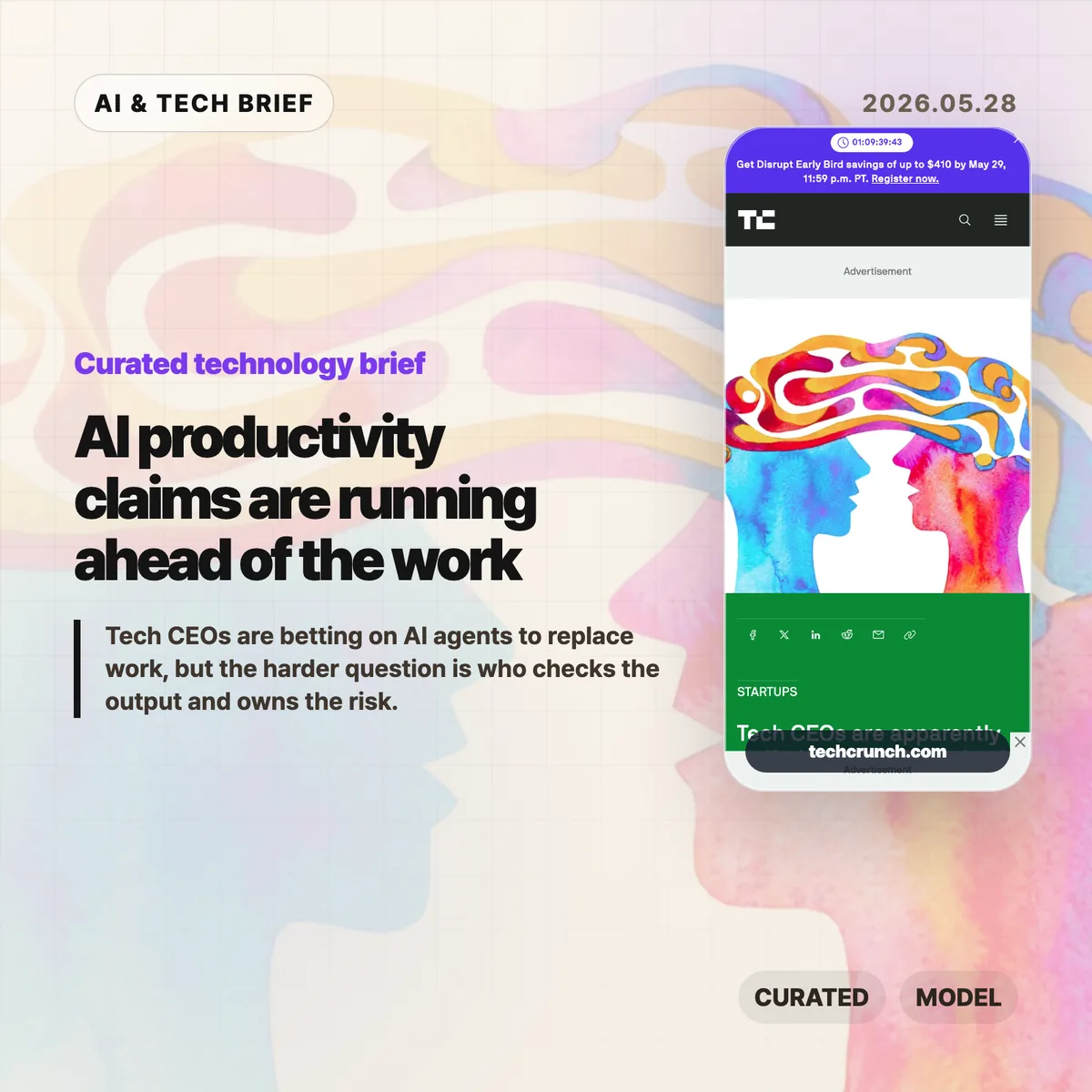
    TechCrunch’s report on Aaron Levie’s warning about “AI psychosis” among CEOs lands because it names a familiar gap: executives see a strong demo, while teams still have to make the work correct, safe, and shippable. AI productivity claims can sound persuasive before that last-mile work is counted. The issue is not whether AI agents are useful. They are. The question is whether companies can tell the difference between a good prototype and a finished business process.

    The short version

    • Box CEO Aaron Levie argued that CEOs are especially vulnerable to overestimating AI because they sit far from the last mile of work.
    • Layoffs.fyi counted 115,430 tech layoffs across 152 companies in the first five months of 2026, close to the 124,636 total it tracked for all of 2025.
    • ClickUp CEO Zeb Evans said the company cut 22% of staff after deploying roughly 3,000 AI agents, a useful case study in how quickly the narrative is moving.
    • The hard part is measurement: more drafts, tickets, pull requests, or proposals do not automatically mean better output.
    • Hacker News readers mostly argued about two things: whether “psychosis” is a fair label, and whether executives understand the review work that AI creates.

    What happened

    The TechCrunch piece starts with Levie’s claim that CEOs are “uniquely prone to AI psychosis” because they are far enough away from frontline work to miss the remaining labor needed to turn AI output into value. That is the sharpest point in the article. A CEO can ask an agent to draft a contract, generate HTML, summarize a customer call, or produce a product mockup. Those outputs can look convincing in a meeting. They still need review, context, policy checks, security judgment, and someone willing to be accountable when the answer is wrong.

    The article also puts that argument next to a rough labor-market backdrop. Layoffs.fyi’s tracker shows 115,430 tech layoffs from 152 companies in the first five months of 2026. That does not prove AI caused the layoffs. It does show why the story is sensitive: AI is becoming part of the language companies use when they explain smaller teams, faster execution, and new operating models.

    ClickUp is the most concrete example in the report. CEO Zeb Evans said the company had deployed about 3,000 AI agents and reduced staff by 22%, while trying to build what he called a “100x org.” That framing is exactly why this debate matters for builders. If agents become part of the org chart, companies need a much better answer to a basic operating question: who reviews the agent’s work, and what happens when the agent is confidently wrong?

    Why this is worth watching for AI productivity claims

    The useful read is that AI adoption is moving faster than AI measurement. A team can count how many agent runs completed. It can count the number of documents, tickets, or pull requests generated. Those are activity metrics. They do not say much about whether the work reduced customer pain, lowered error rates, increased revenue per employee, or freed experts from low-value chores.

    That distinction matters because the research record is still mixed. California Management Review’s summary of AI productivity evidence warns against easy claims that AI adoption produces broad productivity gains by itself. An NBER paper on executives and AI productivity points to a gap between perceived gains and measured outcomes. MIT FutureTech’s labor-task research also suggests that many tasks remain harder to automate at human-level quality than the demo cycle implies.

    The management bottleneck may simply move. Harvard Business Review has made a similar point: if AI increases the volume of output, managers can become the constraint because more work needs to be read, compared, approved, or rejected. Anyone who has reviewed AI-generated code or AI-written legal text knows the pattern. The first draft arrives faster. The expensive part is deciding whether it can be trusted.

    For more briefs on AI products, software teams, and workplace automation, see the IT & AI archive.

    What Hacker News readers are arguing about

    The Hacker News thread around the TechCrunch article is active and messy in the usual useful way. A large part of the discussion focuses on the word “psychosis.” Some readers called it clickbait or a cheap use of medical language. Others defended it as a cultural shorthand for executives becoming detached from what AI can actually do. The split is worth noting because it mirrors the broader AI debate: people agree there is overconfidence, then fight over how harshly to name it.

    The more practical thread is about distance from the work. Several commenters argued that this is not new. Executives have long seen a toy example, assumed the hard part was solved, and pushed a rollout that frontline teams had to absorb. The AI-specific twist is that LLMs can flatter the user while producing a plausible artifact. A CEO who prompts a chatbot into a small front-end demo may come away feeling closer to engineering than they really are.

    There was also a strong operator objection: AI can create review debt. One commenter described a CEO who hit real walls around data architecture and deployment after experimenting with AI prototyping. That is the sane version of the story. The tool helped explore an idea, then exposed the need for human-designed infrastructure. Another repeated concern was failure rate. If a model gets 80% or 90% of text tasks right, the remaining errors can still be disastrous in legal, security, finance, support, or production engineering contexts.

    The thread is not evidence, but it is a useful sentiment check. Builders are not rejecting AI agents outright. They are rejecting the jump from “this generated something impressive” to “this can replace the people who know where the traps are.”

    The practical read

    Companies should treat AI productivity claims like product claims. Define the workflow, the baseline, the quality bar, and the failure mode before tying the result to headcount. If an agent writes support replies, measure refund errors, escalation rates, customer satisfaction, and policy violations. If it writes code, measure review time, defect rate, rollback frequency, and maintenance cost. If it drafts contracts, measure legal review burden and clause-level risk.

    For AI agent startups and workplace apps, the pitch also needs to mature. “We deployed 3,000 agents” is a flashy number, but buyers will eventually ask which agents survived contact with real work. The products that win will probably be the boring ones that make review easier, preserve audit trails, route uncertain cases to humans, and prove that cycle time improved without hiding risk.

    For workers, the signal is more personal. The safer skill is not prompt fluency by itself. It is judgment over the last 20%: checking the output, knowing the domain constraints, spotting the quiet mistake, and deciding when automation should stop.

    Sources