Tag: AI

  • Dead economy theory: AI labor has a demand problem

    Dead economy theory: AI labor has a demand problem

    Dead economy theory is a useful name for a blunt question: if AI labor savings come from replacing workers, who keeps buying the goods and software those companies sell? Owen McGrann’s essay pushes past the usual productivity story and follows the money after the layoffs. The uncomfortable part is that a rational choice for one company can still weaken demand for everyone else.

    The short version

    • McGrann argues that large AI valuations make the most sense if investors expect a huge share of labor spending to move from payroll to software.
    • The demand problem is simple: workers are also customers, and broad layoffs can cut the spending that businesses rely on.
    • The related “AI Layoff Trap” paper models this as an automation arms race where firms automate more than is healthy for the whole economy.
    • Hacker News readers pushed back on the essay’s assumptions, but the thread kept returning to the same worry: past automation is not proof that every future shock will land gently.

    What happened

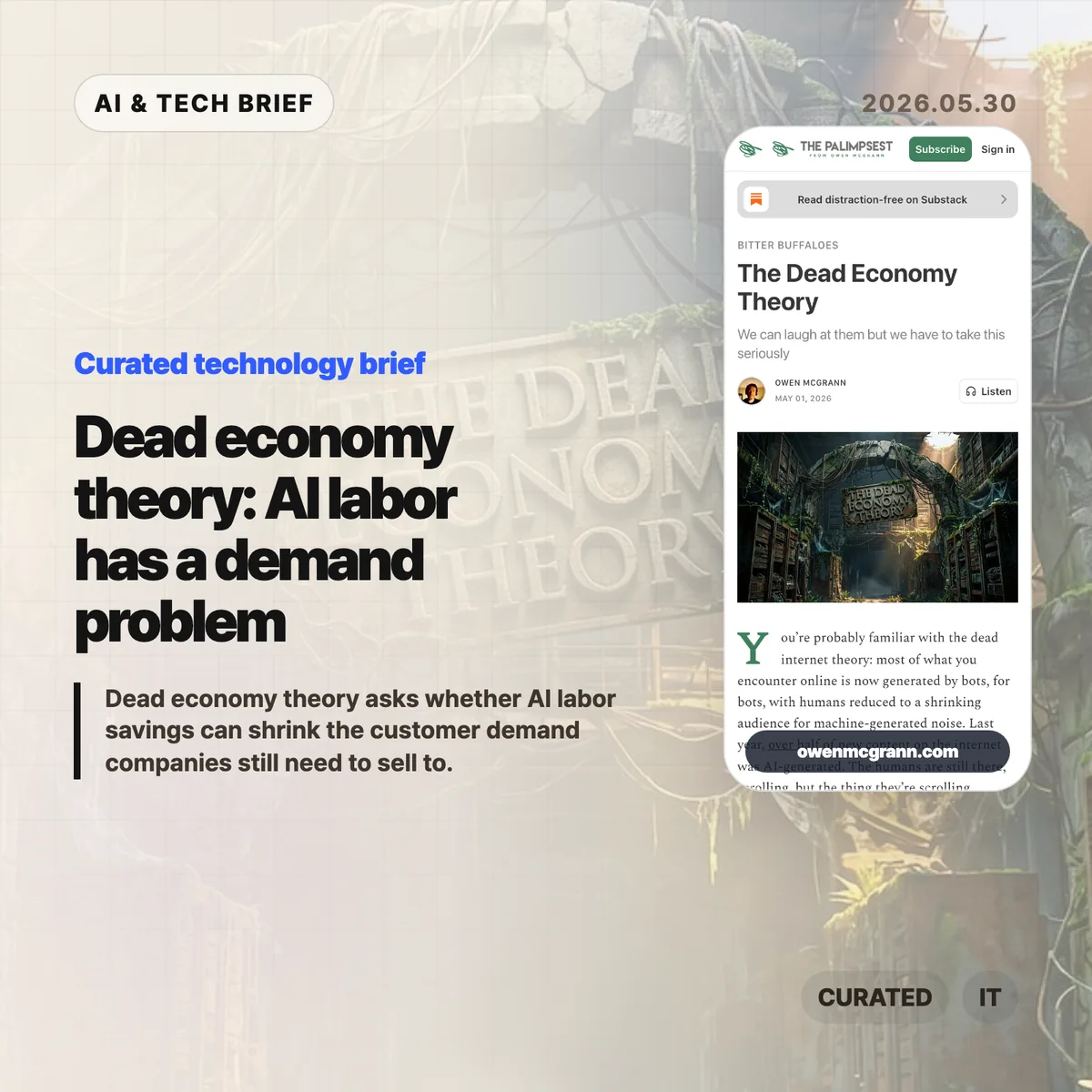
    Owen McGrann published “The Dead Economy Theory” on The Palimpsest, framing it as an economic cousin of the dead internet theory. The essay starts from the way AI firms sell themselves to investors and enterprise buyers. Words like copilot and assistant sound harmless, but the business case often points toward doing more work with fewer people.

    That framing matters because the biggest possible market for AI is not better autocomplete. It is labor spend. McGrann connects that to benchmarks such as OpenAI’s GDPVal, which evaluates model performance on economically valuable work, and to a newer paper called “The AI Layoff Trap.” The paper argues that firms can get stuck in a competitive automation race even when they understand that mass displacement may reduce consumer demand.

    The dead economy theory is not a forecast with a date attached. It is a stress test for the AI investment story. If software replaces labor faster than new income channels appear, the savings show up before the missing demand does.

    Why this is worth watching

    The best version of the AI productivity argument says automation raises output, lowers prices, and eventually creates new work. That has happened before. Mechanized farming, factory automation, and computers all hurt some workers while expanding other parts of the economy.

    The weaker version skips the transition cost. It assumes the people displaced from cognitive work will quickly find new work that pays enough to support the same consumption. That is a large assumption, especially if AI systems also chase the next white collar task those workers might move into.

    How dead economy theory changes the AI sales pitch

    For readers tracking AI companies, dead economy theory is a way to separate product language from financial logic. If an AI tool is priced and marketed around headcount reduction, the macro question is not a side issue. It is part of the product’s long-run market size.

    There is also a builder angle. AI app and agent teams should be careful about promising pure labor removal when the healthier pitch may be workflow capacity, error reduction, or work that would not have been done at all. That distinction matters for customers, regulators, and platform marketplaces. For more AI business coverage, see the IT & AI archive.

    What Hacker News readers are arguing about

    The Hacker News discussion was large and messy, which fits the topic. One camp saw the essay as a dressed-up recession story: firms cut costs, workers spend less, and demand falls. Their objection was that this is not unique to AI and that previous waves of automation did not end employment.

    The stronger skeptical point was about history. Several readers argued that farms and factories automated without making everyone permanently jobless. Others answered that this does not settle the AI case. Past transitions took decades, hurt real people, and depended on new sectors absorbing displaced workers. If AI keeps moving into those sectors too, the usual escape route gets narrower.

    Another thread focused on whether an economy even needs human consumers. Some commenters imagined a machine-heavy economy where AI firms sell compute, energy, data, and services to one another. That idea sounded extreme, but it exposed the core dispute: is the economy supposed to serve human demand, or can capital keep circulating after most people lose market power?

    The most practical comments were less dramatic. They asked who pays for the data centers, GPUs, electricity, and subscriptions if the middle class gets weaker. They also pointed out that consumption-based pricing does not solve much unless the consuming agents are attached to customers with money. The discussion is not evidence, but it shows where technical readers are uneasy.

    The practical read

    Dead economy theory does not prove that AI will destroy demand. It does make one test harder to ignore: does an AI product create new output, or does it mostly move wages into vendor spend and shareholder margin?

    Founders should be specific about that answer. If the product helps a small team handle work it could not otherwise touch, the demand story is different from a product sold mainly as a layoff machine. Investors should ask the same question from the other side. A market built on replacing customers’ payrolls may be large, but it can also be self-limiting if too many buyers make the same move at once.

    Policy people will read the piece differently. The “AI Layoff Trap” paper argues for an automation tax, while noting that basic income, worker equity, and retraining do not fully remove the competitive incentive to automate. You do not have to accept that policy answer to see the problem. The incentive to cut labor is immediate. The cost of weaker demand arrives later and gets shared.
    Sources

  • SQLite agentic code policy draws a hard line for AI patches

    SQLite agentic code policy draws a hard line for AI patches

    SQLite added a plain rule to its repository guidance: it does not accept SQLite agentic code as a contribution. The project still welcomes bug reports that include a reproducible test case, which makes this less of an anti-AI manifesto and more of a maintenance boundary for a public-domain database used almost everywhere.

    The short version

    • SQLite’s AGENTS.md says the project does not accept agentic code, even though maintainers may review concise proof-of-concept patches before reimplementing changes themselves.
    • The project separates code contributions from bug reports: AI-assisted reports are acceptable when they include a reproducible test case.
    • The policy is tied to public-domain requirements, long-lived C code, Fossil-based development, and the cost of reviewing patches the maintainers did not write.
    • For AI coding tools, the useful lesson is blunt: a good repro may travel farther than a generated patch.

    What happened

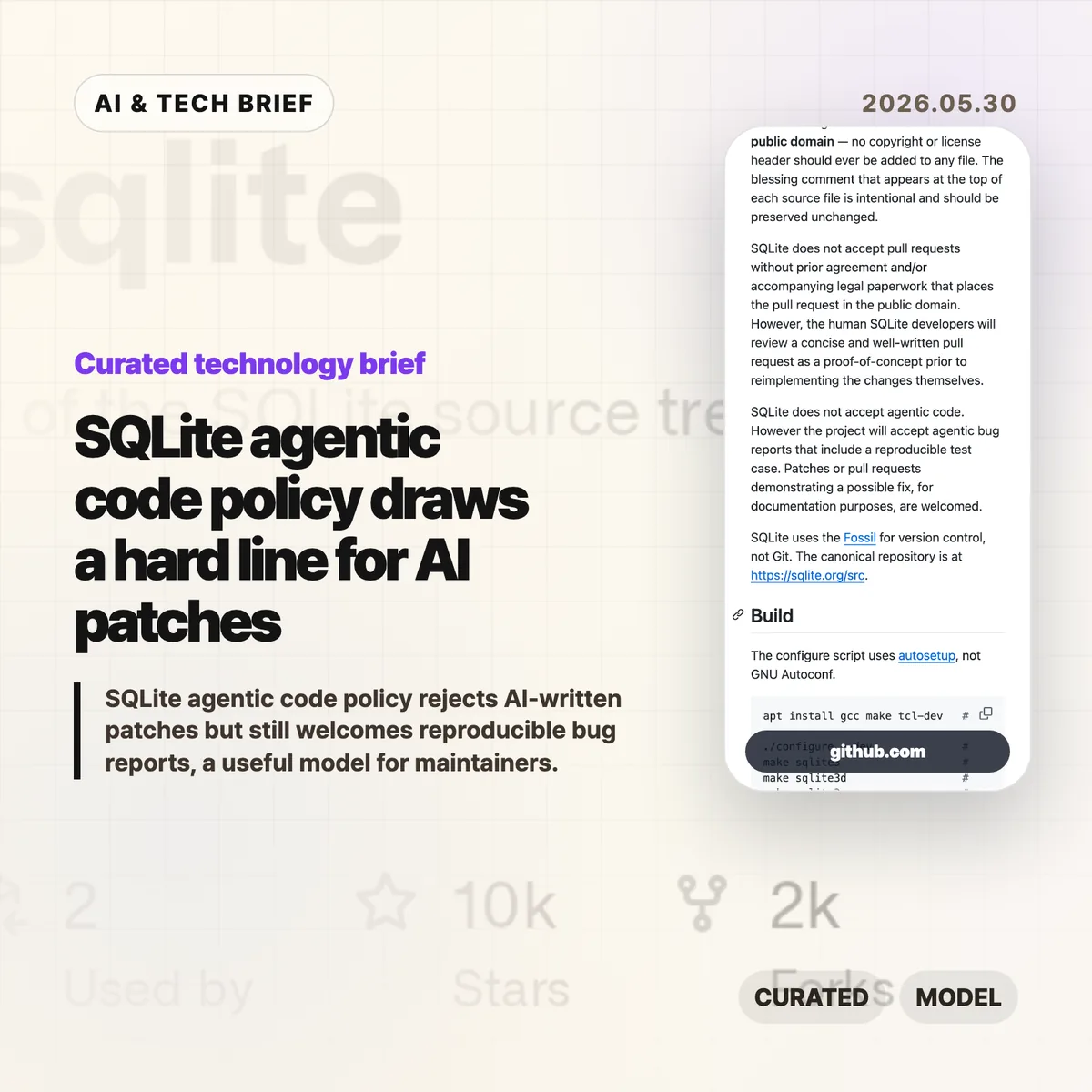
    SQLite now has an AGENTS.md file aimed at people pointing coding agents at the SQLite source tree. The file explains project basics, build commands, testing commands, repository conventions, and contribution rules.

    The sharp part is the contribution policy. SQLite says it does not accept pull requests without prior agreement or legal paperwork that places the contribution in the public domain. It also says, in a separate sentence, that SQLite does not accept agentic code. Maintainers may still review a short, well-written pull request as a proof of concept, but the human SQLite developers reimplement accepted ideas themselves.

    That distinction matters because SQLite is not run like a typical GitHub-first project. Its canonical repository is Fossil, not Git, and its public-domain status is part of the project’s identity. A generated patch is not only a review burden. It can also blur authorship and provenance in a codebase that treats those details seriously.

    Why this is worth watching

    Most open source projects will not copy SQLite word for word. Plenty of maintainers do accept pull requests, and many projects live inside GitHub’s normal review flow. Still, SQLite has given maintainers a clean pattern: reject AI-written code as merge material while accepting AI-assisted evidence when it helps a human reproduce the problem.

    That is a useful split. A patch asks maintainers to trust the author, the code path, the licensing story, the tests, and the future maintenance cost. A reproducible bug report asks them to verify a failure. Those are different jobs.

    The wider lesson for developer tools is that output format matters. If an AI coding assistant produces a patch with no small failing test, it may be creating work for the maintainer. If it produces a minimal case, commands to reproduce it, and enough context for a person to inspect the failure, it has a better chance of being useful.

    For more coverage of developer-tool policy and AI engineering practice, see the IT & AI archive.

    What Hacker News readers are arguing about

    The Hacker News thread around Simon Willison’s write-up is small, so there is not enough there to claim a broad community consensus. The useful point in the comments is a clarification: SQLite is not refusing every artifact touched by an agent. It is refusing agent-written code as codebase input, while still allowing possible fixes to appear as documentation and accepting reproducible bug reports.

    A related earlier discussion on the prototype AGENTS.md commit framed the policy as a reasonable compromise. The tone was less “AI is banned” and more “give agent users rules, then keep generated code out of the project unless a human maintainer owns the final implementation.” That reading fits the file itself.

    The argument that remains open is practical. If AI tools get better at producing tests, minimization steps, and failure cases, maintainers may welcome them as triage tools. If the tools mostly produce plausible patches, projects with strict ownership rules will keep pushing back.

    SQLite agentic code policy in practice

    SQLite agentic code is the wrong deliverable for this project. A reproducible test case is the right one.

    That should influence how developers use coding agents around mature open source infrastructure. Instead of asking an agent to “fix SQLite,” ask it to isolate the failing behavior, reduce the input, show the exact command that fails, and explain why the result conflicts with documented behavior. If a patch is generated along the way, treat it as a debugging note, not as something to submit.

    For coding-agent companies, this is also a product signal. The next useful feature may not be a bigger diff. It may be a maintainer-friendly report: environment, build command, failing test, expected result, actual result, and a short explanation a human can audit.

    The practical read

    If you maintain an open source project, SQLite’s policy is a good starting template even if you soften the wording. Say whether you accept AI-written patches. Say whether AI-assisted bug reports are allowed. Say what evidence makes a report useful. The policy does not need to be dramatic; it needs to reduce ambiguity before the first generated pull request lands.

    If you contribute to projects with AI help, submit less code and better evidence. A concise failing test and reproduction steps respect the maintainer’s time. A large generated patch shifts the risk to someone else.

    Sources

  • Open source burnout made one leader leave tech

    Open source burnout made one leader leave tech

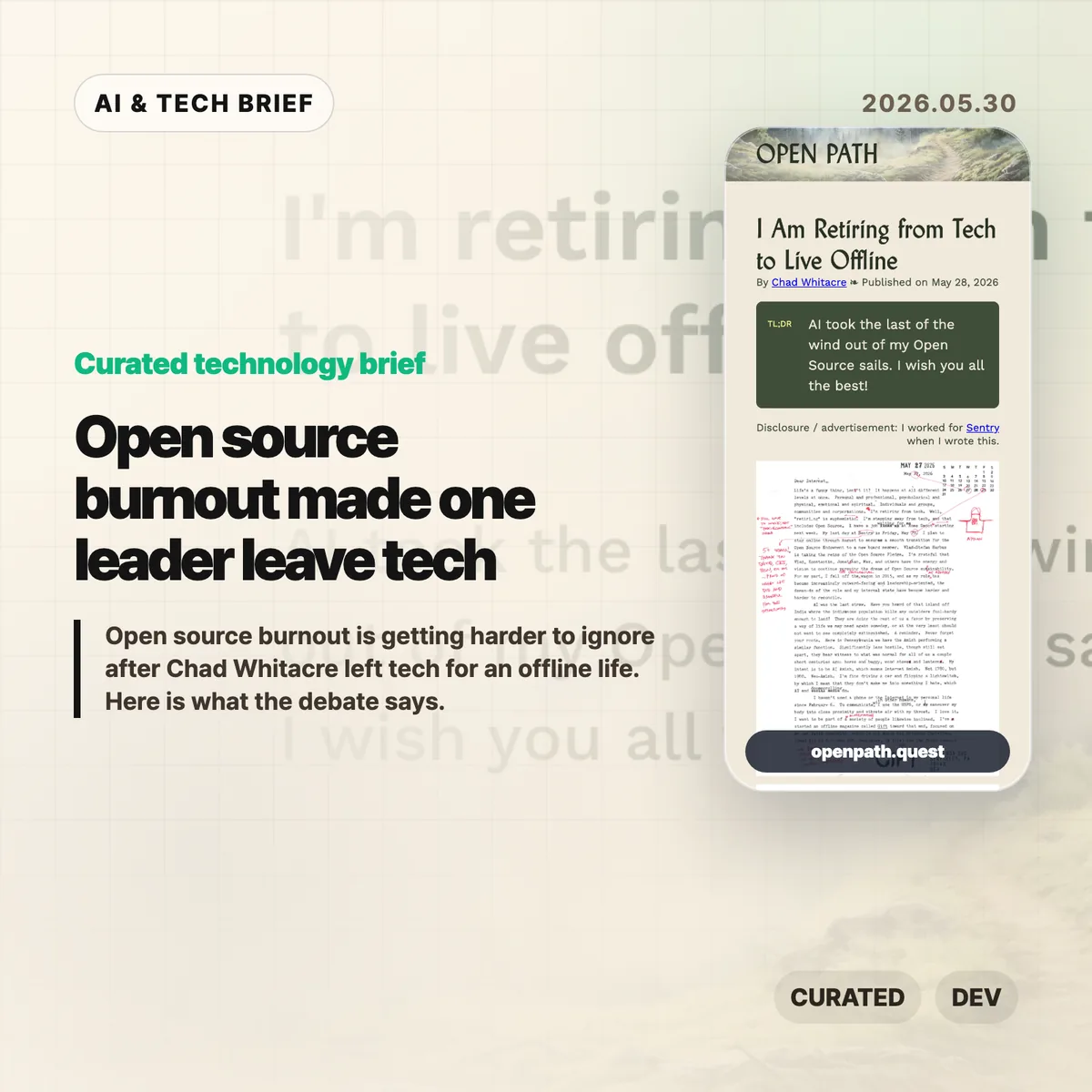
    Open source burnout is the plain reading of Chad Whitacre’s short farewell note. Whitacre, who worked on open source at Sentry and helped push the Open Source Pledge, says AI took the last wind out of his open source sails. He is leaving tech for offline work, postal mail, and a life with fewer screens.

    The short version

    • Chad Whitacre said May 29, 2026 was his last day in tech and that he planned to work at Home Depot next.
    • His post is brief, but the line about AI draining his open source energy landed because many maintainers already feel overloaded.
    • The Hacker News discussion turned into a wider argument about corporate politics, early retirement, the pleasure of writing code, and whether AI removes some of that pleasure.
    • The practical lesson is not that every developer should go offline. It is that teams building on open source should pay attention when experienced maintainers stop wanting to stay online.

    What happened

    Whitacre published “I Am Retiring from Tech to Live Offline” on Open Path on May 28, 2026. The post is almost deliberately small: a title, a date, a disclosure that he worked for Sentry when he wrote it, and the line that AI took the last wind out of his open source sails.

    The surrounding context matters. Whitacre has been visible in open source circles through Sentry and the Open Source Pledge, a project that asks companies to pay maintainers. In the Korean source material, the story was framed around a full exit from online life: no smartphone, no regular internet, and a preference for mail or in-person contact.

    That makes the post easy to overread. Still, the signal is hard to miss. This is not a random complaint from someone who never liked software. It is a note from someone who spent years trying to make open source work more sustainable, then decided the online version of the work was no longer worth it.

    Why this is worth watching: open source burnout

    Open source burnout usually gets discussed as a funding problem. That is part of it, but Whitacre’s note points at something more personal: the loss of meaning in the work.

    AI changes the texture of open source work. Maintainers may receive more generated pull requests, more automated issues, more pressure to move faster, and more questions about whether their craft still matters. Even when AI helps, it can also turn a community project into a review queue.

    That is why this story is useful for people who build developer tools, AI coding products, or infrastructure startups. Open source trust still helps products spread. But trust comes from people who answer issues, review patches, write docs, and keep projects coherent. If those people leave, the repository remains, but the social system weakens.

    For more English-language technology briefs, the IT & AI archive tracks stories where developer culture and AI adoption collide.

    What Hacker News readers are arguing about

    The Hacker News thread is less about Whitacre alone and more about the mood around tech work in 2026. Several commenters treated the post as a burnout story. The complaints were familiar: performance reviews, reorganizations, top-down corporate process, and the feeling that an industry that once felt playful now feels exhausting.

    The AI-specific argument was sharper. One commenter said the pleasure is going out of coding because they enjoy the craft as much as the finished software. That line explains why AI coding tools can feel different from earlier productivity tools. If someone values the act of shaping code, then outsourcing more of that act can feel like losing the best part of the job.

    There was pushback too. Some readers argued that tech remains a comfortable career compared with food service, landscaping, manufacturing, or other physical work. Others said the problem is not technology itself but big-company culture. A few suggested smaller teams, contracting, or nonprofit work as ways to keep the good parts of software while avoiding the corporate machinery.

    The useful read from the thread is that open source burnout is not one thing. For some people it is AI. For others it is management culture, money, health, family, or the realization that they can afford to stop. The thread does not prove a trend, but it does show how many experienced developers have a half-written exit plan in their heads.

    The practical read

    If you run a software team, do not treat open source as a free external department. Pay for the projects you depend on, keep your generated contributions small and reviewable, and make it easy for maintainers to say no.

    If you build AI tools for developers, this is a product warning. Speed alone is not enough. The tool has to preserve agency, reviewability, and the feeling that a human still owns the work. Otherwise the best users may quietly decide they would rather do something else.

    For individual developers, the lesson is more modest. You do not need to disappear into an offline life to notice when the work has stopped feeling like yours. Take that signal seriously before it turns into a public farewell post.

    Sources

  • LLM smells are getting easy to spot

    LLM smells are getting easy to spot

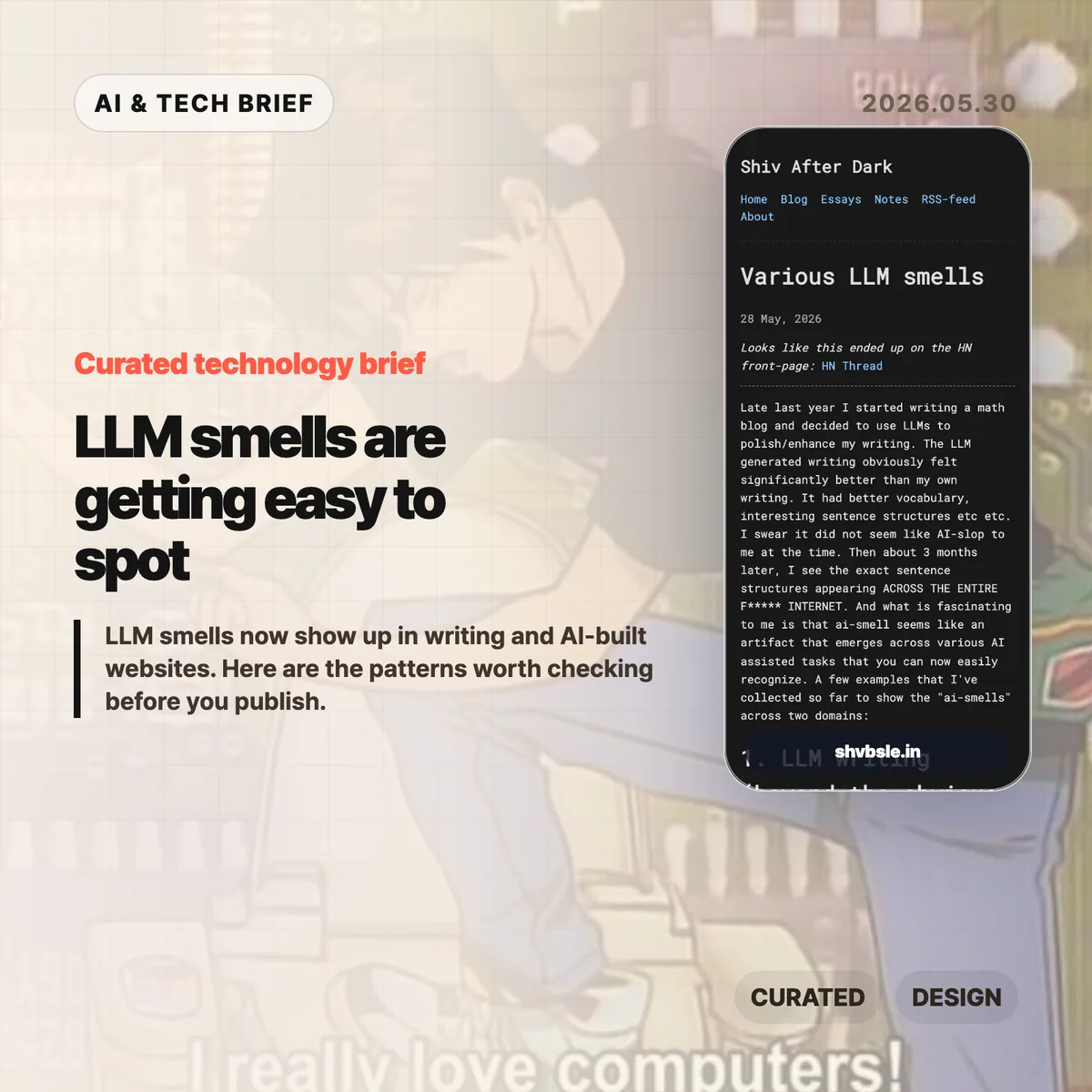
    LLM smells are the tiny tells that make AI-assisted writing or AI-built websites feel oddly familiar. A short post by Shiv After Dark put a useful name on the pattern: punchline-heavy prose, repeated sentence shapes, monospace-heavy pages, badges, cards, and step sections that keep appearing across unrelated work.

    The short version

    • LLM smells are not proof that a piece of work is bad. They are signs that the draft may still be too close to the model’s default style.
    • The clearest writing tells are punchline sentences, repeated short sentences, “X is the Y of Z” metaphors, and tidy contrast formulas.
    • The web design tells are just as visible: JetBrains Mono, step layouts, badge dots, familiar cards, and generic call-to-action buttons.
    • The useful editorial move is to treat AI output as a draft, then add concrete details, uneven human rhythm, and product-specific design choices.
    • Hacker News readers mostly pushed the argument toward code quality: AI output looks strongest when you do not yet know enough to judge it.

    What happened

    Shiv After Dark published “Various LLM smells” on May 28, 2026, after noticing that prose once polished by an LLM had started to resemble a lot of other writing on the web. The post is short, but the examples are sharp: aphoristic one-liners, strings of clipped sentences, metaphor templates, and the familiar “not merely X” style of contrast.

    The second half moves from prose to AI-generated websites. The author points to the same stack of visual habits showing up again and again: monospace typography, step sections, cards, buttons, blinking badge dots, and footnote-style flourishes. None of those choices are wrong by themselves. They become LLM smells when they arrive as a bundle, without much relationship to the product or audience.

    If you follow AI writing and web tooling, this fits a larger pattern. Models are good at producing plausible defaults. Plausible defaults are useful for a first pass. They are also easy to recognize once enough people publish them unchanged. For more English briefs on AI tooling and product craft, see the IT & AI archive.

    Why this is worth watching

    LLM smells are worth watching because they are an editing problem, not a purity test. The author is not arguing that people should stop using AI for creative work. The better reading is more practical: if a model gives you a draft in seconds, you still need to remove the model’s house style before the work feels like yours.

    For writing, that means checking whether a sentence adds information or only adds mood. Punchy lines can work, but a whole page of them starts to feel assembled. The same goes for neat metaphors. “X is the visible signature of Y” may sound elegant the first time. By the tenth version, it reads like a preset.

    For web teams, LLM smells are a useful QA category. A landing page can be clean and still generic. If the typography, cards, steps, icons, and microcopy could belong to any AI startup, the page probably needs one more design pass. App builders should pay special attention here, because store listings, onboarding screens, and extension directories reward clarity, but punish sameness.

    What Hacker News readers are arguing about

    The Hacker News discussion quickly widened from writing to competence. One of the strongest recurring points was that LLM output looks best in domains where the user is least able to judge it. That explains the split many people see in coding threads: beginners may experience the model as a dramatic productivity boost, while experienced engineers see the rework, missing context, and bad abstractions.

    Several commenters gave concrete coding examples. One described an assistant proposing a security-dangerous approach that would have bypassed a WebAssembly sandbox and executed submitted Python in the application container. Others complained about agent-generated codebases growing too large because each feature gets built in isolation: every modal is different, every button drifts, and business logic ends up scattered.

    There was a more positive camp too. Some readers said LLMs are genuinely useful for format conversions, API mappings, learning unfamiliar concepts, or getting past small obstacles. The practical distinction was not “use AI” versus “do not use AI.” It was whether the user has enough taste, tests, and domain knowledge to catch the smells before they harden into the final product.

    LLM smells checklist

    Before the final edit, look for the repeated shapes: punchline stacking, metaphor templates, tidy contrast lines, generic cards, and typography that says more about the model than the product.

    The practical read

    Use LLM smells as a checklist before publishing. In prose, look for punchline stacking, repeated short sentences, decorative metaphors, tidy contrast formulas, and abstract claims that do not name a real example. Replace them with specifics. Add the thing you actually saw, measured, built, shipped, or changed.

    In interface work, scan for the default AI landing page kit: monospace labels, gradient cards, step grids, badge dots, identical buttons, and generic hero copy. Keep the pieces that fit. Cut the ones that only make the page look “AI polished.” The goal is not to hide the tool. The goal is to make the result specific enough that the tool is no longer the most visible author.

    The same rule applies to code. AI can get you moving, especially on routine or verifiable tasks. But if you cannot review the output, you are outsourcing judgment. That is where LLM smells stop being cosmetic and start turning into maintenance work.

    Sources

  • Anthropic Series H is an AI infrastructure bet

    Anthropic Series H is an AI infrastructure bet

    Anthropic Series H is not a normal late-stage startup round. The company says it raised $65 billion at a $965 billion post-money valuation, while pointing to Claude demand, Claude Code adoption, and fresh compute deals with Amazon, Google, Broadcom, and SpaceX. The useful read is simple: frontier AI is now a capital-intensive infrastructure business, not only a model leaderboard contest.

    The short version

    • Anthropic raised $65 billion in Series H funding at a $965 billion post-money valuation, led by Altimeter Capital, Dragoneer, Greenoaks, and Sequoia Capital.
    • The company says Claude run-rate revenue crossed $47 billion in May 2026, up from $30 billion in early April and $14 billion in February.
    • The new money is tied directly to compute expansion: up to 5 GW of Amazon capacity, 5 GW of Google and Broadcom TPU capacity, and access to SpaceX Colossus GPU capacity.
    • The open question is quality of revenue. Run-rate revenue can show demand, but it does not answer margin, churn, customer concentration, or whether enterprise AI bills stay this high.

    What happened

    Anthropic announced that Anthropic Series H brought in $65 billion of new funding and valued the company at $965 billion after the round. The round was led by Altimeter Capital, Dragoneer, Greenoaks, and Sequoia Capital, with a long list of large investors and $15 billion of previously committed hyperscaler investment included in the total.

    The company framed the raise around three uses: safety and interpretability research, more compute for Claude demand, and expansion of products and partnerships. It also said Micron, Samsung, and SK hynix joined as strategic infrastructure partners, which makes the supply-chain angle hard to miss. Memory, storage, logic chips, cloud capacity, and power are now part of the same story as model quality.

    The compute commitments are large. Anthropic says it has signed for up to 5 GW of new capacity with Amazon, 5 GW of next-generation TPU capacity with Google and Broadcom, and access to GPU capacity in SpaceX’s Colossus 1 and Colossus 2. AWS remains its main cloud provider and training partner, but Claude is available across AWS, Google Cloud, and Microsoft Azure.

    Why this is worth watching

    The headline number is huge, but the better signal is what Anthropic is buying time to build. Claude demand is pushing the company toward long-term cloud, chip, and data-center commitments. That means the AI race is less like a software subscription fight and more like a logistics problem with expensive hardware attached.

    There is a product angle too. Anthropic named Claude Code and Cowork in the funding announcement. For builders watching the AI tool market, that matters because developer workflow usage can create heavy, recurring inference demand. If Claude Code keeps spreading inside companies, the question shifts from “which model is best today?” to “who can serve enough tokens at a price finance teams will tolerate?” For more AI and developer-tool coverage, see the IT & AI archive.

    The semiconductor names are another clue. NVIDIA gets most of the public attention, but Anthropic’s announcement pulls memory and storage suppliers into the visible partnership stack. That fits the broader pattern in AI infrastructure: GPUs are scarce, but so are power, networking, HBM, storage, and the operations talent needed to keep large clusters useful.

    what Anthropic Series H changes

    Anthropic Series H changes the frame for AI buyers. Vendor selection now includes product quality, model behavior, price, and whether the provider has enough compute to keep service levels stable under enterprise demand.

    What Hacker News readers are arguing about

    The Hacker News thread is less excited about the valuation than the announcement itself. A lot of the discussion circles around private-market mechanics: how many funding rounds a company can keep doing, whether a Series H delays an IPO, and how employees or investors get liquidity before public markets see the books.

    The sharper argument is about run-rate revenue. Some commenters treat the jump from $14 billion in February to $30 billion in April and $47 billion in May as evidence that Anthropic has one of the fastest-growing enterprise software businesses ever. Others are much more cautious. Their objection is that run-rate revenue is an extrapolation, not audited annual revenue, and it can look better than the business feels if a few large customers are overspending before cost controls arrive.

    There is also a practical split on compute strategy. One camp sees Anthropic’s use of Amazon, Google, Broadcom, Microsoft, and SpaceX capacity as smart diversification. Another worries that relying on third-party capacity leaves Anthropic exposed if shortages tighten or suppliers change pricing. The useful middle view is that every frontier lab is exposed somewhere: chips, memory, power, data centers, pricing, or customer budgets.

    The thread also keeps coming back to Claude Code. Supporters see Claude’s developer mindshare as a reason the revenue number could be real. Skeptics ask whether current enterprise token spending is sustainable once CFOs start asking which usage actually turns into more profit.

    The practical read

    Do not read Anthropic Series H as a clean proof that the AI business model is solved. Read it as proof that top-tier AI labs now need balance sheets large enough to reserve compute before demand is fully understood.

    For founders and product teams, the near-term lesson is to watch pricing and usage limits as closely as model benchmarks. If AI features depend on a frontier model, the vendor’s compute position can affect latency, availability, and your unit economics. If you are using Claude Code or similar tools across a team, measure output quality and business impact, not only token volume.

    For investors and operators, the number to watch after this round is not the $965 billion valuation. It is whether Anthropic can turn heavy enterprise usage into durable revenue after customers learn where AI spending pays off and where it is just expensive experimentation.

    Sources

  • Claude Code dynamic workflows raise the bar for agentic coding

    Claude Code dynamic workflows raise the bar for agentic coding

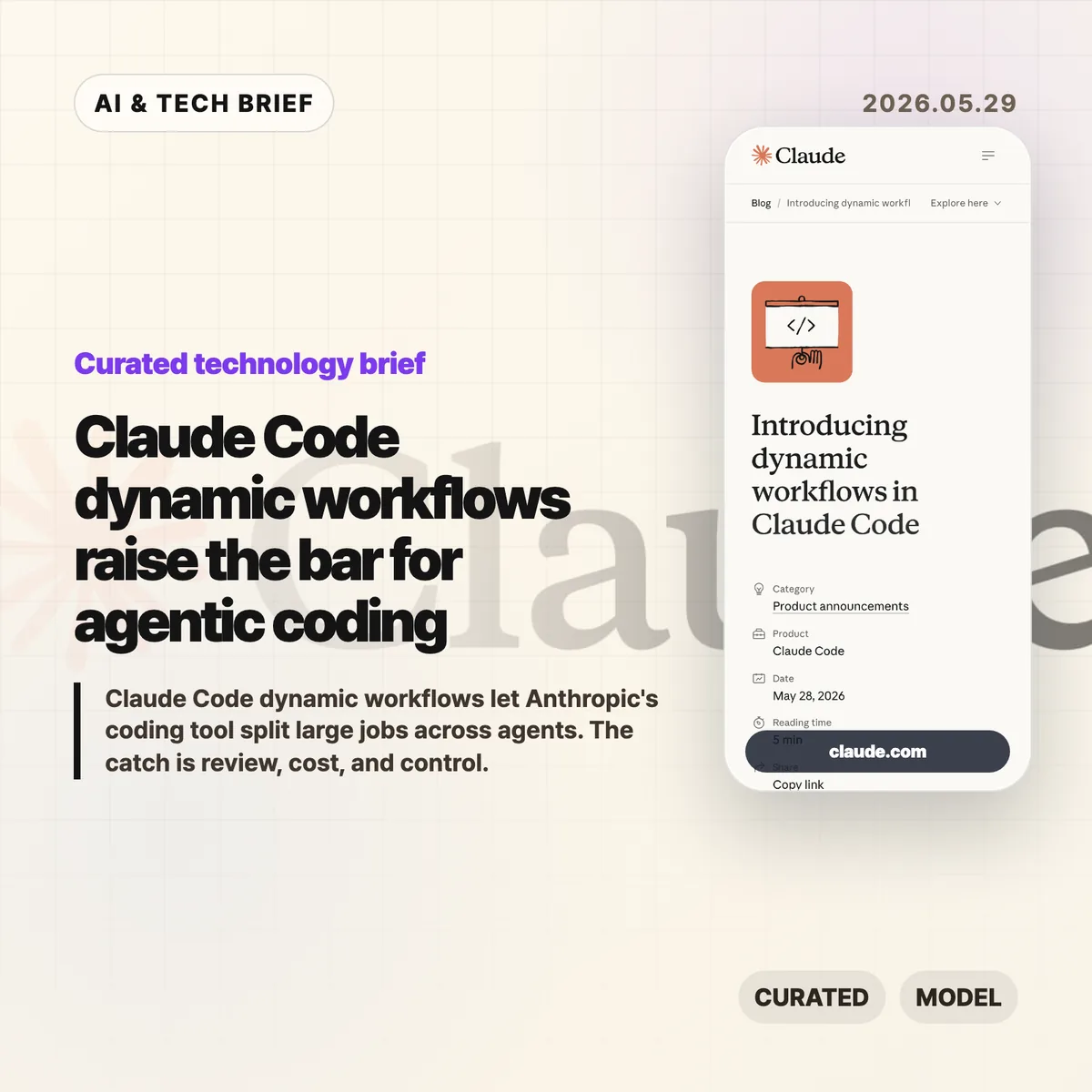
    Claude Code dynamic workflows are Anthropic’s new attempt to make AI coding agents handle work that usually breaks a single chat session: large migrations, broad bug hunts, code review passes, and security audits. The feature lets Claude Code create orchestration scripts, fan work out to tens or hundreds of subagents, and fold the results back into one coordinated answer.

    The short version

    • Anthropic says Claude Code can now split large coding tasks into parallel subagents, then check the results before combining them.
    • The headline case is Bun’s Zig-to-Rust port: roughly 750,000 lines of Rust, 99.8% of the existing test suite passing, and 11 days from first commit to merge.
    • The feature is available in research preview for Claude Code CLI, Desktop, the VS Code extension, the API, Amazon Bedrock, Vertex AI, and Microsoft Foundry.
    • The useful question is not whether agents can generate more code. It is whether teams can afford the tokens, trust the tests, and review the output without losing control.

    What happened

    Anthropic introduced dynamic workflows for Claude Code on May 28, 2026. The feature is built for tasks that have too much breadth for one agent pass: searching a service for related bugs, migrating many files, stress-testing a plan, or running several review angles before a team commits to a change.

    The mechanics matter. Claude Code plans from the prompt, breaks the work into subtasks, runs subagents in parallel, checks the outputs, and keeps iterating until the answers converge. Anthropic also says progress is saved during longer runs, so an interrupted job can resume instead of starting from zero.

    Availability is broad, but not identical across plans. Max and Team users, plus API users, get the feature on by default. Enterprise customers need an admin to enable it. Anthropic also warns that the feature can use substantially more tokens than a normal Claude Code session, which is probably the first thing a team should test before pointing it at a real migration.

    Why this is worth watching

    The Bun example is the reason this announcement is getting attention. Anthropic says Jarred Sumner used dynamic workflows to port Bun from Zig to Rust, with one workflow mapping Rust lifetimes for struct fields, another writing behavior-identical Rust files from Zig counterparts, and a fix loop driving builds and tests until they passed.

    That is an impressive story, but it is also a narrow one. Bun had an owner who knew the codebase deeply and a test suite strong enough to be a useful target. Many companies have neither. In those environments, faster agent output can create a larger review burden instead of a cleaner path to shipping.

    The more durable shift is that coding tools are moving from autocomplete toward orchestration. For more coverage of that shift, the IT & AI archive tracks similar developer-tool and AI infrastructure moves. Claude Code dynamic workflows fit that pattern: the product is less about a clever code suggestion and more about managing a temporary swarm of workers around a codebase.

    What Hacker News readers are arguing about

    The Hacker News discussion is skeptical in a useful way. Several commenters read the launch as a token-burn feature first and a productivity feature second. Their concern is straightforward: more agents, more reviewers, and longer runs can multiply usage before a team knows whether the result is correct.

    The strongest technical objection is about ground truth. Bun is a convenient proof point because a port can be checked against an existing behavior model and a large test suite. Most software work is messier. Product intent, hidden invariants, flaky tests, and review judgment are harder to encode than “make the tests pass.” A few commenters described agents drifting from the requested task or even damaging the test harness while still producing passing CI.

    The builder argument is not empty, though. Some commenters said more tokens can be worth it when they buy independent review passes, adversarial checks, and broader search across a codebase. Jarred Sumner also joined the thread to say dynamic workflows made Claude more effective at complex long-running tasks, describing the workflow as closer to a task-specific build system than a freeform chat.

    The thread lands in a practical middle: parallel agents may help when the task is wide, testable, and well-scoped. They look much weaker when the team cannot define success, interrupt the run cleanly, inspect decisions, or cap cost.

    Claude Code dynamic workflows in practice

    The safest mental model is a temporary build system for one difficult job. You give it a narrow target, enough checks to catch bad work, and a human-owned merge gate at the end.

    The practical read

    Treat Claude Code dynamic workflows as an orchestration tool, not a replacement for engineering judgment. The first good use case is not a vague feature build. It is a bounded job with a reliable check: a mechanical migration, dead-code discovery, broad static review, security candidate search, or a refactor guarded by tests.

    Teams should run one small pilot and measure four things before expanding it: token cost, changed-line volume, review time, and defect rate after human review. If those numbers are worse than a normal Claude Code session, the parallelism is noise. If they are better, the next question is governance: who can start long runs, which repositories are allowed, where logs live, and what must be reviewed before merge.

    For app and developer-tool builders, the product lesson is clear enough. Discovery surfaces for coding assistants will increasingly reward tools that explain control, auditability, and workflow repeatability. Raw generation speed is no longer the whole pitch.

    Sources

  • Push notification summaries are changing who controls alerts

    Push notification summaries are changing who controls alerts

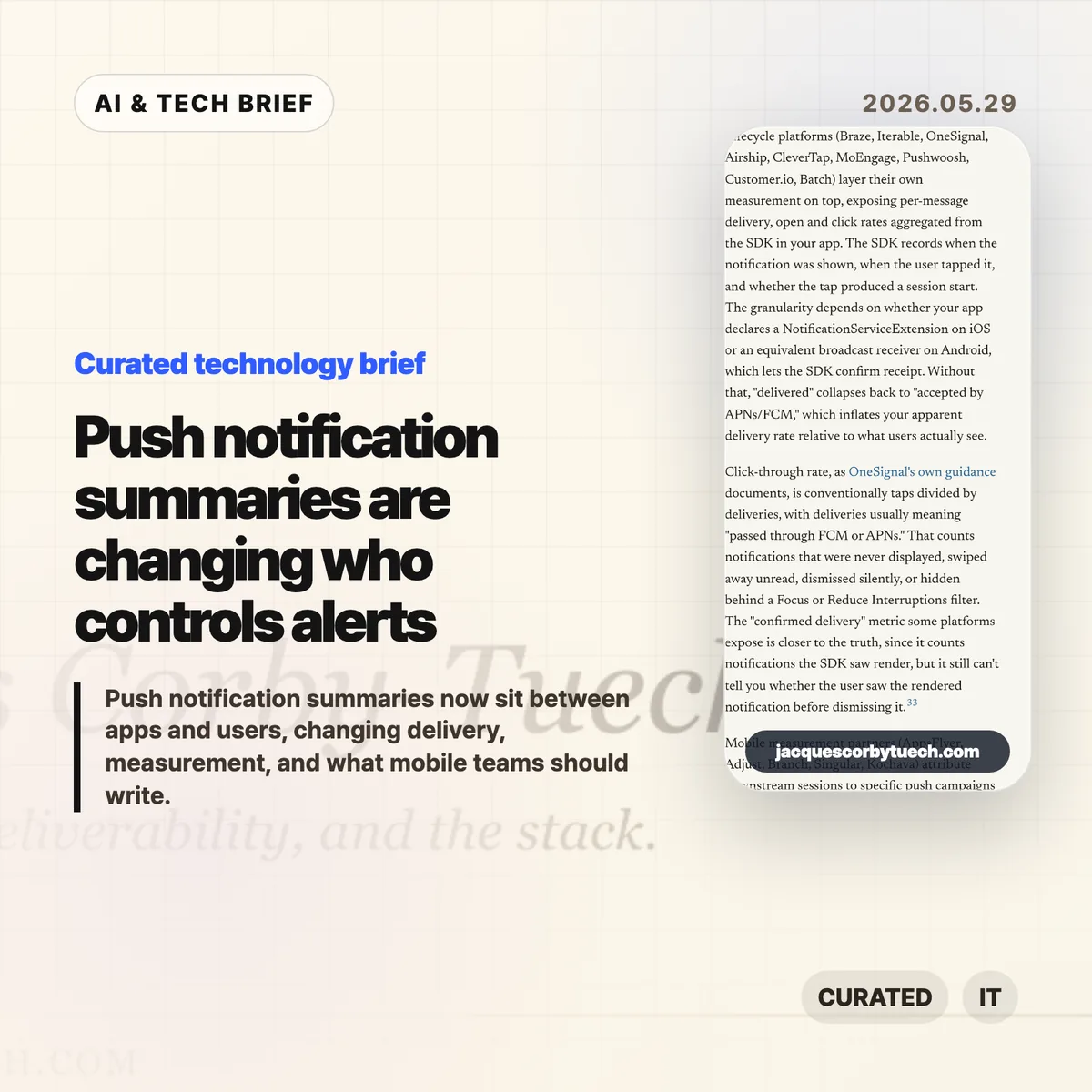
    Push notification summaries now sit between the app that sends an alert and the person who sees it. Apple and Google still run the delivery pipes through APNs and FCM, but the more interesting shift happens on the device, where Focus modes, notification channels, ranking systems, and AI summaries decide what appears on the lock screen.

    The short version

    • Apple and Google have always mediated mobile push through APNs and FCM, so the channel was never fully owned by app teams.
    • The newer layer is editorial: iOS and Android can group, delay, rank, or summarize notifications after delivery.
    • Push notification summaries make vague marketing copy riskier because the operating system may compress it into something less accurate or less persuasive.
    • Hacker News readers mostly sided with users, arguing that promotional pushes created the conditions for platform-level filtering.
    • App teams should measure downstream behavior, keep transactional alerts clean, and build owned surfaces such as in-app inboxes for anything important.

    What happened

    Jacques Corby-Tuech argues that push notifications are following the same path as email: a channel that once looked like transport is becoming an actively managed surface. On iOS, every third-party alert passes through Apple’s push service. On Android, it passes through Google’s Firebase Cloud Messaging or its predecessors. That architecture has existed for years, but the visible editing layer has become much stronger.

    The article traces the shift from battery-saving infrastructure to user and platform control. Android 8 introduced notification channels in 2017. iOS 15 added Focus modes, Scheduled Summary, and interruption levels. Android 13 made notification permission an explicit runtime grant. Apple Intelligence and Google’s Gemini Nano add another layer by summarizing, ranking, and organizing text on the device.

    The point is not that every alert gets rewritten. The point is that app teams can no longer assume that “delivered” means “shown as written.” For more coverage of mobile and AI platform shifts, see the IT & AI archive.

    Why this is worth watching

    Push notification summaries matter because the last mile is no longer just a UI template. The operating system can decide whether an alert belongs in a quiet batch, whether it looks time-sensitive, whether it should be grouped with other messages, or whether an AI-generated line is a better lock-screen representation than the sender’s original copy.

    How push notification summaries change control

    That creates an awkward measurement problem. APNs or FCM delivery tells a team that the platform accepted the message. It does not tell them whether the user saw it, whether a Focus mode hid it, whether Android organized it into a lower-priority bucket, or whether an AI summary changed its meaning. The old email lesson applies here: proxy metrics can survive long after they stop measuring what teams think they measure.

    It also changes copywriting. “Big update today” is easy to compress badly. “Your 6 p.m. delivery moved to 6:30” gives the system less room to blur the point. Amounts, names, times, status changes, and direct next actions are more likely to survive summarization than brand tone or urgency language.

    What Hacker News readers are arguing about

    The Hacker News thread was lively, with more than 300 comments, and the strongest reaction was not sympathy for marketers. Many readers framed push as a user-owned surface, not a sender-owned channel. Their practical stance was simple: transactional alerts are useful, promotional alerts are usually spam, and app teams have abused that trust often enough that platform filtering feels deserved.

    A second camp accepted the author’s broader platform-power concern but wanted the blame spread around. Several commenters argued that Apple and Google have too much arbitrary control over users and developers, yet also said that users need stronger defaults because most people will not tune every app’s notification settings. In that view, platform mediation is a messy defense mechanism rather than a clean win.

    The most useful operator thread came from people who have worked at scale. One commenter described monitoring push delay, suppression, and coalescing at WhatsApp years before today’s AI summaries. That is a good reminder: push was never a guaranteed real-time pipe. The newer concern is that the intervention is becoming more semantic. It is not only “when does this arrive?” but “what does the user actually read?”

    The practical read

    If you run a mobile product, separate alerts by user intent before the platform does it for you. Transactional messages, account security, delivery changes, chat, rides, timers, and live events should live in clean channels with plain copy. Promotional pushes should be opt-in, easy to turn off, and measured by clicks or downstream actions rather than delivery counts.

    Treat push notification summaries as a constraint on product writing. Put the non-negotiable fact first. Avoid clever subject lines that only make sense with the full body. Do not rely on repeated reminders to create urgency. If a message matters after the lock screen disappears, put it somewhere durable inside the app.

    The app-store angle is easy to miss. Notification behavior now affects retention, reviews, permission prompts, and whether users trust the app enough to keep alerts enabled. For app builders, that makes push design part of the product’s discovery and retention surface, not a growth hack bolted on after launch.

    Sources

  • AI productivity should buy back Friday before output

    AI productivity should buy back Friday before output

    AI productivity is usually sold as faster work, cheaper work, or more work. Mike Su asks the more awkward question: if AI can turn a week of white collar output into a much shorter sprint, can workers take Friday off? The post is short and playful, but the argument lands because it goes straight at the missing line in most AI adoption decks: who gets the saved time?

    The short version

    • Mike Su’s “Can we have the day off?” asks whether claimed 10x AI productivity should translate into a four-day workweek for white collar workers.
    • The strongest version of the argument is about distribution, not model capability. If AI agents compress work, employees will ask for time, pay, or both.
    • Hacker News readers turned the joke into a labor debate: some saw a serious bargaining question, while others argued market competition will push companies to demand more output instead.
    • For builders, the product lesson is blunt. AI tools that only promise management more throughput may make employees feel less secure, even when the software is useful.

    AI productivity and the four-day workweek

    Su’s post starts from a familiar claim: AI is supposed to raise white collar productivity by a large multiple. If that premise is true, he asks, why should the gain only appear as more output for the employer?

    The concrete proposal is deliberately simple. People work Monday through Thursday. On Thursday they prepare prompts and tasks. On Friday, AI agents keep working while the humans take the day off. It is partly a joke, but it exposes a real gap in the current workplace conversation.

    Most companies talk about AI productivity as capacity. Ship faster. Write more. Support more customers. Close more tickets. Employees hear a different message: use the same hours to do more, with no guarantee of higher pay, more leave, or better job security.

    That is why the Friday framing works. It turns an abstract productivity claim into a payroll and calendar question.

    What happened

    The original essay, published on May 27, 2026, is a short personal blog post titled “Can we have the day off?” Su writes that if AI can produce the same work in a fraction of the time, then a four-day schedule should be a reasonable ask. He even imagines Friday as an “AI workers’ day,” where agents run while humans are out of the office.

    The post does not present a benchmark or a policy plan. It is closer to a pressure test for the way AI is being marketed inside companies. If executives believe AI can multiply output, employees can reasonably ask whether some of that gain becomes time off.

    That makes the piece useful beyond the joke. For more IT and AI workplace briefs, the IT & AI archive tracks similar shifts in automation, developer tools, and product operations.

    Why this is worth watching

    AI productivity gains are easy to claim and hard to divide. A team can adopt coding assistants, research agents, summarizers, and workflow bots without ever agreeing on what happens to the saved hours.

    That silence creates a management problem. If a company tells employees that AI will make them vastly more productive, but keeps the same schedule and raises the output target, the tool starts to look like surveillance with a nicer interface. If the company offers a share of the gain, through shorter workweeks, better compensation, or fewer low-value tasks, adoption has a better chance of feeling like a deal instead of a threat.

    The four-day workweek is only one possible answer. The larger question is whether AI productivity becomes a worker benefit, an owner benefit, or a mix of both. That question will shape how teams talk about agents, copilots, and automation over the next few years.

    What Hacker News readers are arguing about

    The Hacker News thread was large: more than 1,300 points and hundreds of comments when checked. The first serious thread picked up the post’s main point almost exactly. If employees help introduce AI into their workflows, one commenter argued, they should ask what they get in return: days off, higher pay, or some other concrete share of the gain.

    A second camp was more cynical. They argued that productivity gains usually flow to owners, especially when workers are worried about layoffs. Several comments connected the issue to older automation cycles: computers, software, and the internet made many tasks faster, but the standard workweek did not shrink much for most employees.

    The useful objection in the discussion is competition. Some readers argued that a company offering Fridays off could be outpaced by rivals that use AI to work faster all week. Others pushed back, pointing out that many companies already waste huge amounts of time on busy work, weak coordination, and rework. More hours do not automatically mean more useful output.

    There was also a policy thread. Some readers moved from employer-level bargaining to unions, worker protections, taxes, UBI, and social safety nets. That jump matters because it suggests the four-day workweek may be hard to win company by company if the market rewards whoever turns AI into raw output first.

    Treat the thread as sentiment, not proof. But the sentiment is clear enough: workers are starting to ask whether AI productivity will give them leverage or simply raise the bar.

    The practical read

    If you run a team, do not pitch AI productivity only as acceleration. Say what happens to the saved time. Will it reduce after-hours work? Remove recurring busy work? Change sprint scope? Create a trial four-day schedule after the team proves the workflow? Vague promises will not survive contact with calendars.

    If you build AI tools, this is a product positioning issue. A tool that says “your manager can get 10x more from you” and a tool that says “your team can finish the same work with fewer wasted hours” may have similar features, but they land very differently.

    For employees, the move is to make the bargain explicit. Track which tasks AI actually shortens, how much review work remains, and where quality still depends on humans. Then ask for a share of the gain in terms that can be measured: time off, compensation, narrower scope, or fewer low-value meetings.

    AI productivity will not automatically create a shorter workweek. Someone has to ask for it, price it, and design the workflow around it.

    Sources

  • The orchestration tax is the real limit on AI agents

    The orchestration tax is the real limit on AI agents

    The orchestration tax is Addy Osmani’s name for the cost developers pay when many AI agents produce work faster than one human can review it. The pitch for agentic coding often starts with parallelism. The harder question is what happens when every result still has to pass through one person’s judgment.

    The short version

    • The orchestration tax appears when launching AI agents is cheap but reviewing their output is still slow.
    • Osmani argues that the scarce resource is not agent runtime. It is the developer’s attention.
    • More agents can deepen the review queue instead of increasing merged, reliable work.
    • The useful operating rule is backpressure: scale agents to review capacity, not to whatever the UI allows.
    • This matters for builders of agent tools because workflow design may matter more than raw parallel execution.

    What happened

    Addy Osmani, a Google Cloud AI director and longtime developer advocate, published a short article on X titled “The Orchestration Tax.” It grew out of a Google I/O panel with Richard Seroter, Aja Hammerly, and Ciera Jaspan about where software engineering is going as AI agents become normal parts of the development workflow.

    His argument is blunt: starting more AI agents is easy, but there is still only one person reading the diffs, resolving conflicts, and deciding whether the work fits the system. That makes the human reviewer the serial resource in an otherwise concurrent system.

    Osmani uses two familiar software ideas to frame the problem. The first is Python’s Global Interpreter Lock: many threads can exist, but work that needs the lock still runs through one choke point. The second is Amdahl’s Law: parallel speedup is capped by the part of the process that cannot be parallelized. In agentic software development, he says, that serial part is judgment.

    Why this is worth watching

    The orchestration tax is useful because it moves the AI agent debate away from demos and toward throughput. A dashboard full of active agents can feel productive. That does not mean the team is shipping better code.

    The risk is cognitive debt. If developers accept agent output because forming an independent opinion has become too tiring, they lose the mental model of their own codebase. The failure may not show up on the same day. It shows up later, when production breaks and nobody can explain why the system works that way.

    Osmani’s practical advice is closer to systems design than personal discipline. Use backpressure. Keep the parallel agent count low enough that reviews stay real. Split work into two piles: isolated tasks that can run in the background, and complex tasks where the human judgment is the work. Batch reviews instead of constantly context-switching between half-finished threads.

    That framing is also relevant to the broader IT & AI archive, where the pattern keeps repeating: the biggest gains from AI tools often depend on the boring workflow around the model.

    What Hacker News readers are arguing about

    There is a Hacker News submission for the piece, but it had no meaningful discussion at the time this brief was prepared. That silence is still mildly interesting. The post is not a benchmark launch or a new model release, so it does not trigger the usual speed-and-capability fight.

    The useful debate to have is more operational: how many agents can one engineer review without lowering standards, and what evidence should an agent produce before a human spends attention on it? Tests, screenshots, small diffs, and clear handoff notes are not glamorous. They are what make agent work reviewable.

    A fair skeptical view is that “orchestration tax” may just be a new label for old engineering management problems: code review queues, merge conflicts, and context switching. That is partly true. The new part is the imbalance. AI agents make it much easier to create parallel work than to create parallel understanding.

    The practical read on orchestration tax

    If you run AI coding agents, treat review attention as a capacity limit. Start with one or two concurrent agents on contained tasks. Require each agent to produce evidence before you review the result: a passing test, a screenshot, a concise change summary, or a small diff that can be understood in one sitting.

    Do not use agent count as the success metric. Use merged work that you still understand. If the queue grows faster than you can review it, reduce the fleet. The orchestration tax is paid either way; the choice is whether you pay it deliberately in workflow design or later through shallow reviews and stale system knowledge.

    For product teams building agent platforms, the lesson is awkward but valuable. The winning feature may not be “run 20 agents.” It may be better batching, clearer review packets, dependency boundaries, and defaults that protect the human reviewer from becoming the bottleneck nobody wants to measure.

    Sources

  • Stack Overflow AI is turning a fading forum into a data business

    Stack Overflow AI is turning a fading forum into a data business

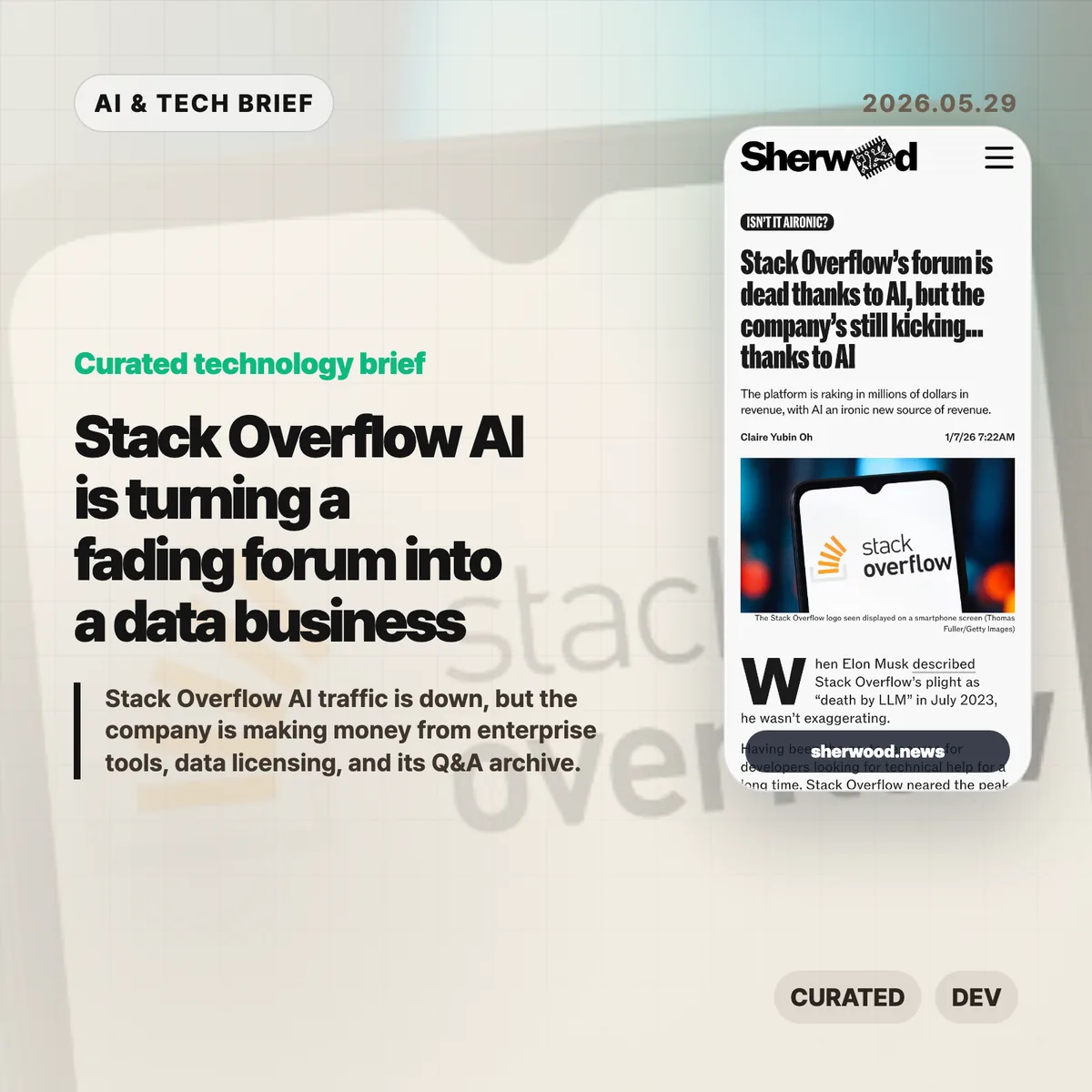
    Stack Overflow AI is a strange story: the public forum is quieter, but the company is not dead. Sherwood reports that Stack Overflow recorded only 6,866 questions last month, while annual revenue has roughly doubled to about $115 million as the business leans on enterprise products and data licensing.

    The short version

    • Stack Overflow’s question volume has fallen close to its 2008 launch-era level, according to Sherwood’s report.
    • The company is still generating about $115 million in annual revenue, with losses down from $84 million in FY2023 to about $22 million in the latest fiscal year.
    • The business has moved toward enterprise tools such as Stack Internal and licensing its developer Q&A archive to AI companies.
    • The uncomfortable part is the loop: AI systems learned from public developer knowledge, but their chat interfaces now keep many new answers out of the public web.

    What happened

    Sherwood’s piece frames Stack Overflow as one of the clearest examples of AI changing developer behavior. Developers who once searched, drafted a question, waited for replies, and left a searchable trail now ask ChatGPT, Claude, Cursor, Gemini, or Copilot first.

    That hurts the forum. A month with 6,866 questions is not a healthy signal for a site that became the default place to solve programming problems. It also changes how new software knowledge gets written down. A private answer in a chat window may solve one person’s bug, but it does not help the next person who hits the same error message.

    The company story is different. Sherwood says Stack Overflow has cut losses and shifted revenue away from forum advertising. Its enterprise product Stack Internal packages company knowledge with a Q&A-style workflow, and Stack Overflow also licenses its data to AI companies that need high quality coding examples and human-curated answers.

    Why this is worth watching

    Stack Overflow AI matters because it shows how a community can lose activity while its archive becomes more valuable. That is not a clean win. It is closer to a salvage model: the old community created a data asset, and the company is now finding buyers for that asset while the public habit that refreshed it weakens.

    Stack Overflow AI and the open-web loop

    For builders, the lesson is blunt. Traffic is not the only asset a technical community creates. Clean answers, reputation signals, accepted solutions, comments, duplicates, and edits all become structured knowledge. That kind of material is useful for retrieval systems, coding assistants, internal copilots, and model evaluation.

    The risk is decay. If fewer developers ask and answer in public, the archive gets older. Libraries change. APIs move. Frameworks break old advice. The AI tools that made the forum less necessary still need fresh, checked, human-written material to stay useful. That loop should worry anyone building on top of public web knowledge.

    This is also why developer tool companies should watch the business model, not only the traffic chart. A product that looks weaker as a destination can still become infrastructure. For more coverage of AI and developer platforms, see the IT & AI archive.

    What Hacker News readers are arguing about

    There is not much of an argument yet. The Hacker News submission exists, but the thread had only 3 points and no comments when checked. That absence is useful in its own way: the story is more developed in the source reporting than in the public discussion around it.

    If a real thread forms later, the useful debate will probably center on three questions. First, whether Stack Overflow’s decline is mostly AI substitution or partly the result of old moderation and onboarding problems. Second, whether licensing community-written answers to AI companies is fair to the people who created the archive. Third, whether private coding assistants are quietly starving the open web of fresh troubleshooting records.

    Those are not abstract complaints. They affect how future developers discover answers, how communities reward contributors, and how AI vendors get the next round of reliable programming data.

    The practical read

    If you run a developer community, Stack Overflow AI is a warning against treating posts as disposable traffic. The durable asset is the knowledge graph around the answers: who corrected what, which answer survived scrutiny, which question was a duplicate, and which explanation still works after a few release cycles.

    If you build AI coding tools, this story is a reminder that source quality matters. A model that answers from stale examples can save time today and create worse bugs tomorrow. Product teams should test answers against current docs, not only old public threads.

    If you are a developer, the practical habit is simple. Use the assistant, but publish the hard-won fix when the answer took real work. A short issue comment, a docs PR, or a public Q&A answer keeps the next person from solving the same problem alone.

    Sources