Category: IT & AI

  • Developer tools that stick usually solve boring pain

    Developer tools that stick usually solve boring pain

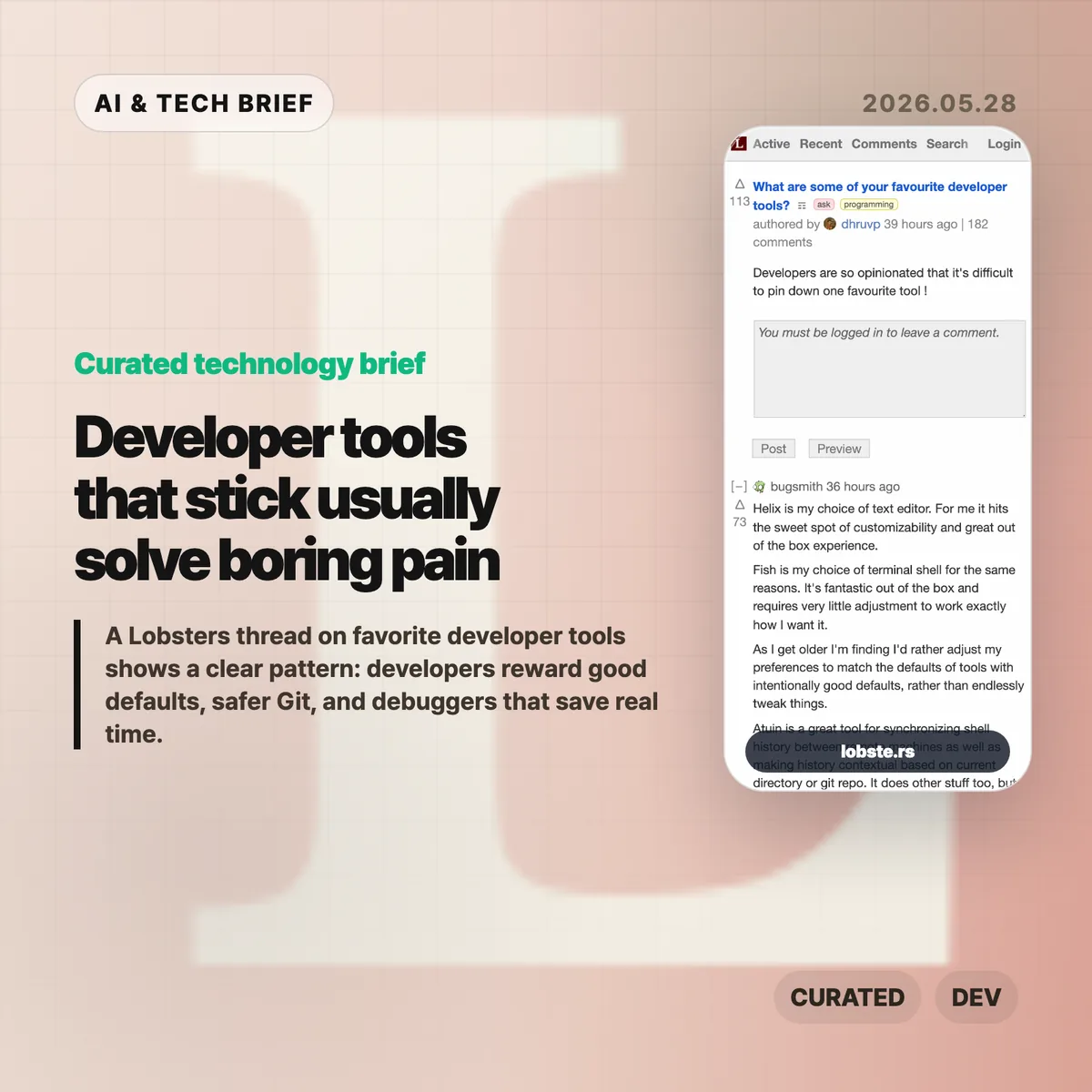
    A long Lobsters thread about favorite developer tools turned into a useful map of what developers actually keep using. The names are scattered across editors, shells, Git front ends, environment managers, and debuggers, but the pattern is fairly consistent: good tools remove friction without demanding a new hobby.

    The short version

    • Editors did not converge on one winner. Helix, Emacs, Neovim, Sublime Text, Zed, and JetBrains IDEs all came up, usually with strong opinions about defaults and muscle memory.
    • Version control comments leaned toward tools that make risky Git work feel safer, including Jujutsu, Magit, lazygit, Sublime Merge, delta, and difftastic.
    • Shell and environment picks such as Fish, WezTerm, Ghostty, tmux, Nix, mise, atuin, and fzf show how much developers care about repeatable setup.
    • The most practical answers were often about debugging and profiling: rr, Pernosco, RenderDoc, Tracy, RemedyBG, and Xcode Instruments.

    Developer tools worth keeping

    The useful developer tools in this discussion share a boring promise: they make daily work safer, faster, or easier to repeat without turning setup into the main project.

    What happened

    A Lobsters user asked a simple question: what are some of your favorite developer tools? The thread drew more than a hundred comments, which is not surprising for a community that can turn editor choice into a personality test.

    The interesting part is that the answers were not only about shiny new tools. Many developers praised tools that feel good out of the box. Helix and Fish came up that way. Several commenters said they now prefer tools with intentional defaults because they have less patience for endless configuration. Others pushed back, arguing that a carefully tuned Emacs or Vim setup can pay off for years.

    That tension says more than any single ranked list would. Some developers want defaults they can trust. Some want a tool chest they can shape over a decade. Both camps are trying to protect the same thing: attention.

    Why this is worth watching

    The thread is a useful reminder that developer productivity is rarely one big leap. It is usually a pile of small reductions in annoyance.

    Version control is a good example. Jujutsu, usually called jj, appeared repeatedly because it changes how people approach rebases, amends, branches, and history editing. Magit, lazygit, Sublime Merge, delta, and difftastic serve a similar need from different angles. They make state visible. They make diffs easier to read. They make undo and review feel less like a trap.

    Environment management came up for the same reason. Nix has a steep learning curve, but the developers who like it are tired of one project breaking another. mise drew praise for language and tool version management without much ceremony. Dev Containers and chezmoi sit in the same problem space: a laptop, a work machine, a remote server, and CI should not all feel like separate archaeological sites.

    The best answers were not always the flashiest ones. rr came up because being able to record a failing C or C++ program and replay it deterministically can save hours on memory corruption bugs. Pernosco adds time travel debugging with data flow analysis. RenderDoc and Tracy matter to graphics and performance work. JetBrains users praised the IDE because its debugger and framework support keep them moving.

    What the discussion is missing

    There is no Hacker News thread attached to this story, and the Lobsters discussion is already the source material. That means the useful caution is not about missing crowd sentiment. It is about sampling.

    Lobsters skews toward developers who enjoy tools enough to discuss them in public. That naturally favors editors, shells, version control tools, language managers, and low level debugging workflows. Enterprise defaults, team policy, accessibility, onboarding cost, Windows-heavy shops, and non-English developer communities get less attention.

    The thread also underplays one awkward truth: a great individual tool can still be a poor team default. Nix may solve dependency drift for one group and become a support burden for another. Jujutsu may make history editing nicer for an experienced engineer while confusing someone who only needs basic Git. The right question is not “which tool won?” It is “which recurring failure does this remove from my day?”

    The practical read

    If you are reviewing your own toolchain, start with the moments that waste time rather than the tools that sound fashionable. Slow search points toward ripgrep, fzf, or a better code search workflow. Messy shell history points toward atuin or autojump-style navigation. Git anxiety points toward lazygit, Magit, jj, Sublime Merge, delta, or difftastic. Reproducible setup problems point toward mise, Nix, Dev Containers, or a smaller dotfiles system.

    For teams, the thread argues for better defaults rather than forced sameness. You do not need every developer in the same editor. You do need a project that starts in minutes, a version control workflow people can recover from, and debugging tools that make the worst bugs less mysterious.

    For more briefs on software teams, AI products, and developer workflows, see the IT & AI archive.

    The dull test is the right one: does the tool get you back to the problem faster?
    Sources

  • AI productivity claims are running ahead of the work

    AI productivity claims are running ahead of the work

    TechCrunch’s report on Aaron Levie’s warning about “AI psychosis” among CEOs lands because it names a familiar gap: executives see a strong demo, while teams still have to make the work correct, safe, and shippable. AI productivity claims can sound persuasive before that last-mile work is counted. The issue is not whether AI agents are useful. They are. The question is whether companies can tell the difference between a good prototype and a finished business process.

    The short version

    • Box CEO Aaron Levie argued that CEOs are especially vulnerable to overestimating AI because they sit far from the last mile of work.
    • Layoffs.fyi counted 115,430 tech layoffs across 152 companies in the first five months of 2026, close to the 124,636 total it tracked for all of 2025.
    • ClickUp CEO Zeb Evans said the company cut 22% of staff after deploying roughly 3,000 AI agents, a useful case study in how quickly the narrative is moving.
    • The hard part is measurement: more drafts, tickets, pull requests, or proposals do not automatically mean better output.
    • Hacker News readers mostly argued about two things: whether “psychosis” is a fair label, and whether executives understand the review work that AI creates.

    What happened

    The TechCrunch piece starts with Levie’s claim that CEOs are “uniquely prone to AI psychosis” because they are far enough away from frontline work to miss the remaining labor needed to turn AI output into value. That is the sharpest point in the article. A CEO can ask an agent to draft a contract, generate HTML, summarize a customer call, or produce a product mockup. Those outputs can look convincing in a meeting. They still need review, context, policy checks, security judgment, and someone willing to be accountable when the answer is wrong.

    The article also puts that argument next to a rough labor-market backdrop. Layoffs.fyi’s tracker shows 115,430 tech layoffs from 152 companies in the first five months of 2026. That does not prove AI caused the layoffs. It does show why the story is sensitive: AI is becoming part of the language companies use when they explain smaller teams, faster execution, and new operating models.

    ClickUp is the most concrete example in the report. CEO Zeb Evans said the company had deployed about 3,000 AI agents and reduced staff by 22%, while trying to build what he called a “100x org.” That framing is exactly why this debate matters for builders. If agents become part of the org chart, companies need a much better answer to a basic operating question: who reviews the agent’s work, and what happens when the agent is confidently wrong?

    Why this is worth watching for AI productivity claims

    The useful read is that AI adoption is moving faster than AI measurement. A team can count how many agent runs completed. It can count the number of documents, tickets, or pull requests generated. Those are activity metrics. They do not say much about whether the work reduced customer pain, lowered error rates, increased revenue per employee, or freed experts from low-value chores.

    That distinction matters because the research record is still mixed. California Management Review’s summary of AI productivity evidence warns against easy claims that AI adoption produces broad productivity gains by itself. An NBER paper on executives and AI productivity points to a gap between perceived gains and measured outcomes. MIT FutureTech’s labor-task research also suggests that many tasks remain harder to automate at human-level quality than the demo cycle implies.

    The management bottleneck may simply move. Harvard Business Review has made a similar point: if AI increases the volume of output, managers can become the constraint because more work needs to be read, compared, approved, or rejected. Anyone who has reviewed AI-generated code or AI-written legal text knows the pattern. The first draft arrives faster. The expensive part is deciding whether it can be trusted.

    For more briefs on AI products, software teams, and workplace automation, see the IT & AI archive.

    What Hacker News readers are arguing about

    The Hacker News thread around the TechCrunch article is active and messy in the usual useful way. A large part of the discussion focuses on the word “psychosis.” Some readers called it clickbait or a cheap use of medical language. Others defended it as a cultural shorthand for executives becoming detached from what AI can actually do. The split is worth noting because it mirrors the broader AI debate: people agree there is overconfidence, then fight over how harshly to name it.

    The more practical thread is about distance from the work. Several commenters argued that this is not new. Executives have long seen a toy example, assumed the hard part was solved, and pushed a rollout that frontline teams had to absorb. The AI-specific twist is that LLMs can flatter the user while producing a plausible artifact. A CEO who prompts a chatbot into a small front-end demo may come away feeling closer to engineering than they really are.

    There was also a strong operator objection: AI can create review debt. One commenter described a CEO who hit real walls around data architecture and deployment after experimenting with AI prototyping. That is the sane version of the story. The tool helped explore an idea, then exposed the need for human-designed infrastructure. Another repeated concern was failure rate. If a model gets 80% or 90% of text tasks right, the remaining errors can still be disastrous in legal, security, finance, support, or production engineering contexts.

    The thread is not evidence, but it is a useful sentiment check. Builders are not rejecting AI agents outright. They are rejecting the jump from “this generated something impressive” to “this can replace the people who know where the traps are.”

    The practical read

    Companies should treat AI productivity claims like product claims. Define the workflow, the baseline, the quality bar, and the failure mode before tying the result to headcount. If an agent writes support replies, measure refund errors, escalation rates, customer satisfaction, and policy violations. If it writes code, measure review time, defect rate, rollback frequency, and maintenance cost. If it drafts contracts, measure legal review burden and clause-level risk.

    For AI agent startups and workplace apps, the pitch also needs to mature. “We deployed 3,000 agents” is a flashy number, but buyers will eventually ask which agents survived contact with real work. The products that win will probably be the boring ones that make review easier, preserve audit trails, route uncertain cases to humans, and prove that cycle time improved without hiding risk.

    For workers, the signal is more personal. The safer skill is not prompt fluency by itself. It is judgment over the last 20%: checking the output, knowing the domain constraints, spotting the quiet mistake, and deciding when automation should stop.

    Sources