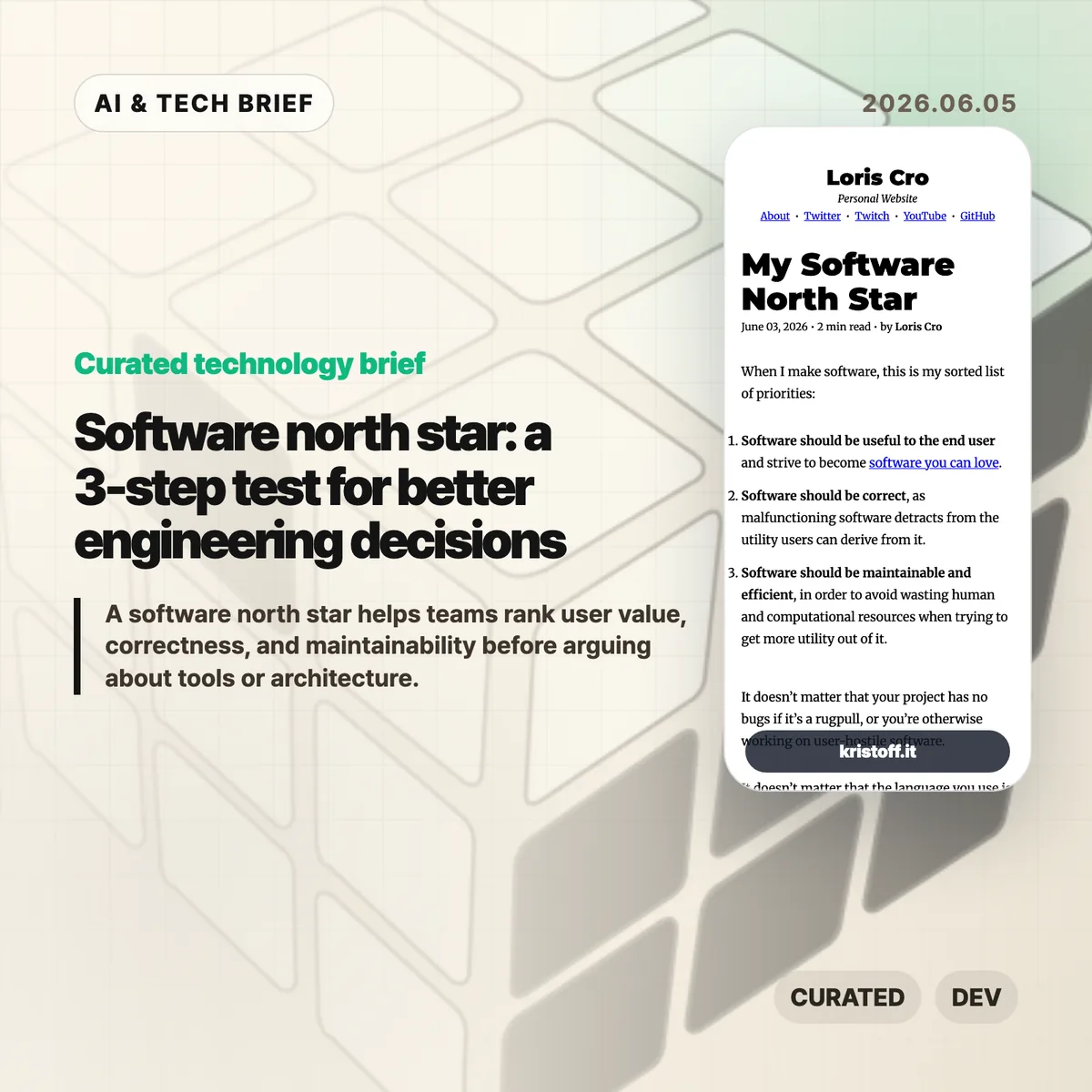
A software north star is a ranking system for engineering tradeoffs, not a slogan for a team poster. Loris Cro’s short post, “My Software North Star,” argues that useful software comes first, correct software comes second, and maintainable, efficient software comes third. That order is a useful check when teams start arguing about languages, architecture, performance, or developer experience before they have settled what the user actually gets.
Table of Contents
The short version
- Loris Cro published “My Software North Star” on June 3, 2026 as a two-minute post with three ranked priorities: usefulness, correctness, then maintainability and efficiency.
- A software north star gives teams a practical order for decisions about languages, rewrites, abstractions, performance, and developer tools.
- The post treats user-hostile software as a failure even when the code has few bugs, which makes it more pointed than a generic quality checklist.
- The Hacker News discussion was tiny, with 7 points and one substantive comment, but the objection centered on whether memory safety and guardrails deserve more weight.
- Product and engineering teams can use the frame before approving work that feels technically attractive but does not improve the product users touch.
What happened
Loris Cro published “My Software North Star” on June 3, 2026. The post is only a few minutes long, but it lays out a compact hierarchy for software work: software should be useful to the end user, software should be correct, and software should be maintainable and efficient.
The examples matter. Cro says a bug-free project still fails the test if it is a rug pull or otherwise hostile to users. He also argues that a memory-safe language does not replace design for correctness or a process that leads teams to fix bugs. The same logic applies to elegant abstraction: a beautiful internal structure is still a problem if the software is unbearably slow or nobody can maintain it.
That makes the post less about one programming language and more about priority order. The claim is not that correctness, memory safety, maintainability, or performance are secondary in the casual sense. The claim is that those engineering goals earn their place by protecting the user’s ability to get value from the software.
Why software north star is worth watching
A software north star is worth watching because it gives engineering teams a fixed order for tradeoffs that usually get argued one at a time. Cro’s June 2026 list starts with end-user usefulness, then correctness, then maintainability and efficiency. That order forces a team to explain whether a safer language, cleaner abstraction, faster build, or lower cloud bill helps users get something valuable without leaving the product harder to trust or improve.
The frame also pushes back on a common developer habit: treating internal elegance as proof of product quality. Code can be clever, well typed, well tested, and still serve a bad product. Code can also be messy enough to hurt future users because every change becomes risky. The priority order makes both failures visible. It gives product managers and engineers a shared language for saying, “this may be technically attractive, but it does not move the top priority.”
For more technology briefs on engineering tools and AI product work, see the IT & AI archive.
What does software north star change for builders?
A software north star changes the order of review for builders. Before approving a rewrite, framework migration, performance project, or developer-tooling investment, a team can ask Cro’s three questions in order. What user value improves? What correctness risk falls? What future maintenance or efficiency burden changes?
That order is useful for app builders because mobile and web products often mix product pressure with engineering cleanup. A new onboarding flow may matter more than an internal refactor if users cannot reach the feature. A correctness fix may beat a cosmetic redesign if bad state or wrong calculations damage trust. A performance project may be the right call when slow screens waste user time or raise infrastructure costs.
The point is not to block engineering work until a product manager can attach a revenue number. It is to keep technical work connected to the product people use. If a developer-experience investment helps teams ship safer changes faster, it fits the north star. If it mainly makes the codebase feel nicer while users keep hitting the same broken path, it should wait.
What Hacker News readers are arguing about
The Hacker News thread was small: the main submission had 7 points and one substantive comment when checked through the public item data. That makes it a weak signal, not a community consensus.
The comment’s useful objection was about guardrails. The reader interpreted Cro’s memory-safety example as too dismissive of Rust or safety-oriented language design, arguing that teams that care about correctness should want as many guardrails as practical. That is a fair tension to surface. Cro’s post says memory safety is not enough without correctness-oriented design and bug-fixing processes. The commenter pushes the other side: guardrails still reduce classes of failure, even when process and design remain necessary.
The better reading is that these positions do not have to conflict. Memory safety can be one strong tool inside the second priority, correctness. It just cannot become the whole north star. A team still has to decide whether the product is worth building, whether it behaves correctly for users, and whether humans can keep it alive after the first clean implementation.
The practical read
Use Cro’s list as a meeting filter. If a technical proposal cannot explain the user benefit, the correctness gain, or the maintainability and efficiency improvement, the proposal probably needs more work. That does not mean every task must be customer-facing. Test infrastructure, type systems, observability, and internal tools can all fit the model when they help teams protect users from broken software or keep improving a product without burning out.
The trap is treating the order as permission to ignore the bottom of the list. Maintainability and efficiency come third, but they still matter. Slow, expensive, or hard-to-change software eventually reaches users as delays, outages, pricing pressure, or abandoned features. Cro’s ranking works because it keeps the chain intact: build something useful, make it correct enough to trust, and keep it healthy enough that the team can continue delivering value.