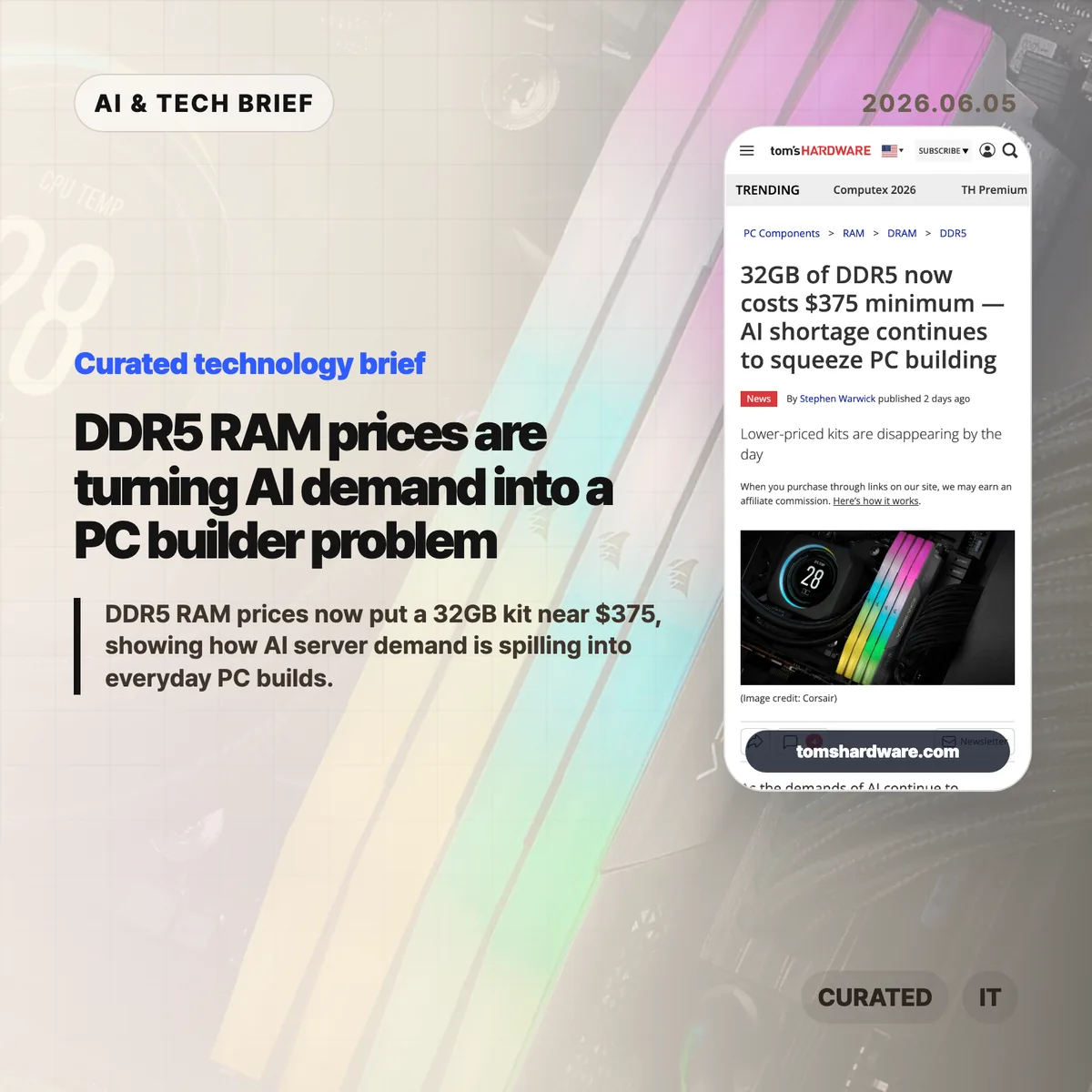
DDR5 RAM prices have moved from a boring parts-list line item to one of the main reasons a new PC build feels expensive. Tom’s Hardware reported on June 3, 2026 that the cheapest available 32GB DDR5 kit had reached $374.97, according to price tracking from PCPartPicker and retailers cited in the article.
Table of Contents
The short version
- A 32GB DDR5 kit now starts near $375, a sharp change from the sub-$100 kits many builders remember from 2025.
- The pressure is tied to AI infrastructure demand, because memory makers can earn more by serving data center and high bandwidth memory buyers.
- The squeeze is not limited to RAM. Storage prices and platform choices are getting harder for PC builders too.
- Hacker News readers mostly treated this as a real consumer pain point, then argued over whether AI demand, tariffs, panic buying, or industry capacity planning deserves more blame.
What happened
Tom’s Hardware says lower-priced DDR5 kits are disappearing quickly from the consumer market. The article points to 32GB DDR5 kits around $375, 64GB kits around $679.99, and even 16GB options that no longer feel like a cheap compromise once taxes and retailer availability are included.
That matters because 32GB is no longer a luxury target for many desktop buyers. Games, browsers, local development environments, virtual machines, creator tools, and small local AI workflows can all make 16GB feel tight. A few years ago, builders could often treat RAM as the part they filled in after choosing a CPU and GPU. In 2026, DDR5 RAM prices can change the whole platform decision.
The source article frames the jump as part of a wider AI supply squeeze. Data center buyers are competing for memory, storage, and manufacturing capacity. Memory producers have a reason to prioritize higher margin server products and HBM-related demand when AI clusters keep expanding. Consumer DDR5 then gets whatever supply remains, and the cheapest kits disappear first.
For more IT and AI hardware coverage, see the IT & AI archive.
Why this is worth watching
DDR5 RAM prices are a clean consumer signal for the cost of the AI buildout. GPU shortages are easy to understand because AI companies buy GPUs directly. Memory is more revealing because it shows the secondary effects: servers need DRAM, HBM, SSDs, packaging capacity, factory time, logistics, power equipment, and cooling systems. Those demands touch the same industrial base that supplies home PCs.
The useful point is not that every expensive RAM kit is caused by one AI lab. The market is messier than that. Tariffs, retailer inventory, panic buying, channel markups, and normal semiconductor cycles can all move prices. Still, AI demand gives memory makers a higher value customer at the same moment consumers are asking for more RAM per machine.
That combination changes buying behavior. Builders who were planning a cheap 32GB upgrade may delay. Buyers with older DDR4 systems may stretch those machines longer. Mini PC, workstation, and home lab buyers may pay closer attention to bundled memory because the barebones price no longer tells the full story.
What do DDR5 RAM prices change for PC builders?
DDR5 RAM prices force PC builders to compare platforms by total cost, not by CPU benchmarks alone. A newer motherboard and CPU can look reasonable until the memory kit adds several hundred dollars. That makes older DDR4 platforms, used parts, prebuilt discounts, and bundles more attractive than they looked when RAM was cheap.
For developers, the tradeoff is sharper. Local containers, IDEs, browsers, test databases, and small model experiments can punish a 16GB machine. Dropping from 32GB to 16GB saves money on paper, but it can also turn daily work into swapping and closed tabs. The better question is whether the machine will still feel usable two years from now.
Gamers face a different version of the same issue. GPU prices still dominate many builds, but RAM and SSD inflation can eat the budget that would have gone to a better graphics card. If a build is not urgent, waiting may make sense. If it is urgent, the practical move is to compare a full parts list against a prebuilt system with memory already included.
What Hacker News readers are arguing about
The Hacker News discussion was less about whether the price spike is real and more about who gets the blame. Several commenters shared receipts or order history showing RAM kits that cost under $100 or $200 in 2023 to 2025 now selling for several times that amount. Others pointed to PCPartPicker trend charts and recent mini PC or Framework Desktop prices as evidence that the squeeze has reached normal buyers.
The most useful skeptical thread asked for a fuller explanation. Some readers wanted the article to separate hard supply constraints from price increases caused by anticipation, retailer behavior, tariffs, and panic buying. That is a fair objection. A spot price does not prove the whole causal chain, and secondhand markets can move for their own reasons.
Another camp treated the shortage as a reason to keep older machines alive. DDR4 platforms, AM4 systems, used parts, and machines bought before the run-up suddenly look better. A few readers turned the discussion into a broader complaint about software bloat: if memory is expensive again, developers may have to care more about how much RAM browsers, chat apps, and desktop software consume.
The practical read
DDR5 RAM prices do not mean every builder should stop buying PCs. They do mean the old shortcut of “just add 32GB” is gone for now. Treat memory as a first-class budget item, especially if the machine is for development, gaming, video work, virtual machines, or local AI experiments.
If you already own a stable DDR4 desktop, upgrading the CPU or GPU inside that platform may be cheaper than moving to a new DDR5 board. If you need a new machine, price the whole system before falling in love with a benchmark chart. Bundled RAM, prebuilt discounts, and refurbished workstations may beat a clean DIY parts list while retail kits stay inflated.
The thing to ignore is the idea that this is only a data center story. AI infrastructure spending is now visible in consumer hardware prices. The thing to watch is whether memory makers add enough capacity to relieve consumer supply, or whether they keep steering production toward the server buyers paying the most.