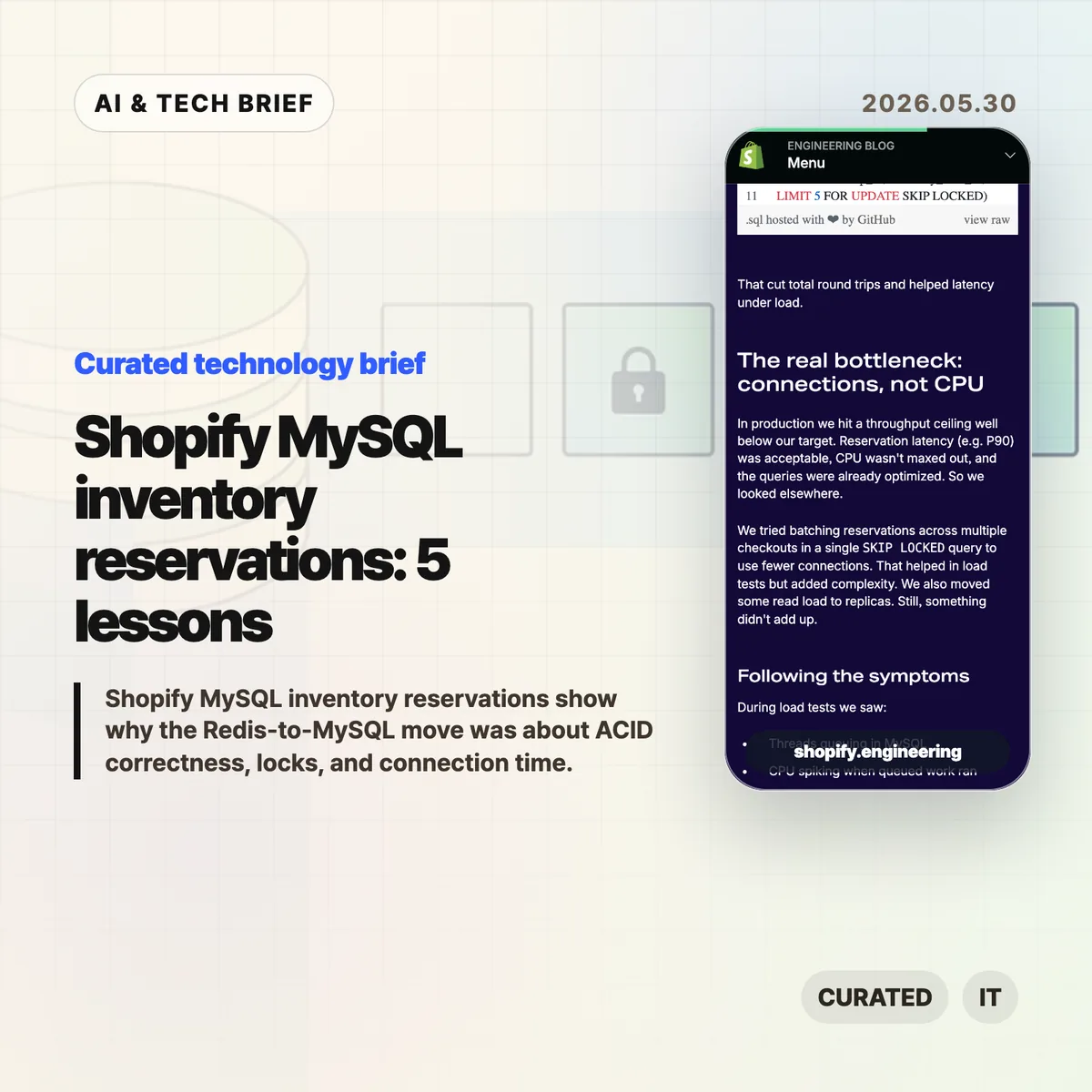
Shopify MySQL inventory reservations are a useful reminder that a database migration story can be less about raw speed than about removing awkward failure modes. Shopify moved checkout-time inventory holds from Redis into MySQL so reservations and the inventory ledger could live inside the same ACID transaction boundary. The interesting part is how much work it took around SKIP LOCKED, schema shape, isolation level, lock ordering, and connection visibility before the design held up at peak commerce traffic.
Table of Contents
The short version
- Shopify’s old Redis reservation system handled concurrency, but Redis and the MySQL inventory ledger could not be claimed in one atomic step.
- The MySQL design used one row per sellable unit, capped the available row pool at 1,000 per item/location pair, and relied on
SKIP LOCKEDto avoid waiting on rows another checkout had already taken. - The migration was not a blanket “MySQL beats Redis” claim. It worked because Shopify changed the data model, tuned transaction behavior, and instrumented the full checkout path.
- The surprising bottleneck was connection hold time, not simply reservation query latency or database CPU.
- Shopify says the system handled high-volume flash-sale traffic with writer CPU under 50% and reader CPU under 16% after cleanup and configuration changes.
What happened
Shopify published an engineering write-up explaining how it replaced a Redis-backed inventory reservation path with a MySQL design for checkout. The reservation step is the short hold that happens while a buyer is paying. If it is wrong, one buyer may purchase stock that no longer exists, or another buyer may be told an item is sold out when it is still available.
The old Redis model used operations like DECR and INCR on quantity keys. That was fast enough for concurrency, but it split the reservation state from the MySQL inventory ledger. Once payment succeeded, Shopify had to update MySQL and clean up Redis without a single atomic transaction across both systems.
The new design put reservations in MySQL. Instead of updating one quantity column for an item, Shopify represented sellable units as rows. A checkout that needs three units selects three rows, skips rows locked by other transactions, and moves the selected units inside the database transaction. That is the core of Shopify MySQL inventory reservations.
Why this is worth watching for Shopify MySQL inventory reservations
The practical lesson is that SKIP LOCKED is not magic dust. It only helped because Shopify changed the shape of the data. A single hot row with a quantity column still creates contention. A pool of unit rows gives MySQL something useful to skip.
Shopify also bounded the row pool. Keeping one row for every unit everywhere would explode for high-stock items, so the system caps available rows at 1,000 per item/location combination and uses a replenishment process to refill the pool from the ledger. That detail matters. It turns a clever locking trick into a design that can survive real catalog size.
The engineering work continued below the schema. Shopify moved the relevant transactions to READ COMMITTED to avoid gap-lock behavior that blocked replenishment, fixed deadlocks by enforcing a consistent table lock order, and batched multi-line carts with UNION ALL to reduce round trips. For readers who follow backend infrastructure, the broader IT & AI archive is useful because this is the kind of systems story where the headline undersells the operational work.
What Hacker News readers are arguing about
The public Hacker News submissions I found were quiet: low score, no comments on the linked discussion. So there is no meaningful community argument to summarize from that thread.
That silence is still telling in a small way. This is not a flashy framework launch or a new database benchmark. It is an operations-heavy post about transaction boundaries, lock behavior, and connection pools. The missing debate is the one backend teams should have internally: whether a separate coordination service is buying enough simplicity to justify the consistency and operating cost it adds.
If a team reads the Shopify story as “replace Redis with MySQL,” it will copy the least important part. The useful question is narrower: can the source of truth, the reservation state, and the failure recovery path sit inside one transaction without making the checkout path a bad neighbor for every other database workload?
The practical read
Shopify MySQL inventory reservations are worth reading before you add Redis, Kafka, or a custom lock service to a checkout path. The first check is not “which tool is faster?” It is “what state must change atomically, and where does that state live?”
For builders, the migration suggests five concrete checks:
- Model contention explicitly. If every buyer fights over the same row, the database choice will not save you.
- Test the isolation level you actually need. Default settings can be wrong for a narrow high-throughput path.
- Keep lock acquisition order boring and consistent.
- Measure connection hold time by caller, not only query latency.
- Roll out with shadow mode or dual writes when the old system is still the safer source of truth.
The app-builder angle is straightforward: checkout reliability affects conversion. For commerce apps, marketplaces, and inventory plugins, a reservation bug is not a backend detail. It can become a canceled order, a support ticket, or a merchant who stops trusting the platform.