Anthropic Series H is not a normal late-stage startup round. The company says it raised $65 billion at a $965 billion post-money valuation, while pointing to Claude demand, Claude Code adoption, and fresh compute deals with Amazon, Google, Broadcom, and SpaceX. The useful read is simple: frontier AI is now a capital-intensive infrastructure business, not only a model leaderboard contest.
Table of Contents
The short version
- Anthropic raised $65 billion in Series H funding at a $965 billion post-money valuation, led by Altimeter Capital, Dragoneer, Greenoaks, and Sequoia Capital.
- The company says Claude run-rate revenue crossed $47 billion in May 2026, up from $30 billion in early April and $14 billion in February.
- The new money is tied directly to compute expansion: up to 5 GW of Amazon capacity, 5 GW of Google and Broadcom TPU capacity, and access to SpaceX Colossus GPU capacity.
- The open question is quality of revenue. Run-rate revenue can show demand, but it does not answer margin, churn, customer concentration, or whether enterprise AI bills stay this high.
What happened
Anthropic announced that Anthropic Series H brought in $65 billion of new funding and valued the company at $965 billion after the round. The round was led by Altimeter Capital, Dragoneer, Greenoaks, and Sequoia Capital, with a long list of large investors and $15 billion of previously committed hyperscaler investment included in the total.
The company framed the raise around three uses: safety and interpretability research, more compute for Claude demand, and expansion of products and partnerships. It also said Micron, Samsung, and SK hynix joined as strategic infrastructure partners, which makes the supply-chain angle hard to miss. Memory, storage, logic chips, cloud capacity, and power are now part of the same story as model quality.
The compute commitments are large. Anthropic says it has signed for up to 5 GW of new capacity with Amazon, 5 GW of next-generation TPU capacity with Google and Broadcom, and access to GPU capacity in SpaceX’s Colossus 1 and Colossus 2. AWS remains its main cloud provider and training partner, but Claude is available across AWS, Google Cloud, and Microsoft Azure.
Why this is worth watching
The headline number is huge, but the better signal is what Anthropic is buying time to build. Claude demand is pushing the company toward long-term cloud, chip, and data-center commitments. That means the AI race is less like a software subscription fight and more like a logistics problem with expensive hardware attached.
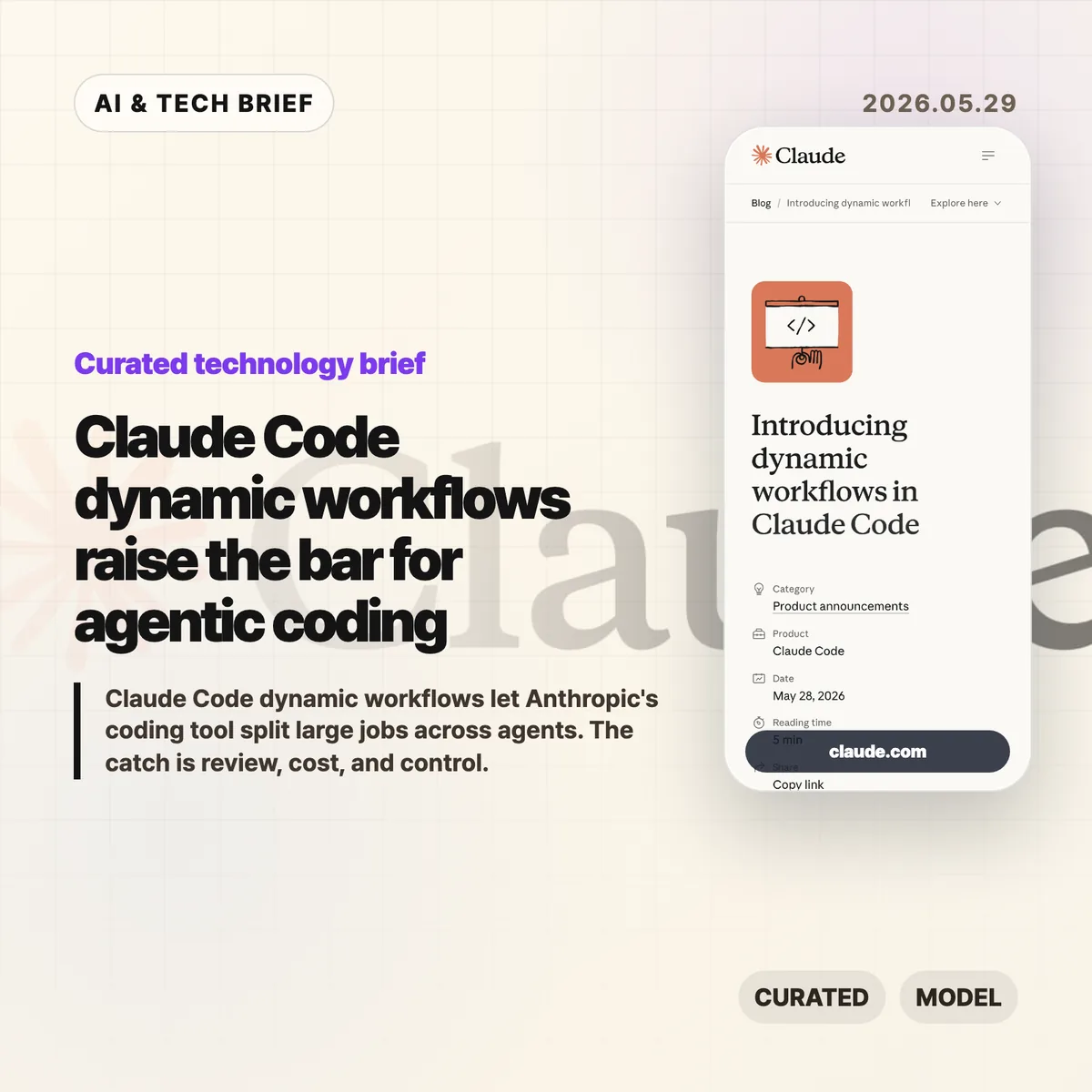
There is a product angle too. Anthropic named Claude Code and Cowork in the funding announcement. For builders watching the AI tool market, that matters because developer workflow usage can create heavy, recurring inference demand. If Claude Code keeps spreading inside companies, the question shifts from “which model is best today?” to “who can serve enough tokens at a price finance teams will tolerate?” For more AI and developer-tool coverage, see the IT & AI archive.
The semiconductor names are another clue. NVIDIA gets most of the public attention, but Anthropic’s announcement pulls memory and storage suppliers into the visible partnership stack. That fits the broader pattern in AI infrastructure: GPUs are scarce, but so are power, networking, HBM, storage, and the operations talent needed to keep large clusters useful.
what Anthropic Series H changes
Anthropic Series H changes the frame for AI buyers. Vendor selection now includes product quality, model behavior, price, and whether the provider has enough compute to keep service levels stable under enterprise demand.
What Hacker News readers are arguing about
The Hacker News thread is less excited about the valuation than the announcement itself. A lot of the discussion circles around private-market mechanics: how many funding rounds a company can keep doing, whether a Series H delays an IPO, and how employees or investors get liquidity before public markets see the books.
The sharper argument is about run-rate revenue. Some commenters treat the jump from $14 billion in February to $30 billion in April and $47 billion in May as evidence that Anthropic has one of the fastest-growing enterprise software businesses ever. Others are much more cautious. Their objection is that run-rate revenue is an extrapolation, not audited annual revenue, and it can look better than the business feels if a few large customers are overspending before cost controls arrive.
There is also a practical split on compute strategy. One camp sees Anthropic’s use of Amazon, Google, Broadcom, Microsoft, and SpaceX capacity as smart diversification. Another worries that relying on third-party capacity leaves Anthropic exposed if shortages tighten or suppliers change pricing. The useful middle view is that every frontier lab is exposed somewhere: chips, memory, power, data centers, pricing, or customer budgets.
The thread also keeps coming back to Claude Code. Supporters see Claude’s developer mindshare as a reason the revenue number could be real. Skeptics ask whether current enterprise token spending is sustainable once CFOs start asking which usage actually turns into more profit.
The practical read
Do not read Anthropic Series H as a clean proof that the AI business model is solved. Read it as proof that top-tier AI labs now need balance sheets large enough to reserve compute before demand is fully understood.
For founders and product teams, the near-term lesson is to watch pricing and usage limits as closely as model benchmarks. If AI features depend on a frontier model, the vendor’s compute position can affect latency, availability, and your unit economics. If you are using Claude Code or similar tools across a team, measure output quality and business impact, not only token volume.
For investors and operators, the number to watch after this round is not the $965 billion valuation. It is whether Anthropic can turn heavy enterprise usage into durable revenue after customers learn where AI spending pays off and where it is just expensive experimentation.