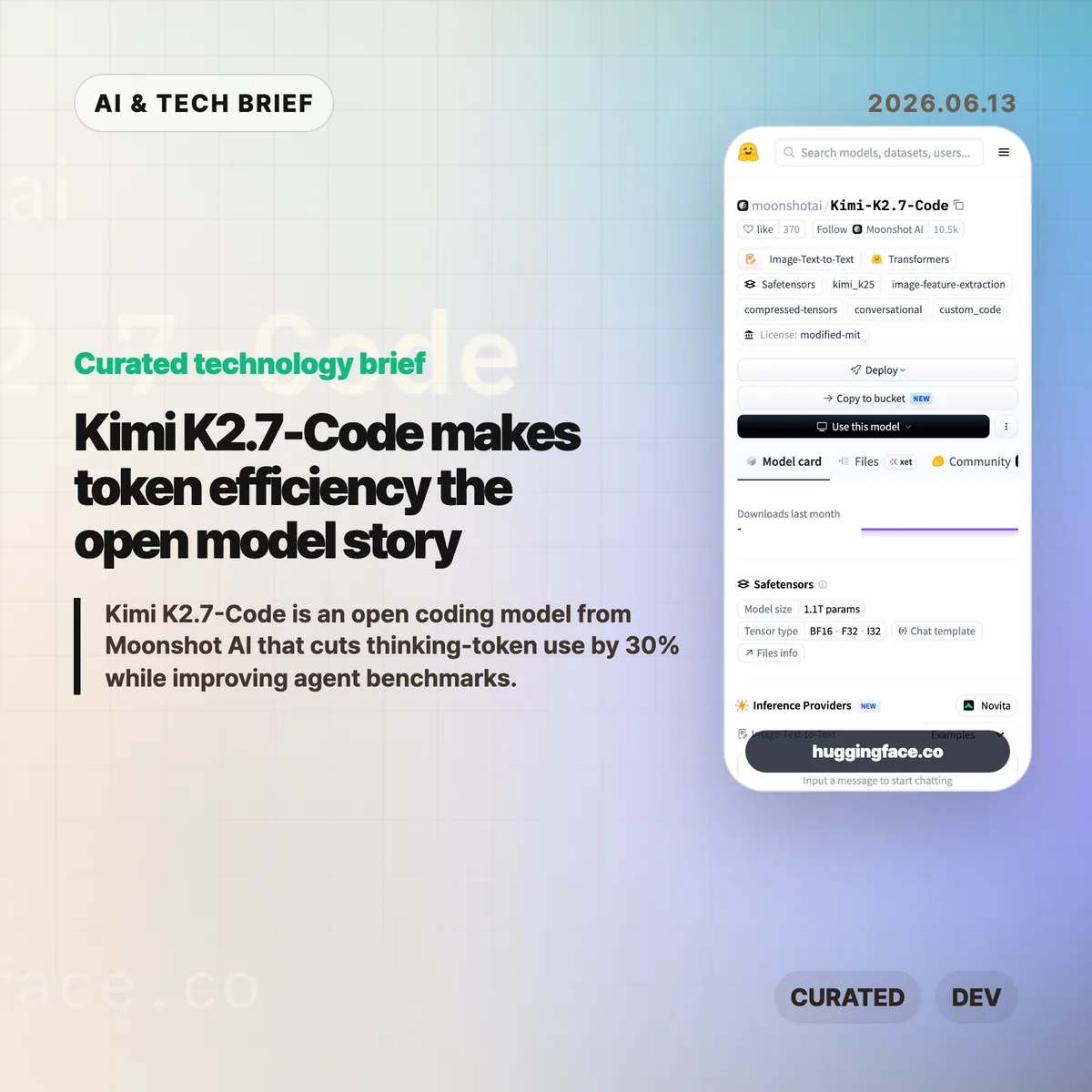
Kimi K2.7-Code is Moonshot AI’s new open-weight coding model for long-running software agents. The company says it reduces thinking-token use by about 30% compared with Kimi K2.6, while raising its Kimi Code Bench v2 score from 50.9 to 62.0 and MCP Mark Verified from 72.8 to 81.1.
Table of Contents
The short version
- Kimi K2.7-Code is a coding-focused agent model built on Kimi K2.6, with 1T total parameters, 32B activated parameters, a 256K context window, and MoonViT vision input.
- Moonshot AI says the model uses roughly 30% fewer thinking tokens than K2.6, which matters because coding agents often spend money on planning, retries, tool calls, and failed test loops.
- The model improves several published Moonshot benchmarks, including Kimi Code Bench v2 at 62.0 and MCP Mark Verified at 81.1, but GPT-5.5 and Claude Opus 4.8 still lead in several rows of the same table.
- Deployment is practical but not casual: the guide points teams toward vLLM, SGLang, and KTransformers, with specific parser flags for tool calls and reasoning content.
- For more English-language coverage of AI infrastructure and developer tooling, see the IT & AI archive.
What happened
Moonshot AI released Kimi K2.7-Code on Hugging Face as a modified-MIT open-weight model aimed at coding agents rather than short autocomplete prompts. The model card describes it as a coding-focused model built on Kimi K2.6 for long-horizon software engineering work, including repository edits, tool use, and multi-step debugging.
The spec sheet is large: Mixture-of-Experts architecture, 1T total parameters, 32B activated parameters per token, 384 experts, eight selected experts per token, a 160K vocabulary, 61 layers, a 256K context length, and a 400M-parameter MoonViT vision encoder. That scale puts the model outside casual local use for most developers, but the open weights still matter for hosting providers, internal platforms, and teams that want more control than a closed API gives them.
The headline number is the 30% reduction in thinking-token use compared with K2.6. In agentic coding, that is more than a billing footnote. Agents can spend many hidden or semi-visible tokens planning a change, reading files, calling tools, interpreting test failures, and trying again. A cheaper model per token can still be expensive if it needs a long recovery loop. A model that gets similar work done with fewer reasoning tokens changes the cost calculation.
Why Kimi K2.7-Code is worth watching
Kimi K2.7-Code is worth watching because it treats token efficiency as a product feature, not a footnote at the bottom of a benchmark table. For coding-agent teams, the billable unit is often the whole task: prompt, planning, file reads, tool calls, retries, review, and cleanup. Moonshot’s claim of 30% lower thinking-token use attacks that total task cost directly.
The benchmark table is more mixed than a launch headline. Kimi K2.7-Code rises from K2.6’s 50.9 to 62.0 on Kimi Code Bench v2, from 48.3 to 53.6 on Program Bench, and from 72.8 to 81.1 on MCP Mark Verified. In the same published table, GPT-5.5 scores 69.0 on Kimi Code Bench v2 and 92.9 on MCP Mark Verified, while Claude Opus 4.8 leads some rows such as MLS Bench Lite and MCP Atlas. The practical read is that Moonshot has narrowed the open-model gap in useful places, not erased it.
That matters for teams building agent products. If a workflow runs hundreds of small code tasks, the winning model may be the one with the best blend of quality, latency, tool calling, hosting flexibility, and cost per completed task. Kimi K2.7-Code gives those teams another serious open-weight option to test against closed coding models.
What does Kimi K2.7-Code change for developers?
Kimi K2.7-Code changes the evaluation checklist for developers from “which model is smartest?” to “which model completes our real tasks at the lowest total cost?” Moonshot’s own documentation makes that clear: the deployment guide calls out vLLM, SGLang, and KTransformers, and the examples require parser flags such as --tool-call-parser kimi_k2 and --reasoning-parser kimi_k2 for correct tool and reasoning handling.
Teams should test it with their own repositories before making a switch. A good trial would track total input tokens, output tokens, reasoning tokens, wall-clock time, failed tool calls, test-pass rate, code-review changes, and final merge rate. The model card says K2.7-Code supports image and video input, but the deployment guide notes that video chat is experimental and supported only in the official API for now. That is a reminder to separate model capability from deployment capability.
The licensing and operations story also needs a real check. Hugging Face lists the license as modified MIT. That may be fine for internal agents, but companies shipping a customer-facing coding product should read the actual license, attribution terms, and provider contracts before routing user code through it.
What Hacker News readers are arguing about
The Hacker News discussion focused less on the raw release notes and more on whether cheaper open models can really pressure Anthropic, OpenAI, and other frontier coding systems. Several commenters argued that token price alone is the wrong metric. Their point was that a model with lower sticker pricing can cost more in practice if developers spend extra time managing bad edits, reverting changes, or asking a stronger model to fix the output.
A second camp pushed back with real-world cost examples. Some developers said they can split work by using a stronger model for planning or review and a cheaper model for scoped implementation tasks. That is probably the most useful operating pattern in the thread: Kimi K2.7-Code does not need to beat every closed model on every broad task to be valuable. It needs to be reliable enough on the parts of the workflow where volume and cost hurt.
There was also skepticism about benchmarks. Commenters questioned whether public or vendor-run coding benchmarks reflect day-to-day repository work, and a few mentioned newer or less saturated evaluations as useful counterweights. The sharpest criticism was practical: teams should measure completed-work cost, attention cost, and repair cost alongside benchmark rank and dollars per million tokens.
The practical read
Kimi K2.7-Code is a strong candidate for teams that already run coding agents and can measure outcomes. Start with the official API or a hosted endpoint, then move to vLLM or SGLang only after the model has passed tasks from real repositories. The deployment work is too heavy to justify on vibes.
Use it first on bounded changes: tests, refactors, small feature slices, documentation fixes, internal tools, and MCP-heavy workflows where tool use is part of the job. Keep a stronger closed model in the loop for architecture, security-sensitive changes, and final review until local evidence says otherwise.
The important metric is not whether Kimi K2.7-Code is cheaper per token. It is whether it lowers cost per merged change without increasing review pain. If the 30% thinking-token reduction survives real workloads, Moonshot has made open coding models harder to dismiss.