Elixir v1.20, released on June 3, 2026, turns gradual typing into a default compiler feature for every Elixir program. The important part is what it does not demand: teams do not need to add type annotations before the compiler can start finding dead code and type violations that would fail at runtime. The release team says the new checker passed 12 of 13 categories in the If T type-narrowing benchmark.
Table of Contents
The short version
- Elixir v1.20 applies type inference and gradual type checking across every program, according to the official June 3, 2026 release post.
- The release looks for “verified bugs,” meaning type violations where the accepted and supplied types are disjoint enough that runtime failure is guaranteed if the code executes.
- The new
dynamic()behavior narrows possible runtime types instead of throwing away type information the way many gradual systems do. - Elixir passed 12 of 13 categories in the If T type-narrowing benchmark cited by the release team.
- The Hacker News discussion was excited about the type-system work, but much of the useful skepticism centered on Elixir’s learning curve, Phoenix macros, LiveView security habits, and BEAM concepts.
What happened
Elixir v1.20 is the first development milestone in the language team’s set-theoretic type-system plan. Jose Valim’s release post says every Elixir program is now gradually type checked without new type annotations, with the compiler using inference to find dead code and runtime-guaranteed type errors. That is a meaningful shift for a dynamic language that has historically leaned on pattern matching, guards, Dialyzer-style analysis, and runtime confidence rather than mandatory type signatures.
The release also reports progress on type narrowing. Elixir v1.20 passed 12 of the 13 categories in the If T benchmark, a test suite focused on how well languages recover type information from ordinary control flow. That result matters because gradual typing is easy to sell in theory and hard to make pleasant in old codebases. A system that floods developers with false positives loses trust quickly.
Why Elixir v1.20 is worth watching
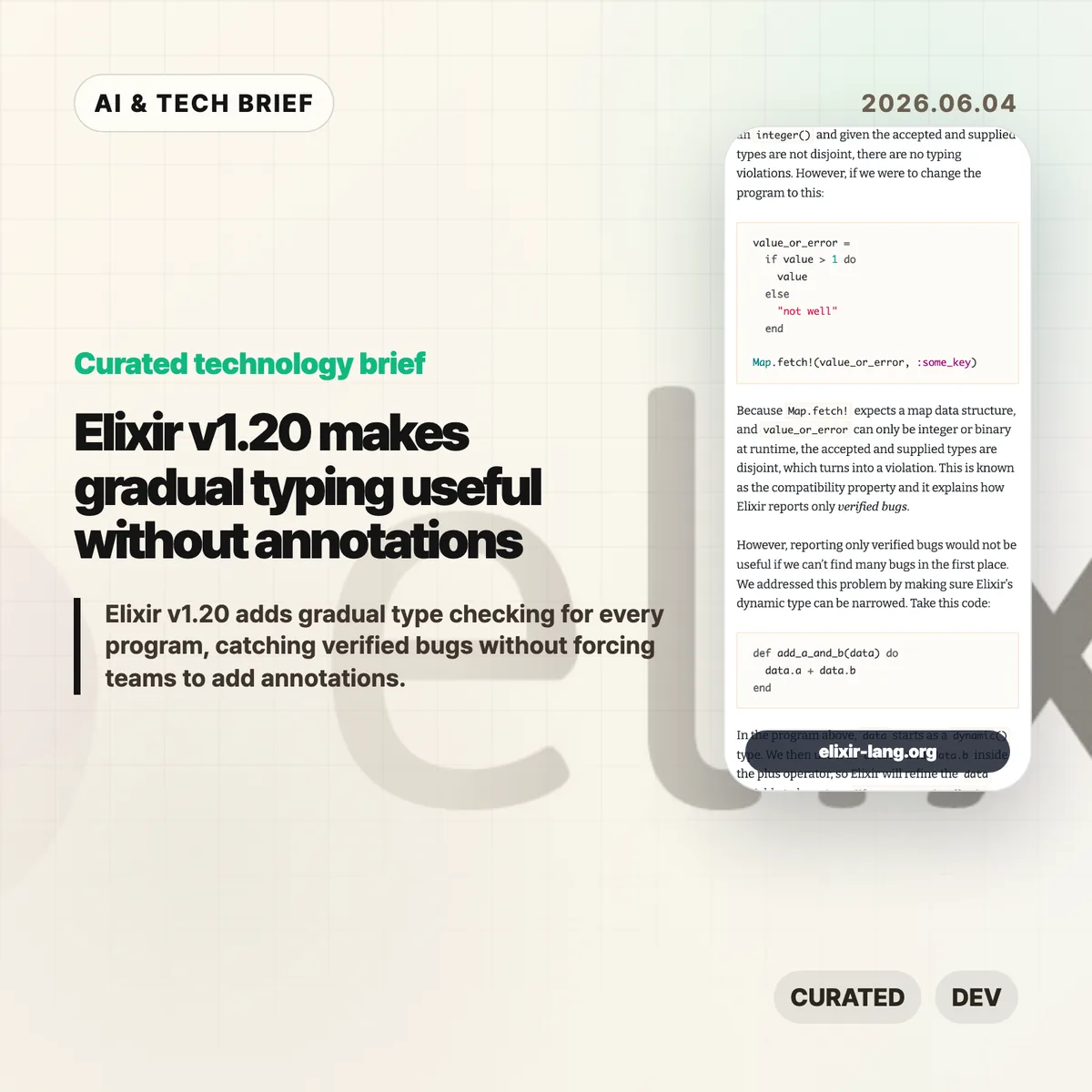
Elixir v1.20 is worth watching because it tries to make type checking useful before a project commits to a typed migration. The compiler behaves as if function arguments began as dynamic(), then narrows the possible range as code uses guards, pattern matches, conditionals, tuple checks, map-key checks, and standard-library calls. If a value might be an integer or a string, the compiler does not immediately reject every operation that accepts only one of those possibilities. It waits until the accepted type and the possible type no longer overlap.
That design is more conservative than a strict static checker, but it fits the way many Elixir teams work. Existing Phoenix, OTP, and BEAM applications can upgrade and see which bugs the compiler now proves, without stopping the team for a large annotation project. For more IT and AI developer-tool coverage, see the IT & AI archive.
What does Elixir v1.20 change for developers?
Elixir v1.20 changes the default feedback loop for backend developers by moving some runtime failures into compile-time warnings. The June 2026 release gives examples where is_list, is_integer, is_map_key, tuple_size, case, and nil checks refine what the compiler knows. If a branch has already handled nil, the next branch can be checked as if the value is only the remaining type.
The practical effect is not that Elixir suddenly becomes TypeScript or Rust. It is closer to a quiet compiler assistant that reads the shape of the code developers already write. That makes Elixir v1.20 especially interesting for teams that like the BEAM runtime and Phoenix ecosystem but still want earlier warnings for impossible calls, redundant clauses, and dead code before those paths reach production.
How dynamic() avoids the usual gradual-typing trap
The dynamic() type in Elixir v1.20 is not a polite spelling of “anything goes.” The release describes two properties: compatibility and narrowing. Compatibility means the compiler only reports a violation when the possible supplied type and the function’s accepted type are disjoint. Narrowing means the compiler keeps refining the possible type range as the program uses the value.
A simple example from the release explains the difference. If a value can be either an integer or a binary, calling a function that accepts one of those types is not automatically an error. But passing the same value to a map-only function is a verified violation because neither integer nor binary overlaps with map. That choice trades aggressive warnings for developer trust. It will miss some questionable code, but the warnings it does produce should be harder to dismiss.
What Hacker News readers are arguing about
The Hacker News thread treated Elixir v1.20 as a serious language milestone, not a minor release-note item. The post drew more than 500 points and about 200 comments by June 4, 2026. The strongest positive thread was simple: gradual typing makes Elixir more attractive to developers who already like the BEAM model but hesitate because dynamic code can hide mistakes until production.
The useful skepticism was less about the type system itself and more about adoption friction. Several commenters said Elixir and Phoenix can feel hard to learn because the ecosystem assumes familiarity with functional programming, OTP supervision, macros, optional parentheses, keyword lists, and LiveView’s security model. Others pushed back, pointing to ElixirForum, official guides, Elixir in Action, Erlang in Anger, Joy of Elixir, and the Phoenix LiveView security documentation as practical learning paths.
The builder takeaway from that discussion is blunt: Elixir v1.20 improves compiler feedback, but it does not remove the need to learn the runtime model. Teams evaluating Elixir should test the new type checker on an existing service, then separately judge whether their team is comfortable with BEAM processes, supervision trees, Phoenix macros, and LiveView authorization patterns.
The practical read
Elixir v1.20 is not the release where Elixir gets user-written type signatures everywhere. The official post says typed struct definitions and broader type signatures still depend on more work around performance, recursive types, parametric types, and efficient traversal of map key-value pairs. Treat this release as the compiler starting to earn trust, not as the final typed-Elixir destination.
For current Elixir teams, the obvious move is to upgrade a non-critical service first and read the new warnings with care. The warnings should identify code that is dead, redundant, or guaranteed to fail if reached. For teams outside the ecosystem, Elixir v1.20 is a reason to revisit the language if gradual typing was the missing piece. It is not a reason to ignore the learning curve. The runtime and framework model still matter as much as the new checker.