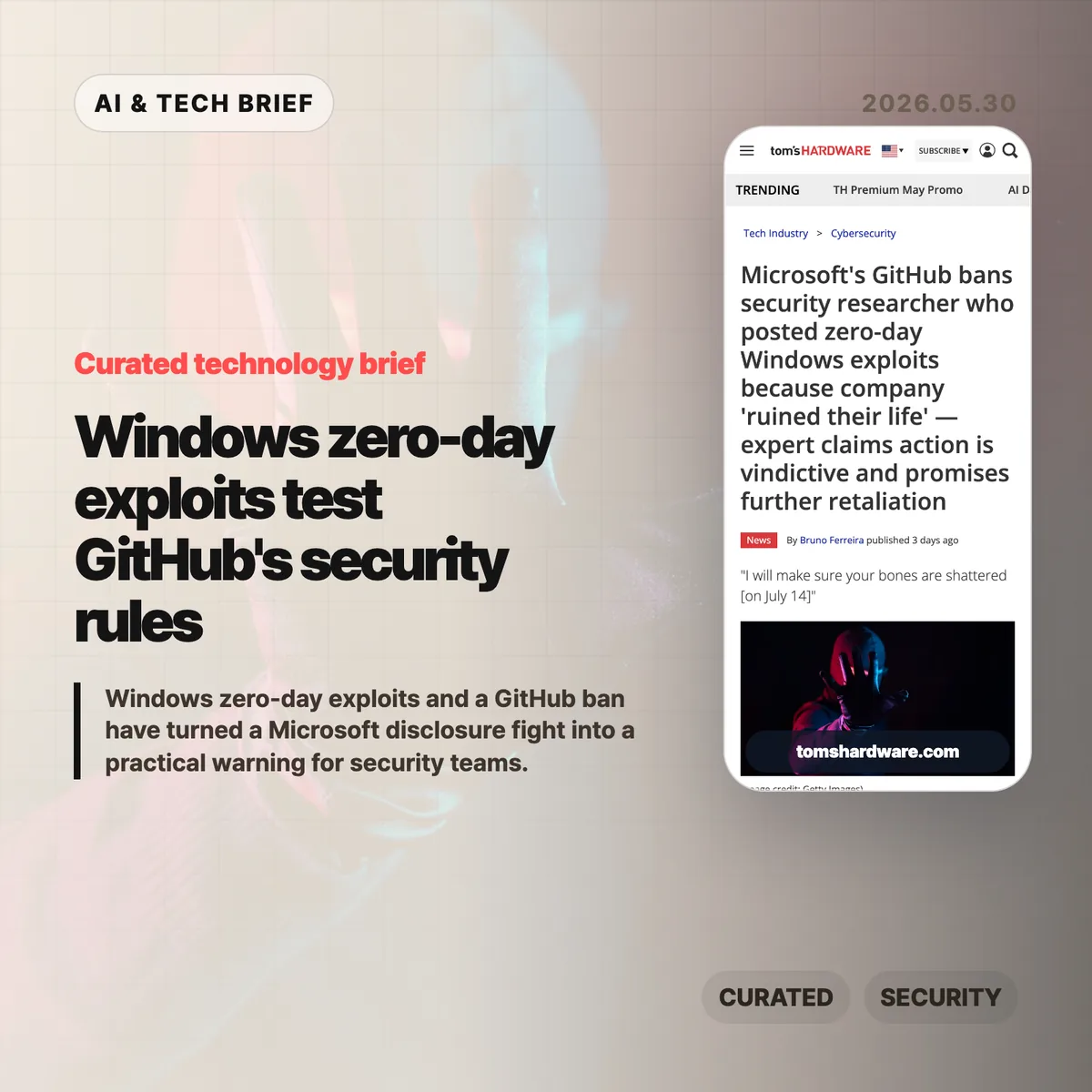
Windows zero-day exploits are at the center of a messy public fight between Microsoft, GitHub, and the researcher known as Nightmare-Eclipse. GitHub banned the researcher’s account after a run of Windows exploit disclosures, according to Tom’s Hardware, while the researcher claims Microsoft mishandled vulnerability reports and bounty requests.
Table of Contents
The short version
- GitHub banned Nightmare-Eclipse’s account after the researcher published several Windows zero-day exploits, then the work moved to GitLab.
- The dispute includes claims about Microsoft’s MSRC process, bounty handling, and whether the researcher followed a defensible disclosure path.
- Some named projects, including BlueHammer, RedSun, and UnDefend, reportedly touch high-value Windows components such as Defender, CTFMon, Cloud Filter, and BitLocker.
- The practical problem is boring but urgent: once exploit code is public, deleting one account does little for defenders who need detection rules, mitigations, and patch plans.
What happened
Tom’s Hardware reports that Microsoft-owned GitHub banned the account of Nightmare-Eclipse, also known as Chaotic Eclipse, after the researcher published a series of Windows zero-day exploits. The researcher moved the projects to GitLab and framed the ban as retaliation.
The public dispute appears to have escalated after BlueHammer, a Windows exploit disclosed in April. Nightmare-Eclipse claims Microsoft ignored or rejected reports and did not pay requested bounty rewards. Microsoft has not publicly explained the GitHub ban in detail, which leaves the central question unresolved: was this mainly reckless disclosure, a broken reporting process, or both?
The named projects matter because they are not abstract proof-of-concept toys. Tom’s Hardware lists BlueHammer, RedSun, UnDefend, GreenPlasma, MiniPlasma, and YellowKey, with reported impact across Windows Defender, CTFMon, Cloud Filter, and BitLocker-related behavior. For readers tracking security and developer platforms, our IT & AI archive follows similar fights where tooling, platform policy, and operational risk collide.
Why this is worth watching
Windows zero-day exploits create two clocks at once. One clock belongs to vendors and platform operators, who need time to verify reports, build fixes, and decide what code a hosting service should allow. The other belongs to attackers and defenders, who can move as soon as public code or even a clear write-up appears.
That is why the GitHub ban is an awkward remedy. If the code has already been copied, account enforcement may reduce visibility more than risk. Defenders still have to assume the techniques are circulating and look for exposure around the affected Windows components.
The disclosure side is just as uncomfortable. Bug bounty programs ask researchers to trust the vendor’s process. If researchers believe reports vanish into a queue, or that proof requirements keep changing, some will publish first and negotiate later. That does not make public exploit dumps safe. It does explain why platform bans rarely settle the argument.
What Hacker News readers are arguing about
The Hacker News discussion is less focused on the personality fight and more focused on whether vulnerability reporting is worth the personal risk. Several commenters describe avoiding security bug reports after bad experiences with companies, police, or employers. The useful thread running through those comments is simple: a researcher who reports a bug can still be treated like an attacker.
A second camp points to mediators such as national cyber security centers, CERT-style coordinators, and groups like the Chaos Computer Club. The appeal is obvious. A trusted third party can take the sharp edges off disclosure when a vendor is defensive or slow. The pushback is also practical: sending exploit details to a foreign agency may feel risky, and the legal answer changes by country.
The more sober takeaway is that “responsible disclosure” is not one process. It depends on law, vendor behavior, evidence requirements, and whether the researcher can afford a fight. The discussion is not evidence that this specific researcher handled everything well. It is evidence that many technical readers no longer assume companies will treat good-faith reports kindly.
Windows zero-day exploits checklist
Treat the named Windows zero-day exploits as leads for defensive review, not as confirmed coverage gaps in your own fleet. The right question is whether your team would notice the behavior those projects point toward.
The practical read
Security teams should treat the Windows zero-day exploits as an exposure review, not as platform drama. Start with the named components and projects: Defender, CTFMon, Cloud Filter, BitLocker, BlueHammer, RedSun, UnDefend, GreenPlasma, MiniPlasma, and YellowKey. Check whether endpoint logging, tamper protection, BitLocker recovery workflows, and privileged process monitoring would catch suspicious behavior around those areas.
Developers and security researchers should take a different lesson. Keep a clean disclosure record: timestamps, report IDs, scope language, vendor replies, proof material, and escalation attempts. If the vendor relationship gets hostile, that paper trail matters more than a social media argument.
For platform operators, the hard part is policy clarity. Hosting exploit code is dangerous. So is quietly removing research without explaining the rule. The next version of this story will depend less on the ban itself and more on whether Microsoft and GitHub can show researchers where the line actually is.