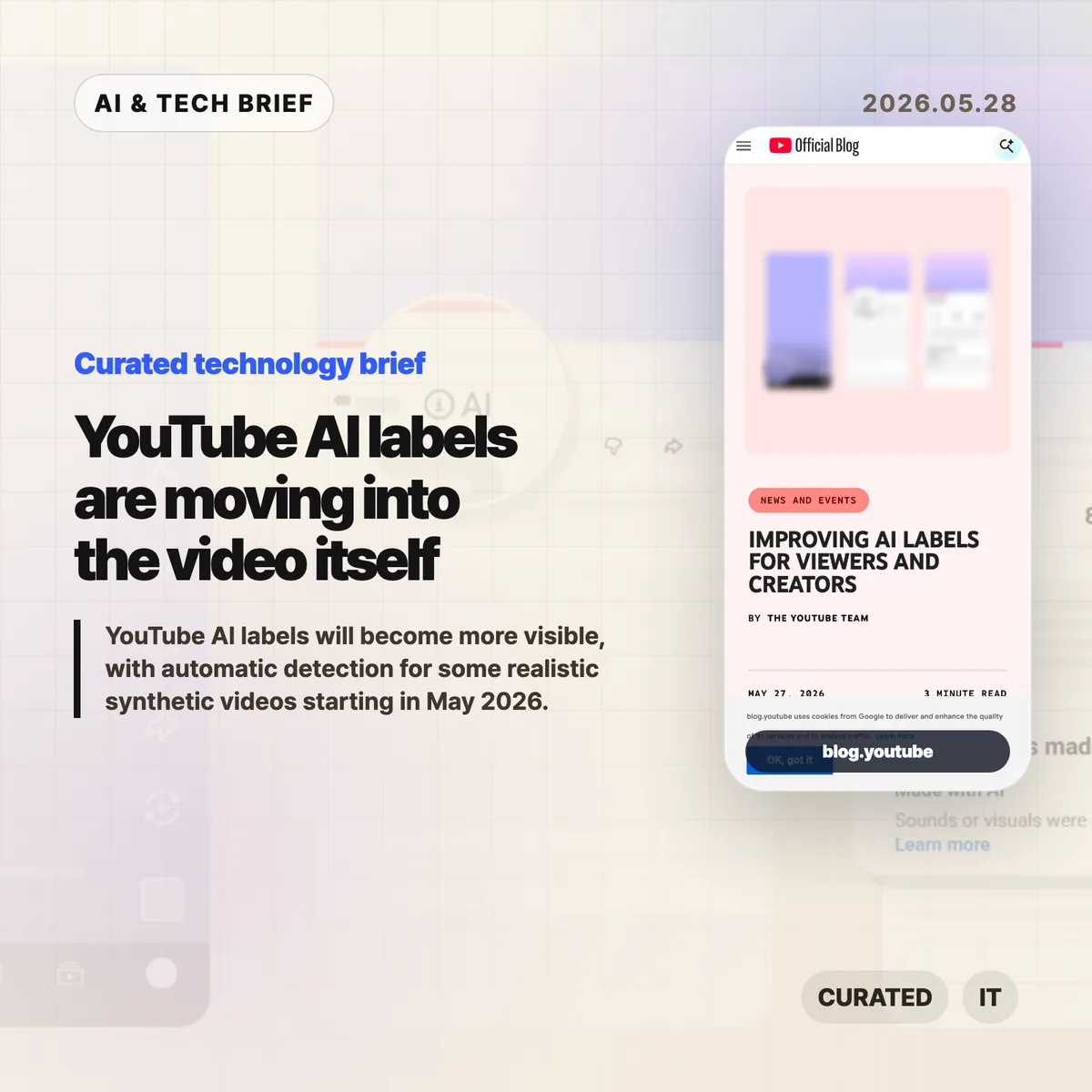
YouTube AI labels are getting harder to miss. Starting in May 2026, YouTube says it will automatically apply a label when its systems detect significant photorealistic AI use and the creator has not disclosed it. The change matters because synthetic video disclosure is moving from the description box into the viewing experience.
Table of Contents
The short version
- YouTube will place labels for photorealistic or meaningfully AI-altered videos directly below long-form videos and as overlays on Shorts.
- Creators still have to disclose realistic AI use during upload, but YouTube will add internal detection signals in May 2026.
- If YouTube applies a label by mistake, creators can update the disclosure status in YouTube Studio.
- Labels will stay permanent for content made with YouTube’s own AI tools, including Veo and Dream Screen, or for fully generative AI content carrying C2PA metadata.
- YouTube says the label by itself does not change recommendations or monetization eligibility.
What happened
YouTube announced two changes to how it handles AI disclosure on May 27, 2026. The first is placement. For long-form videos, the disclosure label for photorealistic or meaningfully AI-altered content will appear below the player and above the description. For Shorts, the label will sit on the video as an overlay.
The second change is automatic detection. YouTube will keep asking creators to disclose realistic AI use, but it will also use internal signals to identify significant photorealistic AI content. If a creator leaves the disclosure blank and YouTube’s systems detect that kind of AI use, the platform can apply the label itself.
There are limits. YouTube says unrealistic, animated, or lightly altered content can still keep its disclosure in the expanded description. It also says creators can correct a mistaken label in YouTube Studio, except in cases tied to YouTube’s own generative tools or C2PA metadata that marks the content as fully generative.
Why this is worth watching
The useful part of this update is the placement. A buried disclosure is easy to miss, especially on mobile, where people often watch before they read anything around the video. A label near the player or on a Short changes the timing. Viewers see the context while they are deciding whether to trust the clip.
That matters for health advice, news-like clips, fake trailers, product demos, political speech, and anything that uses synthetic people or scenes to look filmed. The disclosure does not prove a video is bad. It tells the viewer that the production method should be part of the interpretation.
For more coverage of AI product and platform policy, the IT & AI archive tracks similar shifts across consumer apps and developer platforms.
YouTube AI labels and the moderation problem
YouTube AI labels are also a moderation bet. Manual disclosure depends on creators knowing the rule, understanding the boundary, and choosing to be honest. Automatic detection tries to close the gap, but it creates a different risk: false positives can annoy creators, while false negatives can make the label feel decorative.
The hard cases will not be the obvious fully synthetic clips. They will be videos with AI narration over real footage, synthetic b-roll in otherwise human commentary, AI-generated music, partial face replacement, or educational videos that show synthetic examples. A platform can write a policy for those categories, but the product still has to make the answer legible to the person uploading the video.
This is also an app-builder lesson. If a product lets users generate or publish media, disclosure belongs in the interface. Hiding it in a help page or a terms-of-service update will not scale once synthetic media becomes normal.
What Hacker News readers are arguing about
The Hacker News thread is less interested in the label UI than in what AI video has already done to YouTube. The strongest concern is not that all synthetic content is fake news. It is that children, older viewers, and casual users are being pulled into low-effort, procedurally generated videos that look like stories, advice, documentary clips, or entertainment but offer very little substance.
One camp sees visible labels as a necessary minimum. They argue that people need a quick signal before treating a video as ordinary reporting, health advice, or real-world footage. Several commenters also wanted stronger viewer controls: filters for synthetic videos, recommendation settings, or easier ways to keep AI-heavy channels out of a feed.
The skeptical camp focuses on detection quality and incentives. If YouTube cannot reliably tell the difference between fully synthetic video, AI-assisted editing, narration, b-roll, and ordinary post-production, the label could become noisy. Some creators will complain about being mislabeled. Other creators will try to route around the system. The thread also keeps returning to a broader point: labels help, but recommendation systems decide how much of this material people actually see.
The practical read
Creators should treat realistic AI disclosure as part of the upload workflow, especially if a video includes synthetic people, altered real events, AI-generated scenes, or footage that could be mistaken for camera capture. Waiting for YouTube to detect it is a weak strategy because a visible label applied after the fact can feel worse than a clear disclosure from the start.
Platforms should read this as a product-pattern change. AI disclosure is becoming a surface-level control, closer to captions, paid-promotion labels, or age restrictions than to a policy footnote. Video apps, creator tools, and marketplaces should decide where the disclosure appears, when it appears, how users can appeal it, and what happens when metadata such as C2PA is present.
Viewers should still be careful. YouTube AI labels can add context, but they do not tell you whether a clip is accurate, useful, or manipulative. The label answers one question: was realistic synthetic media likely used? Trust still depends on the source, the claim, and the evidence behind the video.