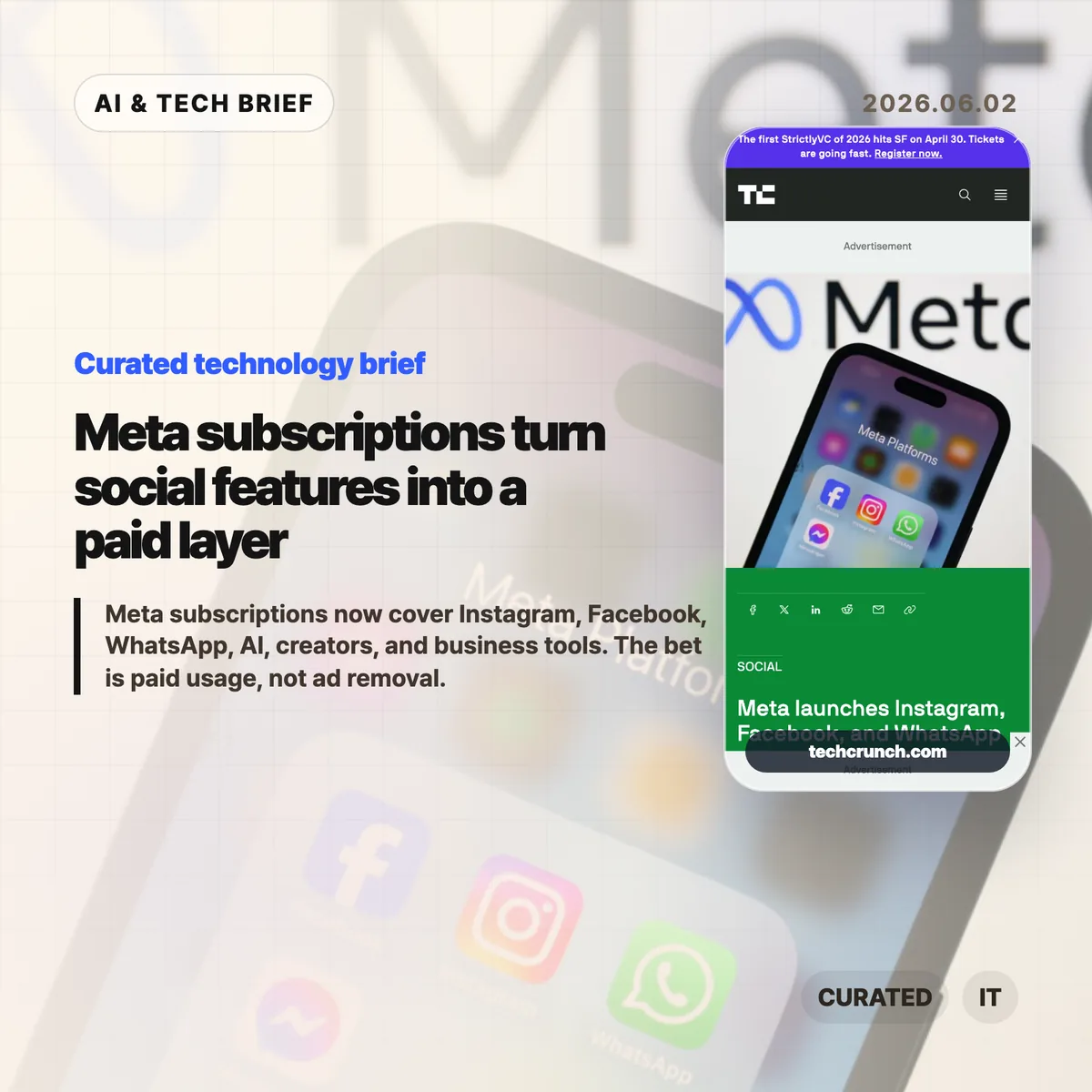
Meta subscriptions are moving beyond verification badges. Meta is rolling out paid plans for Instagram, Facebook, and WhatsApp worldwide, while testing Meta One plans for AI users, creators, and businesses. The awkward part is what these plans do not appear to sell: a cleaner, ad-free version of the apps.
Table of Contents
The short version
- Instagram Plus and Facebook Plus are priced at $3.99 per month, while WhatsApp Plus starts at $2.99 per month.
- Meta One AI tests include a $7.99 Plus plan and a $19.99 Premium plan, with higher limits for heavier AI requests.
- Creator and business plans move closer to paid distribution, with features tied to search placement, feed recommendations, analytics, and follower growth.
- The useful question is whether paid features make Meta’s apps better for heavy users or simply add another bill on top of an ad-funded product.
What happened
TechCrunch reports that Meta is taking its consumer subscription plans global across Instagram, Facebook, and WhatsApp. Instagram Plus and Facebook Plus focus on social expression and audience tools: profile customization, Story insights, Super Heart reactions, extra profile pins, custom fonts, and options around Story visibility. WhatsApp Plus is more about messaging polish, with app themes, custom ringtones, extra pinned chats, list customization, and premium stickers.
Meta says the new Plus plans do not replace Meta Verified, which still centers on verification, impersonation protection, and support. That matters because these are not trust-and-safety subscriptions. They are closer to paid product knobs for people who already spend a lot of time inside Meta’s apps.
The company is also testing Meta One, a broader subscription brand for AI, creators, and businesses. Meta One Plus is priced at $7.99 per month and Meta One Premium at $19.99 per month for AI users. The difference is less about a new chatbot personality and more about capacity: more thinking-mode use, more image and video generation, and more room for complex prompts.
Why this is worth watching
Meta subscriptions are a sign that the company wants more ways to charge existing users without reducing its dependence on advertising. That is a sensible business move. Instagram, Facebook, and WhatsApp are already massive, so growth has to come from deeper usage, higher spending per user, or business tools layered on top of the existing network.
The creator and business plans are the more delicate part. Meta One Essential is being tested at $14.99 per month with verification, impersonation protection, and a linksheet. Meta One Advanced, at $49.99 per month, adds features such as Facebook feed recommendations, higher placement in Facebook and Instagram search results, a bolder Reels follow button, automated follow invitations, link prompts, competitive insights, and scheduling tools.
That starts to look less like customization and more like paid reach. For small brands and creators, the tradeoff is uncomfortable: pay for tools that may help discovery, or stay on the free tier and wonder whether the algorithmic surface is slowly getting more expensive to compete on.
For more on how consumer AI and product pricing are changing, see the IT & AI archive.
What Hacker News readers are arguing about
The Hacker News thread is mostly skeptical, but not in a single way. One camp reads the launch as another step toward bloated social apps: more AI content, more paid profile decoration, and no clear improvement to the core feed. Several commenters said the only subscription they would consider is an ad-free or friends-only feed, which is exactly what Meta is not selling here.
A smaller but useful counterargument is that paid products can give product teams a reason to build for users instead of advertisers. If meaningful revenue comes from subscribers, the argument goes, Meta can justify features that do not directly serve ad targeting. Even that defense usually came with a caveat: the ads remain, so Meta may be trying to collect both advertising money and subscription money from the same user base.
The strongest builder-side observation was about creators. People can joke about paying for custom icons, but musicians, artists, performers, small shops, and local communities still rely on Instagram and Facebook for discovery. If paid plans influence search placement or feed recommendations, the subscription is not cosmetic. It becomes part of the cost of being visible.
The practical read on Meta subscriptions
For ordinary users, the first test is simple: do Meta subscriptions buy something you already wanted, or do they make the existing app feel more segmented? Profile styling and extra stickers are easy to ignore. Paid visibility and AI capacity are harder to ignore because they can change how creators, businesses, and heavy AI users behave on the platform.
For app builders, the lesson is sharper. Meta is pricing features by intensity of use: more audience analysis, more discovery tools, more AI compute, more control over expression. That model is tempting because it avoids charging everyone. It also creates a product design problem. Once reach, analytics, or generation limits become paid features, users start asking whether the free product is being held back on purpose.
The launch is worth watching because it puts social, creator tooling, and AI usage into the same subscription conversation. Meta does not need every user to pay. It needs enough heavy users, creators, and businesses to accept that the platform’s best knobs now come with a monthly price.