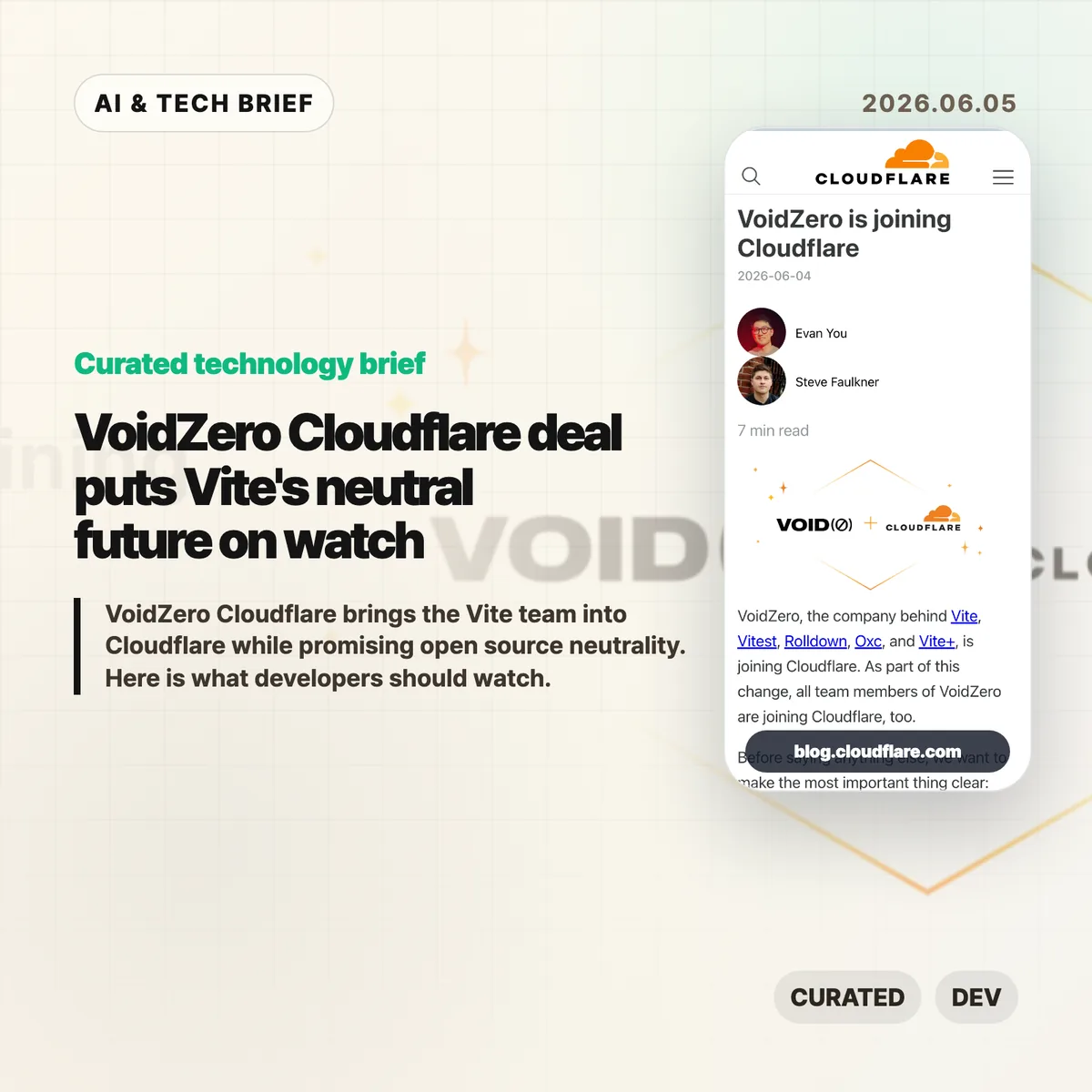
VoidZero Cloudflare is the kind of developer tooling deal that sounds small until you count how many projects depend on Vite. Cloudflare says the team behind Vite, Vitest, Rolldown, Oxc, and Vite+ is joining the company, while those projects will stay open source, vendor agnostic, and community driven.
Table of Contents
The short version
- VoidZero’s full team is joining Cloudflare, according to Cloudflare’s June 4 announcement.
- Cloudflare says Vite, Vitest, Rolldown, Oxc, and Vite+ will remain MIT licensed, open source, vendor agnostic, and community driven.
- Cloudflare is committing $1 million to a Vite ecosystem fund administered by the Vite core team.
- The practical risk is not an immediate license change. It is whether future Vite full stack APIs stay equally useful outside Cloudflare.
- Hacker News readers mostly argued about open source funding, Big Tech ownership of developer tools, and whether sponsorship can compete with acquisition money.
What happened
Cloudflare announced on June 4, 2026 that VoidZero, Evan You’s developer tooling company, is joining Cloudflare. The announcement names Vite, Vitest, Rolldown, Oxc, and Vite+ as the projects affected by the move, and says all VoidZero team members are joining Cloudflare too.
The company tried to answer the obvious question first: Vite is not supposed to become a Cloudflare-only path. Cloudflare says the projects will remain open source, vendor agnostic, and portable. It also says Vite will stay MIT licensed and continue to be developed in public.
That promise matters because Vite is already shared infrastructure. Vue, SvelteKit, Nuxt, Astro, Solid, Qwik, Angular, React Router, TanStack Start, and other projects use it in different ways. A change in Vite’s direction can ripple through a large part of the JavaScript ecosystem, including teams that never deploy to Cloudflare. For more English-language tech briefs like this, see the IT & AI archive.
Why VoidZero Cloudflare is worth watching
VoidZero Cloudflare is worth watching because Cloudflare is buying talent and influence around a toolchain that many web teams already treat as default infrastructure. The public promise is neutral: Vite remains portable, and Cloudflare says it does not expect the web ecosystem to build around one vendor. The harder test will come later, when new runtime hooks, full stack features, and CLI flows need real governance decisions.
Cloudflare is also putting money behind that promise. The company says it will commit $1 million to a Vite ecosystem fund for maintainers and contributors, administered by the Vite core team. That is meaningful support, but it also changes the power map. When one platform provides staff, funding, and product direction around a shared tool, developers will watch how much room other platforms and framework teams still have in the roadmap.
What does VoidZero Cloudflare change for builders?
For builders, VoidZero Cloudflare could make Vite feel more like the control plane for modern web apps, not only the dev server. Cloudflare’s post points to the Vite Environment API, which lets Vite run server code somewhere other than Node.js during development. Cloudflare built its Vite plugin on top of that API so vite dev can run server code inside workerd, the open source runtime that powers Workers in production.
That is useful if a project depends on Workers, Durable Objects, D1, KV, R2, Workflows, Workers AI, Agents, Service Bindings, or Workers RPC. Local development can look closer to production, which reduces the old gap between a Node-based dev server and a non-Node edge runtime.
The same idea could also make Vite more valuable outside Cloudflare if the abstractions stay broad. If other hosts can implement the same environment model cleanly, Vite becomes a better common layer. If the best path quietly tracks Cloudflare’s runtime first, developers will still have portable source code, but the smoothest workflow may point toward one platform.
What Hacker News readers are arguing about
The Hacker News discussion was less about Vite’s current code and more about the economics behind open source developer tools. One early reaction captured the mood: acquisitions of open source organizations feel scary, even when the buyer promises neutrality. Several commenters argued that this is what happens when developers expect core tools to be free. Maintainers have salaries to pay, and donations rarely match what a large platform can offer.
Another camp pushed back on the idea that sponsorship would have prevented the sale. A well funded company can usually pay more than community donations, even for successful projects. That made the thread turn toward foundations, governance, and whether infrastructure-level projects should sit inside nonprofits instead of venture-backed companies.
There was also a practical thread for developers asking what the alternatives are if Vite’s direction changes. Suggestions included esbuild, Web Components plus Jest, and forking, but none of those answers really matches Vite’s adoption across frameworks. The useful signal in the discussion is that developers are not expecting a sudden break. They are watching for small product incentives: which APIs get first-class docs, which platforms get the best plugins, and whether non-Cloudflare runtimes keep equal footing.
The practical read
Treat the VoidZero Cloudflare deal as a governance story before treating it as a migration story. Vite users do not need to rip out anything because of this announcement. The license and public commitments still point toward open use, and Cloudflare has a strong reason to keep Vite trusted by the wider ecosystem.
The right test is boring and specific. Watch the next few Vite releases, the Vite Environment API, the Cloudflare Vite plugin, Vite+ packaging, and any new cf CLI flow. If the abstractions remain implementable by Vercel, Netlify, local runtimes, framework teams, and self-hosted setups, this deal could put more engineering behind tools developers already use. If the best examples, defaults, and integrations cluster around Cloudflare Workers, the neutrality promise will still exist on paper but feel weaker in practice.
For AI-assisted development, the stakes are also practical. Agents and coding assistants run dev servers, parse errors, repeat tests, and touch build tools more often than humans do manually. Faster, clearer, more consistent Vite tooling helps those loops. The same tools will be less useful if they make platform assumptions the agent cannot see until deployment.