Zstandard in Rust now has a public prerelease from Trifecta Tech Foundation, and the interesting part is where it sits: under web traffic, package managers, logs, build systems, and plenty of code that users never see. The project, libzstd-rs-sys, aims to provide a Rust implementation of Zstd that can also compile into a C-compatible static library. In plain terms, it is an attempt to make a common compression layer less dependent on memory-unsafe C without asking every downstream project to redesign its stack.
Table of Contents
The short version
- Trifecta Tech Foundation has published
libzstd-rs-sysversion0.0.1-prerelease.2, a Rust implementation of the Zstandard file format. - The cleaned-up decoder and dictionary builder are the most mature parts today; the encoder still needs more cleanup and funding.
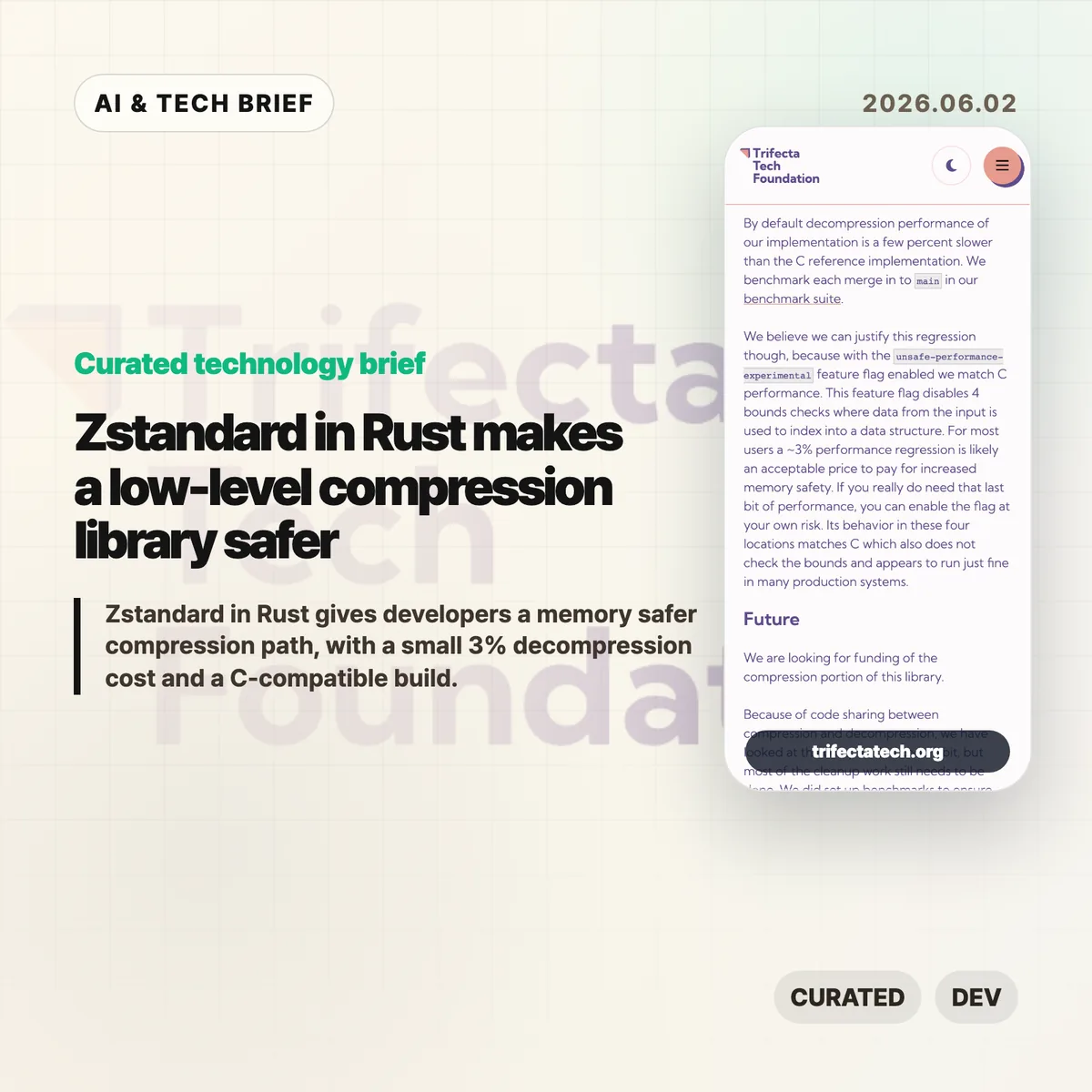
- Default decompression is a few percent slower than the C reference implementation, but Trifecta says the gap is about 3% for most users.
- An
unsafe-performance-experimentalfeature can match C performance by disabling four bounds checks, so the project is explicit about the safety-speed tradeoff. - Zstandard in Rust matters most for developers targeting Windows, WebAssembly, embedded systems, or cross compiled builds where a C toolchain can be the thing that breaks.
What happened
Trifecta Tech Foundation announced the first prerelease of libzstd-rs-sys, a Rust implementation of Zstandard. The repository describes the decoder as mostly cleaned up and ready for experimental use, while the dictionary builder has some remaining unsafe code and the encoder is still close to the raw c2rust translation.
The foundation started from the Zstandard reference implementation, translated it with c2rust, and then cleaned up the decompression and dictionary builder paths. It tests the Rust code as a C static library against the reference implementation’s test suite. It also uses fuzz testing and Miri, which is the right kind of boring for a compression project. One bit wrong is still wrong.
The work is not framed only as a Rust crate. Trifecta wants the library to compile into a drop-in compatible C library, similar to its earlier zlib and bzip2 work. That gives C projects a possible replacement path instead of limiting the work to Rust-only consumers.
Zstandard in Rust details for builders
For Rust developers, the first practical benefit is portability. The existing zstd crate already lets Rust code use Zstandard, but it compiles C code from source. That means the target needs a working C toolchain, and the target has to be supported by that C build path.
That is usually manageable on mainstream Linux servers. It gets more annoying on Windows, WebAssembly, cross compiled targets, and smaller deployment environments. A dependency that stays inside the Rust toolchain can remove a surprising amount of build friction.
There is also a software supply chain angle. Compression libraries are small enough to ignore and common enough to matter. If a safer implementation can be swapped in without breaking C callers, maintainers get a migration option instead of a rewrite plan. For more stories in this lane, the IT & AI archive tracks similar developer infrastructure shifts.
Why this is worth watching
The story is less about Zstd getting a shiny new language badge and more about where memory safety is moving. Rust rewrites usually get attention in browsers, kernels, cloud services, or command line tools. Compression sits lower. It is the kind of dependency that quietly spreads through many systems and then stays there for years.
The performance numbers are also more honest than a lot of rewrite announcements. Trifecta says decompression is a few percent slower by default, and that most users may accept about a 3% cost for memory safety. If someone needs the last bit of speed, the experimental feature flag exists, but it turns off four bounds checks where input data indexes into structures. That is a clear choice, not marketing fog.
The unfinished parts matter. The encoder still needs substantial cleanup, and the library is not described as battle-tested. The current release is a serious milestone, not a universal replacement for every Zstd deployment.
What Hacker News readers are arguing about
The Hacker News thread is tiny, so it should not be treated as a broad community read. The useful objection is specific: one commenter pointed to an existing pure Rust implementation, zstd-rs, and said the announcement should have compared against it directly.
That criticism is fair. Trifecta explains why the current Rust zstd crate is not enough, because it still builds C code, but a reader can reasonably ask how libzstd-rs-sys differs from other pure Rust Zstd efforts. A comparison table would help: compatibility goals, C drop-in support, decoder maturity, encoder state, performance, unsafe code, and test coverage.
The thread does not offer much more than that. Still, the comment catches the main editorial caveat: this project is easier to understand if you separate “Rust implementation for C-compatible replacement” from “another Rust library for Rust applications.”
The practical read
If you maintain software that already uses Zstd through the C reference implementation, watch libzstd-rs-sys but do not treat it as a finished migration path yet. The decoder looks like the part to test first. The encoder still needs work.
If your pain is build portability, especially around Windows, WebAssembly, or cross compiled targets, Zstandard in Rust is more immediately interesting. The value is not only memory safety. It is fewer toolchain surprises.
If performance is your reason to hesitate, benchmark your workload. A 3% decompression cost may be irrelevant for package downloads, logs, and background jobs. It may matter in a hot path. The experimental flag is there, but using it means accepting the same kind of unchecked indexing that Rust was supposed to help avoid.