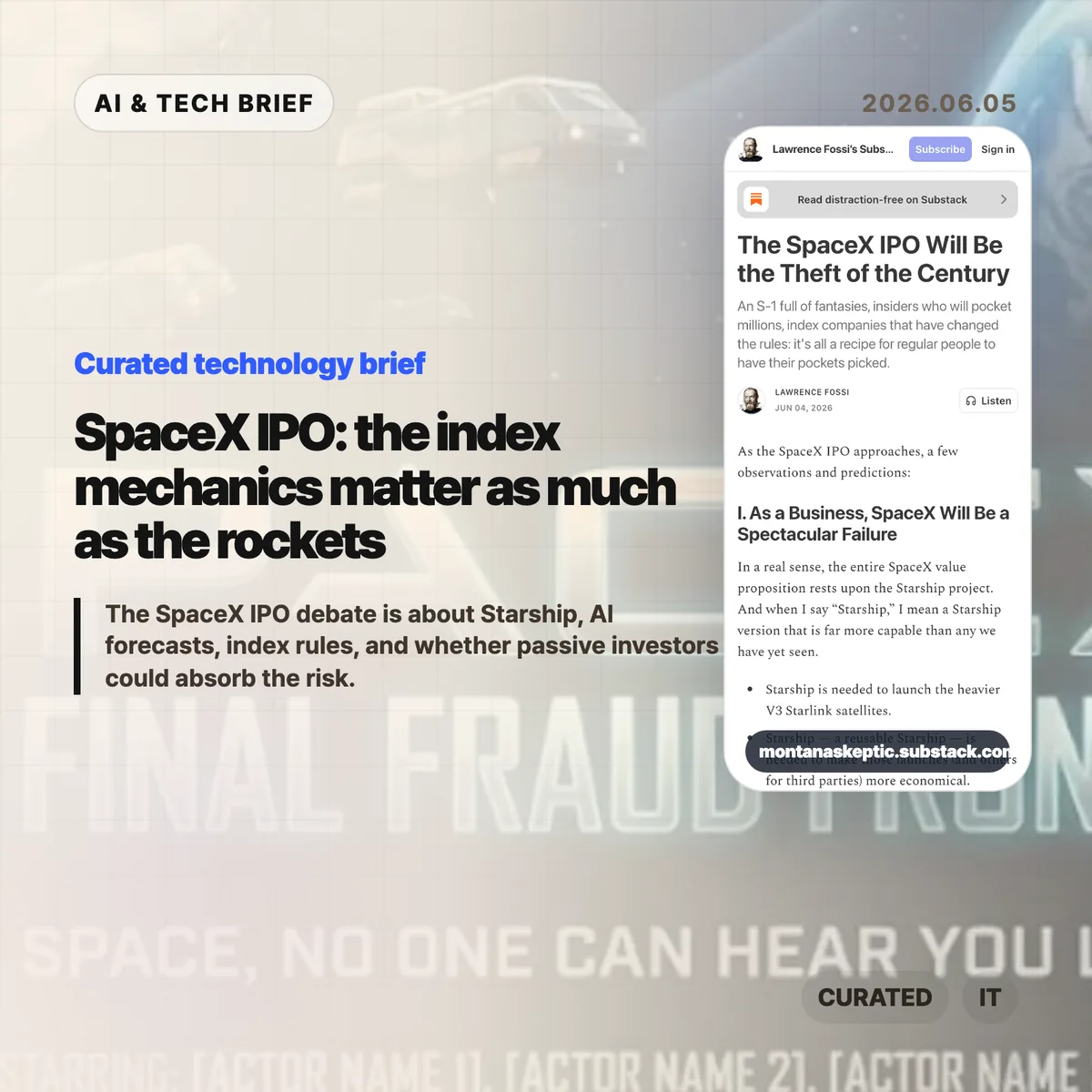
The SpaceX IPO debate is no longer only about reusable rockets. Lawrence Fossi’s June 2026 critique argues that a public listing would combine a huge Starship-dependent growth story with index rules that could pull passive money into the stock quickly. That mix is why the argument has spread beyond space investors into AI infrastructure, retirement funds, and market-structure circles.
Table of Contents
The short version
- Fossi’s main claim is that SpaceX’s valuation story depends heavily on Starship becoming far more capable than the version investors can evaluate today.
- The article also criticizes the way xAI, Grok, Anthropic compute contracts, and rumored AI-tool acquisitions get folded into the broader Musk-company narrative.
- The market-structure issue is sharper: Nasdaq, S&P 500, and FTSE Russell rule changes could affect how fast passive index funds must buy a newly public mega-cap stock.
- Hacker News readers were split between distrust of Elon Musk critics, skepticism about space data centers and point-to-point Starship travel, and a narrower debate over whether launch dominance can support the valuation.
What happened
Lawrence Fossi published “The SpaceX IPO Will Be the Theft of the Century” on June 3, 2026. The article is opinionated and hostile to the proposed listing, but the useful part is the structure of the criticism. Fossi separates the SpaceX IPO into three questions: whether Starship can support the business plan, whether AI-adjacent claims are inflating the addressable market, and whether index inclusion could shift risk from insiders to ordinary fund holders.
The first source Fossi points at is SpaceX’s own registration statement. The filing frames SpaceX around launch, Starlink, Starship, lunar and Mars ambitions, and longer-horizon space infrastructure. Fossi’s objection is that several of those lines depend on a reusable, high-capacity Starship that can launch heavier Starlink satellites, serve NASA’s Artemis needs, and make larger off-Earth projects look economically plausible.
The second source is Keubiko’s March 2026 “Nasdaq’s Shame,” which argues that proposed Nasdaq-100 methodology changes could make a low-float mega-cap IPO eligible for faster and larger index demand than a free-float-adjusted approach would allow. That is the part that makes this more than another argument about whether SpaceX is overvalued.
Why SpaceX IPO is worth watching
The SpaceX IPO is worth watching because it connects an engineering forecast to a forced-buyer problem. If a company lists at a very high valuation with limited public float, index methodology can matter almost as much as operating results in the first months of trading. Passive funds do not buy because they like the story. They buy because their benchmark tells them to.
That distinction changes the investor question. A discretionary buyer can decide that Starship, Starlink, and long-range space infrastructure are too speculative at the offered price. A broad-market or Nasdaq-linked index product has less room to make that judgment once the stock is inside the benchmark. Fossi and Keubiko both argue that this creates a path for insiders to sell into demand that price-sensitive investors did not create.
The claim should still be handled carefully. SpaceX has real launch market share, real Starlink revenue, and engineering results that competitors have not matched. The critique is not that SpaceX is fake. The critique is that a public market valuation could price in several future businesses before investors can separate proven cash flow from forecasts.
What does SpaceX IPO change for builders and investors?
For builders, the SpaceX IPO debate is a reminder that technical ambition and capital-market distribution are now part of the same product story. A space company can describe satellites, lunar contracts, Mars plans, orbital data centers, AI compute, and developer-tool rumors in one narrative. That may be exciting, but each layer has a different evidence standard.
AI infrastructure is the clearest example. Fossi references Patrick Boyle’s discussion of xAI, Grok, Anthropic compute access, and reports around Cursor as signs that the Musk-company ecosystem is being used to expand the addressable-market story. A builder should read that as a warning label, not as a verdict. Data centers, AI models, launch systems, and satellite networks can reinforce each other, but they do not automatically become one durable business.
Investors should ask a colder question: which part of the story produces cash now, which part requires Starship to improve, and which part depends on index demand after listing? Those are separate bets. Blending them together is how a technical roadmap turns into a valuation shortcut.
What Hacker News readers are arguing about
The Hacker News discussion was less unified than the headline suggests. One camp focused on Fossi’s reputation as a long-running Musk and Tesla critic. Those commenters argued that a source with a history of bearish Tesla calls should not be treated as neutral evidence, even if some of the mechanics deserve scrutiny.
A second camp accepted the bias but still found the warning useful. Several commenters argued that Musk-related valuations can stay irrational for a long time, yet still rest on weak assumptions. Tesla comparisons came up repeatedly, especially around profit, revenue, market cap, and the gap between operating results and market enthusiasm.
The most practical thread was about feasibility. Commenters questioned point-to-point Starship travel, orbital data centers, Mars timelines, and space manufacturing. The objections were not only financial. They were physical and political: launch noise near cities, cooling requirements for orbital compute, and the long history of space-manufacturing promises that have not become major businesses.
There was also a smaller pro-SpaceX argument. Some readers pointed out that SpaceX dominates mass to orbit and has a real launch business. The counterargument was that launch dominance may still be too small to justify a valuation built around Starlink expansion, Starship, AI infrastructure, and future space projects all at once. The thread reads like a debate between people who admire the engineering and people who do not want engineering respect to become automatic valuation approval.
The practical read
The practical read is to separate SpaceX the company from the SpaceX IPO trade. SpaceX can be an unusually capable engineering organization and still come public at a price or structure that creates poor risk transfer for late buyers. Those two claims can both be true.
For investors, the first document to read is not a fan thread or a short-seller essay. It is the registration statement, followed by the index methodology that would govern inclusion, float adjustment, and rebalancing. The second step is to split the business into launch, Starlink, Starship-dependent growth, AI infrastructure claims, and any governance terms attached to the shares.
For builders and founders, the lesson is different. The market now rewards stories that connect hardware, AI infrastructure, distribution, and capital access. That can help ambitious companies finance hard technical work. It can also make weak links harder to see. More coverage in the IT & AI archive follows the same pattern across AI, developer tools, and infrastructure markets.