Tag: SQLite

  • SQLite durable workflows make a small-stack case for agent infrastructure

    SQLite durable workflows make a small-stack case for agent infrastructure

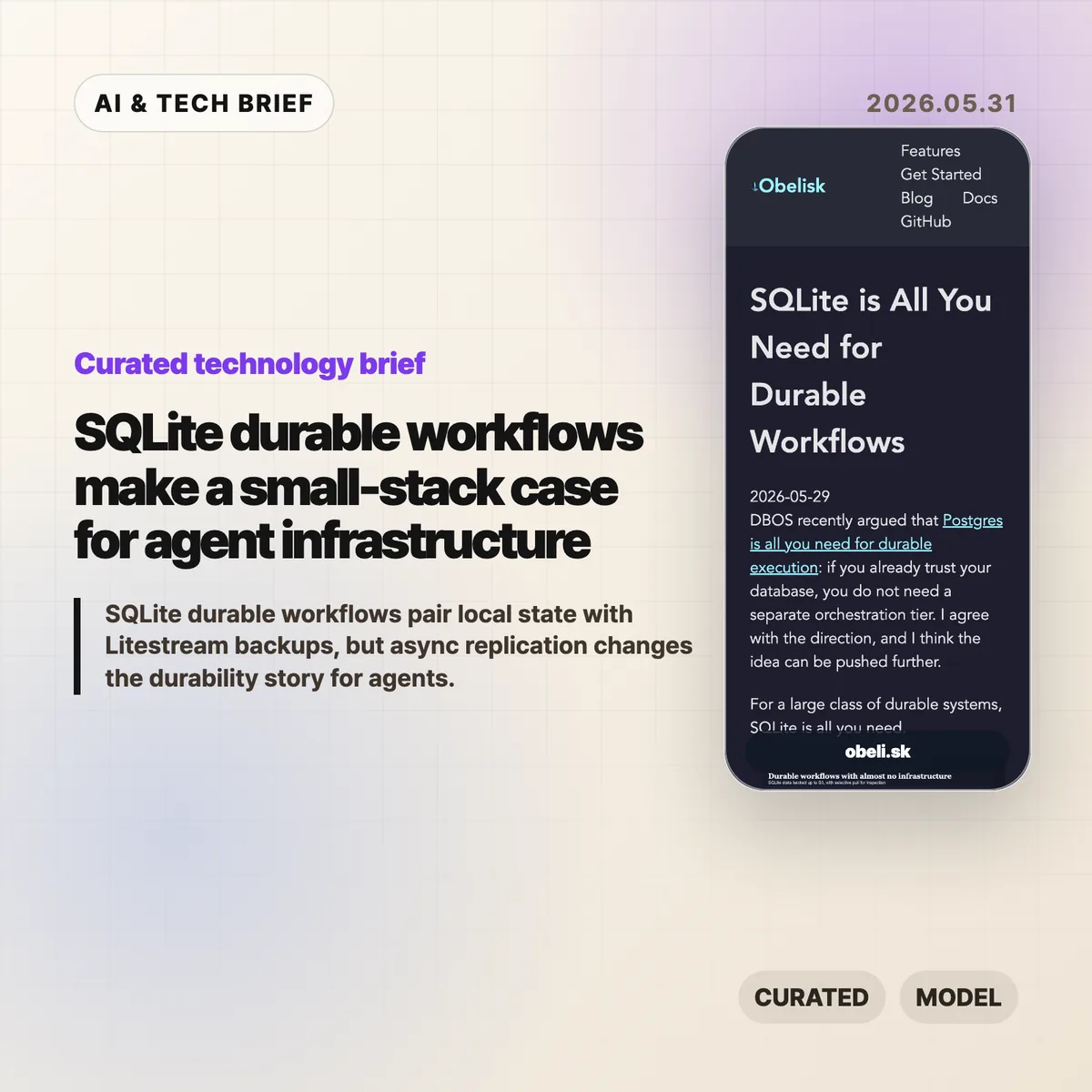
    SQLite durable workflows are a bet that many agent systems need reliable state more than they need a heavy orchestration platform on day one. Obelisk argues that a local SQLite database, backed up with Litestream to S3-compatible storage, can be enough for small durable execution systems where losing the newest local writes is acceptable.

    The short version

    • Obelisk’s argument is narrow but useful: keep workflow state close to the runtime, persist an execution log, and replay from history when work resumes.
    • Litestream adds portability by streaming SQLite changes to object storage, but the replication is asynchronous.
    • The pattern fits bursty AI agents, internal automation, prototypes, and tenant-isolated workloads better than large shared systems.
    • Postgres still makes more sense when teams need strong availability, shared writes, mature operations, or a durability model that cannot lose recent local writes.

    SQLite durable workflows in one sentence

    SQLite durable workflows turn a database file into the recovery point for a run, while Litestream makes that file easier to back up and move.

    What happened

    Obelisk published a short piece arguing that SQLite can be enough for a large class of durable workflow systems. The post responds to DBOS’s recent “Postgres is all you need for durable execution” framing and pushes the same idea toward an even smaller database: if the durable part is workflow state, the compute can be disposable.

    The design is simple. An Obelisk server writes workflow progress to SQLite. Workflows can replay from persisted history, and failed activities can be retried. Litestream then streams SQLite changes to S3-compatible object storage for backup, migration, and inspection.

    That last word matters. The article is not claiming that SQLite plus Litestream gives you the same behavior as a highly available shared database. Litestream replication is asynchronous, so a restore can miss the newest writes if the local volume disappears before those writes are copied.

    Why this is worth watching

    SQLite durable workflows are interesting because they match how a lot of agent infrastructure is being built right now: small workers, short spikes of activity, many experiments, and state that is easier to understand when it belongs to one agent or one tenant.

    For that shape, a database file is not a toy. It is a debugging artifact. You can copy it, inspect it locally, replay a run, or move one tenant without dragging a central system into every step. That is different from saying SQLite should replace Postgres everywhere. It is closer to saying that some workflows are naturally partitioned, and those partitions can be operational units.

    The pattern also lines up with a cost question that keeps showing up in developer tools. Before a team adds Temporal, Step Functions, a Postgres-backed workflow engine, or a full control plane, it can ask a smaller question: can the state model survive restarts with SQLite and object storage? For more briefings like this, the IT & AI archive tracks the developer infrastructure stories that keep resurfacing.

    What Hacker News readers are arguing about

    The Hacker News discussion is useful because it pushes back on the word “durable.” The strongest skeptical camp argues that once Litestream’s asynchronous replication is part of the story, the system may be durable enough for experiments but not durable in the stricter production sense. Several commenters called out the risk of losing the most recent local writes, and one reported replacing Litestream in production after upgrade and disk usage concerns.

    The builder camp is more sympathetic. A few commenters said they already use SQLite-backed task state for agents or pipelines because it keeps iteration simple. One pattern that came up: ask an agent to plan a DAG, store each task in SQLite, and rerun only the steps that changed. Another practical argument was token cost. Agents can query a row instead of rereading a pile of Markdown or logs.

    There was also a familiar SQLite-versus-Postgres fight. Critics argued that SQLite is the wrong tool for concurrent production systems. Supporters answered that many workloads do not need multiple writers across machines, and that strongly partitioned state changes the tradeoff. The thread is not evidence that the architecture is safe. It is a good map of where teams will disagree: recent-write loss, concurrency, operator comfort, and whether a workflow engine is worth the overhead.

    The practical read

    Use SQLite durable workflows when the workflow state is small, naturally partitioned, and valuable to inspect. That describes a lot of AI agent workloads: tool calls, step logs, inputs, outputs, retries, and run history for one tenant or one worker.

    Do not use this pattern as a blanket replacement for Postgres or Temporal. If multiple services need to coordinate writes, if the newest write must survive a node loss, or if operations already depend on database-level replication and failover, a network database or dedicated workflow engine is the safer default.

    The good test is plain: if you can explain exactly which writes may be lost before Litestream catches up, and the product can tolerate that, SQLite plus object storage may keep the stack pleasantly small. If that sentence makes you nervous, it probably should.
    Sources

  • SQLite agentic code policy draws a hard line for AI patches

    SQLite agentic code policy draws a hard line for AI patches

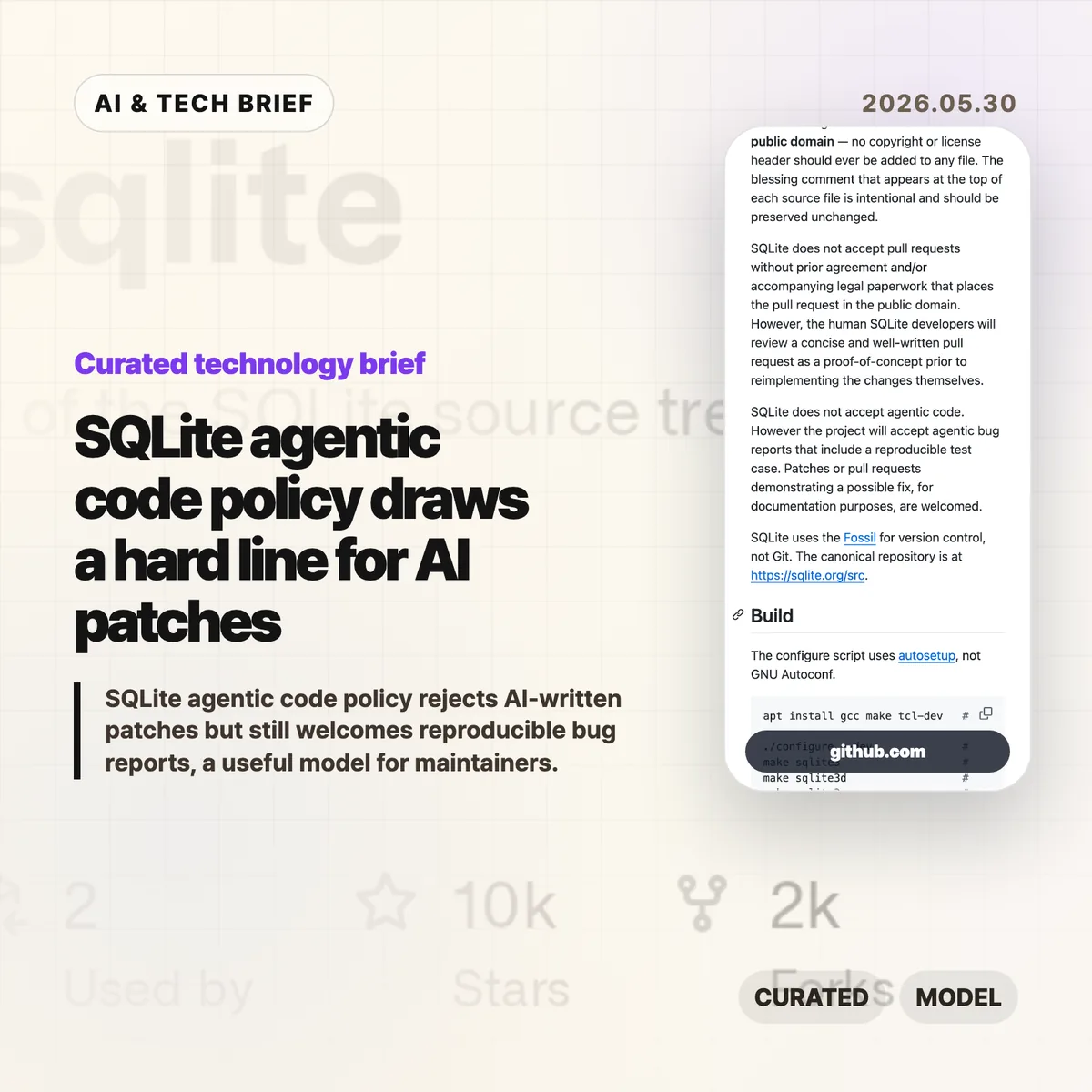
    SQLite added a plain rule to its repository guidance: it does not accept SQLite agentic code as a contribution. The project still welcomes bug reports that include a reproducible test case, which makes this less of an anti-AI manifesto and more of a maintenance boundary for a public-domain database used almost everywhere.

    The short version

    • SQLite’s AGENTS.md says the project does not accept agentic code, even though maintainers may review concise proof-of-concept patches before reimplementing changes themselves.
    • The project separates code contributions from bug reports: AI-assisted reports are acceptable when they include a reproducible test case.
    • The policy is tied to public-domain requirements, long-lived C code, Fossil-based development, and the cost of reviewing patches the maintainers did not write.
    • For AI coding tools, the useful lesson is blunt: a good repro may travel farther than a generated patch.

    What happened

    SQLite now has an AGENTS.md file aimed at people pointing coding agents at the SQLite source tree. The file explains project basics, build commands, testing commands, repository conventions, and contribution rules.

    The sharp part is the contribution policy. SQLite says it does not accept pull requests without prior agreement or legal paperwork that places the contribution in the public domain. It also says, in a separate sentence, that SQLite does not accept agentic code. Maintainers may still review a short, well-written pull request as a proof of concept, but the human SQLite developers reimplement accepted ideas themselves.

    That distinction matters because SQLite is not run like a typical GitHub-first project. Its canonical repository is Fossil, not Git, and its public-domain status is part of the project’s identity. A generated patch is not only a review burden. It can also blur authorship and provenance in a codebase that treats those details seriously.

    Why this is worth watching

    Most open source projects will not copy SQLite word for word. Plenty of maintainers do accept pull requests, and many projects live inside GitHub’s normal review flow. Still, SQLite has given maintainers a clean pattern: reject AI-written code as merge material while accepting AI-assisted evidence when it helps a human reproduce the problem.

    That is a useful split. A patch asks maintainers to trust the author, the code path, the licensing story, the tests, and the future maintenance cost. A reproducible bug report asks them to verify a failure. Those are different jobs.

    The wider lesson for developer tools is that output format matters. If an AI coding assistant produces a patch with no small failing test, it may be creating work for the maintainer. If it produces a minimal case, commands to reproduce it, and enough context for a person to inspect the failure, it has a better chance of being useful.

    For more coverage of developer-tool policy and AI engineering practice, see the IT & AI archive.

    What Hacker News readers are arguing about

    The Hacker News thread around Simon Willison’s write-up is small, so there is not enough there to claim a broad community consensus. The useful point in the comments is a clarification: SQLite is not refusing every artifact touched by an agent. It is refusing agent-written code as codebase input, while still allowing possible fixes to appear as documentation and accepting reproducible bug reports.

    A related earlier discussion on the prototype AGENTS.md commit framed the policy as a reasonable compromise. The tone was less “AI is banned” and more “give agent users rules, then keep generated code out of the project unless a human maintainer owns the final implementation.” That reading fits the file itself.

    The argument that remains open is practical. If AI tools get better at producing tests, minimization steps, and failure cases, maintainers may welcome them as triage tools. If the tools mostly produce plausible patches, projects with strict ownership rules will keep pushing back.

    SQLite agentic code policy in practice

    SQLite agentic code is the wrong deliverable for this project. A reproducible test case is the right one.

    That should influence how developers use coding agents around mature open source infrastructure. Instead of asking an agent to “fix SQLite,” ask it to isolate the failing behavior, reduce the input, show the exact command that fails, and explain why the result conflicts with documented behavior. If a patch is generated along the way, treat it as a debugging note, not as something to submit.

    For coding-agent companies, this is also a product signal. The next useful feature may not be a bigger diff. It may be a maintainer-friendly report: environment, build command, failing test, expected result, actual result, and a short explanation a human can audit.

    The practical read

    If you maintain an open source project, SQLite’s policy is a good starting template even if you soften the wording. Say whether you accept AI-written patches. Say whether AI-assisted bug reports are allowed. Say what evidence makes a report useful. The policy does not need to be dramatic; it needs to reduce ambiguity before the first generated pull request lands.

    If you contribute to projects with AI help, submit less code and better evidence. A concise failing test and reproduction steps respect the maintainer’s time. A large generated patch shifts the risk to someone else.

    Sources