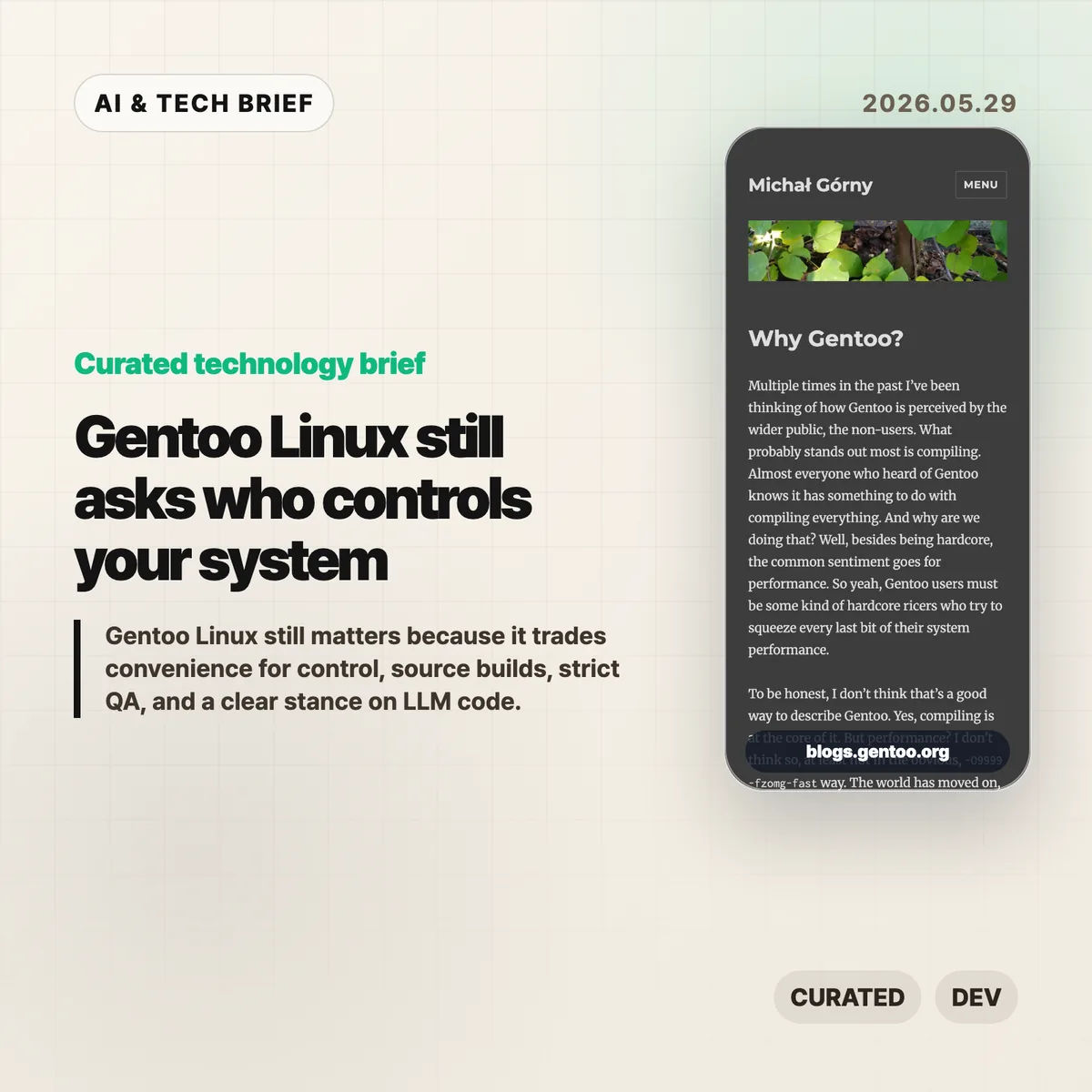
Gentoo Linux is easy to caricature as the distribution for people who enjoy waiting for compilers. Michał Górny’s new essay makes a sharper case: the point is not raw speed, it is control. Gentoo is still useful because it forces an old but unresolved question onto the table: who gets to decide what your system includes, how it is built, and which code you trust?
Table of Contents
The short version
- Gentoo Linux is less about squeezing out a few percent of performance and more about letting users choose build options, dependencies, init systems, libc variants, and patches.
- Its governance pitch is independence: no single company, donor, forge, or business model should be able to steer the distribution on its own.
- The security argument is practical, not nostalgic. Gentoo cares about bundled dependencies, static linking, pinned libraries, mirrors, OpenPGP distribution channels, and QA policy.
- Its ban on LLM generated contributions has become part of the project’s trust model, even though upstream software may still contain AI-assisted code.
- For more open source and AI infrastructure briefs, see the IT & AI archive.
What happened
Górny opens by pushing back on the usual Gentoo joke. Yes, Gentoo builds from source. No, that does not mean the main payoff in 2026 is turning on exotic compiler flags and beating Ubuntu in a benchmark. Modern CPUs are fast, mainstream distributions optimize their packages, and most desktop users will not feel a meaningful difference.
The better argument is that source builds give Gentoo Linux a different contract with the user. Portage and USE flags make build choices visible. You can decide which optional features a package should include, patch a package before it builds, keep or reject parts of the dependency graph, and run combinations that a binary distribution may never ship as first-class options.
That matters most when defaults are not enough. A developer can drop a local patch into Portage and have it applied across future package rebuilds. A systems operator can keep a narrow stack rather than accept every optional feature a maintainer enabled for the average user. None of this is frictionless. The trade is time and attention in exchange for a system that explains itself.
Why this is worth watching
The essay also frames Gentoo as a governance project. There is no company behind it, no SaaS funnel, and no single commercial roadmap. Infrastructure comes from donations and volunteer work. Górny says the project is even moving away from the Gentoo Foundation toward Software in the Public Interest to reduce the chance that legal or financial administration becomes a bottleneck.
That may sound organizational, but it affects the software. A distribution depends on servers, mirrors, signing keys, package review, bug handling, and release discipline. If those pieces sit behind one sponsor or one platform, the technical system inherits that dependency.
Gentoo’s position is more conservative. Codeberg and GitHub can be useful mirrors and contribution channels, but the project does not want to depend on either. That is not a fashionable answer, and it is not the cheapest answer. It is the answer you expect from people who think a distribution should survive a platform policy change or a sponsor walking away.
Security is where the philosophy gets concrete
The most practical part of the essay is the security section. Gentoo’s maintainers talk about a dedicated security team, project-controlled infrastructure, OpenPGP-protected distribution channels, and QA rules that often push against upstream habits.
The examples are familiar to anyone who has dealt with software supply chain risk: bundled dependencies, static linking, pinned versions, and old libraries hiding inside packages. These choices may make upstream development easier, but they can make downstream security updates painful. A distribution that builds from source has more room to catch and unwind those choices, although it also inherits more combinations to test.
This is the part of Gentoo Linux that feels newly relevant. The industry has spent years hiding build systems behind container images, package registries, managed runtimes, and remote development environments. Those tools are often the right choice. But when something breaks or a dependency becomes toxic, somebody still has to understand the layers underneath.
What Hacker News readers are arguing about
The Hacker News discussion is small, but the split is useful. Some longtime users defended Gentoo as a uniquely customizable system. One practical example stood out: putting a local patch under /etc/portage/patches/ so it applies automatically whenever a package is rebuilt. That is the kind of feature that explains Gentoo better than a performance benchmark.
The more heated thread was about LLM generated code. One commenter said AI tools had helped them fix Arch User Repository package builds and that Gentoo’s strict policy would make contributing less appealing. Others argued that overlays still let users maintain their own packages, while critics called the policy inconsistent because upstream projects may already include AI-assisted changes before Gentoo packages them.
The strongest defense of the policy was not anti-AI in the abstract. It was about review burden. If maintainers cannot tell whether a patch is understood by the person submitting it, the project absorbs risk it did not choose. The skeptical reply is fair too: a downstream distribution cannot fully audit how every upstream project writes code. Gentoo can set rules for its own tree, but it cannot make the wider ecosystem human-written by decree.
There was also the expected comparison to Nix and Guix. That comparison is worth making because those systems offer a more formal model for reproducibility and package composition. Gentoo’s answer is different. It is less about a pure functional model and more about giving the local machine, the local maintainer, and the local patch set a lot of room.
Gentoo Linux trade-offs
The harder part is deciding when this model is worth the work. Gentoo Linux gives you more control, but it also asks you to carry more context in your head. That is a bad bargain for casual use and a good bargain when the build itself is part of what you need to understand.
The practical read
Most people should not switch to Gentoo Linux after reading one essay. Fedora, Ubuntu, Debian, Arch, NixOS, and managed developer environments are easier defaults for many teams. Convenience is not a moral failure.
But Gentoo remains a useful benchmark for a different value system. If your team ships infrastructure, maintains internal developer tools, or depends on a large open source supply chain, Gentoo’s questions are worth borrowing. Which dependencies are bundled? Which features are enabled by default? Can you patch a package without forking your whole workflow? Who reviews code generated by an LLM? Who understands the system when the abstraction leaks?
That is the reason this story still travels. Gentoo Linux is not only a distribution. It is a reminder that control has a cost, and sometimes that cost is the point.