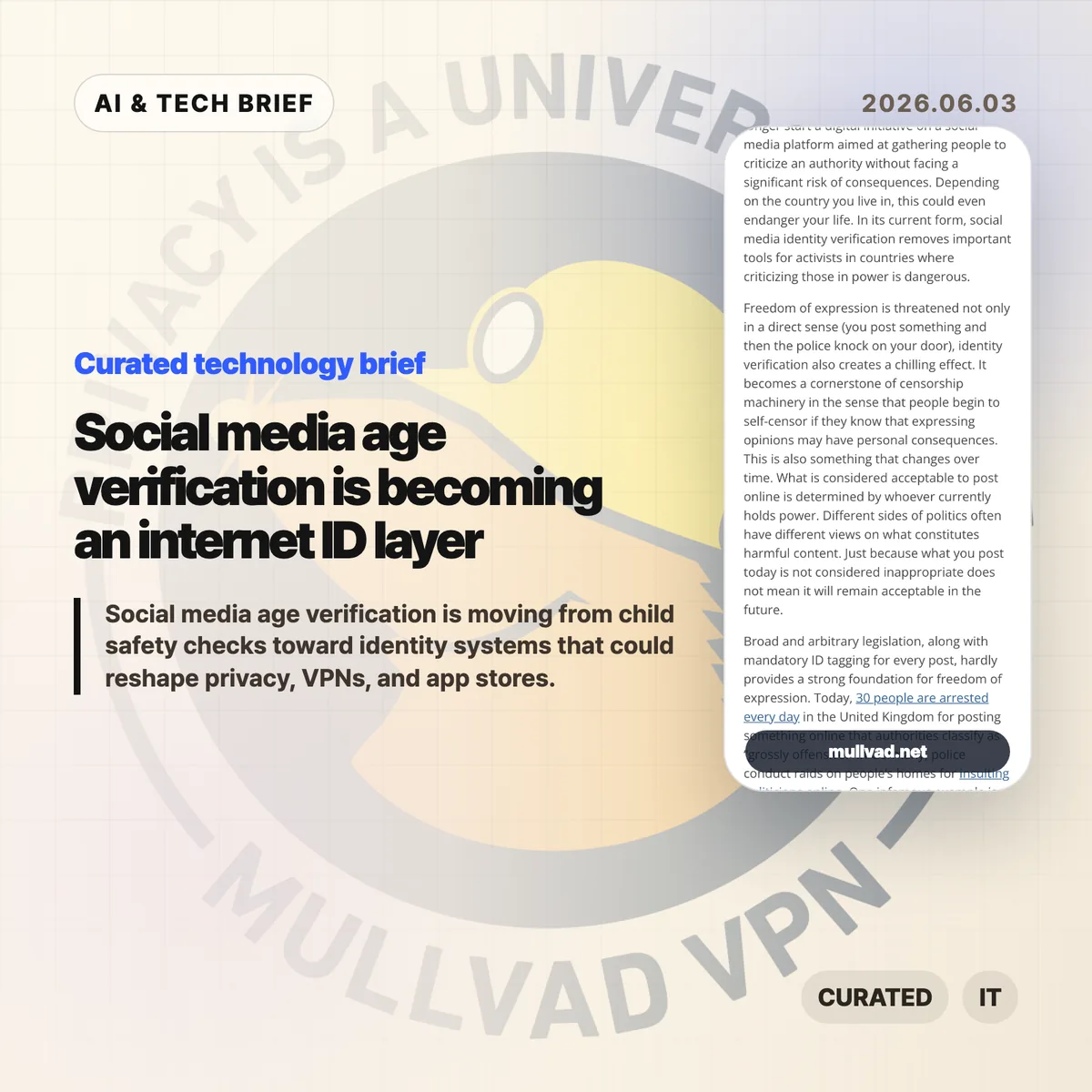
Social media age verification is being sold as a child safety measure, but the current policy push is starting to look like a broader identity layer for the internet. Mullvad’s June 2026 analysis argues that many age checks require users to identify themselves to a website, a platform, a third party, an app store, or an operating system before they can read, post, or install.
Table of Contents
The short version
- Mullvad says social media age verification is spreading across Australia, Brazil, Indonesia, Europe, and the United States, with many systems functioning closer to identity verification than a simple age check.
- The risk is not limited to social platforms. Policymakers are already discussing VPNs, app stores, browsers, and operating systems as places where age controls could be enforced.
- One concrete example in Mullvad’s piece is Apple’s UK iPhone change on March 24, 2026, which the article says pushed 35 million British users toward credit-card or government-ID checks to avoid device restrictions.
- Zero knowledge proofs could reduce the tracking risk, but Mullvad argues the EU’s age verification app can still fall back to a non-ZKP model.
- The practical question for builders is whether they can prove age without creating a reusable identity trail.
What happened
Mullvad published a long privacy critique of online age checks on June 1, 2026. The company starts with social media bans and restrictions for minors, then follows the enforcement logic outward: if children can bypass a platform rule with a VPN, a foreign app store account, Tor, an eSIM, or a browser, regulators may try to control those layers too.
The article names several countries that have adopted, approved, or debated social media restrictions for minors, including Australia, Indonesia, Brazil, Denmark, Portugal, Malaysia, France, Spain, Turkey, Germany, and Sweden. It also says roughly half of US states have either pending or introduced age-restriction laws for inappropriate content, social media, or both.
Mullvad’s central claim is blunt: most age verification systems ask every user to identify themselves to someone. That someone might be the platform, an identity vendor, an issuer, an app store, or an operating system provider. Once that check is tied to a visit, post, app install, or device account, the system can expose more than age.
For more privacy and platform-policy coverage, the IT & AI archive tracks similar questions around regulation, app distribution, and digital identity.
Why social media age verification is worth watching
Social media age verification is worth watching because age checks can become durable identity infrastructure. A website may only need to know that a user is over 16 or over 18. A poorly designed system can reveal the user’s legal identity, the sites they visit, the apps they install, or the accounts they use to speak in public.
That matters for more than adult-content access. Anonymous and pseudonymous use protects whistleblowers, activists, journalists, dissidents, teenagers exploring sensitive topics, and people who do not want every health, sexuality, political, or religious query tied to a name. Mullvad points to the chilling effect: if users believe a future government, platform, or vendor can connect posts back to them, they may stop speaking before anyone orders censorship.
The most important policy detail is enforcement location. If verification happens only at one website, users can still choose another service or privacy tool. If verification moves into app stores, operating systems, browsers, or VPN access, the control point becomes harder to avoid and easier to reuse for other categories of content.
What does social media age verification change for builders?
Social media age verification changes the product requirement from “check an age” to “decide what identity data the product is willing to collect, store, outsource, and expose.” Developers building social apps, marketplaces, gaming communities, browsers, VPNs, and app-store integrations may soon face age-gating rules that were originally aimed at large platforms.
The safer design pattern is data minimization. A service should prefer one-time credentials, narrow age assertions, short retention windows, independent audits, and clear separation between the credential issuer and the site using the proof. If a product stores identity documents, logs which credential opened which account, or shares checks across services, it may create a privacy liability even when the law frames the feature as safety.
App builders should also watch where the obligation lands. If age checks move to Apple, Google, or OS-level APIs, smaller developers may inherit platform decisions they cannot negotiate. That affects app discovery, onboarding, parental-control flows, and whether privacy tools are treated as normal user protection or as circumvention.
What the discussion is missing
There was no reliable Hacker News discussion attached to the source at the time of this brief, so the missing debate is the engineering trade-off. Policy arguments often collapse into two camps: protect minors or protect privacy. Product teams need a more specific question: what proof is required, who sees it, how long it survives, and whether it can be linked across services.
The strongest unanswered point is practical enforcement. If a jurisdiction requires age checks but users can switch VPNs, app stores, accounts, browsers, or operating systems, regulators may keep moving the checkpoint deeper into the stack. That is the path Mullvad warns about. The counterpoint is that platforms already classify users by age for advertising, safety, and recommendation systems, so lawmakers may argue that formal age gates are less invasive than today’s behavioral profiling. That argument only works if the legal system forbids reusable identity trails.
The technical question is also unsettled. Zero knowledge proofs can prove an age threshold without revealing a birth date or identity to the relying website. They do not solve every problem: people without ID documents can still be excluded, issuers can be pressured, and fallback modes can remove the privacy property that made the design acceptable.
The practical read
Treat social media age verification as an identity-system decision, not a compliance checkbox. If a law or platform rule requires an age check, the first review should ask whether the product can verify an age threshold without learning the user’s name, storing an ID document, or letting an issuer reconstruct where the credential was used.
For developers, the near-term work is threat modeling. Map the verifier, issuer, platform, and storage layer. Check whether logs connect credentials to accounts or IP addresses. Test what happens when users are underage, undocumented, traveling, using a VPN, or using a privacy-focused browser. If the only working path requires a government ID and a persistent account, the product has built an identity gate.
For policymakers, the useful line is narrower than “age checks are good” or “age checks are bad.” Require data minimization, ban credential reuse for tracking, mandate privacy-preserving proof where possible, and block attempts to turn VPNs or browsers into identity checkpoints. Child safety rules should not quietly become an ID card for the open web.