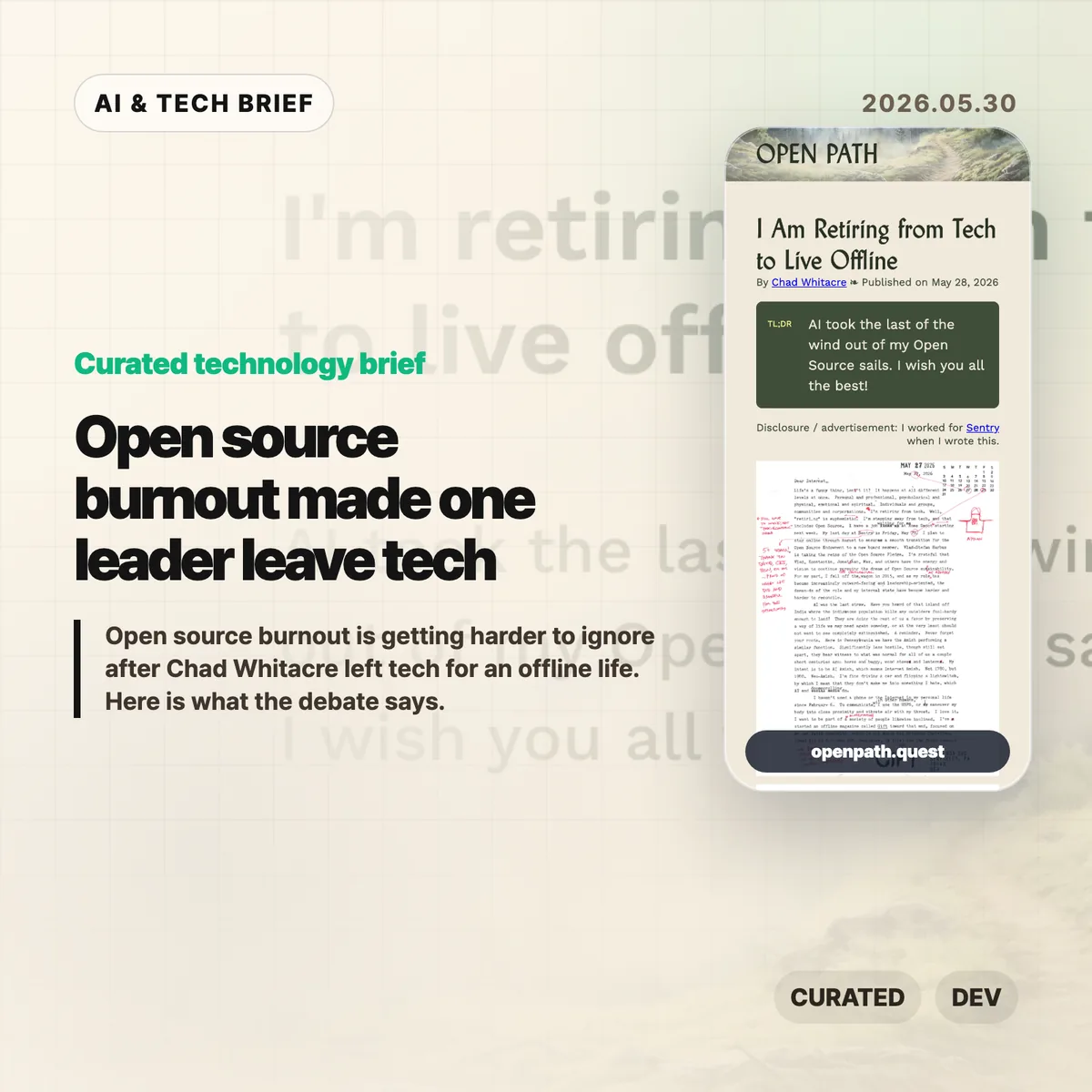
Open source burnout is the plain reading of Chad Whitacre’s short farewell note. Whitacre, who worked on open source at Sentry and helped push the Open Source Pledge, says AI took the last wind out of his open source sails. He is leaving tech for offline work, postal mail, and a life with fewer screens.
Table of Contents
The short version
- Chad Whitacre said May 29, 2026 was his last day in tech and that he planned to work at Home Depot next.
- His post is brief, but the line about AI draining his open source energy landed because many maintainers already feel overloaded.
- The Hacker News discussion turned into a wider argument about corporate politics, early retirement, the pleasure of writing code, and whether AI removes some of that pleasure.
- The practical lesson is not that every developer should go offline. It is that teams building on open source should pay attention when experienced maintainers stop wanting to stay online.
What happened
Whitacre published “I Am Retiring from Tech to Live Offline” on Open Path on May 28, 2026. The post is almost deliberately small: a title, a date, a disclosure that he worked for Sentry when he wrote it, and the line that AI took the last wind out of his open source sails.
The surrounding context matters. Whitacre has been visible in open source circles through Sentry and the Open Source Pledge, a project that asks companies to pay maintainers. In the Korean source material, the story was framed around a full exit from online life: no smartphone, no regular internet, and a preference for mail or in-person contact.
That makes the post easy to overread. Still, the signal is hard to miss. This is not a random complaint from someone who never liked software. It is a note from someone who spent years trying to make open source work more sustainable, then decided the online version of the work was no longer worth it.
Why this is worth watching: open source burnout
Open source burnout usually gets discussed as a funding problem. That is part of it, but Whitacre’s note points at something more personal: the loss of meaning in the work.
AI changes the texture of open source work. Maintainers may receive more generated pull requests, more automated issues, more pressure to move faster, and more questions about whether their craft still matters. Even when AI helps, it can also turn a community project into a review queue.
That is why this story is useful for people who build developer tools, AI coding products, or infrastructure startups. Open source trust still helps products spread. But trust comes from people who answer issues, review patches, write docs, and keep projects coherent. If those people leave, the repository remains, but the social system weakens.
For more English-language technology briefs, the IT & AI archive tracks stories where developer culture and AI adoption collide.
What Hacker News readers are arguing about
The Hacker News thread is less about Whitacre alone and more about the mood around tech work in 2026. Several commenters treated the post as a burnout story. The complaints were familiar: performance reviews, reorganizations, top-down corporate process, and the feeling that an industry that once felt playful now feels exhausting.
The AI-specific argument was sharper. One commenter said the pleasure is going out of coding because they enjoy the craft as much as the finished software. That line explains why AI coding tools can feel different from earlier productivity tools. If someone values the act of shaping code, then outsourcing more of that act can feel like losing the best part of the job.
There was pushback too. Some readers argued that tech remains a comfortable career compared with food service, landscaping, manufacturing, or other physical work. Others said the problem is not technology itself but big-company culture. A few suggested smaller teams, contracting, or nonprofit work as ways to keep the good parts of software while avoiding the corporate machinery.
The useful read from the thread is that open source burnout is not one thing. For some people it is AI. For others it is management culture, money, health, family, or the realization that they can afford to stop. The thread does not prove a trend, but it does show how many experienced developers have a half-written exit plan in their heads.
The practical read
If you run a software team, do not treat open source as a free external department. Pay for the projects you depend on, keep your generated contributions small and reviewable, and make it easy for maintainers to say no.
If you build AI tools for developers, this is a product warning. Speed alone is not enough. The tool has to preserve agency, reviewability, and the feeling that a human still owns the work. Otherwise the best users may quietly decide they would rather do something else.
For individual developers, the lesson is more modest. You do not need to disappear into an offline life to notice when the work has stopped feeling like yours. Take that signal seriously before it turns into a public farewell post.