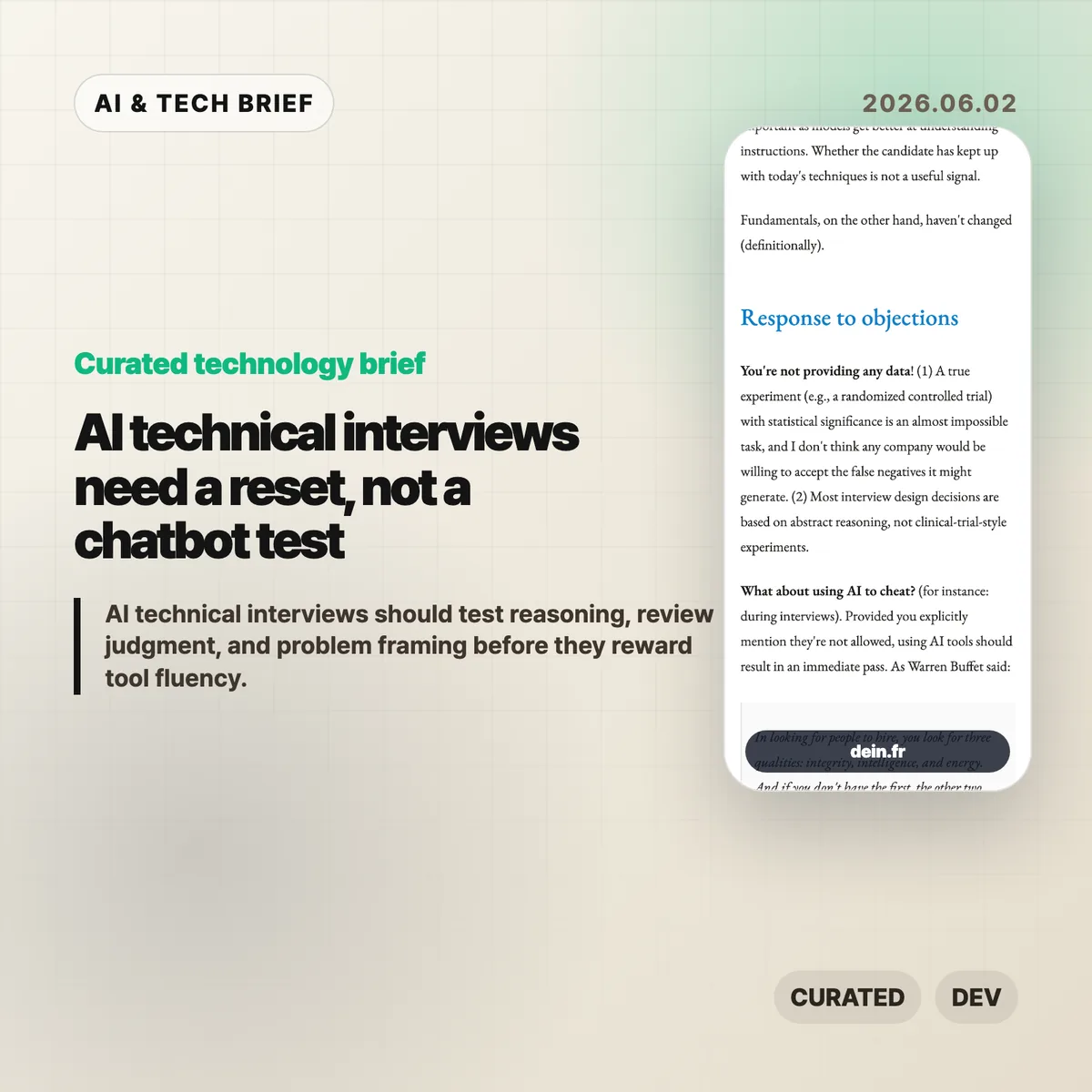
AI technical interviews are getting harder to design because coding assistants can now help with the exact artifacts companies used to treat as evidence. A polished take-home project no longer tells you as much about how a candidate thinks. The better question is whether the interview still exposes reasoning, review judgment, and the ability to finish one messy problem without hiding behind a model.
Table of Contents
The short version
- Charles-Axel Dein argues that most companies should keep AI out of technical interviews unless the exercise is explicitly about AI use.
- Take-home coding challenges are the weakest signal now because candidates can generate strong-looking submissions faster than interviewers can review them.
- Live exercises, follow-up changes, and review-style questions still give companies a better look at how a candidate reasons under constraint.
- AI fluency matters at work, but the piece treats it as an instrumental skill rather than the foundation of engineering judgment.
- Anthropic’s own candidate guidance makes a similar split: AI can help with preparation and refinement, while take-home assessments and live interviews are usually meant to show the candidate’s own thinking.
What happened
Charles-Axel Dein published an essay on how companies should adapt engineering interviews as AI coding tools improve. His core recommendation is blunt: do not let AI use become the default in most interviews, and do not turn the process into a contest over who has the best prompts.
The essay breaks interview design into two practical dimensions: signal quality and company cost. A good interview should reveal the traits the role actually needs, while staying cheap enough to run, calibrate, and explain to candidates. AI pushes on both sides. It can make a take-home challenge easier for the candidate, but it can also leave the company with more code to inspect and less confidence about who made the important decisions.
The piece is not anti-tooling. Dein’s sharper point is that AI skill is closer to editor fluency or language familiarity than to engineering judgment. You can teach a strong engineer a new tool. It is much harder to teach the habit of breaking down ambiguous requirements, spotting risk in a codebase, or explaining why a design will fail.
Why this is worth watching
AI technical interviews are now a hiring product problem, not only an engineering culture debate. A company has to decide what it is actually buying with each interview round: implementation speed, reasoning, communication, review quality, integrity, or all of those at different points in the funnel.
That matters because the old take-home model is becoming expensive in a strange way. The candidate can produce more. The company must verify more. If the review loop turns into “AI wrote it, AI graded it, and a human checked both,” the process has not saved much work. It may have added another layer of uncertainty.
The useful move is to separate tool use from fundamentals. Let candidates prepare with AI if that matches normal work. Be explicit when AI is allowed. But keep at least part of the process focused on human reasoning: explain the tradeoff, modify the solution live, critique an AI-generated plan, review a small codebase, or walk through a product requirement that has gaps.
For readers tracking developer tools and hiring workflows, this is also a market signal. Interview platforms, coding assessment vendors, and AI IDEs will all be pulled into the same question: are they helping teams see better evidence, or just producing cleaner artifacts? The IT & AI archive tracks similar shifts where AI tools change the workflow before teams agree on the evaluation rules.
What Hacker News readers are arguing about
The Hacker News submission for the essay exists, but it has no meaningful comment thread at the time of writing. That silence is useful in a small way: this is not a case where a loud thread can be treated as community consensus.
The discussion worth having is still clear. One camp will argue that banning AI in interviews creates an artificial test because real engineers use tools. The stronger reply is that interviews are already artificial; the point is to isolate a signal. Companies do not ban calculators in every job because arithmetic is sacred. They ban them in some tests when the goal is to see whether the person understands the underlying operation.
The builder argument cuts the other way. If the job requires daily collaboration with AI agents, a company should test that workflow directly. The problem is making it the whole interview. A candidate who can drive a model well but cannot detect a flawed assumption is still a risky hire.
The practical read
Companies should stop treating “AI allowed” as a yes-or-no policy and make it a per-stage rule. Use AI freely for application polish and interview preparation. For take-home work, either forbid it clearly or allow it and make the live follow-up do the real evaluation. For live interviews, keep at least one round where the candidate has to reason without outside assistance.
The most practical interview formats are review-heavy. Ask candidates to inspect an AI-generated plan, find bugs in an existing implementation, respond to a changed requirement, or explain what they would delete from a proposed architecture. Those tasks map better to how AI-assisted engineering actually feels: less typing from scratch, more judgment under uncertainty.
For candidates, the lesson is simple. Being good with AI tools helps, but it does not replace the basics. You still need to understand the code well enough to defend it, change it, and catch the part where the model sounded confident and got the problem wrong.
AI technical interviews in practice
A useful hiring loop should state the AI rule for each stage, then test the candidate’s own judgment somewhere in the process. That is the part a cleaner code sample cannot prove on its own.