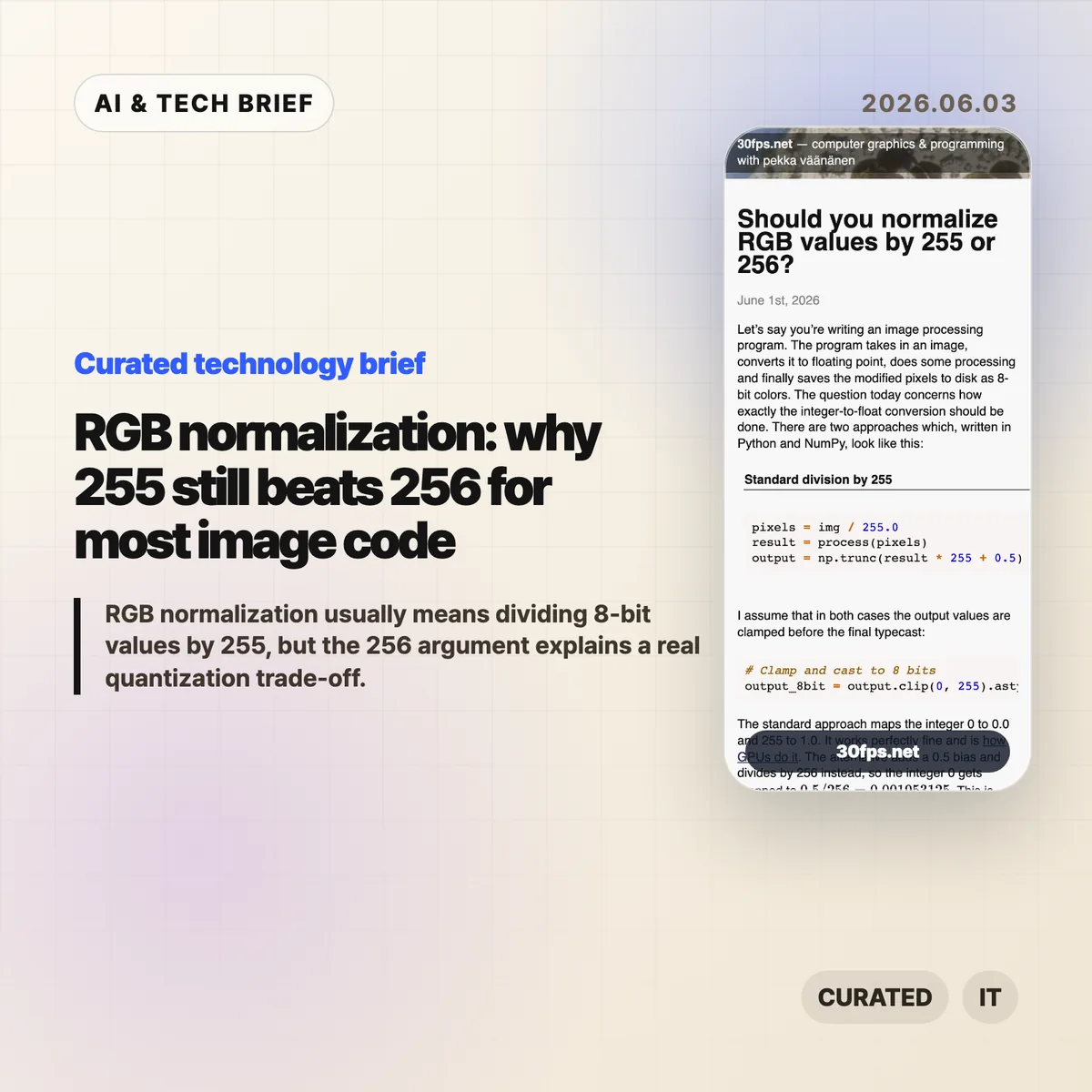
RGB normalization for 8-bit images usually means mapping channel values 0-255 into floating point with value / 255.0. Pekka Vaananen’s June 1, 2026 article on 30fps.net explains why (value + 0.5) / 256.0 can look cleaner as a quantization model, but still makes a poor default when a program loads ordinary PNGs, screenshots, textures, or user-supplied images.
Table of Contents
The short version
- RGB normalization by 255 maps the 256 possible 8-bit codes so that 0 becomes 0.0 and 255 becomes 1.0, matching common GPU UNORM behavior.
- The 256 formula,
(value + 0.5) / 256.0, maps black to 0.001953125 instead of 0.0, which complicates exact endpoint checks. - A centered 256-bin model can help in controlled color-depth conversion or dithering, as Andrew Kensler argued in his 2015 note on color conversion.
- For outside images, the safer rule is to decode with 255, round and clamp on output, and avoid mixing quantizer contracts in one pipeline.
- The public Hacker News thread reached 322 points and 137 comments, with the best arguments centered on whether a byte represents an endpoint or a bucket.
What happened
Pekka Vaananen published a detailed note on whether 8-bit RGB values should be converted to floats with img / 255.0 or (img + 0.5) / 256.0. The standard formula preserves endpoints: integer 0 becomes 0.0, and integer 255 becomes 1.0. Vaananen points out that this is also the direction used by GPUs when they convert unsigned normalized values to floating point.
The alternative formula treats each byte as the center of a quantization interval. Under that model, 0 maps to 0.5 / 256, 128 maps near the center of its interval, and the output bins are more evenly arranged inside the [0, 1] range. That makes the math feel tidier, especially for programmers thinking about quantizers, dithering, or fixed-point color-depth conversion.
The article’s practical conclusion is conservative: use 255 when loading and processing images from outside your own pipeline. A 256-based mapping can make sense when a team controls the entire save-load cycle and accepts that exact black and exact white no longer map to the endpoints that most tools expect.
Why RGB normalization is worth watching
RGB normalization is worth watching because one divisor changes the contract for every later step in an image pipeline. With 255, 8-bit black is exactly 0.0 and 8-bit white is exactly 1.0. With the centered 256 formula, black becomes 0.001953125 and white becomes 0.998046875, so a shader, image editor, ML preprocessor, or Python threshold may stop seeing the endpoints it expects.
The 255 formula is not mathematically perfect. Vaananen shows that when uniformly distributed floats in [0, 1] are rounded back into 8-bit values, the two extreme bins can be half-width compared with the interior bins. He also notes that values like 128 / 255.0 are not exactly representable in binary floating point. His judgment is that these are usually aesthetic or theoretical objections, not bugs that justify decoding other people’s images with a different scale.
The more useful takeaway is consistency. A graphics pipeline can use an endpoint model or a centered-bin model, but it needs to use the same model when it decodes, processes, dithers, and writes pixels back to disk.
What does RGB normalization change for builders?
RGB normalization changes real builder work when the project crosses a boundary between libraries, file formats, GPU APIs, and custom math. Most app developers, graphics programmers, and ML engineers should divide 8-bit image channels by 255.0 because that is what surrounding tools usually expect. It keeps black and white easy to test, preserves common assumptions in masks and alpha, and matches the way many APIs expose normalized bytes.
The 256 approach is still worth understanding. Andrew Kensler’s 2015 post on converting color depth argues for a centered mapping because it generalizes cleanly across bit depths and works nicely with dithering. If a team is building a custom renderer, a pixel-art tool, a color quantizer, or an image codec experiment, that model can be cleaner. The catch is that the team must own both sides of the conversion. Reading arbitrary PNGs with the centered formula does not recover precision that was lost when someone else quantized the file.
For app builders, the ASO angle is simple: image tools get judged by visual trust. A filter app, camera editor, or pixel art workflow that shifts black levels or changes round-trip behavior can create visible differences users describe as washed out, crushed, or inconsistent.
What Hacker News readers are arguing about
The Hacker News thread around the article was active, with 322 points and 137 comments when checked through the public Algolia API. The useful part of the discussion was not a unanimous verdict. It was the set of mental models commenters used to decide what the byte means.
One camp leaned on the endpoint model: if the byte runs from 0 to 255, then the span from darkest to lightest has length 255, much like a ruler with marks at both ends. That view supports dividing by 255, especially when 0 and 255 are physical or display endpoints. Another camp pushed back with an interval model: a byte can represent one of 256 buckets, and placing the reconstructed value at the bucket center is a reasonable estimate of the original continuous value.
Several commenters moved the debate into implementation details. Some argued that division by 256 can be faster in integer-heavy software rendering because it becomes a shift. Others replied that modern float multiplication, SIMD, GPU execution, compiler behavior, memory bandwidth, and color-space correctness matter more than a single divisor in most real pipelines. A separate thread pointed out that compositing math should happen in linear color space, which is a larger correctness issue than 255 versus 256.
The best practical objection in the discussion was that graphics code often mixes domains: file bytes, display-referred sRGB values, linear-light math, alpha compositing, dithering, and GPU formats. The divisor decision only stays clean if the code is honest about which domain it is in.
The practical read
Use value / 255.0 for ordinary RGB normalization when reading 8-bit images from files, user uploads, screenshots, design assets, game textures, or third-party libraries. It matches common expectations, keeps endpoints exact, and avoids surprising downstream code. If the code later writes back to 8-bit, use a matching encode path with rounding and clamping rather than mixing formulas. For more technical briefs like this, browse the IT & AI archive.
Consider (value + 0.5) / 256.0 only when the pipeline is designed around centered quantization from the start. That means the encoder, decoder, tests, documentation, and any dithering logic agree on the same model. It is a pipeline contract, not a drop-in replacement for the standard image-loading formula.
The debugging rule is even simpler: if colors look slightly lifted, blacks stop comparing equal to zero, or round-trips change pixels unexpectedly, check whether one stage divided by 255 and another stage assumed 256. These bugs are small enough to hide in code review and visible enough to annoy anyone looking at the output.