Tag: Product strategy

  • AI product building needs taste more than raw speed

    AI product building needs taste more than raw speed

    AI product building can now turn rough ideas into prototypes, screens, and working flows faster than most teams could a few years ago. In a June 2026 Figma essay, chief product officer Yuhki Yamashita argues that once making gets easier, the real advantage moves to choosing the right thing to make and shaping it with enough care that users can tell the difference. The point is especially relevant for teams using Figma Make, AI coding tools, or prompt-based prototyping to compress the path from idea to demo.

    The short version

    • Figma says speed is becoming table stakes as AI lowers the cost of turning product ideas into prototypes.
    • The harder job for product teams is choosing a direction before they spend weeks refining the wrong one.
    • Product teams should compare several concrete directions in parallel, not fall in love with the first plausible output.
    • Craft still matters because AI defaults can make products feel polished but interchangeable.

    What happened

    Figma published a June 2026 essay by chief product officer Yuhki Yamashita on what changes when AI lets more people build products. The article, titled “What Matters When Anyone Can Build,” frames the shift around a concrete product pressure: if many teams can generate screens, prototypes, and flows quickly, shipping speed alone becomes a weaker signal of product quality.

    The essay argues that builders face two traps. Newer teams can go deep on the first idea because AI makes that idea feel alive almost immediately. More experienced teams can stay too abstract, comparing strategy maps and wireframes without seeing how the end user experience feels. Figma’s proposed middle ground is to go broad and deep at the same time: explore multiple directions and push each far enough to be experienced, not merely described.

    That framing fits Figma’s own product direction. The company has been leaning into AI-assisted prototyping through tools such as Figma Make, where teams can generate interactive versions of an idea and compare them side by side. The article is part product philosophy, part pitch for a workflow where humans and AI agents test options together before a team commits.

    Why AI product building is worth watching

    AI product building is worth watching because the bottleneck is moving from production to judgment. When a team can make five plausible prototypes instead of one static mockup, the question changes from “can we build this?” to “which version deserves the team’s attention?” That is a more useful question, but it is also easier to dodge when every generated result looks polished enough to keep.

    Figma’s useful warning is that AI tools can accelerate a team inside a bad starting point. Agents tend to be helpful and agreeable. They extend the initial prompt, fill in missing pieces, and make the current direction look more complete. That makes local improvement feel productive even when the team has not checked whether the starting idea is the right one.

    The better habit is parallel exploration. Product managers, designers, founders, and engineers can ask for distinct directions, make each one concrete, and then compare actual flows. Teams get a better conversation when they react to screens, states, copy, and friction instead of arguing over a vague concept board.

    What does AI product building change for teams?

    AI product building changes the product team’s job by making taste, prioritization, and review harder to outsource. A model can propose layout patterns, write interface copy, or generate a clickable flow, but it does not know which trade-off fits the customer, the market, or the company’s appetite for risk. Teams still have to decide what problem is worth solving and what level of finish the first release needs.

    For founders and small app teams, this is a practical point rather than a design slogan. AI can shorten the distance between idea and demo, which is useful for app discovery, MVP testing, and investor conversations. It can also make weak ideas look more credible than they are. A generated prototype should start a sharper review: which user problem is this solving, what did the team intentionally leave out, and where does the experience still feel generic?

    For larger product teams, the collaboration pattern may matter as much as the tooling. Figma describes teammates and agents reacting together to multiple options. That pushes AI work out of a private prompt box and into a shared review process, where a team can challenge the defaults before they harden into the product.

    What the discussion is missing

    There was no reliable Hacker News thread for this specific Figma essay at the time of writing. The missing debate is still easy to name: Figma’s argument is strong on product craft, but it leaves open how teams should measure whether AI-assisted exploration actually improves decisions.

    The hard questions are operational. How many directions should a team generate before comparison becomes theater? Who decides when a prototype is realistic enough to test? How does a team avoid rewarding the most visually convincing option when the best product choice may be less flashy? Those questions matter because AI tools can produce a lot of plausible work, and plausible work can crowd out slow, uncomfortable customer evidence.

    A good discussion would also separate craft from polish. Figma is right that products can become interchangeable when teams accept model defaults. But a high-gloss interface is not the same as a cared-for product. The real test is whether the team can explain the choices behind the flow, the words, the empty states, the constraints, and the things it decided not to build.

    The practical read

    Teams using AI prototyping tools should treat the first output as evidence, not as a draft to protect. A practical review process starts with competing directions, pushes each one into a testable flow, and then compares the options against a real user problem. The generated UI matters only after the team can explain why this direction deserves to exist.

    The best use of this Figma essay is as a checklist for product reviews. Before a team ships, it should be able to answer three questions: did we explore more than one direction, did we choose this direction for a reason we can defend, and did we refine the parts users will actually feel? If the answer is no, the team may have used AI to move faster without getting closer to a better product.

    Readers tracking AI tools, design systems, and product workflows can find more related coverage in the IT & AI archive. The short version: faster building raises the bar for choosing well. Teams that treat AI product building as a review discipline, rather than a shortcut, will have a better chance of making products that feel intentional rather than merely generated.
    Sources

  • Product strategy questions: stop debating wide vs deep

    Product strategy questions: stop debating wide vs deep

    Product strategy questions can sound smart and still waste a room. Shreyas Doshi’s X article argues that “should we go wide or deep?” is often the wrong opening move, especially for an AI startup suddenly facing larger incumbents. The better question is smaller and harder: which customer, which pain, which feature, and which reason to buy?

    The short version

    • Doshi describes an AI startup founder whose team started debating whether to widen the product or deepen the current workflow after two large incumbents entered the space.
    • His advice is to reject the binary because it pulls teams into abstract language before they have named the customer bet.
    • The useful product strategy questions sit one level lower: what feature will resonate, who will buy because of it, and why will they stay?
    • For founders and PMs, the article is a reminder that frameworks do not rescue weak customer understanding.

    What happened

    Doshi published an X article titled “Get to the Core of the Thing” after advising a founder running an AI startup. The founder’s team was anxious because two established companies had moved into the same market. Their proposed frame was familiar: should the product expand its surface area, or should the team sharpen what it already had?

    Doshi’s answer was blunt. Drop the frame. In his view, a wide-versus-deep debate lets smart people sound strategic while avoiding the work that actually matters: naming the specific bet on a specific feature for a specific customer.

    That distinction matters because many product meetings drift upward. Teams start with a real market threat, then jump into platform versus point solution, CAC versus LTV, horizontal versus vertical, or whatever analogy sounds good that week. Those phrases can be useful later. They are dangerous when they arrive before the team has done the customer work.

    Why this is worth watching

    The article lands because AI product teams are living through exactly this kind of pressure. When a bigger company enters a category, a smaller team can feel pushed to look broader, more platform-like, or more defensible on a slide. That instinct is understandable. It can also blur the only question a customer cares about: does this product solve my problem better than the thing I already use?

    The piece is also useful for non-AI teams. “Wide or deep” is only one version of the trap. Founders can swap in “enterprise or SMB,” “workflow or infrastructure,” “self-serve or sales-led,” and still avoid the harder work. The language changes. The escape hatch is the same.

    A better meeting starts with product strategy questions that make the team prove what it knows. Which buyer felt the pain last week? What did they try before? Which feature would change the buying conversation? What can the team ship quickly enough to learn from real use?

    For more technology and AI briefs, the IT & AI archive tracks similar product and builder signals without turning every link into a trend forecast.

    What the discussion is missing

    There does not appear to be a Hacker News thread tied to this article. That is probably fine. Doshi’s post is less a news event than a product operating note, and the missing debate is the practical one inside teams: when is a framework helpful, and when is it camouflage?

    The useful objection is that teams still need high-level strategy. A startup cannot interview its way out of every positioning decision. The point is not to ban strategy language. It is to use it after the team can state the customer bet in plain language.

    The other open question is speed. Doshi says the team needs real differentiation and needs to build it quickly. That is the part many teams will agree with and still struggle to do. The test is whether the next roadmap meeting produces a feature bet someone can validate, or another hour of vocabulary.

    The practical read

    If your team is stuck in a wide-versus-deep debate, pause the labels and rewrite the agenda around product strategy questions.

    Ask who the customer is in a way that points to a real person or account, not a segment name. Ask what that customer is doing today instead of using your product. Ask which feature would change the purchase or retention decision. Ask whether your team can build enough of that feature to learn before the market moves again.

    If you cannot answer those questions, choosing “wide” or “deep” will not fix the product. It will only make the uncertainty sound organized. If you can answer them, the shape of the product usually becomes less mysterious. You go wider where the customer bet requires reach, and deeper where the buying reason requires depth.

    Product strategy questions to ask first

    Use these product strategy questions before the roadmap turns into a framing contest:

    • Which customer call, support ticket, renewal risk, or lost deal are we using as evidence?
    • Which feature would make that customer buy, stay, expand, or switch?
    • What do we believe competitors cannot copy quickly enough to erase the advantage?
    • What can we ship in the next cycle that will make the answer clearer?

    That is less glamorous than a strategy offsite. It is also harder to fake.

    Sources

  • nice nano wireless keyboard: a dorm-room board that found a real market

    nice nano wireless keyboard: a dorm-room board that found a real market

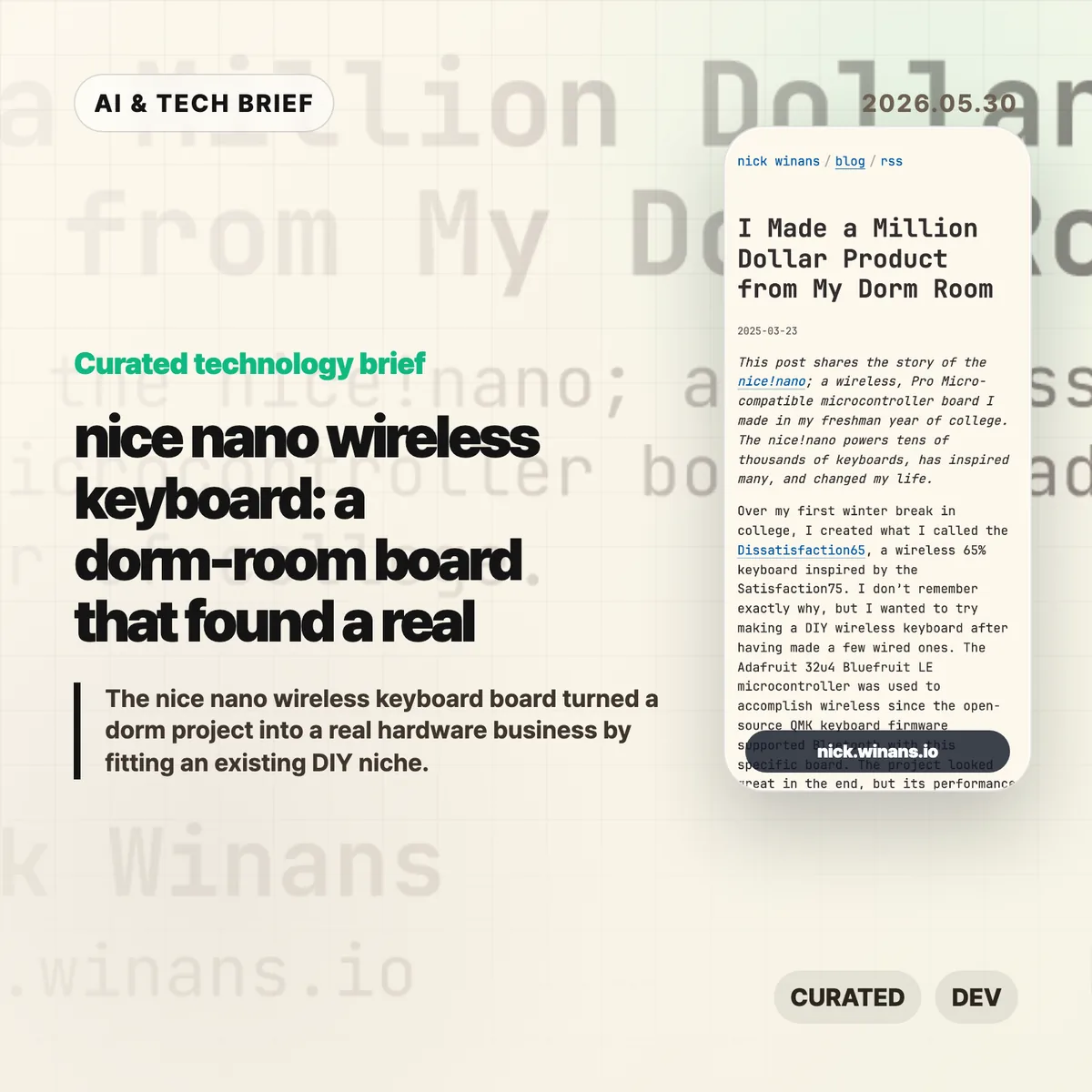
    The nice nano wireless keyboard board is a good reminder that a hardware product does not need a huge category to become meaningful. Nick Winans built a Pro Micro-compatible wireless controller as a college freshman, sold the first 1,000 units in seven hours, and later saw more than 50,000 boards move through the custom keyboard world.

    The short version

    • The product worked because it fit the Pro Micro footprint that many DIY keyboard designs already expected.
    • The first group buy sold 1,000 units in seven hours, but the experience convinced Winans not to keep using preorder funding.
    • ZMK firmware turned the board from a clever part into a more complete wireless keyboard platform.
    • The bigger lesson is distribution: Reddit, Discord, vendors, and Typeractive made a tiny niche easier to buy into.

    What happened

    Winans started with a failed wireless keyboard project called the Dissatisfaction65. It looked good, but the typing latency was poor and the battery lasted only a few days even with a large battery. That pushed him toward Nordic chips, the Pro Micro form factor, and the gap between commercial wireless keyboards and the DIY keyboard scene.

    The nice nano wireless keyboard board came out of that search. Winans designed the first version over a weekend using KiCad, Nordic documentation, the nRFMicro wiki, and Adafruit’s nRF52840 Feather schematic. The result was a thin nRF52840 board that could drop into many keyboard builds designed around a Pro Micro.

    The early proof was practical. He built a Lily58 with the boards and saw weeks of battery life from a 110mAh battery. A Reddit post drew interest, the Discord community grew, and the first group buy sold out its 1,000-unit cap within seven hours. The order still created stress: customer money arrived before the physical product did, PayPal held funds, and fulfillment became a family operation.

    From there, the project became a small ecosystem. ZMK gave wireless keyboard builders a stronger firmware path. Vendors started carrying the board. In 2022, Winans and his family launched Typeractive, a store built around wireless split keyboard kits and a 3D configuration tool that helped buyers choose the right parts.

    Why this is worth watching

    The useful part of this story is not the dorm-room mythology. It is the constraint. Winans did not ask buyers to adopt a new keyboard architecture. He made the wireless part fit where the community already expected a controller to fit.

    That is a product lesson software teams often forget. A niche can be small and still be serious if the pain is specific, the buyers talk to each other, and the product slips into an existing workflow. For more technology briefs like this, the IT & AI archive keeps a running set of builder-focused stories.

    The nice nano wireless keyboard story also shows the tradeoff in open hardware. Public schematics and community firmware helped the board spread, but they also made cloning easier. Winans says clones appeared on Taobao and AliExpress, including products advertised as nice!nanos and shipped with the same firmware identity. That is not a clean win or loss. It is the usual bargain: openness can create trust and distribution, then force a founder to compete on quality, brand, support, and buying experience.

    nice nano wireless keyboard lesson

    The repeatable pattern is compatibility first, then community, then purchasing help. That order made the board easier to try and easier to recommend.

    What Hacker News readers are arguing about

    The Hacker News discussion is less about the circuit board and more about whether niche products can still make good businesses. Several commenters liked the simple framing: make something a small group badly wants, then reach that group directly. Others pushed back on the idea that any niche works. Their point was that 50,000 reachable, solvent, motivated buyers is rare, and finding them is often the hard part.

    Winans joined the thread and gave the most useful detail. He credited timing, a Reddit post during the early Covid period, fast community work in Discord, frequent updates, and a quick move into vendor storefronts. In other words, luck helped, but he also converted attention into a channel before it faded.

    The skeptical thread was about compliance and clones. Some readers asked about FCC obligations for an intentional radiator. Others argued that small hardware makers face a harsh choice between regulatory cost and shipping a product before the market is proven. The clone discussion split in a similar way: trademark enforcement may be possible in some channels, but cross-border hardware copying is rarely a neat problem.

    The most practical comments came from keyboard users. A few said they owned multiple boards, which explains why a part that sounds impossibly narrow can still sell in volume. A wireless split keyboard often needs two controllers, and hobbyists rarely stop at one build.

    The practical read

    If you are building a niche hardware product, the nice nano wireless keyboard case points to three tests. Does it fit an existing standard? Can buyers explain the pain to each other without your sales deck? Can a first-time buyer get from interest to a working build without getting lost?

    The board passed those tests better than most hobby projects. The Pro Micro footprint lowered adoption friction. ZMK made the firmware story credible. Typeractive reduced the shopping problem. None of that removes the ugly parts of hardware: cash timing, fulfillment, certification, clones, support, and inventory. It does explain why a small board could become a real business.

    For app and product builders, the discovery angle is similar. The 3D kit configurator was not decoration; it helped people assemble the right purchase. In a niche market, the buying path can be as important as the product spec.

    Sources

  • DuckDuckGo AI-free search is the real Google AI backlash signal

    DuckDuckGo AI-free search is the real Google AI backlash signal

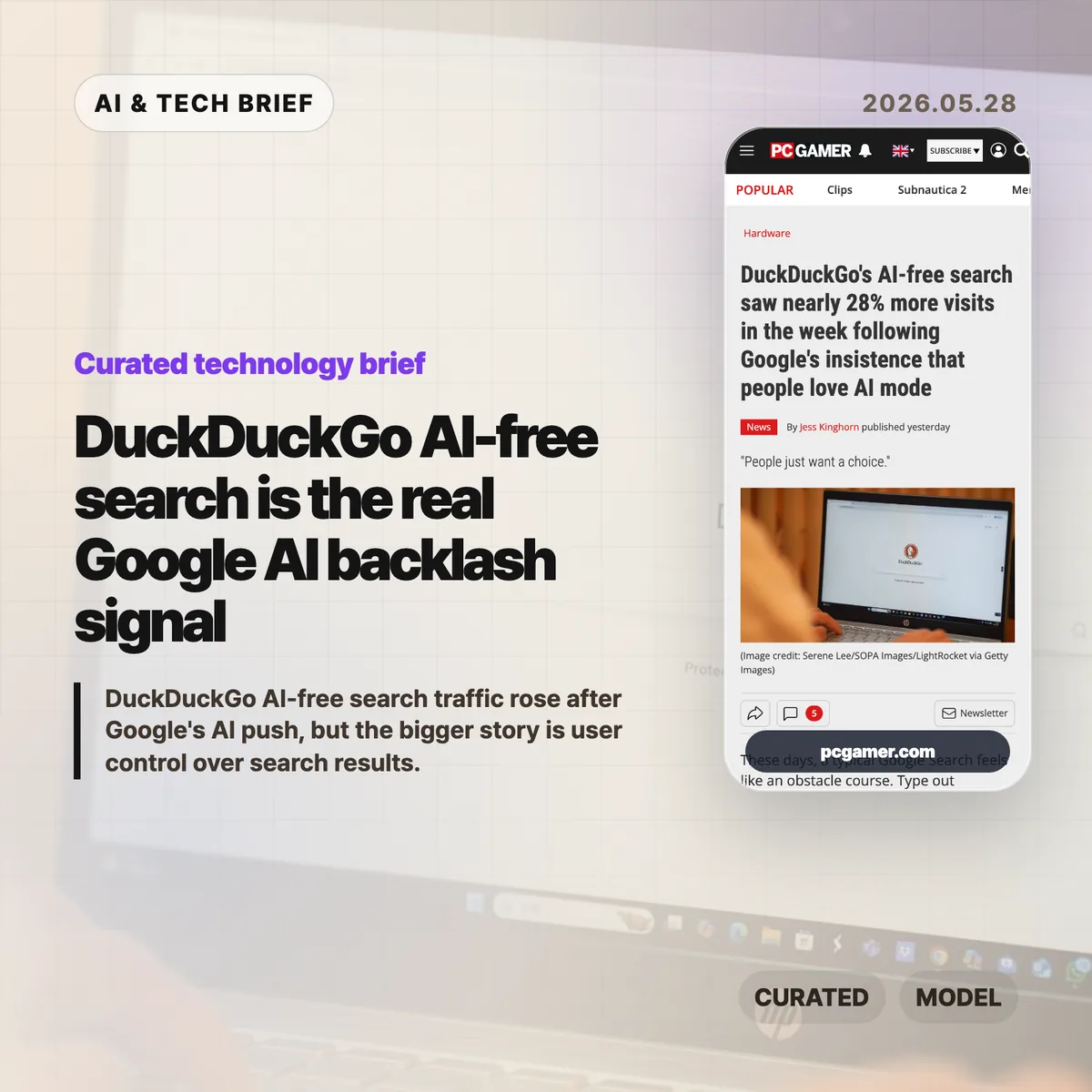
    DuckDuckGo AI-free search traffic rose after Google pushed AI Mode and AI Overviews harder into the search experience. The numbers are still small next to Google’s market share, but the reaction points to a product problem: some people want AI answers, and some people want search results without a model stepping in first.

    The short version

    • Visits to DuckDuckGo’s AI-free search page reportedly rose by an average of 22.7% week over week from May 20 to May 25, peaking at 27.7% on May 24.
    • TechCrunch reported that DuckDuckGo mobile app installs in the US rose 18.1% on average over the same stretch, with a 30.5% peak on May 25.
    • This does not make DuckDuckGo a near-term threat to Google Search, which still has a much larger share of the US search market.
    • The useful signal is product fatigue: users are reacting less to AI itself than to AI being treated as the default layer in search.

    What happened

    PC Gamer reported that DuckDuckGo saw a sharp bump in usage around its AI-free search surface after Google kept promoting AI Mode as a direction users supposedly like. DuckDuckGo’s noai page, which gives people a cleaner path to search without AI answers, saw visits rise 22.7% on average week over week from May 20 through May 25. The peak was 27.7% on May 24.

    TechCrunch reported a related app-store signal. DuckDuckGo mobile app installs in the US rose 18.1% on average over the same six-day window, and the increase peaked at 30.5% on May 25. Those figures are not a market-share earthquake. They are a behavior change worth watching because they happened around a visible product dispute: Google putting AI answers closer to the center of search, and some users looking for a way around it.

    Google has a business reason to keep going. In Alphabet’s Q1 2026 remarks, Sundar Pichai said Search revenue rose 19% year over year and tied part of Google’s momentum to AI experiences such as AI Overviews and AI Mode. From Google’s side, AI search is a growth story. From the user’s side, it can feel like a familiar utility changing its rules without asking.

    Why this is worth watching

    Search is not a side feature. It is the front door to the web for a lot of people. When AI answers sit above links, the search engine is no longer only helping users find pages. It is deciding when a synthesized answer should come before the open web.

    That can be useful. Plenty of queries are simple enough that an answer box saves time. The friction starts when a user wants links, source comparison, official pages, forum threads, product documentation, or a plain list of results. In those moments, an AI answer can feel like an obstacle rather than a shortcut.

    The privacy angle also gives DuckDuckGo a cleaner message. DuckDuckGo is not anti-AI across the board. It offers AI chat and summaries in other contexts. Its pitch is closer to control: let the user choose how much AI they want, and do not turn search logs or chats into training material. For people already uneasy about data collection, that distinction is easy to understand.

    There is also a lesson for anyone building AI into consumer products. If a feature changes a daily habit, opt-out controls are part of the product, not a settings afterthought. For more coverage of search, AI products, and platform shifts, see the IT & AI archive.

    DuckDuckGo AI-free search and user control

    DuckDuckGo AI-free search is a useful phrase because it names the demand more clearly than “anti-AI search.” The demand is not for a web frozen in 2015. It is for a visible choice between answer generation and ordinary results.

    What Hacker News readers are arguing about

    The Hacker News thread was split in a useful way. Some readers had already moved to DuckDuckGo or were trying alternatives because they disliked seeing AI answers in ordinary search. A repeated complaint was not that AI is useless, but that Google Search is where they go for links. If they want a chatbot, they would rather open a dedicated AI product.

    Another group defended Google AI Mode. They said it is fast, convenient from the address bar, and good enough for quick factual checks. That camp is not imaginary; it explains why Google’s internal metrics may look positive even while a visible group of users complains loudly.

    The strongest skeptical point was about the denominator. A 28% increase sounds large, but DuckDuckGo starts from a much smaller base than Google. Several commenters argued that the headline could overstate the competitive impact if readers treat a relative increase as proof of a broad search migration.

    The more practical thread was about controls. Readers kept coming back to the same distinction: AI can be useful when asked for, annoying when forced, and worrying when it changes what counts as a search result. That is the part product teams should notice.

    The practical read

    DuckDuckGo is not suddenly replacing Google Search. The safer read is that AI search has entered the backlash phase that most default-on product changes eventually face.

    For Google, the risk is not that every frustrated user leaves tomorrow. The risk is training people to keep a second search engine nearby for cases where AI gets in the way. That is a small habit change at first, but it weakens the assumption that Google is the only search box worth using.

    For DuckDuckGo and other search apps, the opening is clear but narrow. Privacy and AI opt-out messaging can bring people in. The hard part is keeping them when results quality, local search, maps, shopping, and vertical search matter. A search engine can win a protest click and still lose the daily habit.

    For builders, the rule is simple enough: do not confuse adoption with consent. If an AI feature is genuinely useful, people will use it when the path is clear. If they have to fight the interface to get back to the old behavior, the alternative with a simple off switch starts to look better.

    Sources