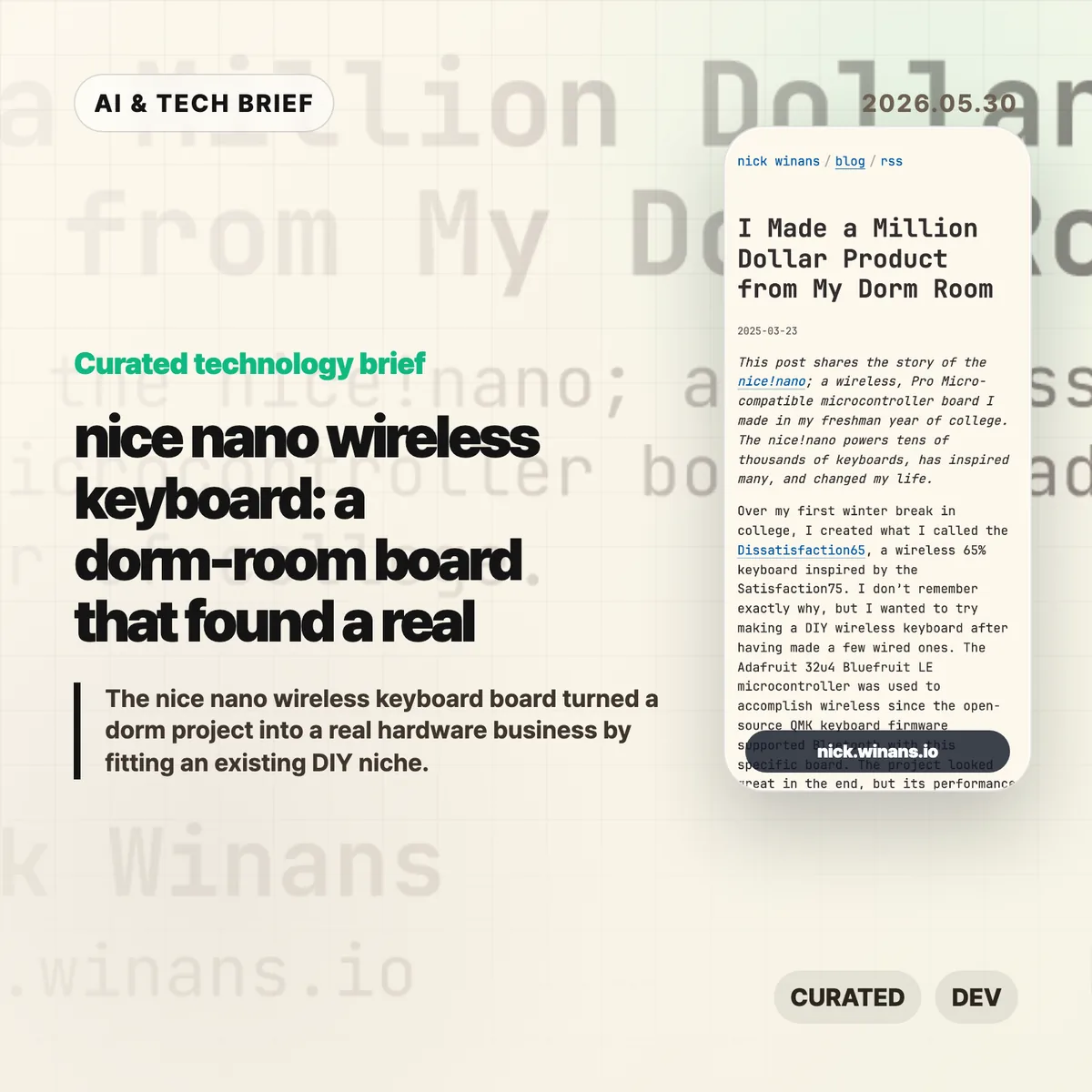
The nice nano wireless keyboard board is a good reminder that a hardware product does not need a huge category to become meaningful. Nick Winans built a Pro Micro-compatible wireless controller as a college freshman, sold the first 1,000 units in seven hours, and later saw more than 50,000 boards move through the custom keyboard world.
Table of Contents
The short version
- The product worked because it fit the Pro Micro footprint that many DIY keyboard designs already expected.
- The first group buy sold 1,000 units in seven hours, but the experience convinced Winans not to keep using preorder funding.
- ZMK firmware turned the board from a clever part into a more complete wireless keyboard platform.
- The bigger lesson is distribution: Reddit, Discord, vendors, and Typeractive made a tiny niche easier to buy into.
What happened
Winans started with a failed wireless keyboard project called the Dissatisfaction65. It looked good, but the typing latency was poor and the battery lasted only a few days even with a large battery. That pushed him toward Nordic chips, the Pro Micro form factor, and the gap between commercial wireless keyboards and the DIY keyboard scene.
The nice nano wireless keyboard board came out of that search. Winans designed the first version over a weekend using KiCad, Nordic documentation, the nRFMicro wiki, and Adafruit’s nRF52840 Feather schematic. The result was a thin nRF52840 board that could drop into many keyboard builds designed around a Pro Micro.
The early proof was practical. He built a Lily58 with the boards and saw weeks of battery life from a 110mAh battery. A Reddit post drew interest, the Discord community grew, and the first group buy sold out its 1,000-unit cap within seven hours. The order still created stress: customer money arrived before the physical product did, PayPal held funds, and fulfillment became a family operation.
From there, the project became a small ecosystem. ZMK gave wireless keyboard builders a stronger firmware path. Vendors started carrying the board. In 2022, Winans and his family launched Typeractive, a store built around wireless split keyboard kits and a 3D configuration tool that helped buyers choose the right parts.
Why this is worth watching
The useful part of this story is not the dorm-room mythology. It is the constraint. Winans did not ask buyers to adopt a new keyboard architecture. He made the wireless part fit where the community already expected a controller to fit.
That is a product lesson software teams often forget. A niche can be small and still be serious if the pain is specific, the buyers talk to each other, and the product slips into an existing workflow. For more technology briefs like this, the IT & AI archive keeps a running set of builder-focused stories.
The nice nano wireless keyboard story also shows the tradeoff in open hardware. Public schematics and community firmware helped the board spread, but they also made cloning easier. Winans says clones appeared on Taobao and AliExpress, including products advertised as nice!nanos and shipped with the same firmware identity. That is not a clean win or loss. It is the usual bargain: openness can create trust and distribution, then force a founder to compete on quality, brand, support, and buying experience.
nice nano wireless keyboard lesson
The repeatable pattern is compatibility first, then community, then purchasing help. That order made the board easier to try and easier to recommend.
What Hacker News readers are arguing about
The Hacker News discussion is less about the circuit board and more about whether niche products can still make good businesses. Several commenters liked the simple framing: make something a small group badly wants, then reach that group directly. Others pushed back on the idea that any niche works. Their point was that 50,000 reachable, solvent, motivated buyers is rare, and finding them is often the hard part.
Winans joined the thread and gave the most useful detail. He credited timing, a Reddit post during the early Covid period, fast community work in Discord, frequent updates, and a quick move into vendor storefronts. In other words, luck helped, but he also converted attention into a channel before it faded.
The skeptical thread was about compliance and clones. Some readers asked about FCC obligations for an intentional radiator. Others argued that small hardware makers face a harsh choice between regulatory cost and shipping a product before the market is proven. The clone discussion split in a similar way: trademark enforcement may be possible in some channels, but cross-border hardware copying is rarely a neat problem.
The most practical comments came from keyboard users. A few said they owned multiple boards, which explains why a part that sounds impossibly narrow can still sell in volume. A wireless split keyboard often needs two controllers, and hobbyists rarely stop at one build.
The practical read
If you are building a niche hardware product, the nice nano wireless keyboard case points to three tests. Does it fit an existing standard? Can buyers explain the pain to each other without your sales deck? Can a first-time buyer get from interest to a working build without getting lost?
The board passed those tests better than most hobby projects. The Pro Micro footprint lowered adoption friction. ZMK made the firmware story credible. Typeractive reduced the shopping problem. None of that removes the ugly parts of hardware: cash timing, fulfillment, certification, clones, support, and inventory. It does explain why a small board could become a real business.
For app and product builders, the discovery angle is similar. The 3D kit configurator was not decoration; it helped people assemble the right purchase. In a niche market, the buying path can be as important as the product spec.