Tag: NVIDIA

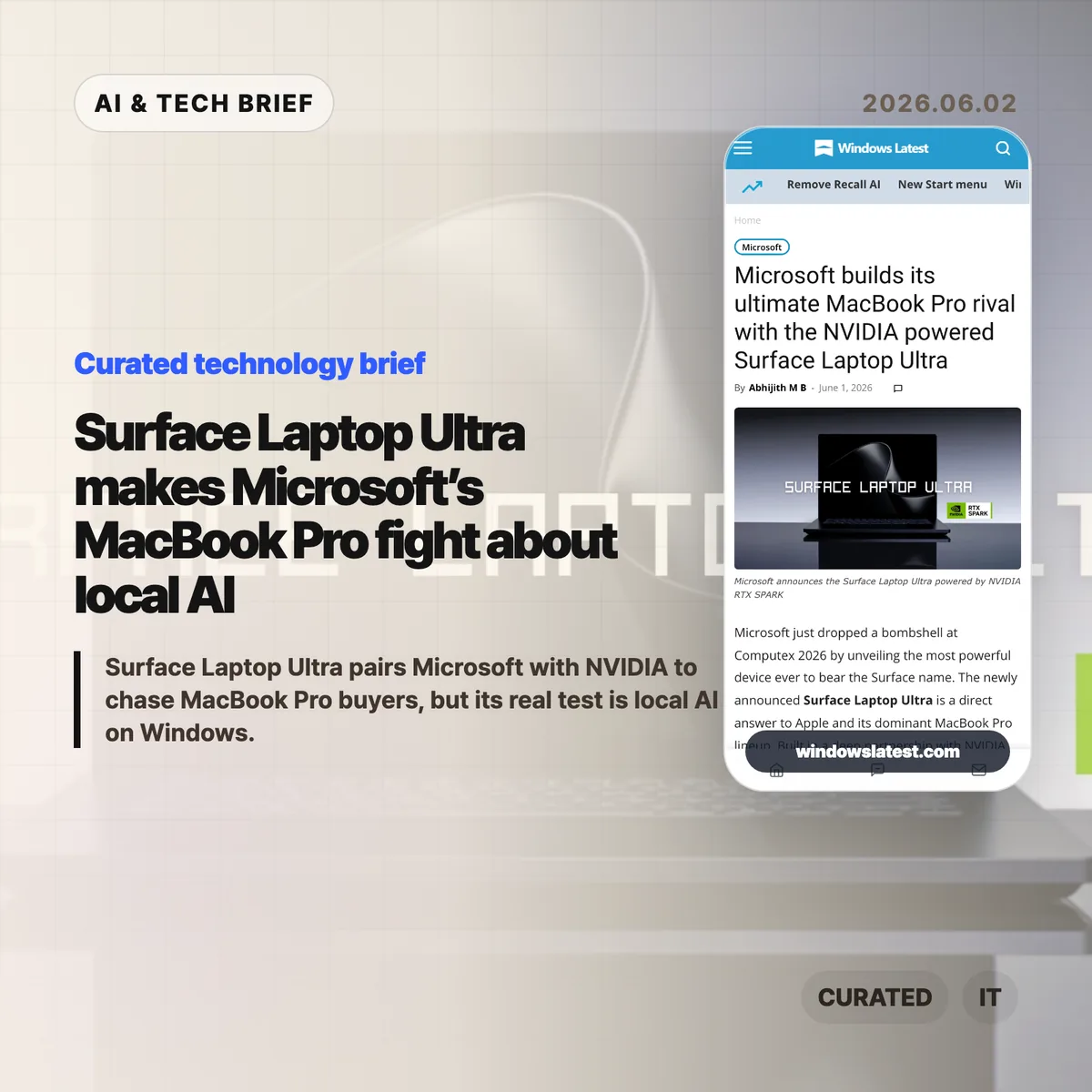
  • Surface Laptop Ultra makes Microsoft’s MacBook Pro fight about local AI

    Surface Laptop Ultra makes Microsoft’s MacBook Pro fight about local AI

    Surface Laptop Ultra is being framed as Microsoft’s answer to the MacBook Pro. That comparison is useful, but only up to a point. The more interesting question is whether Microsoft and NVIDIA can make a Windows laptop feel credible for local AI work instead of stopping at spec-sheet bragging.

    The short version

    • Windows Latest reports that Microsoft has introduced Surface Laptop Ultra, a high-end Windows on Arm laptop built around NVIDIA’s RTX Spark platform.
    • The headline specs are aggressive: a 20-core NVIDIA Grace CPU, Blackwell RTX graphics, up to 128GB of unified memory, CUDA support, and claims around 120-billion-parameter local model runs.
    • The hard part is not raw GPU marketing. Microsoft has to prove battery life, heat, x86 compatibility, creative-app support, and Windows on Arm developer tooling in daily use.
    • Hacker News readers mostly argued about price, fan noise, and whether large local AI workloads belong on a laptop at all.

    What happened with Surface Laptop Ultra

    Windows Latest says Microsoft used Computex 2026 to show Surface Laptop Ultra, a new top-end Surface laptop built with NVIDIA. The reported platform combines a 20-core NVIDIA Grace CPU, a Blackwell RTX GPU, fifth-generation Tensor Cores with FP4 support, NVLink-C2C between CPU and GPU, and up to 128GB of unified memory.

    The article also says Microsoft tuned Windows 11 on Arm for the platform. That includes scheduler work across 20 cores, power and thermal management, higher GPU-accessible memory limits, shared-memory page handling, Prism emulation changes for older x86 apps, and containment primitives for local AI agents.

    Those details matter more than the MacBook Pro comparison. Apple’s current advantage is not one chip or one benchmark. It is the boring, valuable mix of performance, battery life, unified memory, silence, app support, and predictable hardware behavior. Surface Laptop Ultra has to compete with that whole package.

    Why this is worth watching

    Surface Laptop Ultra could become a useful test case for the next phase of AI PCs. A lot of AI laptop talk has been stuck on NPU TOPS. This machine points at a different lane: local inference, CUDA-backed experimentation, video work, 3D rendering, and agent workflows that need a bigger shared memory pool.

    If the 128GB unified-memory configuration works as described, the appeal is obvious for developers who want to prototype with local models before moving serious jobs to the cloud. It could also matter for creators who already live inside Adobe, game engines, 3D tools, and GPU-heavy production software.

    The catch is that Windows on Arm still has to earn trust. Native apps are better than they were, and Prism emulation has improved, but professional buyers do not want a science project. They want Premiere, Photoshop, anti-cheat-protected games, IDEs, drivers, plugins, and weird old utilities to behave without becoming the day’s main problem.

    That is why this story fits the broader IT & AI archive: the hardware is interesting, but the platform question is the real story. Microsoft needs the laptop, the operating system, and the developer ecosystem to land at the same time.

    What Hacker News readers are arguing about

    The Hacker News thread was less impressed by the launch language than by the practical tradeoffs. Price came up first. Several commenters guessed that a 64GB or 128GB RTX Spark laptop would land somewhere around premium workstation pricing, with DGX Spark comparisons making a sub-$3,000 product sound unlikely.

    Fan noise became another sticking point. Some readers thought Microsoft’s promo emphasis on cooling was a strange way to chase MacBook Pro buyers, because one of Apple Silicon’s strongest selling points is how quiet it feels during normal work. Others pushed back: if you are running large local models or GPU-heavy creative jobs, fans are part of the deal.

    The most useful split was about local AI itself. One camp asked why anyone would run large models on a Windows laptop instead of using a server. The other camp wanted exactly that portability: a machine you can take to a coffee shop, run a coding model without depending on cloud access, and keep working when Wi-Fi is bad or locked down.

    There was also a familiar Windows skepticism. Some readers treated “built on Windows” as a warning label. Others brought up older Surface devices they still like, especially for unusual form factors, pens, keyboards, and portable creative work. The thread did not settle the question. It did make the buyer profile clearer: this only makes sense if local GPU work matters enough to pay for weight, heat, and price.

    The practical read

    Treat Surface Laptop Ultra as a platform bet, not a simple MacBook Pro clone. The spec list is strong enough to make Windows hardware interesting again for local AI, but the first reviews need to answer five plain questions.

    Can it stay quiet and fast under long AI or rendering jobs? Does battery life hold up when the GPU is actually doing work? Do x86 apps, anti-cheat systems, Adobe tools, drivers, and dev utilities behave on Windows on Arm? Is CUDA support easy to use on the laptop, or does it feel like a demo path? And does the price make sense against a MacBook Pro, a desktop workstation, or rented cloud GPU time?

    If Microsoft gets those answers right, Surface Laptop Ultra could give Windows developers and creators a serious local AI machine. If not, it will be another impressive Surface idea that people admire from a distance.
    Sources

  • NVIDIA RTX Spark turns the local AI PC fight toward Windows

    NVIDIA RTX Spark turns the local AI PC fight toward Windows

    NVIDIA RTX Spark is Nvidia’s attempt to make the local AI PC feel less like a cloud workaround and more like a real Windows machine. The company says the platform combines Blackwell RTX graphics, Grace CPU cores, and up to 128GB of unified memory in slim laptops and small desktops. That is a direct pitch to developers and creators who want CUDA, local inference, and everyday PC software in one box.

    The short version

    • NVIDIA RTX Spark laptops are pitched with up to 1 petaflop of FP4 AI performance, up to 6,144 RTX GPU cores, and up to 128GB unified memory.
    • The bigger story is not gaming alone. Nvidia is trying to bring CUDA-heavy local AI development into Windows laptops and compact desktops.
    • Asus, Dell, HP, Lenovo, Microsoft, and MSI are listed as partners, which makes this look like a platform push rather than a single demo device.
    • The open questions are price, battery life, thermals, Windows on Arm compatibility, and whether real local LLM workloads run well enough to justify the hardware.

    What happened with NVIDIA RTX Spark

    NVIDIA RTX Spark is a PC platform built around what Nvidia calls the RTX Spark Superchip. The company describes it as a single processor that fuses NVIDIA AI acceleration with RTX graphics for creators, developers, and gamers. The headline configuration reaches up to 128GB of unified memory, which is unusually large for a consumer laptop class device and useful for local AI workloads that quickly run into memory limits.

    The pitch is easy to understand: keep more AI work on the machine. A developer could prototype an agent, run smaller models, test CUDA code, or do creative work without sending every step to a remote GPU. That does not remove the need for cloud compute, but it could make the first loop faster and cheaper for some teams. If you follow AI hardware and developer tools, the broader IT & AI archive is the right place to track this shift.

    Nvidia is also selling RTX Spark as a Windows PC story, not a lab box story. That matters because a laptop has to survive normal laptop questions: does it sleep properly, does the battery last, do creative apps behave, do games run, and does the fan sound reasonable under mixed workloads?

    Why this is worth watching

    The phrase “AI PC” has been stretched thin. A lot of recent PC marketing has centered on NPUs, meeting effects, or small assistant features. NVIDIA RTX Spark is a heavier bet. It puts the focus on local model work, CUDA software, RTX graphics, and large unified memory.

    That makes the comparison set more interesting. Apple Silicon has strong unified memory and a mature Arm transition. AMD’s Strix Halo points at high-end integrated graphics and local AI experiments. Traditional RTX laptops already have CUDA, but usually with a split between system memory and VRAM. NVIDIA RTX Spark tries to combine pieces from all three worlds.

    The catch is that specs do not settle this market. Local LLM performance depends on memory bandwidth, quantization, prefill speed, software support, and thermal limits. A machine that looks excellent in a product page can still feel awkward if the developer workflow is fragile or the best apps are not native.

    What Hacker News readers are arguing about

    The Hacker News discussion is less about whether local AI is useful and more about whether Windows is the right home for it. One camp is skeptical of Microsoft and Windows on Arm. Their concern is simple: previous Arm Windows machines had compatibility gaps, and a high-end AI laptop still has to run normal Windows apps, developer tools, games, and drivers.

    Another camp is more pragmatic. For them, the operating system matters less than getting a portable CUDA machine with enough unified memory to run local models. Some commenters framed it as a possible alternative to Apple Silicon Macs, AMD Strix Halo laptops, or a desktop full of used GPUs. The useful caveat in that argument is memory bandwidth. Several readers pointed out that 128GB of unified memory is attractive, but bandwidth and real model throughput will decide whether the machine feels fast.

    There is also a hardware-nerd thread around what Nvidia and MediaTek actually built. Commenters picked apart the CPU side, the relationship to DGX Spark, and whether the same silicon will be constrained by laptop power limits. That is the right kind of skepticism. RTX Spark may be a strong developer machine, but the first reviews need to show sustained performance, Linux behavior, Windows on Arm compatibility, and price before anyone can call it a MacBook or workstation replacement.

    The practical read

    If you build AI tools, NVIDIA RTX Spark is worth watching because it could make the local development loop more realistic on Windows. The sweet spot is not training frontier models on a laptop. It is running smaller models, testing agents, doing CUDA-first prototyping, and moving fewer early experiments to paid cloud GPUs.

    If you are buying hardware soon, wait for benchmarks. Look for sustained tokens per second, prefill speed, memory bandwidth, battery behavior under AI workloads, fan noise, Linux support, and whether your actual Windows apps run natively or through translation. A spec sheet can tell you the direction. It cannot tell you whether the machine is pleasant to use.

    Sources