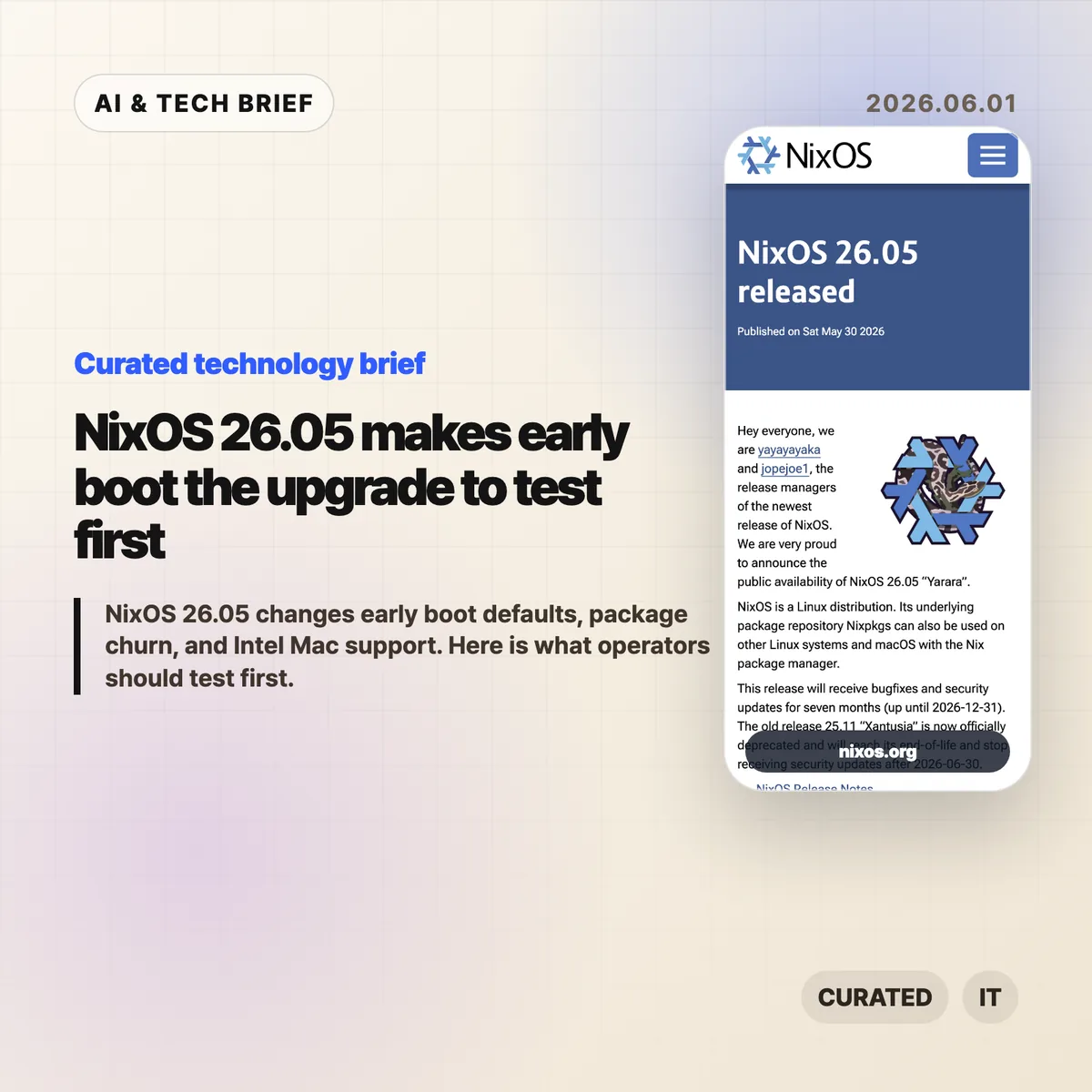
NixOS 26.05 is less interesting as a package refresh than as an operations release. The headline change is that Stage 1, the early initrd phase before the root filesystem is mounted, now uses systemd by default. For teams that use NixOS because they like reproducible infrastructure, that is exactly the sort of default you test before touching production.
Table of Contents
The short version
- NixOS 26.05, code-named “Yarara,” ships with seven months of bug fixes and security updates, ending on December 31, 2026.
- Stage 1 is now systemd-based by default, while the old scripted implementation is deprecated and scheduled for removal in 26.11.
- Nixpkgs added 20,442 packages, updated 20,641, and removed 17,532, so the release has real package churn.
- This is the last Nixpkgs release to support x86_64-darwin, which matters for Intel Mac development setups.
- GNOME 50 and GCC 15 are included, while LLVM stays at version 21.
What happened
NixOS 26.05 was announced on May 30, 2026 by the NixOS release managers. The release will receive fixes until December 31, 2026, while NixOS 25.11 reaches end of life on June 30, 2026.
The scale is large even by Nixpkgs standards. The project says 2,842 contributors produced 59,703 commits for this cycle. Nixpkgs added 20,442 packages, updated 20,641, and removed 17,532 outdated packages. NixOS itself added 85 modules and 1,547 configuration options, while removing 25 modules and 355 options.
The practical point is simple: NixOS 26.05 is not a casual channel bump for every machine. It deserves the same treatment as any infrastructure upgrade that touches boot behavior, package availability, desktop components, and compiler defaults.
Why this is worth watching
The most operationally sensitive change is Stage 1. This is the early boot environment inside initrd, before the system has mounted the real root filesystem. In NixOS 26.05, that stage is now based on systemd by default.
That may be a welcome cleanup for many users. It aligns early boot with the system manager most Linux operators already know. But it also changes the assumptions around custom initrd hooks, encrypted disks, unusual storage layouts, network boot, recovery flows, and any setup that depended on the older scripted implementation.
The old scripted Stage 1 is deprecated in this release and scheduled for removal in NixOS 26.11. That gives operators a clear window: test the new path now, while rollback is still easy and the old behavior has not disappeared.
Nixpkgs 26.05 is also the last release that will support x86_64-darwin. The project says it will keep platform support and binary builds available until Nixpkgs 26.05 goes out of support at the end of 2026. After that, Nixpkgs 26.11 will no longer build packages for x86_64-darwin or support building them from source.
The stated reasons are ordinary but important: Apple has moved away from the platform, build infrastructure is limited, and volunteer maintainer time is finite. If your team still uses Intel Macs with Nix-managed development shells, this is the moment to decide whether those machines stay pinned, move to Apple Silicon, shift to Linux builders, or run more of the workflow remotely.
For teams that discover developer tools through package sets and reproducible environments, this is also an app-store-like discovery issue in miniature. The packages that remain easy to install tend to become the tools people actually try. That is why Nix and Linux operations stories often belong beside broader coverage in the IT & AI archive, even when they are not about AI directly.
NixOS 26.05 upgrade checklist
Use this release to check the parts of your setup that are hardest to fix after a reboot: initrd behavior, disk access, network boot, Intel Mac builders, compiler-sensitive packages, and desktop extensions.
What Hacker News readers are arguing about
The Hacker News thread is small, so it should not be treated as a broad community poll. The useful signal is still clear enough.
One commenter focused on the package numbers. Updating roughly 20,000 packages sounded plausible given the size of Nixpkgs, but adding 20,442 and removing 17,532 looked unusually high. The question was whether renames or accounting details inflated the turnover, since recent releases had reportedly added closer to 7,000 or 8,000 packages.
Another commenter pointed at the new NixOS modules as the fun part of each release. That is a good reminder of how people actually use NixOS release notes: not only to check breaking changes, but to discover mature projects that have become first-class enough to get a module.
The thread is too thin for a verdict on NixOS 26.05. It does show the two checks many Nix users care about: how much churn is real, and what new modules are worth stealing ideas from.
The practical read
If you run NixOS on servers or workstations, start with machines that have custom boot behavior. Verify systemd Stage 1 with encrypted storage, remote disk access, nonstandard filesystems, or hardware-specific initrd logic before the old scripted path is removed.
If you maintain development environments, audit package removals and compiler-sensitive builds. GCC 15 can expose warnings or build failures that were hidden before. GNOME 50 is also worth testing on machines with extensions or display-specific settings.
If you still depend on Intel Mac builders or x86_64-darwin development shells, treat NixOS 26.05 as the last comfortable planning point. Pinning may buy time, but it is not the same as staying on the maintained path.
The best upgrade plan is boring: test one representative machine, keep rollback generations available, read the release notes for the modules you use, and only then move the wider fleet.